
Not autonomously. Based on the current peer-reviewed evidence, generative AI is not safe to use as an independent producer of hospital discharge instructions. It can make instructions easier to read, more patient-facing, and in some supervised settings more useful. But the safety problem is not whether the text sounds medical enough. It is whether the final document reliably preserves the facts a patient needs after leaving the hospital: what to take, what to stop, what symptoms require return, what follow-up is actually scheduled, and what has not been said at all.
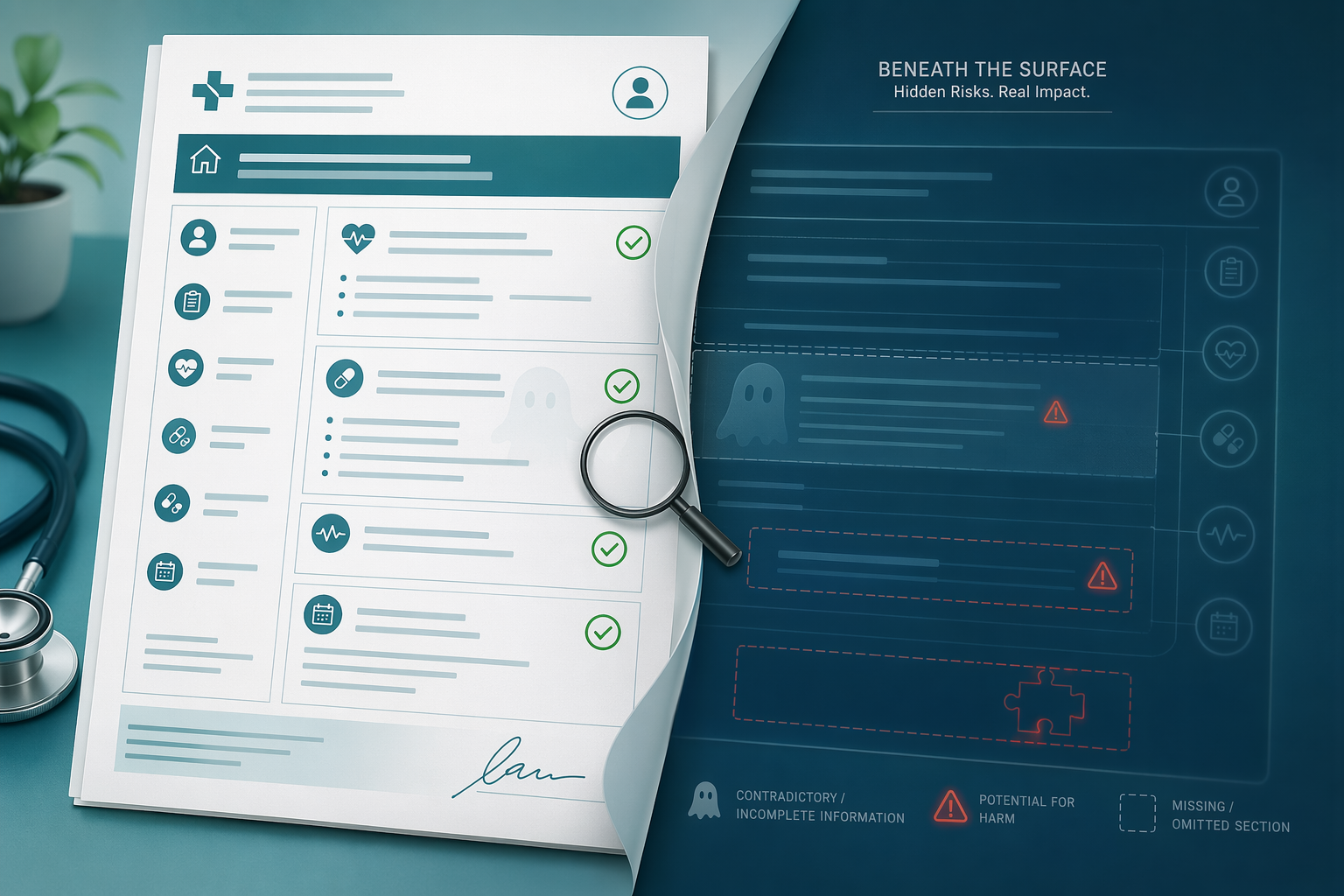
The most uncomfortable finding across the studies is that polish and safety can separate. A draft can be complete by a scoring rubric and still contain a medication that was never prescribed. It can be readable and still omit a return precaution. It can translate cleanly by automated metrics and still reverse a clinically important negation. That is why the safety question has to be asked at the level of specific failure modes, not general enthusiasm about using generative AI for discharge instructions.
What the Evidence Shows
The six studies below do not ask the identical question. Some test discharge-instruction generation, some test medication instructions, one tests patient-oriented summaries in a randomized trial, and others examine translation. Taken together, they are still useful because they pressure-test the same handoff: clinical information is transformed into patient-facing language before the patient goes home.
| Study | Design and sample | Model or task | Main safety signal | Dominant failure mode |
|---|---|---|---|---|
| Stanceski et al., 2024 | 100 MIMIC-IV discharge summaries | GPT-3.5 patient-centered discharge instructions | 18% contained potentially harmful safety issues; 6% had hallucinations; 3% contained medications not in the original summary; 42% introduced new clinical actions [1] | Hallucinated content, introduced medications, added actions |
| Tang et al., 2026 | Medication-instruction evaluation; details partly limited by access | GPT-4o medication instructions | Reported about 95% completeness, while a secondary synthesis reports about 69% of outputs with potential safety issues [2][3] | Completeness coexisting with safety concerns |
| Grolleau et al., 2026 | 100 physician-reviewed AI-generated summaries | Stanford MedAgentBrief workflow | 2% hallucination rate, but omissions in 25% and inaccuracies in 20%; 88% rated no harm [4] | Omissions and inaccuracies under a structured workflow |
| Brewster et al., 2025 | Human-in-the-loop translation across 6 languages | LLM-assisted translation with human review | Comparable or better quality than professional-only translation, completed in 7.1 versus 16.8 minutes, preferred 46.5% versus 28.4% of the time [5] | Supervised translation may improve workflow, but does not remove review |
| Mundo, Goldberg, and Gao, 2026 | Translation-safety analysis reported by CU Anschutz | AI-generated translated discharge instructions | Automated metrics missed clinically dangerous errors, including a negation reversal from "take with food" to "do not take with food" [6] | Metric-blind language-specific clinical distortion |
| Rust et al., 2026 | Randomized controlled trial of physician-reviewed patient-oriented discharge summaries | LLM-generated summaries reviewed by physicians | 9.6-point improvement in patient activation on PAM-13; no critical errors detected in publicly visible reporting [7] | Benefit signal under physician review, not autonomous generation |
That table does not support a simple anti-AI conclusion. It supports a narrower and more operational one: generative AI may be useful in discharge communication when it is treated as a drafting or translation aid, but the evidence does not support letting it send patients home without a clinician-controlled review process.
The Safety Errors Are Not Abstract Hallucinations
“Hallucination” is a convenient word, but it can make the harm sound theatrical and rare. In discharge work, the more dangerous version is often quiet. A medication appears in the patient instructions even though it was not in the source summary. A new clinical action is added without a clinician ordering it. A return precaution disappears. A dose looks plausible enough that a tired reviewer may not stop on it.
Stanceski et al. put numbers on that quiet risk. In their GPT-3.5 study of 100 MIMIC-IV discharge summaries, 18% of AI-generated patient-centered instructions contained potentially harmful safety issues. Hallucinations appeared in 6%, medications not present in the original summary appeared in 3%, and 42% introduced new clinical actions [1]. The last figure matters because added actions can be harder to catch than obvious nonsense. They may look like reasonable discharge advice, especially when surrounded by fluent, patient-friendly language.
A nurse reviewing a discharge packet is not usually asking whether the prose is elegant. She is checking whether the patient with heart failure understands weight gain precautions, whether the antibiotic stop date matches the order, whether the anticoagulant instructions reflect the actual plan, and whether the family knows which symptom means “come back now.” A generated instruction that improves tone while changing one of those facts has not improved the discharge. It has moved the hazard into a cleaner format.
Tang et al. sharpen the same concern from another angle. The study is especially important because the reported completeness was high, around 95%, while safety concerns were still widespread; the approximately 69% potential-safety-issue figure should be treated with caution unless verified against the paywalled primary article, because it is reported in a secondary synthesis rather than fully inspectable here [2][3]. Even with that caveat, the finding is exactly the kind that a discharge-safety review should not ignore: a tool can capture many expected elements and still create enough clinically meaningful risk to fail as an autonomous system.
Completeness Is Not the Same as Safe Instruction
Completeness metrics answer a limited question: did the output include the expected categories or facts? Safety asks a different question: did the output preserve the right clinical meaning, without adding or deleting anything that changes what the patient will do?
That distinction is not academic. A discharge instruction can mention medications, follow-up, activity, diet, and return precautions, and still be unsafe if one medication is invented, one dose is misstated, or one warning sign is omitted. In a real workflow, the patient does not experience a completeness score. The patient experiences a set of instructions that either guide the next 24 to 72 hours safely or do not.
The MedAgentBrief pilot is useful because it narrows the argument rather than overturning it. Under a more structured workflow, the reported hallucination rate was 2%, far lower than earlier single-pass rates described in the study context, and 88% of summaries were rated as no harm. But omissions were still reported in 25% and inaccuracies in 20% [4]. For a hospital deciding whether to approve deployment, that is not a clean bill of health. It is evidence that structure helps, and that the remaining failure modes still need a human checkpoint.
Omissions deserve more attention than they usually get. An invented medication is alarming when found. A missing instruction is often discovered only after the patient has done the wrong thing or failed to do the right one. If an AI-generated summary leaves out a return precaution for fever, wound drainage, shortness of breath, neurologic change, or medication reaction, the absence may not draw attention during a fast review because there is no visible wrong sentence to circle.
The Evidence for Benefit Is Real, but It Is Supervised
The best argument for using generative AI in discharge communication is not that hospitals need a new gadget. It is that many discharge documents are too dense for patients to use, and clinicians already struggle to turn complex inpatient records into plain language under time pressure. Patient comprehension and clinician workload are safety issues too.
Rust et al. provide the most important benefit signal because the study was randomized and tested physician-reviewed, LLM-generated patient-oriented discharge summaries. Publicly visible reporting describes a 9.6-point improvement in patient activation on PAM-13 and no critical errors detected [7]. That matters. A patient who understands the plan better may be more able to notice deterioration, take medications correctly, and attend follow-up.
But the condition attached to that benefit is not incidental: the summaries were reviewed by physicians [7]. The trial supports supervised use. It does not show that an LLM can independently generate final discharge instructions at hospital scale, across diagnoses, languages, literacy levels, and medication complexity.
Brewster et al. point in the same direction for language access. In a human-in-the-loop translation study across six languages, the LLM-assisted process achieved comparable or better quality than professional-only translation, took 7.1 minutes rather than 16.8 minutes, and was preferred 46.5% of the time compared with 28.4% for professional-only translation [5]. Those findings should not be dismissed. A faster translation workflow can matter when a patient is waiting for discharge teaching, a family member is available only briefly, or an interpreter is coordinating with multiple teams.
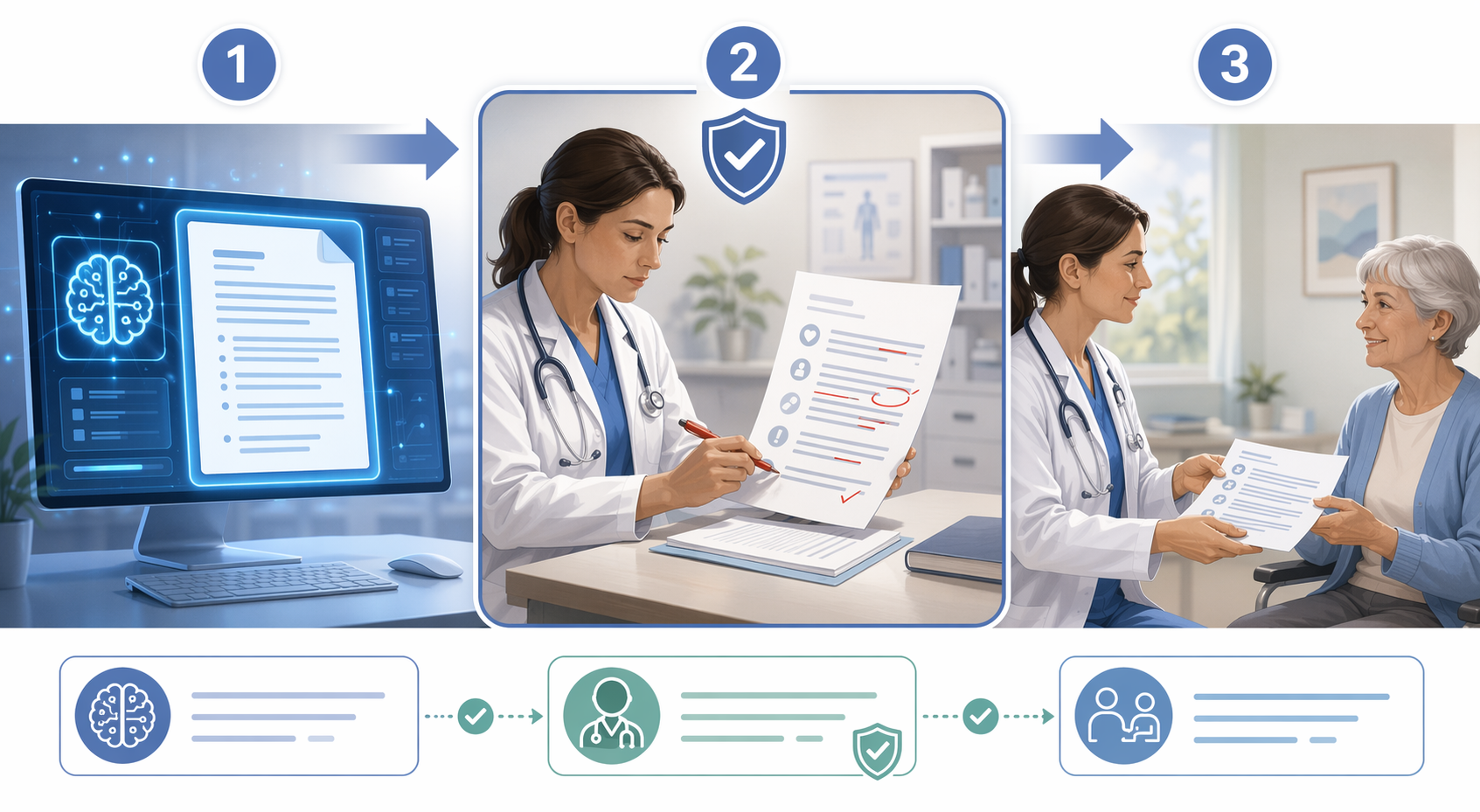
The safety lesson is still the same: the successful workflow had a human in the loop. The evidence favors designing review into the process, not treating review as a courtesy after the AI has produced something that looks finished.
Translation Makes the Safety Problem More Specific
Language access is where the usual shortcut metrics become especially dangerous. Automated translation scores can reward surface similarity while missing a clinical reversal. The CU Anschutz example is blunt: metrics such as BLEU, NIST, and ROUGE failed to detect dangerous errors, including a reversal from “take with food” to “do not take with food” [6].
That error is not a minor fluency problem. It changes the patient’s action. It also shows why English-language safety findings do not automatically generalize to multilingual discharge workflows. A system that performs acceptably in English may fail differently when instructions move through another language, especially when medical phrasing, negation, dosage timing, or culturally specific explanations are involved.
Hospitals should be cautious about separating “translation quality” from “clinical safety.” If the reviewer is not able to verify clinical meaning in the target language, the workflow may only be checking that the document looks complete in a language the clinical team cannot read.
What Human Oversight Has to Catch
Human-in-the-loop is an easy phrase to put in a policy and a hard control to make real. A discharge workflow does not become safe because a clinician technically has the option to look at the draft. The review has to be assigned, timed, auditable, and matched to the error types the evidence has already shown.
- Medication reconciliation: every medication, dose, route, frequency, start date, stop date, and change must be checked against the discharge medication list.
- Return precautions: diagnosis-specific red flags must be present, not merely replaced by generic “seek care if worse” language.
- Follow-up instructions: appointments, pending tests, responsible services, and timing must match the actual discharge plan.
- Added actions: any new instruction created by the model must be treated as suspect until confirmed in the source record.
- Language concordance: translated instructions must be checked for clinical meaning, especially negation, timing, and medication-use conditions.
The person doing that review also needs enough authority to stop the discharge packet from going out. If the AI draft is generated late, printed automatically, and handed to a patient while the resident is still reconciling medications, the review process is symbolic. If a pharmacist checks medication text but no one checks return precautions, one class of hazard is controlled while another remains open.
Automation bias has to be handled as a workflow risk, not a training-slide warning. Once a generated instruction is formatted, grammatically smooth, and embedded in the EHR, it carries the visual authority of the institution. That makes it easier for a tired reviewer to skim for obvious errors and harder to notice what is missing.
Governance Should Start From the Failure Modes
A hospital does not need a separate bureaucracy for every AI discharge pilot, but it does need governance that is specific enough to survive contact with the discharge desk. The approval question should not be “Does the model improve readability?” It should be “Can the workflow reliably catch the known unsafe outputs before the patient leaves?”
That means the review body should define the intended use narrowly: draft simplification, medication-instruction support, translation support, after-visit-summary restructuring, or another bounded task. A committee charter like the one described in ClinicalMind’s AI governance committee guide is useful only if it assigns real responsibility for monitoring the specific errors at issue here: omissions, hallucinated facts, introduced medications, dose errors, and language-specific distortions.
Risk management frameworks can help, but they should not turn this into a paperwork exercise. The NIST AI Risk Management Framework in healthcare is most relevant when it forces teams to map who is harmed by a missed precaution, who detects an invented medication, how errors are logged, and when the tool is paused.
Equity review belongs in the same process. Available evidence flags concern that errors may cluster in complex and older patients; where a hospital observes that pattern locally, it should treat it as a safety and fairness signal, not as a subgroup footnote. The broader problem is familiar from algorithmic bias in healthcare AI: average performance can hide predictable risk for the patients whose charts are longer, medications more numerous, and discharge plans less standard.
Hospitals have seen what happens when AI tools are trusted before the local safety case is mature. The Epic sepsis model governance case is not a discharge-instruction case, but it is a useful reminder that deployment can outrun validation when accountability is diffuse.
A Safe Use Case Is a Controlled Use Case
The evidence supports a controlled role for generative AI in discharge communication. It may draft a plain-language version of clinician-written instructions. It may help reorganize dense summaries into patient-facing sections. It may assist translation when qualified human review is built into the process. It may improve patient activation when physicians review the output before release.
The evidence does not support autonomous discharge-instruction generation. The recurring failures are too clinically specific: omitted precautions, hallucinated facts, introduced medications, misstated doses, inaccuracies, and language distortions that ordinary quality scores can miss.
The practical test is simple. If the workflow cannot reliably catch those errors before the patient leaves, the system is not ready for independent deployment, no matter how readable, complete, or reassuring its output appears.
References
- Assessment of the readability, understandability, actionability, and potential safety issues of generative AI-generated patient-centred discharge instructions, npj Digital Medicine, 2024.
- GPT-4o generated medication instructions for patients discharged from hospital: Evaluation of completeness and safety, International Journal of Medical Informatics, 2026.
- When AI Writes the Discharge Summary, Integrity Systems Institute.
- MedAgentBrief: Development and Evaluation of an Artificial Intelligence Agent to Generate Discharge Summaries, JAMA Network Open, 2026.
- Human-in-the-loop translation of discharge instructions using large language models, npj Digital Medicine, 2025.
- AI-generated discharge instructions may contain dangerous translation errors, CU Anschutz Department of Biomedical Informatics, 2026.
- Effect of large language model-generated patient-oriented discharge summaries on patient activation: a randomised controlled trial, The Lancet Digital Health, 2026.
Comments
Join the discussion with an anonymous comment.