
The question behind Eric Topol's Deep Medicine has become less literary and more measurable. By mid-2026, the cleanest evidence does not come from diagnostic marvels or hospital command centers. It comes from a humbler place: the exam room, where ambient AI documentation listens, drafts the note, and may let the clinician keep looking at the patient.
That matters because the most persuasive part of Eric Topol's deep medicine argument was never simply that AI would be powerful. It was that medicine had become shallow in a particular way. Clinicians were surrounded by more data, more screens, and more mandatory text, while the human encounter became the thing squeezed between clicks. The compact frame was deep phenotyping, deep learning, and deep empathy: richer understanding of the person, better computational help, and more room for care that feels like care.
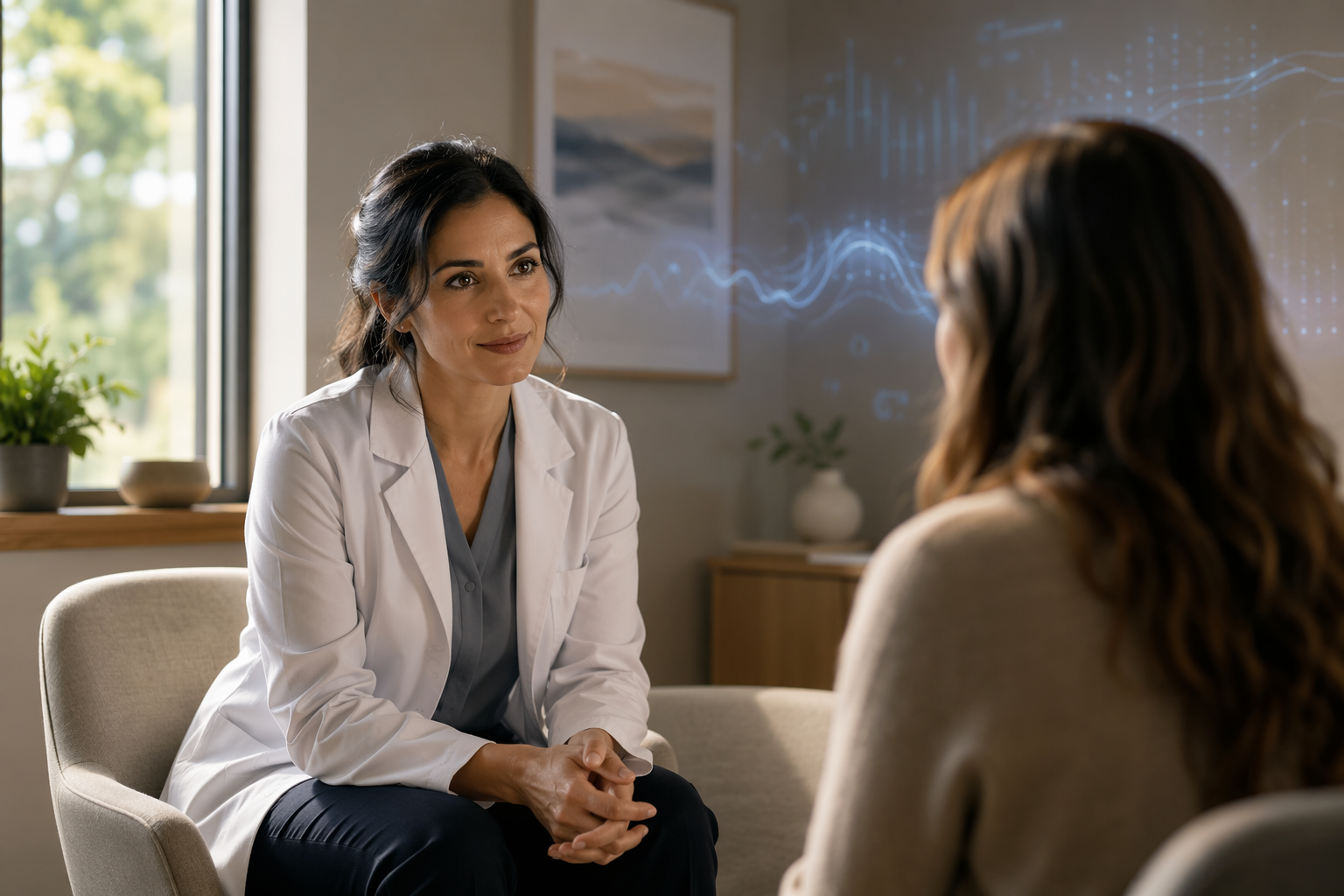
The strongest current case for that vision is narrow but real. Ambient AI scribes have not proven that healthcare is broadly humane again. They have, however, produced unusually concrete evidence that one punishing layer of clinical work can be reduced, and that clinicians can feel more able to give patients undivided attention.
The Best Evidence Is About Documentation, Not All of Deep Medicine
The landmark study is Olson and colleagues' multicenter quality improvement evaluation of ambient AI scribes, published in JAMA Network Open in October 2025. It included 263 clinicians across 6 US health systems and examined burnout, cognitive task load, documentation burden, and clinicians' reported ability to give patients undivided attention before and after implementation.[1]
The headline finding deserves attention because it is not just a satisfaction blip. Burnout decreased from 51.9% to 38.8%, with an adjusted odds ratio of 0.26 and a 95% confidence interval of 0.13 to 0.54.[1] Cognitive task load improved by 2.64 points on a 10-point scale, and clinicians' ability to give patients undivided attention improved by 2.05 points.[1]
Those endpoints are not interchangeable. Burnout is a professional distress measure. Cognitive task load is closer to the felt burden of holding the visit, the record, the differential, and the billing logic in mind at once. Undivided attention is closest to the patient, though still reported by the clinician rather than directly observed as a longer, deeper, or better encounter.
| Claim | What the evidence supports | What remains unproven |
|---|---|---|
| Less charting burden | Ambient AI documentation can reduce the work clinicians associate with note creation and after-visit documentation. | The size and durability of the effect may vary by specialty, workflow, vendor, and local implementation. |
| Less burnout | The Olson multicenter study found a measurable burnout reduction after ambient AI scribe implementation. | The study design cannot prove the same effect would occur in every setting or isolate the tool from implementation context. |
| More human care | Clinicians reported better ability to give patients undivided attention. | Studies have not directly shown that saved time becomes longer visits, deeper relationships, or higher-quality communication. |
This is where the evidence becomes more interesting than the slogans. If a physician is no longer half-composing the assessment and plan while the patient is describing pain, the encounter can plausibly become more human. But plausibility is not proof. A clinician feeling more present is meaningful, especially in a profession where attention has been systematically taxed. It is still not the same as demonstrating that patients received better listening, more shared decision-making, or more trust.
Why the Olson Study Carries So Much Weight
Ambient AI documentation is one of the few generative AI use cases in healthcare where the problem, the user, and the workflow all line up. The clinician already has to create a note. The patient conversation already contains much of the source material. The output is reviewable before it enters the record. The value proposition is not that AI replaces clinical judgment; it is that the machine drafts the clerical residue of an encounter that a human clinician remains responsible for signing.
That makes the Olson findings clinically legible. A 2.64-point improvement in cognitive task load on a 10-point scale is not an abstraction to anyone who has watched a physician leave one room already behind on the last note, open the next chart, and begin the next conversation with part of the previous one still occupying working memory.[1] Reduced cognitive load is not automatically empathy, but it is one condition under which empathy has a chance.
The study's limitations also matter. It was a quality improvement study, not a randomized trial. It did not include a control group. Clinician self-selection was present.[1] That means the results should not be treated as a universal estimate of effect, and they should not be used to declare that ambient AI scribes are equally useful in every specialty, staffing model, or documentation culture.
Still, the design limitations do not make the findings disposable. Multicenter implementation evidence is exactly the kind of evidence healthcare often has when a workflow technology begins moving from pilot to practice. The responsible conclusion is narrower: in real clinical settings that chose to deploy these tools, ambient AI documentation was associated with less burnout, lower cognitive load, less documentation burden, and better clinician-reported attention to patients.[1]
Physicians Are Signaling the Same Priority
The broader profession is not asking AI first to diagnose zebras. In a 2025 American Medical Association physician survey of roughly 1,200 physicians, 57% cited reducing administrative burden as AI's biggest opportunity, 75% believed AI could improve work efficiency, and 48% reported using AI tools.[2] That is adoption and attitude data, not proof of clinical benefit. But it shows why documentation AI has moved faster than many flashier applications.
The AMA figures also help separate enthusiasm from need. Physicians are not uniformly embracing AI because they want a more automated profession. Many are interested because the existing job has been overrun by tasks that do not feel like doctoring. If an AI tool reduces the amount of time spent manufacturing the chart without weakening the clinical record, it addresses a pain point clinicians can recognize by Tuesday afternoon.
A 2025 scoping review on artificial intelligence and physician burnout reached a similarly cautious synthesis: AI may reduce administrative burden and support clinician well-being, but the evidence base remains uneven and concentrated in specific use cases rather than across the full range of medical AI.[3] That distinction is important. The evidence is not that artificial intelligence, as a category, has made medicine humane. The evidence is that some AI documentation tools appear to reduce a documented source of inhumanity.
Less Charting Is Not the Same as Deeper Care
Three claims often get blended together in discussions of deep medicine. The first is that AI can reduce documentation work. The second is that reducing that work can reduce burnout. The third is that reduced burden will be converted into more humane patient care. The first two now have measurable support in ambient documentation. The third is still the exposed joint in the argument.
Clinician-reported undivided attention is a meaningful intermediate outcome. It is also not a patient-centered endpoint. It does not tell us whether the patient spoke more, understood more, trusted more, or experienced the visit as less rushed. It does not tell us whether the clinician used the regained attention for relationship, diagnostic thinking, shared decisions, or simply catching up internally before the next room.
That does not make the outcome trivial. The absence of attention is one of the quiet injuries of modern care. Patients notice when the doctor is typing through the story; clinicians notice when they cannot listen without simultaneously producing billable prose. A tool that improves the conditions for attention deserves more respect than generic AI boosterism usually earns. It just has to be evaluated for what it has actually shown.
The Gift of Time Can Be Spent Twice
The sharpest critique of deep medicine is not that AI cannot save time. It is that saved time is not automatically returned to patients. Sparrow and Hatherley argued in 2020 that the economic structure of healthcare could redirect AI's “gift of time” toward greater throughput rather than deeper care.[4] In plain operational terms, a health system can look at ambient documentation and see two different things: a physician with more space to be present, or a physician with capacity for more visits.
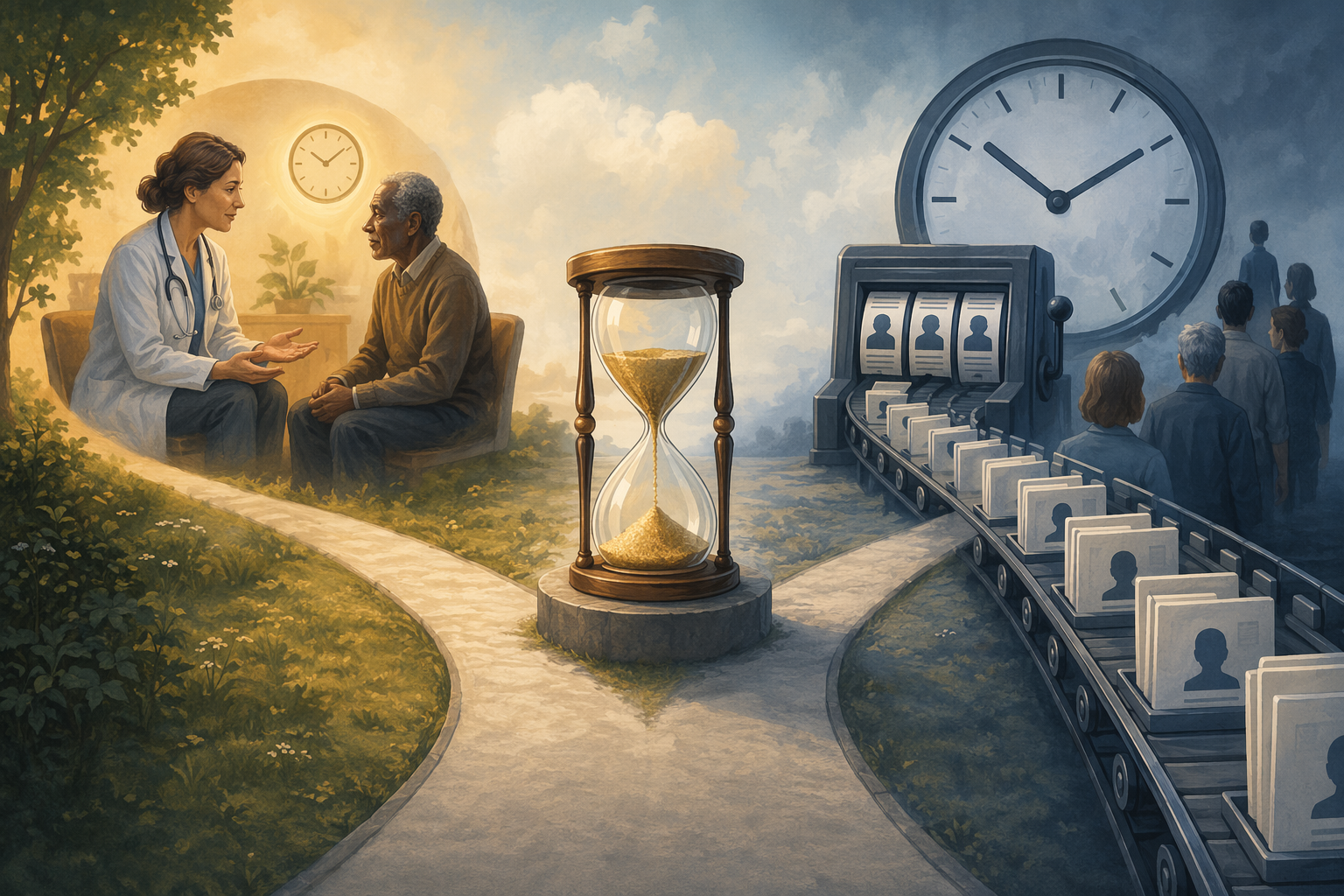
That concern is not anti-technology. It is an old informatics wound. Electronic health records were expected to organize information and make clinical work more efficient; in many settings, they also became engines for compliance, billing, measurement, inbox work, and copy-forward note expansion. The lesson is not that every new tool will repeat the EHR story. The lesson is that time saved at the keyboard has to be governed, not merely celebrated.
This is the part of the deep medicine thesis that cannot be solved by model performance alone. If ambient AI saves a clinician time after clinic, the benefit may appear as less pajama-time documentation. If it saves time during the visit, the benefit may appear as eye contact, silence, better questions, or a less fragmented explanation. If administrators absorb the gain into shorter appointment templates or higher panel throughput, the same technical success can become another capacity instrument.
Sparrow and Hatherley also questioned whether clinician activism would be a sufficient counterforce against those incentives, especially if disruption demoralizes and fragments the profession.[4] That critique is normative rather than empirical; it does not prove that health systems will misuse ambient AI. But it names the governance problem precisely. The technology can create recoverable time. Institutions decide whether that time is protected.
What a Responsible Implementation Would Measure
The next evidence threshold should be more patient-facing. It is no longer enough to ask whether clinicians like ambient scribes or whether notes appear faster. Health systems that invoke human-centered care should be willing to measure whether appointment length changes, whether visit interruptions decrease, whether patients perceive better listening, whether shared decision-making improves, and whether documentation quality remains safe after AI drafting.
They should also report what happens to the recovered time. If after-hours documentation falls, that is a real well-being gain. If same-day note closure improves, that may improve continuity and reduce mental spillover. If visit slots are shortened or panel expectations rise, that should be visible too. Without that accounting, “efficiency” becomes a word that can mean relief for clinicians or extraction from them.
Ambient documentation also needs the ordinary disciplines of clinical informatics: consent workflows, privacy safeguards, specialty-specific note review, error monitoring, escalation pathways, and clear rules about who is responsible for the final record. A scribe that drafts fluently can still omit a relevant negative, misplace a medication detail, or turn conversational ambiguity into false certainty. The fact that clinicians review the note is reassuring only if review is actually feasible inside the day they are being asked to work.
So Has Deep Medicine Made Healthcare More Human?
Not broadly. Not yet. The full deep medicine vision remains larger than the current evidence. Deep phenotyping and deep learning have advanced in many areas, but the most persuasive humanizing evidence is concentrated in ambient documentation, where the target is not a mysterious clinical frontier but the everyday administrative burden that clinicians already know is damaging care.
Deep medicine has not made healthcare human again. Ambient AI documentation has produced the clearest evidence so far that AI can return attention to the clinical encounter. Whether that attention stays with the patient is now less a question for the model than for the institutions deploying it.
References
- Use of Ambient AI Scribes to Reduce Administrative Burden and Professional Burnout, JAMA Network Open, October 2025
- Physicians' greatest use for AI? Cutting administrative burdens, American Medical Association, March 2025
- A Scoping Review of the Role of Artificial Intelligence in Physician Burnout, Cureus, July 2025
- High hopes for Deep Medicine? AI, economics, and the future of care, Hastings Center Report, 2020
Comments
Join the discussion with an anonymous comment.