
The search for “ai cloud data center stocks 2025 decline” usually starts with a market chart and ends with a much more specific question: did the sell-off in AI infrastructure mean healthcare AI demand was cracking, too? In 2025, the answer was mostly no. The rout hit companies exposed to GPU sales, China export policy, data center financing, and hyperscaler capital spending. At the same time, healthcare AI application companies were being judged on a different set of operating tests: whether clinicians used the tools, whether hospitals renewed them, whether life-science customers paid for them, and whether workflow ROI showed up somewhere more concrete than a demo.
That distinction mattered because the sell-off was not imaginary. NVIDIA warned of a $5.5 billion charge tied to China export controls, while AMD cited an $800 million hit from the same policy pressure.[1] AMD was also punished after a data center disappointment, with its stock reported down about 9% as investors questioned the pace of AI infrastructure revenue growth.[2] Later in the year, Oracle became the visible proxy for a different fear: whether AI data center buildouts were being financed with too much debt, as its shares fell 19% in a month amid concerns over roughly $182 billion in data center debt issuance.[3]

Put beside healthcare AI operating data, however, the market story looked less like an AI recession and more like a repricing of one layer of the stack. Menlo Ventures estimated that healthcare AI spending reached $1.4 billion in 2025, three times the 2024 level; counted eight new healthcare AI unicorns; and reported that organizational adoption rose to 22%, a sevenfold increase in its survey sample.[4] Tempus AI, one of the few public companies investors could use as a direct healthcare AI reference point, reported Q2 2025 revenue of $314.6 million, up 89.6% year over year.[5]
Those numbers do not prove that every healthcare AI company was healthy, or that application-layer margins were already durable. Menlo is a venture firm, and its market map naturally sees more of the venture-backed startup universe than a hospital accounts payable file would. Tempus’s Q2 report was an interim public-market counterexample, not a sector index. Still, the contrast is hard to dismiss: the infrastructure trade was being repriced on capacity, policy, and balance-sheet risk, while healthcare AI demand was showing up in budgets attached to documentation, coding, diagnostics, trial matching, and administrative throughput.
The Sell-Off Was Real, but It Was Layer-Specific
Infrastructure stocks are not valued like clinical workflow companies. NVIDIA, AMD, Broadcom, Oracle, and the data center REIT and financing ecosystem around them sit close to the capital-intensive base of the AI economy. Their investors care about accelerator volumes, gross margins, export eligibility, tariff exposure, power access, lease structures, and whether hyperscalers can keep spending without frightening the bond market.
That is why the China export-control headlines moved chip stocks so sharply. A charge attached to restricted shipments is not merely a one-time accounting item when the market is already pricing a company for years of accelerator demand. It raises a more uncomfortable question: how much of the future revenue curve depends on customers, geographies, and product configurations that policy can interrupt?
AMD’s 2025 reaction showed the second vulnerability. A data center miss can damage the stock even when the broader AI story remains intact, because infrastructure investors are watching whether promised AI server demand converts into segment revenue at the expected speed.[2] Oracle showed the third vulnerability. The company was not trading as a clinical AI proxy; it was being questioned as a data center buildout and financing story, with investors focused on whether infrastructure obligations were getting ahead of cash-flow confidence.[3]
| Question investors were asking | Infrastructure layer | Healthcare AI application layer |
|---|---|---|
| What drives near-term revenue? | GPU volume, cloud capacity, data center leases, and infrastructure utilization | Clinician adoption, enterprise contracts, diagnostics volume, life-science demand, and workflow savings |
| What can reprice the stock quickly? | Export controls, tariff exposure, CapEx doubts, debt financing concerns, and segment misses | Slow deployments, weak renewal evidence, regulatory delays, reimbursement uncertainty, or poor integration into clinical operations |
| What does adoption mean? | Customers reserve or consume compute capacity | Hospitals, clinicians, administrators, or researchers use the product inside a healthcare workflow |
| What should not be assumed? | Rising AI usage guarantees infrastructure margins | Strong pilots guarantee long-term profitability |
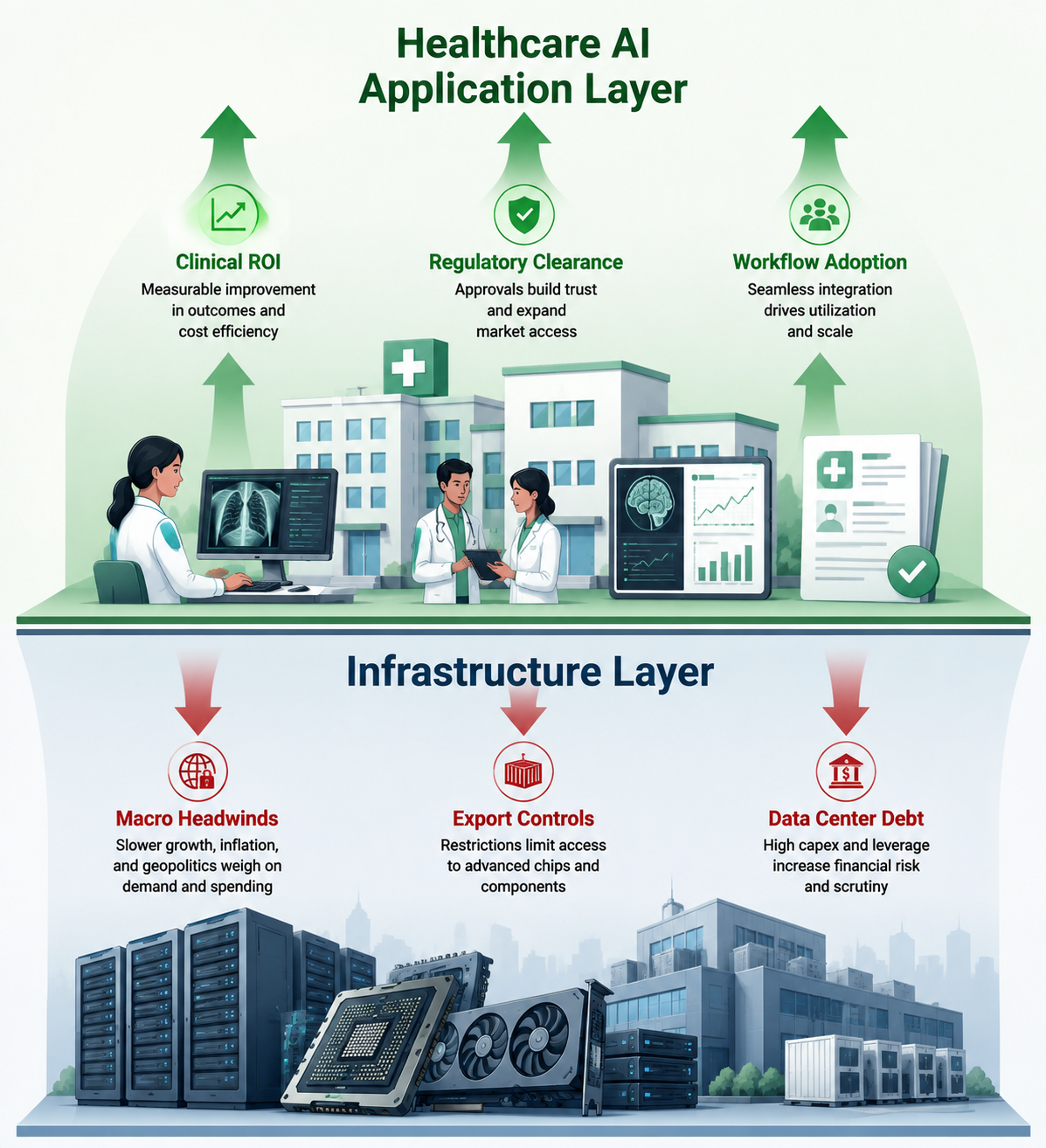
The table is not a neat separation of risk. Healthcare AI companies still depend on cloud infrastructure, and a compute shock can eventually show up in their cost structure. But the 2025 decline was not primarily a referendum on whether a physician would use an ambient documentation tool, whether an oncology platform could sell into life sciences, or whether a health system could automate prior authorization work. It was a referendum on the economics of building and financing the AI substrate.
Why Healthcare AI Did Not Trade Like a GPU Cycle
Healthcare AI buyers do not procure “AI” in the abstract for very long. A CMIO may tolerate a pilot because it is strategically interesting; a CFO renews it because it reduces a bottleneck, protects revenue, improves documentation quality, supports throughput, or keeps clinicians from abandoning the tool after the first week. That makes application-layer revenue more tedious to analyze than chip demand, but also less directly tied to the same market shocks.
Menlo’s 2025 data is useful here if treated carefully. Its estimate that 85% of healthcare AI spend flowed to startups suggests buyers were not only extending incumbent enterprise software contracts; they were also funding specialized application companies.[4] Its adoption figure deserves the same caution and attention. A reported 22% organizational adoption rate, based on an August–September 2025 survey sample of 700, may overrepresent larger and more technology-forward organizations, but it still points to a market moving beyond isolated executive curiosity.[4] For a broader look at how that adoption jump fits into provider behavior, ClinicalMind’s analysis of healthcare AI adoption from 3% to 22% is the more relevant companion piece than another semiconductor chart.
The most telling category was ambient scribing. Menlo described it as a $600 million category growing 2.4 times year over year, with Nuance DAX Copilot at 33% share, Abridge at 30%, and Ambience at 13%.[4] That is not proof that ambient documentation has solved clinician burnout or that every deployment produces attractive margins. It does show a purchasing pattern hospitals understand: physicians spend less time writing notes, documentation moves closer to the encounter, and the product can be evaluated against a familiar labor and revenue-cycle backdrop.
That is a different physics problem from the one facing an AI data center stock. The hospital buyer is not asking whether another hyperscaler region can be financed at the same spread. The buyer is asking who reviews the note, how the tool handles specialty variation, whether the EHR integration creates new work, whether compliance is comfortable with the workflow, and whether clinicians keep using it after novelty fades.
The same logic applies outside documentation. In diagnostics, the value question is tied to accuracy, workflow placement, regulatory clearance, and reimbursement. In clinical trial matching, it is tied to whether the platform can identify eligible patients fast enough to matter to a sponsor or research site. In revenue-cycle and administrative AI, it is tied to denial management, coding consistency, staffing pressure, and queue reduction. Compute is necessary for many of these products, but it is rarely the product the healthcare customer believes it is buying.
Tempus Was the Public-Market Counterexample, Not the Whole Market
Tempus mattered in 2025 because it gave public-market investors something more concrete than private valuation marks. The company reported Q2 2025 revenue of $314.6 million, up 89.6% year over year, and raised its full-year revenue guidance to $1.26 billion.[5] Its stock was also up roughly 89% year to date in the research window, making it a visible counterexample to the broad anxiety around AI infrastructure equities.[5]
The important part is not that Tempus “proved” healthcare AI stocks were immune. It did not. One company with a particular mix of genomics, data, diagnostics, and AI-enabled services cannot stand in for the whole sector. The useful point is narrower: investors were willing to reward a healthcare AI company when revenue growth was tied to domain-specific demand rather than to the next data center capacity cycle.
That distinction is especially relevant for analysts comparing public AI names. A chip company can miss because product restrictions reduce access to a geography. A cloud infrastructure company can fall because investors worry that data center obligations will strain the balance sheet. Tempus’s Q2 result was evaluated through a different lens: whether its healthcare data, diagnostics, and AI platform business was converting customer demand into revenue. The risk set did not disappear; it shifted to execution, evidence, reimbursement, competitive durability, and margin structure.
That is also why private-market healthcare AI valuations need discipline. Menlo’s eight new unicorns in 2025 are a strong signal that capital was still forming around application-layer companies.[4] They are not a guarantee that every unicorn has revenue quality, clinical evidence, or implementation depth to justify its price. For investors trying to separate category momentum from company fundamentals, the better comparison set is an AI health company landscape by category, valuation, and clinical evidence, not a basket of cloud and semiconductor tickers.
Compute Still Mattered, Just Not as the Main Demand Signal
Healthcare AI companies did not escape the infrastructure layer. They run on it. Model training, inference, data processing, image analysis, voice capture, and secure deployment all depend on cloud and compute availability. If infrastructure costs rose sharply or capacity became constrained, application vendors would feel it through gross margins, pricing, latency, or product roadmap tradeoffs.
But the 2025 market evidence did not show compute access suddenly shutting down. Data center deal activity hit a record $61 billion even as investors worried about AI funding and stock pressure.[6] Separate analysis pointed to more than $600 billion in projected 2026 hyperscaler capital spending, based on analyst estimates and company guidance rather than a guaranteed spending floor.[7] That is the stabilizing condition healthcare AI investors needed to notice: infrastructure equities could be volatile without immediately depriving application companies of the compute base required to serve customers.
This is where hyperscaler analysis is useful, but only up to a point. Alphabet, Microsoft, Amazon, and Oracle can spend aggressively on AI infrastructure, and that spending can support healthcare AI tools built on cloud platforms. ClinicalMind’s discussion of where Alphabet’s AI healthcare investments go is relevant because cloud CapEx becomes strategically meaningful only when it connects to specific healthcare products, partnerships, and deployment channels. It is less useful when it turns every healthcare AI company into a disguised data center trade.
The market’s mistake was not in worrying about AI infrastructure financing. Those concerns were legitimate. The mistake was transferring that anxiety wholesale onto companies whose revenue was not primarily a function of selling chips, leasing data center capacity, or financing cloud buildouts. A hospital documentation vendor can be exposed to cloud costs without being valued as a cloud landlord.
What the 2025 Divergence Means for 2026 Screens
The cleaner investor question for 2026 is not whether a company is “AI-exposed.” That label became too blunt to be useful. The better question is where the company sits in the AI stack and what has to happen for revenue to grow.
- If revenue depends on GPU shipments, data center leasing, or cloud capacity expansion, the relevant risks include export controls, tariff changes, hyperscaler CapEx discipline, power constraints, and debt financing.
- If revenue depends on healthcare workflow adoption, the relevant risks include implementation drag, clinician resistance, EHR integration, regulatory clearance, reimbursement, privacy governance, and renewal proof.
- If the business model mixes both layers, the margin bridge matters: how much compute cost is absorbed by the vendor, passed to customers, or offset by higher-value healthcare use cases.
- If the company cites adoption, the next question is whether adoption means pilots, contracted seats, active users, reimbursed activity, revenue retention, or measurable operational savings.
That last distinction is where healthcare AI analysis can become too forgiving. Adoption is a stronger signal than a press release, but it is not the same as proven long-term profitability. A hospital can use a tool and still renegotiate price. A startup can win share and still spend heavily on implementation. A category can grow quickly and still consolidate around fewer platforms than venture investors expect. The Menlo data supports the view that healthcare AI demand was forming quickly in 2025; it does not settle the question of which companies will produce durable cash flow.
For health system buyers, the implication is similarly practical. Vendor risk should not be assessed by looking only at whether the NASDAQ punished AI infrastructure names. A documentation, coding, diagnostics, or care-navigation vendor may face far more immediate risk from weak product utilization, unresolved compliance review, poor integration, or fragile financing than from a temporary decline in chip stocks. Conversely, a vendor that is deeply dependent on expensive proprietary model training may deserve more scrutiny if infrastructure costs or cloud terms change.
For venture investors, the divergence argues against both lazy optimism and lazy contagion. The 2025 infrastructure sell-off did not invalidate healthcare AI demand, but neither did healthcare AI’s fundraising and adoption data make every application company financeable at any price. The practical work is to connect the use case to budget ownership, implementation burden, measurable workflow improvement, evidence requirements, and renewal behavior. Broader market context, including the generative AI healthcare market and governance picture, helps only when it is tied back to those operating questions.
The 2025 rout mattered for healthcare AI investors if their thesis depended on infrastructure margins, GPU supply economics, or debt-funded cloud expansion. It was far less damaging for companies whose growth came from clinical ROI, regulatory progress, and accelerating workflow adoption. The better 2026 screen is therefore not “AI or not AI.” It is infrastructure layer or healthcare application layer; compute-volume revenue or measurable healthcare adoption.
References
- Chip stocks fall as Nvidia, AMD warn of China export control costs, CNBC, April 16, 2025
- AMD stock drops 10% on data center disappointment, Fast Company
- Tech stocks fall on data center debt concerns, Marketplace, December 18, 2025
- 2025: The State of AI in Healthcare, Menlo Ventures
- Tempus Reports Second Quarter 2025 Results, Tempus AI
- Data center deals hit record amid AI funding concerns, CNBC, December 19, 2025
- The Market Hates Big Cloud Spending. The Data Says The Market Is Wrong, UncoverAlpha
Comments
Join the discussion with an anonymous comment.