
A healthcare AI validation checklist has to answer a harder question than whether a tool is cleared, impressive in a paper, or already sold to peer hospitals. It has to answer whether this organization can safely put the tool in front of its clinicians and patients, in this workflow, with this data, under these legal obligations, and with named people responsible when performance changes.
That is why a one-dimensional review fails. FDA status addresses a regulatory pathway, not every local deployment condition. A vendor’s AUC may describe model discrimination in a development or validation dataset, not whether alerts arrive fast enough for a night-shift clinician to act. A privacy review can approve data handling while leaving workflow fit unresolved. Censinet’s framework usefully separates healthcare AI validation into clinical performance, technical integration, regulatory compliance, and vendor reliability; in practice, fairness and post-deployment monitoring need to be explicit domains rather than implied subtopics.[1]
The cautionary example is not theoretical. In local evaluation at Michigan Medicine, the Epic Sepsis Model missed two-thirds of actual sepsis cases, a failure tied to population differences and local performance gaps; the original JAMA Internal Medicine study remains the key reference point for the case.[2][3] The lesson is narrow but important: an AI tool can be widely implemented and still require local validation before a health system treats its output as clinically dependable.
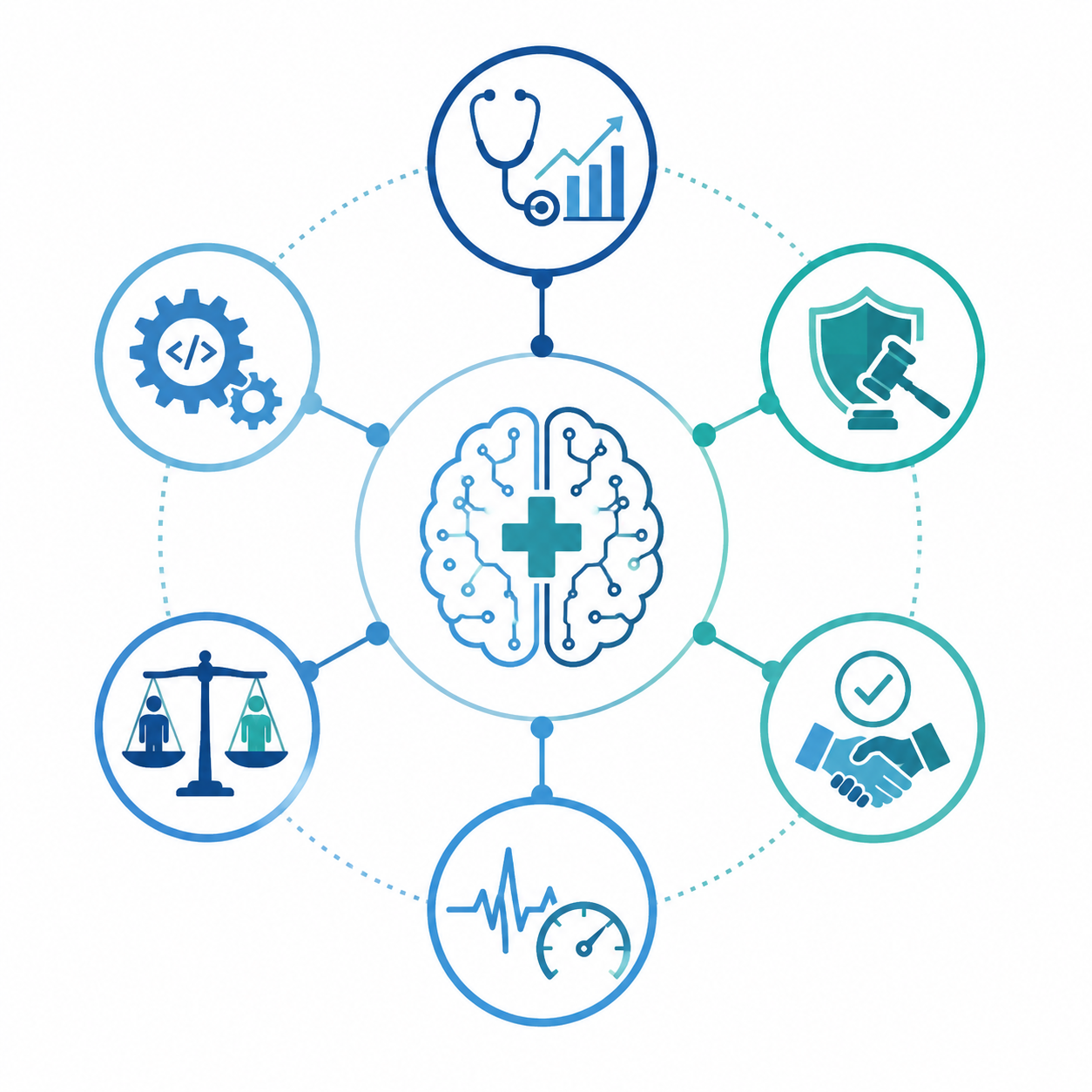
Checklist at a Glance
The checklist below is organized for governance, not for procurement theater. A committee should be able to assign an owner, request evidence, document a decision, and define a monitoring obligation for each domain before go-live.
| Domain | What must be verified before deployment | Evidence to request |
|---|---|---|
| Clinical performance | The model performs acceptably for the intended use, local population, clinical setting, and decision point. | Local sensitivity, specificity, PPV, calibration, subgroup performance, pressure testing, intended-use statement, reporting-standard checklist. |
| Technical integration | The tool runs reliably inside the actual EHR, data pipeline, authentication environment, alerting channel, and clinical workflow. | Interface specifications, uptime and latency tests, throughput testing, failure-mode handling, downtime procedures, audit logs. |
| Regulatory compliance | The organization understands the applicable FDA pathway, HIPAA obligations, data rights, contractual controls, and state-level requirements. | FDA documentation where applicable, HIPAA analysis, business associate agreement terms, lifecycle oversight plan, legal review. |
| Fairness and bias | The tool does not create unacceptable performance differences across relevant patient groups for the intended use. | Subgroup metrics, demographic parity review where appropriate, PSI divergence analysis, missingness analysis, mitigation plan. |
| Vendor reliability | The vendor can support the product clinically, technically, contractually, and operationally after implementation. | Model documentation, change-control commitments, incident response terms, support SLAs, transparency limits, update history. |
| Post-deployment monitoring | The organization can detect drift, degradation, outages, unsafe alert behavior, and workflow failures after launch. | Monitoring dashboard, escalation pathway, named owners, review cadence, rollback criteria, retraining or recalibration triggers. |
Clinical Performance and Local Evidence
Clinical validation should begin with a sentence plain enough to audit: the tool is intended to do what, for which patients, at what moment, to inform which action, by which clinician or operational team. Without that statement, the committee cannot interpret sensitivity, specificity, positive predictive value, calibration, or alert burden. A high-performing model for retrospective risk stratification may still be poorly suited for a time-sensitive bedside alert.
EisnerAmper’s local validation framework puts useful pressure on this point by separating safety measures such as sensitivity, specificity, and PPV from software quality, pressure testing, and fairness. It also names practical technical measures such as uptime, latency, and throughput, which matter because a correct prediction that arrives too late is not clinically equivalent to a correct prediction that arrives when the team can still act.[2]
A clinical performance review should ask for more than the headline metric. At minimum, the committee should document:
- The intended use, patient population, care setting, and decision point.
- The source of the performance evidence: development data, external validation data, peer-reviewed study, vendor validation, or local validation.
- Local sensitivity, specificity, PPV, and calibration expectations, with thresholds tied to clinical consequences.
- Subgroup performance for clinically and operationally relevant populations.
- The expected action after a positive, negative, or unavailable output.
- The consequences of false positives, false negatives, delayed outputs, and missing outputs.
Reporting standards help committees ask better questions about the evidence base. A Nature Digital Medicine scoping review mapped seven AI reporting guidelines to study types, including CONSORT-AI, SPIRIT-AI, TRIPOD-AI, and STARD-AI.[4] These are not academic ornaments. They help reviewers notice whether a study clearly describes participants, data sources, model inputs, missing data, comparator conditions, human-AI interaction, and analysis choices.
Roosan’s 30-item checklist gives another methodological anchor. It was validated across 50 AI/ML healthcare studies; the average score was 22.8 out of 30, and studies with inadequate design and analysis descriptions scored 3.8 points lower, with P<0.01.[5] The sample does not prove how every AI paper will perform, but it does show why committees should not accept a polished validation packet without checking whether the study design and analysis are described well enough to judge.
Local validation should include pressure testing. The committee should ask what happens when data are delayed, when a feed is missing, when a patient falls outside the training distribution, when a field is documented differently across sites, or when the model receives plausible but unusual combinations of inputs. These tests do not need to be theatrical. They need to expose whether the system fails silently, fails loudly, or fails in a way clinicians can recognize and manage.
For specialty-specific tools, the review should become more specific rather than more abstract. ASCO’s Clinician’s Artificial Intelligence Checklist and Evaluation Questionnaire, developed from a 24-article review, uses yes/no questions and open-ended prompts for oncologists evaluating AI tools.[6] That kind of specialty adaptation matters because the clinically acceptable tradeoff for a triage aid, a treatment-selection tool, and a documentation assistant will not be the same. For broader deployment examples, a committee can compare the tool against documented AI in healthcare examples by specialty without treating adoption itself as proof of benefit.
Technical Integration as Safety Review
Technical integration is often described as implementation work, but for clinical AI it is part of validation. The same model can behave differently when the EHR mapping changes, when lab results arrive on a different schedule, when a department uses a different documentation pattern, or when an alert lands in a queue no one owns.
The technical review should verify the live operating environment, not only the vendor’s reference architecture. EisnerAmper’s local validation criteria explicitly include software quality measures such as uptime, latency, and throughput, as well as failure detection.[2] Those measures belong in the go-live decision because they determine whether clinicians receive a usable output at the moment of care.
- Data inputs: Are all required fields available, mapped correctly, refreshed at the required interval, and stable across sites?
- Workflow placement: Where does the output appear, who sees it, and what action is expected?
- Latency: Does the prediction arrive early enough to change the intended decision?
- Reliability: What are the uptime expectations, downtime procedures, and fallback processes?
- Auditability: Can the organization reconstruct what the model output was, when it appeared, which data were used, and who acted?
- Change control: What happens when the EHR, interface, model, threshold, or source system changes?
A technical signoff that ignores clinical workflow is incomplete. If an alert routes to the wrong role, appears after the decision has already been made, or fires so frequently that clinicians learn to dismiss it, the tool has failed a deployment condition even if the model service remains online.
Regulatory Compliance: Current, Specific, Contractual
Regulatory review should not be reduced to a single question about whether a product is FDA-cleared. Morgan Lewis’s May 2026 practical checklist points to FDA premarket pathways including 510(k), De Novo, and PMA; HIPAA data authorization; AI-specific business associate agreement terms; total product lifecycle oversight; and state-level regulatory developments.[7] Those are separate obligations, and clearing one does not clear the others.
The organization should document whether the tool is a regulated medical device, whether the deployed use matches the cleared or authorized intended use if applicable, what data the vendor receives, whether protected health information is used for model improvement, and what contractual rights the organization has if the vendor changes the product. A legal checklist is useful, but it is not a substitute for current regulatory verification at the time of deployment.
Business associate agreements deserve particular attention for AI products. The review should address permitted uses of data, model training or improvement rights, de-identification obligations, subcontractors, breach notification, audit rights, data return or destruction, and restrictions on secondary use. If the vendor describes a feature as configurable, the contract should still specify who approves configuration changes and how those changes are tested before release.
Fairness Tied to Intended Use
Fairness cannot be handled by asking whether the vendor has an ethics statement. The review has to identify which patient groups could be harmed by differential performance and which metrics are appropriate for the tool’s purpose. EisnerAmper’s framework names demographic parity and population stability index divergence as fairness-related measures, while also placing them alongside safety and pressure-testing criteria rather than isolating them as a separate public-relations concern.[2]
The committee should ask for subgroup performance across variables relevant to the clinical context and local population. That may include race, ethnicity, sex, age, language, insurance status, geography, disability, comorbidity burden, or site of care, depending on the tool. The point is not to demand every possible slice for every model; it is to identify the groups for whom an error would be more likely, less visible, or more consequential.
When subgroup results are unstable because sample sizes are small, the committee should say so rather than convert uncertainty into reassurance. It can require monitoring after launch, limit the initial deployment population, adjust thresholds, or delay use until local evidence is stronger. For broader context, the fairness review can connect to established concerns around algorithmic bias and health equity in clinical AI, but the deployment decision still needs tool-specific evidence.
Vendor Reliability and Clinical Risk
A vendor review should go beyond financial viability and implementation timelines. Censinet includes vendor reliability as one of its core AI validation pillars because the organization depends on the vendor for documentation, support, updates, security, transparency, and incident response after the contract is signed.[1]
The committee should ask what the vendor will disclose about training data, validation data, model versioning, known limitations, update frequency, threshold changes, monitoring tools, and customer-specific performance. If a requested artifact is “not usually provided,” that should become a documented risk, not an informal reassurance.
- Model documentation: intended use, contraindicated use, input requirements, known limitations, and validation evidence.
- Operational support: service levels, escalation contacts, outage communication, and clinical incident procedures.
- Change management: notice periods, release notes, rollback rights, and validation obligations after updates.
- Security and privacy: data flows, subcontractors, access controls, logging, and breach response.
- Transparency boundaries: what the vendor will not disclose and how the organization will manage that uncertainty.
Large platform ecosystems require the same discipline. A health system evaluating predictive analytics embedded in an EHR can use broader governance lessons from Epic AI governance without assuming that platform familiarity replaces tool-level validation.
Post-Deployment Monitoring
Prelaunch validation is a gate. Post-deployment monitoring is the safety system on the other side of the gate. A model that performs acceptably at launch can degrade when clinical practice changes, documentation shifts, patient mix changes, a data feed is modified, or the vendor releases an update. Monitoring is not a dashboard someone remembers to open after a complaint; it is a set of responsibilities assigned before the first patient is affected.
A monitoring plan should name the owner for clinical performance, technical reliability, fairness, privacy, vendor communication, and escalation. It should also define the review cadence and the thresholds that trigger investigation, recalibration, temporary suspension, or rollback. For a deeper treatment of performance degradation, the governance team can use a dedicated resource on model drift in clinical AI, but the deployment checklist should still specify what the local team will measure.
| Monitoring area | Question to answer | Escalation trigger |
|---|---|---|
| Clinical performance | Are sensitivity, specificity, PPV, calibration, and alert yield staying within approved bounds? | Metric crosses a predefined threshold or diverges from baseline. |
| Population fit | Has the patient mix or subgroup performance changed since validation? | PSI divergence, subgroup degradation, or unexplained performance gap. |
| Workflow impact | Are clinicians receiving, reviewing, and acting on outputs as intended? | Unexpected override patterns, alert fatigue signals, or unassigned queues. |
| Technical reliability | Are uptime, latency, throughput, and data feeds stable? | Outage, delayed output, missing input, interface failure, or audit-log anomaly. |
| Vendor change | Has the vendor changed the model, threshold, interface, or documentation? | Release or configuration change without completed local review. |
| Safety event | Did an output contribute to delayed care, missed care, unnecessary intervention, or patient harm? | Reported incident, near miss, complaint, or sentinel review referral. |
The monitoring plan should also define who is paged when the system fails. If a sepsis alert feed stops running at 2 a.m., is that an IT incident, a clinical operations incident, a vendor incident, or all three? If the answer is discovered during the outage, the checklist did not do its job.
Review cadence should match risk. A low-risk administrative automation may need periodic sampling and exception review. A clinical deterioration model used for escalation decisions needs more active surveillance, including alert volume, timeliness, performance by subgroup, missed-event review, and downtime reporting. The point is not to build the same oversight machinery for every tool. It is to make the monitoring burden proportional to the consequences of being wrong.
What “Validated Enough to Deploy” Means
A healthcare organization does not need perfect certainty before deploying an AI tool. It does need a defensible record that the tool has been evaluated across the domains that determine clinical safety and operational reliability. That record should show what evidence was reviewed, what gaps remain, who accepted those gaps, what safeguards were added, and what monitoring will continue after launch.
A tool is not validated because it is cleared, popular, technically sophisticated, or contractually available. It is validated for deployment when the organization can document that it is clinically appropriate for the intended use, technically reliable in the local environment, legally compliant, equitable enough for the decision it supports, supported by a vendor whose obligations are clear, and continuously monitored where patients and clinicians will actually encounter it.
References
- Checklist for Choosing AI Validation Tools in Healthcare. Censinet.
- Mitigating AI Risks in Healthcare: Why Local Validation Matters. EisnerAmper.
- External Validation of a Widely Implemented Proprietary Sepsis Prediction Model in Hospitalized Patients. JAMA Internal Medicine.
- Reporting guidelines for clinical trial reports for interventions involving artificial intelligence: the CONSORT-AI extension. Nature Digital Medicine.
- Comprehensive guide and checklist for clinicians to evaluate AI/ML methodological research. Journal of Medical Artificial Intelligence. 2024.
- Clinician's Artificial Intelligence Checklist and Evaluation Questionnaire. ASCO. 2025.
- AI in Healthcare: A Practical Checklist for Compliance and Risk Management. Morgan Lewis. May 2026.
Comments
Join the discussion with an anonymous comment.