
The most durable heatstroke prevention myth is also the most reasonable-sounding one: if people drink enough water, they will be protected. Hydration matters. It reduces strain, supports sweating, and belongs in any serious heat-safety plan. But as a decision rule for whether an overheated, confused, collapsing person is moving toward heatstroke, it is dangerously incomplete.
The best recent machine learning evidence does not identify hydration status as the signal that separates heatstroke from non-heatstroke cases. In a 2025 PeerJ study by Zeng and colleagues, a gradient boosting machine model predicted heatstroke using six admission variables: transfer time, CK-MB, lactate, core temperature, mean arterial pressure, and D-dimer. The model reached an AUROC of 0.971 in training and 0.836 in validation across 24 hospitals and 691 patients; SHAP analysis identified CK-MB as the strongest predictor. Logistic regression and neural networks performed worse, with AUROCs of 0.594 and 0.710 respectively.[1]
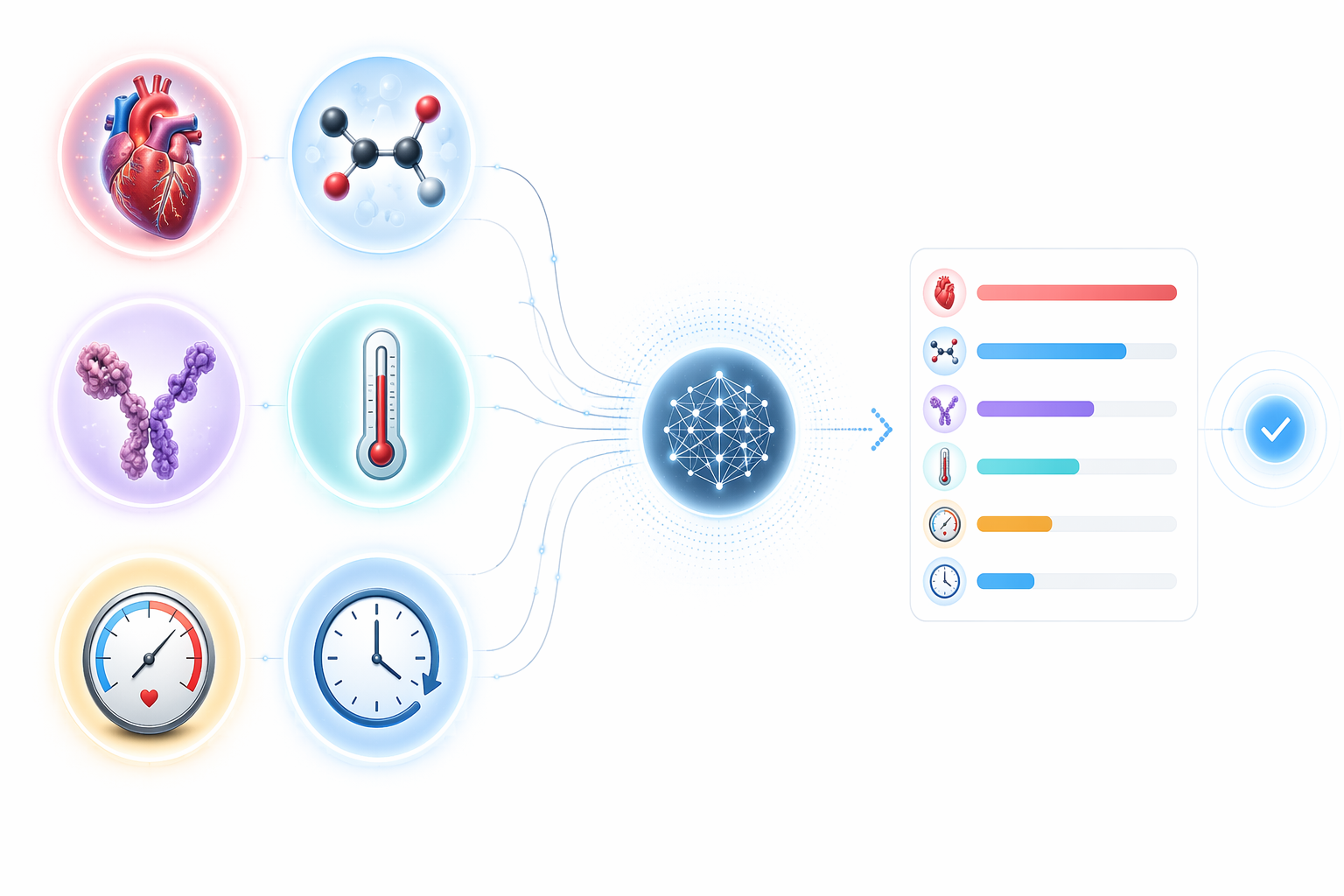
That finding does not make water irrelevant. It does something more useful: it shows why a hydration-only story fails at the clinical edge. By the time a patient reaches triage or an athletic trainer is assessing altered mental status on a sideline, the important question is not whether the person followed the water rule. It is whether physiology is already declaring injury: myocardial strain, anaerobic metabolism, coagulation activation, temperature burden, blood pressure instability, and the time elapsed before definitive evaluation.
What the GBM model actually adds
The Zeng model is more interesting than a generic “AI predicts heatstroke” headline because it is parsimonious. Six admission variables are not a mystical sensor cloud. They are recognizable clinical data points, and that matters when a model is expected to support decisions made under time pressure.
| Variable | Clinical meaning in context |
|---|---|
| CK-MB | A marker associated with cardiac muscle injury; ranked strongest in SHAP analysis |
| Lactate | A signal of metabolic stress and impaired oxygen utilization |
| D-dimer | A coagulation-related marker, relevant because severe heat illness can involve clotting pathway disturbance |
| Core temperature | A direct physiologic heat burden measure |
| Mean arterial pressure | A hemodynamic stability measure |
| Transfer time | A time-to-care variable that captures delay before definitive assessment |
The comparison models are part of the point. A neural network can sound more advanced, but in this study it did not perform as well as the GBM. Logistic regression was more familiar, but less discriminative. The useful result is not “more AI.” It is a specific model class, using a small number of clinically legible variables, outperforming alternatives in the dataset where it was tested.[1]
There is a boundary around that conclusion. The cohort was 95.1% male, with a median age of 22, and came from Chinese military hospitals.[1] That population is highly relevant to exertional heatstroke, but it is not the same as an older adult with chronic disease in a poorly cooled apartment during a heat wave. Exertional and classical heatstroke overlap in organ injury and urgency; they should not be casually collapsed into one universal prediction problem.
Still, the model pressures one of the most common prevention shortcuts. It suggests that risk assessment should be organized around measurable physiologic derangement, not reassurance that the person had been drinking fluids.
Heat illness does not have to climb a neat ladder
Another familiar myth says heat illness progresses in an orderly sequence: cramps, then exhaustion, then heatstroke. That sequence is tidy enough for posters and pregame talks, but it can mislead the person asked to recognize danger in real time.
Exertional heatstroke can present abruptly. A runner, recruit, football player, or laborer may not pass through a visible, well-labeled stage of heat exhaustion before central nervous system dysfunction appears. Waiting for a complete progression can delay the moment when someone checks core temperature, initiates emergency cooling, or escalates care.
This is where prediction models and clinical protocols are aligned in spirit even when they operate at different moments. The model does not ask whether the case followed a story arc. It weighs signals of injury and instability. A competent sideline or occupational protocol should do the same: confusion, collapse, altered behavior, severe hyperthermia, and context should outrank a mental checklist of earlier symptoms.
Sweating does not rule heatstroke out
The “hot, dry skin” teaching has done particular damage because it gives observers a false negative. In exertional heatstroke, patients are often still sweating heavily. A wet uniform, soaked shirt, or dripping helmet should not reassure anyone if the person is disoriented, collapsing, combative, or unable to continue purposeful activity.
The sweating myth persists because it is visually simple. Dry skin looks like failed cooling. Profuse sweating looks like the body is still compensating. But compensation and safety are not the same thing. Sweating can continue while core temperature and metabolic injury have already reached a dangerous point.
For frontline staff, this changes the burden of proof. The absence of sweating may be concerning, especially in passive heat exposure, but the presence of sweating cannot be used to downgrade risk in exertional collapse. The more defensible question is whether the presentation fits heatstroke physiology and whether rapid cooling and escalation are being delayed by a single visible cue.
Acetaminophen is the wrong mechanism
Antipyretics are another place where a familiar fever habit gets imported into the wrong condition. Acetaminophen is designed for fever physiology, where the hypothalamic set point is altered. Heatstroke is not that problem. It is overheating with impaired heat dissipation and organ-threatening physiologic stress.
The practical consequence is straightforward: giving acetaminophen should not distract from measuring temperature accurately, initiating appropriate cooling, and activating emergency care. The medication may feel like treatment because it is associated with high temperature in everyday life, but the mechanism does not match the emergency.
Cold-water immersion is not the folk danger people fear
The fear that ice baths or cold-water immersion will cause shock has also survived in settings where it can cost time. In exertional heatstroke, the clinical logic is “cool first.” National Athletic Trainers’ Association and Wilderness Medical Society guidance identify cold-water immersion as the gold-standard treatment for exertional heatstroke, and sports medicine summaries report 100% survival when it is applied within 30 minutes.
That statement is not a license for improvising beyond one’s training or delaying EMS activation. It is a correction to the folk rule that rapid cooling is inherently more dangerous than waiting. In true exertional heatstroke, delay is the greater hazard.
Where AI may help before the collapse
Once the myths are stripped away, the appeal of AI-driven heat monitoring becomes easier to understand. The promise is not that an algorithm knows heat illness better than clinicians. The promise is lead time: a chance to detect rising physiologic risk before altered mental status, collapse, or organ injury is obvious.
Prototype systems are already pointing in that direction. A smart helmet system developed through a BeeInventor, SAS, and Illinois Tech hackathon used Internet of Things sensor data including heart rate, core temperature, and ambient conditions to predict heat risk 5 to 10 minutes ahead. That is a meaningful design target, but it remains a prototype signal rather than a clinically validated device: it is not described in the available material as FDA-cleared or validated in large randomized trials.
The same caution applies to NIH-sponsored biopatches for farmworkers and Army HIPS chest straps. These tools address a real operational gap: many high-risk workers and trainees are monitored in environments where serial laboratory testing is unavailable. But wearable detection is not automatically clinical prediction. A sensor alert still needs calibration, workflow integration, accountability, and evidence that acting on it improves outcomes rather than merely increasing alarms.
Population surveillance is a different category. A transformer-based model analyzing 27,040 geo-tagged tweets over five years was reported to support real-time heatstroke risk detection at the population level. That may help public health teams see geographic signals earlier, but it should not be mistaken for diagnosing the individual worker, athlete, or older adult in front of a clinician.
Why the myths persist
Simple rules survive because they are portable. A farm supervisor cannot run lactate and D-dimer in the field. A coach may not have immediate rectal thermometry. An emergency department triage nurse may be assessing several patients during a regional heat event. In those settings, “drink water,” “look for dry skin,” and “avoid ice baths” sound usable.
The occupational stakes are not evenly distributed. Farmworkers are reported to be 35 times more likely to die from heat stress; South Carolina recorded 14 deaths from excessive natural heat in 2022, and EPA data from 1992 to 2022 estimated 34 worker deaths annually from heat exposure. Those figures do not make a wearable device effective by themselves, but they explain why prevention shortcuts keep being used in places where better surveillance and rapid clinical assessment are hard to deploy.
Market pressure will not wait for perfect evidence. The wearable heat stress monitoring market was valued at $274.6 million in 2025 and projected to reach $570.8 million by 2034, an 8.5% compound annual growth rate. Adoption pressure can bring useful tools into the field, but it can also reward dashboards before the clinical validation is mature.
That is why the evidence hierarchy matters. The Zeng GBM model is not equivalent to a hackathon helmet. A guideline correction about cold-water immersion is not equivalent to a market forecast. A population-level social media signal is not equivalent to an individual risk score. They all belong in the same conversation only if their limits stay visible.
A better standard than single-cue prevention
The useful lesson from AI and clinical evidence is not that heatstroke prevention has become technologically exotic. It is that single-cue myths are too brittle for a condition that moves through physiology, environment, exertion, delayed recognition, and time-to-cooling.
Hydration should remain part of prevention, but it cannot be treated as proof of safety. Sweating should be observed, but not used to rule out exertional heatstroke. Antipyretics should not substitute for cooling. Cold-water immersion should not be delayed because of a folk fear that conflicts with exertional heatstroke guidance. Sensor systems may eventually extend lead time, but prototype alerts have to earn their place through validation and workflow fit.
Heatstroke prevention should be organized around validated physiologic risk signals, exposure context, rapid recognition, and fast escalation—not around rules that sound practical until someone is already confused, overheated, and out of time.
Comments
Join the discussion with an anonymous comment.