
A hospital AI policy template in 2026 has to answer a more uncomfortable question than “May our staff use AI?” It has to answer who is allowed to approve the tool, what proof they must review, what clinicians may do with the output, what patients must be told, how bias is monitored, where incidents go, and when the organization stops using the system.
That is no longer a theoretical governance exercise. Nearly 70% of physicians reported using AI tools in 2024, while only 8% said their organization’s AI decision-making process was clear.[1] The gap matters more in 2026 because hospitals are operating inside a patchwork of state laws, federal civil rights obligations, patient communication rules, safety guidance, vendor claims, and FDA expectations. Texas TRAIGA took effect on January 1, 2026, and reported civil penalties for failure to disclose AI use in diagnosis or treatment can reach $200,000 per violation.[2] California AB 489 adds another pressure point by giving medical licensing boards enforcement authority over AI systems that imply licensure, making labeling and patient-facing language part of the policy problem rather than a marketing detail.[2]
A defensible hospital AI policy template cannot be a generic acceptable-use memo. It has to be a working control system: something procurement can use before signing a contract, clinicians can use before putting output into care, compliance can audit, and risk management can activate when an AI-related event reaches the safety system.

The Template Has to Start With Ownership
The first failure point in many AI policies is not the definition of AI. It is the missing owner. A department buys a documentation assistant. A quality team tests a prediction model. A physician uses a consumer-facing tool to draft patient instructions. A vendor embeds a model inside a platform already under contract. If the policy does not say who reviews these situations before use, the hospital has not governed AI; it has merely described it.
The Joint Commission and the Coalition for Health AI released responsible-use guidance in September 2025 that, as described in coverage of the release, points health systems toward seven required elements: a formal governance structure, patient privacy and transparency policies, data security protections, ongoing quality monitoring, voluntary safety-event reporting, risk and bias assessment, and education and training.[3][4][5] Those elements are useful because they force the policy out of abstraction. A hospital cannot satisfy them with a paragraph saying “AI shall be used responsibly.”
A practical hospital AI policy template should name a standing AI governance committee and give it decision rights. The committee does not need to be enormous, but it does need enough authority to stop a tool that creates clinical, legal, privacy, or equity risk. Current guidance and healthcare AI policy materials converge around a multidisciplinary structure that typically includes the chief medical officer or equivalent clinical executive, CIO, CMIO, legal counsel, privacy or compliance leadership, an ethics representative, a health equity leader, nursing leadership, a patient representative, and named algorithm stewards for approved systems.
Template language:
The Hospital AI Governance Committee has authority to review, approve, conditionally approve, suspend, or reject the acquisition, development, deployment, expansion, or retirement of AI systems used in clinical care, patient communication, administrative decision-making, population health, revenue cycle, operations, or research when such systems may affect patients, workforce members, protected health information, clinical decisions, access to services, or organizational risk.

No department may deploy an AI system within the scope of this policy until the Committee or its delegated review pathway has documented approval, required safeguards, monitoring obligations, responsible owners, patient disclosure requirements if applicable, and incident reporting procedures.
The second sentence is the one that matters on Monday morning. It tells a department that enthusiasm, budget approval, and vendor availability are not enough.
Eight Domains a 2026 Hospital AI Policy Template Should Cover
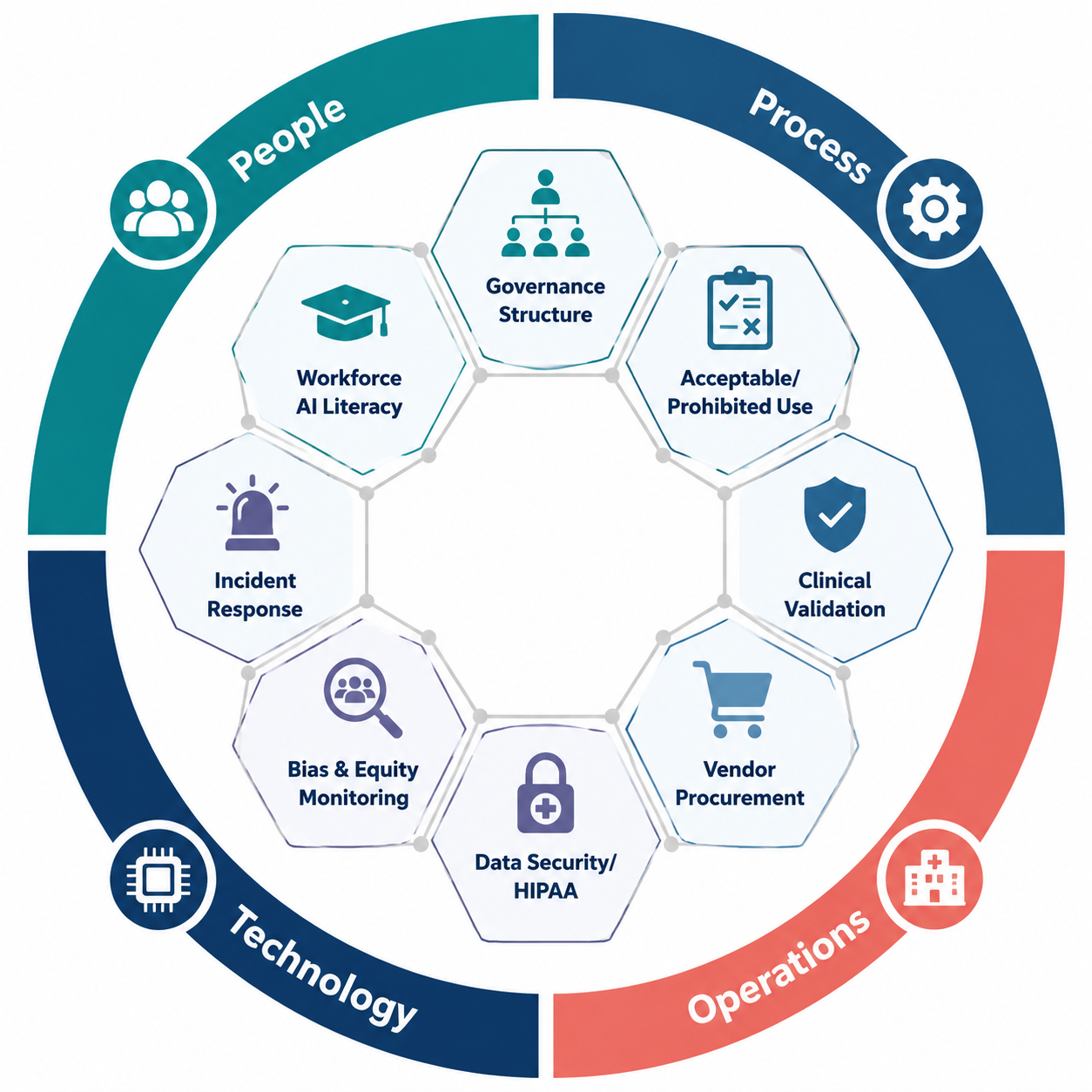
The policy can be organized in many formats, but the substance should cover eight operational domains. These domains synthesize the governance elements reflected in the JC/CHAI responsible-use guidance, public AMA discussion of AI policy development, and healthcare AI policy template materials.[1][3][7][8][9]
| Domain | What the Policy Must Decide | Minimum Operational Output |
|---|---|---|
| Governance structure | Who reviews, approves, monitors, pauses, and retires AI systems | Committee charter, escalation path, algorithm steward role |
| Acceptable and prohibited use | What staff may use AI for and what uses are barred or require prior approval | Use categories, prohibited-use list, clinician accountability language |
| HIPAA and data security | What data may enter AI systems and under what controls | PHI restrictions, access controls, vendor security review |
| Clinical validation and pilots | What evidence is required before clinical use | Pilot protocol, validation criteria, stop rules, lifecycle review |
| Vendor procurement and contracting | What vendors must disclose and accept contractually | Due diligence checklist, audit rights, disclosure duties, data-use limits |
| Bias and equity monitoring | How the hospital evaluates differential performance and civil rights risk | Equity impact review, subgroup monitoring, mitigation plan |
| Incident response | Where AI-related safety, privacy, discrimination, or performance issues are reported | Event taxonomy, reporting workflow, investigation owner |
| Workforce AI literacy | Who must be trained and what they must know before using AI | Role-based training, attestation, refresh cycle |
Use PPTO to Make the Template Assignable
The People, Process, Technology, and Operations framework is useful because it prevents the policy from becoming a document owned only by legal or informatics. In a 2025 hospital case study, a co-designed PPTO governance structure with diverse stakeholders was associated with improved policy adoption, though the case was Canadian and should not be treated as proof that the same implementation results will occur in U.S. hospitals.[6]
For a U.S. hospital AI policy template, PPTO works best as the assignment layer beneath the eight domains.
| PPTO Layer | Policy Question | Typical Hospital Owner |
|---|---|---|
| People | Who is accountable for review, use, oversight, and escalation? | AI governance committee, algorithm steward, department leader, clinician user |
| Process | What workflow must happen before and after deployment? | Governance office, compliance, clinical operations, risk management |
| Technology | What controls, integrations, logs, and technical safeguards are required? | IT, cybersecurity, data governance, biomedical or digital health teams |
| Operations | How does the tool behave in routine care, downtime, audit, training, and incident review? | Clinical leadership, quality and safety, nursing, medical staff office |
This structure also exposes weak drafting. If a policy says the hospital will “monitor AI for bias” but does not assign a person, data source, interval, threshold, or escalation route, the policy has not reached the operations layer. If it says users must “validate outputs” but does not distinguish a clinician’s review of a generated note from institutional validation of a sepsis model, the policy has blurred people and process in a way that will create confusion during an audit or safety investigation.
1. Governance Structure
The governance section should do more than create a committee. It should define scope, review tiers, voting or approval authority, emergency review, documentation requirements, and periodic reassessment. AI embedded in a radiology device, an ambient documentation tool, a claims denial assistant, a patient messaging chatbot, and a homegrown risk model do not carry the same risk, but all need a pathway into governance.
Template language:
The Committee shall classify AI systems into risk tiers before approval. Risk classification shall consider intended use, patient-facing status, effect on diagnosis or treatment, degree of automation, use of protected health information, potential impact on access to care or benefits, vendor or internally developed status, regulatory clearance or authorization status, and foreseeable harm from incorrect, biased, unavailable, or misunderstood output.

Each approved AI system shall have a named executive sponsor, operational owner, technical owner, and algorithm steward. The algorithm steward is responsible for maintaining the approved-use description, monitoring obligations, known limitations, change notices, user education materials, and escalation records for the system.
The algorithm steward role is especially important for tools that live inside another platform. Without a named steward, change notices from vendors drift into inboxes, model updates are treated like routine software patches, and no one knows whether a new feature changed the approved use.
2. Acceptable and Prohibited Use
The acceptable-use section should separate low-risk administrative drafting from clinical decision support, autonomous action, patient-facing communication, and use involving protected health information. A single permission statement invites misuse because staff will reasonably ask whether “AI may be used to improve efficiency” includes discharge instructions, triage responses, prior authorization appeals, diagnosis suggestions, or staffing decisions.
A workable template gives users both permissions and hard stops.
- Permitted without prior committee review: use of approved enterprise AI tools for non-clinical drafting, summarization, formatting, translation support where separately authorized, or internal administrative assistance when no protected health information or confidential data is entered.
- Permitted only with approval: AI use that affects diagnosis, treatment, triage, discharge planning, medication recommendations, patient communication, scheduling priority, coverage decisions, access to services, clinical documentation, or quality reporting.
- Prohibited unless specifically approved through an exception pathway: entry of PHI into public or non-contracted AI tools, autonomous clinical decision-making without human review, undisclosed patient-facing AI communication where disclosure is required, and use of AI output as the sole basis for denying care, benefits, or access.
- Always required: a qualified human remains accountable for reviewing AI output before it is used in patient care, documentation, operational decisions, or external communication.
Texas TRAIGA makes the disclosure portion of this section harder to postpone. Because the law is described as imposing penalties for failure to disclose AI use in diagnosis or treatment, a hospital operating in or serving Texas patients should not leave disclosure to individual clinician instinct.[2] The policy should define which approved tools trigger disclosure, who gives it, where it is documented, and what script is used.
Template language:
When an AI system is used in a manner that materially contributes to diagnosis, treatment, or patient-specific clinical communication and applicable law or Committee determination requires disclosure, the responsible clinical team shall provide patient-facing disclosure using approved language before or at the time the AI-informed service or communication is delivered, unless an approved exception applies.

The medical record or designated disclosure log shall identify that disclosure occurred, the AI system or category of system involved, the person or role providing disclosure, and any patient questions or objections requiring follow-up.
California AB 489 adds a different concern: whether an AI system’s presentation implies that it is licensed to practice medicine or another healing art. The policy should therefore control not only whether AI communicates with patients, but how it identifies itself and how human oversight is represented.[2]
3. HIPAA, Data Security, and Access Controls
The data security section should be written for the actual ways AI enters hospital work: browser tools, EHR-integrated functions, vendor-hosted models, internal analytics workspaces, mobile apps, transcription platforms, and device software. Staff should not have to infer whether a tool is safe for PHI because it looks professional or because a vendor calls it “HIPAA-ready.”
Template language:
Workforce members may not enter, upload, paste, dictate, transmit, or otherwise expose protected health information, confidential business information, credentials, security information, or nonpublic operational data into any AI system unless the system has been approved for that data type and use case through the Hospital's privacy, security, legal, and AI governance review.

Approved AI systems must meet documented requirements for access control, authentication, audit logging, data retention, encryption where applicable, incident notification, subcontractor disclosure, data-use limitations, and secure decommissioning.
The policy should also require a data flow review before approval. For AI systems, the security question is not only where data is stored. It is whether prompts, outputs, feedback, metadata, recordings, or user corrections are retained, reused, shared with subcontractors, or incorporated into product improvement.
4. Clinical Validation, Pilots, and Lifecycle Review
Clinical validation is where an AI policy has to resist two shortcuts. The first is assuming that a vendor demonstration proves local safety. The second is assuming that FDA clearance or authorization, where present, eliminates the hospital’s responsibility to assess fit for local workflow. FDA-related expectations matter most at the point of intended use, cleared indications, software changes, monitoring, and lifecycle oversight; they do not replace local implementation governance.
Hospitals tracking the growth of AI-enabled tools can also connect this section to their medical device inventory and digital health intake process. For teams maintaining a device-specific oversight list, an internal FDA count resource such as How Many AI Devices Has the FDA Authorized? A 2025–2026 Breakdown can help frame which tools may arrive with regulatory history but still need hospital-level controls.
Template language:
Before clinical deployment, the requesting department must submit an AI Clinical Use Proposal describing the intended use, user population, patient population, clinical workflow, decision point affected, anticipated benefit, foreseeable risks, human review requirements, evidence supplied by the vendor or developer, regulatory status if applicable, local validation plan, pilot duration, success criteria, failure criteria, monitoring metrics, and stop rules.

The Committee shall not approve clinical deployment unless the record identifies the approved intended use, prohibited uses, required human oversight, user training, patient disclosure determination, monitoring plan, incident reporting pathway, and reassessment date.

Material changes in model function, input data, output format, intended use, user population, patient population, integration, vendor terms, or regulatory status require reassessment before continued or expanded use unless the Committee has approved a defined change-management pathway.
A pilot should not be a quiet deployment with a softer name. The policy should say who may enroll the tool in a pilot, how users are trained, whether patients are affected, who reviews early signals, and what happens when the pilot misses its safety, quality, equity, or workflow criteria.
5. Vendor Procurement and Contracting
Vendor procurement is often where an AI policy either becomes real or gets bypassed. If the contracting office does not have AI intake questions, the first serious review may occur after a department has selected the product, negotiated the budget, and promised a go-live date. At that point, governance looks like obstruction even when it is doing its job.
The policy should require AI screening before contract execution, renewal, material amendment, or activation of an AI feature in an existing platform. A vendor should not be allowed to avoid review by describing the function as automation, analytics, optimization, digital assistant functionality, or a workflow enhancement.
Template language:
All proposed contracts, renewals, statements of work, order forms, product activations, or material feature changes involving AI functionality must be screened through the AI procurement intake process before execution or activation.

The vendor must disclose, at a minimum: the AI functionality supplied; intended use and limitations; whether the system is patient-facing; whether output may affect diagnosis, treatment, access, payment, or patient communication; training and evaluation information available to the Hospital; known performance limitations; regulatory status if applicable; use of Hospital data for training, tuning, monitoring, or product improvement; subcontractors with access to Hospital data; audit logging; security controls; incident notification commitments; model or feature change notification; and support for bias, quality, and safety monitoring.

Contracts for approved AI systems must include terms addressing data rights, confidentiality, privacy and security obligations, breach and incident notice, subcontractor controls, prohibition or limits on secondary data use, model update notice, cooperation with audits and investigations, required documentation, termination assistance, and obligations related to patient-facing disclosures or labels when applicable.
This is also where California AB 489 and SB 942 should be routed into operations, not left for later legal interpretation. If a patient-facing tool produces messages, summaries, scheduling guidance, intake responses, or clinical education, procurement should ask whether the product creates AI-generated content that must be labeled, whether it could imply professional licensure, and whether the vendor will support the hospital’s required patient-facing language.[2]
6. Bias and Equity Monitoring
Bias monitoring cannot be a values paragraph. Under Section 1557 and the broader civil rights environment, the practical question is whether AI systems produce, worsen, or conceal unequal access, communication, diagnosis, treatment, scheduling, risk scoring, resource allocation, or benefit decisions. The policy should require equity review before deployment and monitoring after deployment for systems that can affect patients or protected classes.
Template language:
For AI systems that may affect clinical care, patient communication, access to services, eligibility, scheduling priority, risk stratification, care management, payment, or other patient-impacting decisions, the requesting department must complete an equity impact review before approval.

The review shall identify affected populations, available demographic and clinical variables for monitoring, known limitations in training or evaluation data, potential differential performance, risk of language access or disability access barriers, mitigation steps, monitoring frequency, responsible owner, and escalation thresholds.

If monitoring identifies materially different performance, access, error rates, communication quality, or adverse outcomes across patient groups, the algorithm steward must notify the Committee and the designated health equity and compliance leaders. The Committee may require mitigation, additional training, limitation of use, patient or user notice, suspension, vendor remediation, or retirement.
The policy should not promise perfect subgroup measurement when the hospital does not have the data or statistical power to support it. It should require a documented monitoring plan proportionate to risk, and it should make uncertainty visible. A smaller facility may not be able to detect every performance difference locally, but it can require vendor evidence, review complaints and safety events for equity signals, examine language access effects, and escalate concerns before harm becomes normalized.
7. Incident Response and Safety Reporting
AI incidents need a defined route into existing safety, privacy, compliance, and IT processes. If the only instruction is “report concerns,” clinicians may not know whether a hallucinated note, a wrong risk score, a discriminatory scheduling recommendation, a chatbot disclosure failure, or an unexpected model update belongs in patient safety, privacy, IT security, compliance, or vendor management.
The JC/CHAI responsible-use guidance includes voluntary safety-event reporting among the responsible-use elements reported from its September 2025 release.[3][4][5] A hospital policy should align that idea with the organization’s existing event-reporting culture instead of creating a separate AI inbox no one checks.
Template language:
Workforce members must report known or suspected AI-related events through the Hospital's designated safety, privacy, compliance, or IT incident reporting system as applicable. Reportable AI-related events include, but are not limited to: incorrect or misleading output that reaches clinical workflow; patient harm or near miss involving AI output; inappropriate disclosure or exposure of protected health information; discriminatory or inequitable output or workflow effect; use outside approved scope; failure to provide required patient disclosure; unauthorized AI tool use; unexpected system behavior; vendor model or feature change not reviewed under this policy; and downtime or unavailability affecting patient care.

The receiving office shall route AI-related events to the algorithm steward, operational owner, risk management, privacy, security, compliance, legal counsel, and the Committee as appropriate. The Committee shall maintain an AI event log and may require temporary suspension, use restrictions, user retraining, patient notification review, vendor notice, corrective action, or retirement.
The event log matters because AI risk is often cumulative. One odd draft, one missed label, or one unexplained alert may not justify suspension. A pattern across units, patient groups, or updates may.
8. Workforce AI Literacy
Training should be role-based. A board member, procurement analyst, nurse, physician, call center supervisor, data scientist, and compliance investigator do not need the same AI course. They do need a shared understanding of the hospital’s approval process, prohibited uses, disclosure obligations, incident reporting route, and the limits of AI output.
Template language:
The Hospital shall provide role-based AI education for workforce members whose duties involve AI selection, approval, configuration, use, monitoring, contracting, patient communication, or incident review.

Training shall address approved and prohibited uses; protection of PHI and confidential information; human review and accountability; patient disclosure and labeling obligations; bias and equity risks; limitations of AI output; documentation expectations; incident reporting; and consequences for unauthorized use.

Users of approved AI systems must complete required training before access is granted when the Committee determines training is necessary for safe, compliant, or effective use.
The training requirement should be connected to access control. If a tool is high enough risk to require training, the hospital should not rely on a PDF posted to an intranet page as the control.
How State and Federal Pressure Changes the Clauses
The easiest way to mishandle the 2026 legal environment is to create a separate “regulatory considerations” appendix that no workflow owner reads. The better approach is to place each legal pressure point where a decision has to be made.
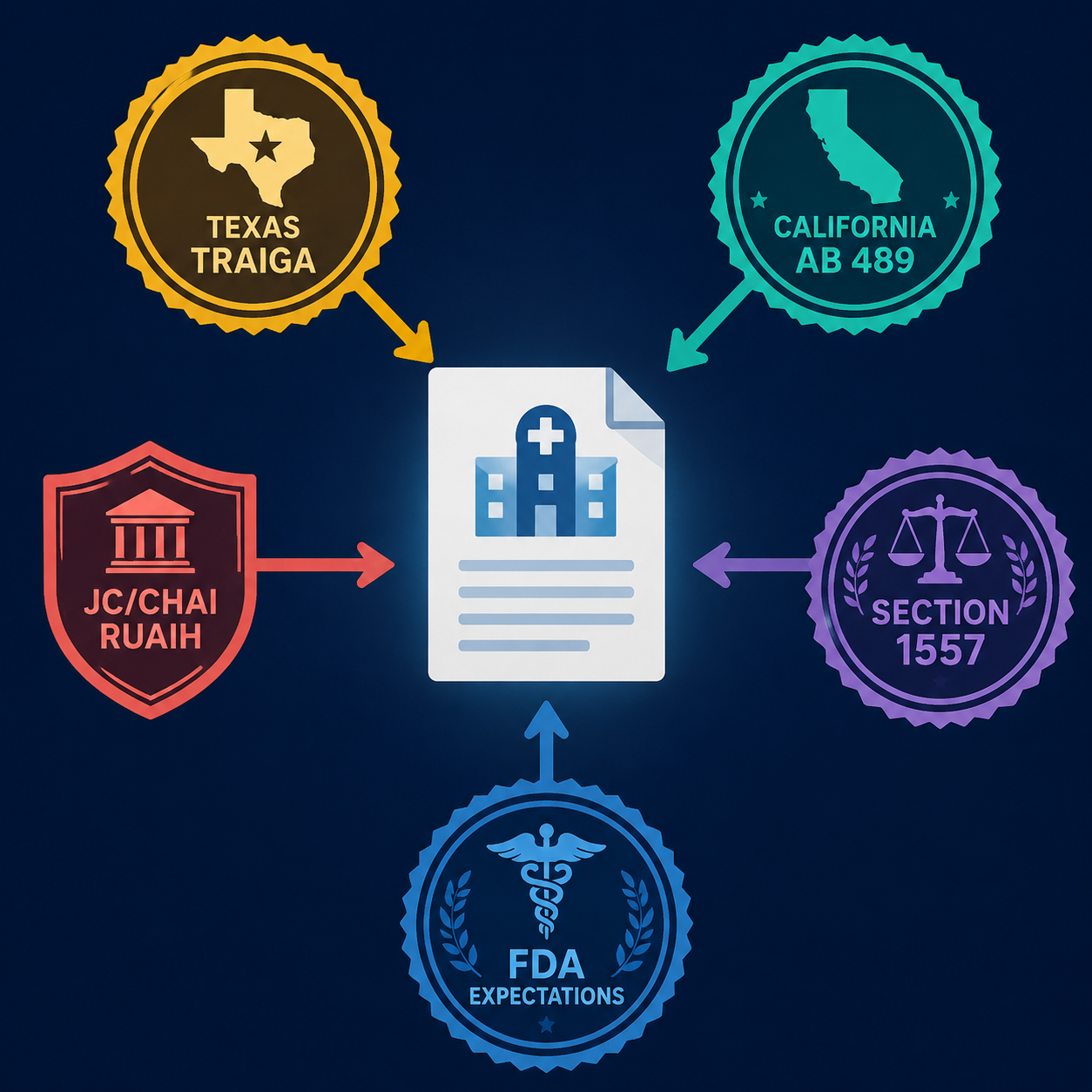
| Pressure Point | Where It Belongs in the Template | Operational Effect |
|---|---|---|
| Texas TRAIGA | Acceptable use, clinical use, patient disclosure, incident response | Define when AI use in diagnosis or treatment requires disclosure and how disclosure is documented |
| California AB 489 | Patient-facing communication, vendor procurement, labeling controls | Prevent AI systems from implying licensure and require approved patient-facing language |
| California SB 942 | Generated-content labeling and patient communication review | Screen AI-generated patient-facing content for labeling or disclosure obligations |
| JC/CHAI RUAIH guidance | Governance, privacy, monitoring, reporting, bias, training | Use the seven responsible-use elements as the minimum control map |
| Section 1557 | Bias and equity monitoring, language access, disability access, complaint review | Treat equity monitoring as a civil rights control, not only an ethics statement |
| FDA expectations | Clinical validation, device inventory, lifecycle review, change management | Confirm intended use, regulatory status, local fit, monitoring, and update review |
Hospitals should also be careful about federal preemption uncertainty. Akerman’s January 2026 analysis notes uncertainty created by a December 2025 Executive Order on AI and possible federal challenges to state AI laws.[2] That uncertainty does not give hospitals a safe reason to ignore state-facing obligations. It means the policy should assign legal monitoring and update responsibility, especially for multistate systems.
Template language:
Legal counsel, in coordination with compliance and the Committee, shall monitor federal, state, and local AI-related legal developments affecting approved or proposed AI systems. When a legal change may affect patient disclosure, labeling, procurement, clinical use, data use, equity monitoring, reporting, or enforcement exposure, counsel shall advise the Committee on required policy revisions, operational changes, user notices, patient-facing language, or suspension of affected uses.A Ready-to-Adapt Policy Skeleton
A hospital can use the following skeleton as the working structure for its own template. The language still needs local counsel, state-law review, medical staff alignment, privacy and security review, and operational testing before adoption.
- Purpose and scope: define covered AI systems, covered users, covered settings, and excluded tools.
- Definitions: define AI system, generative AI, predictive model, patient-facing AI, clinical AI, algorithm steward, approved use, and material change.
- Governance authority: establish the AI governance committee, membership, quorum or approval model, delegated review pathways, risk tiers, documentation, and reassessment.
- Roles and accountability: assign executive sponsor, operational owner, technical owner, algorithm steward, clinician user, procurement owner, and incident response roles.
- Acceptable and prohibited use: define permitted low-risk uses, approval-required uses, prohibited uses, human review requirements, and consequences for unauthorized use.
- Patient disclosure and labeling: define when disclosure is required, approved scripts, documentation, patient-facing AI identity rules, and state-specific requirements.
- Privacy, HIPAA, and data security: define data-entry restrictions, approved systems, vendor safeguards, logging, retention, access controls, and incident notification.
- Clinical validation and pilots: require intended-use statements, evidence review, local validation, pilot criteria, stop rules, lifecycle review, and material-change reassessment.
- Vendor procurement and contracting: require AI intake screening, vendor disclosures, contract clauses, audit rights, data-use limits, update notices, and disclosure support.
- Bias and equity monitoring: require equity impact review, monitoring plans, mitigation, subgroup review where feasible, complaint review, and escalation thresholds.
- Incident response: define reportable AI events, reporting systems, routing, event logs, investigation roles, corrective actions, suspension authority, and vendor notification.
- Training and AI literacy: require role-based education, user attestations where appropriate, refresher training, and access controls tied to training completion.
- Audit and policy maintenance: define review interval, metrics, record retention, legal monitoring, policy exceptions, and board or executive reporting.
What to Test Before Adoption
Before approving the policy, run it through a few ordinary hospital scenarios. Do not use exotic hypotheticals first. Use the kinds of tools departments are already asking for.
- A physician wants to use a public generative AI tool to rewrite discharge instructions.
- A vendor offers to activate an AI feature inside an already contracted EHR module.
- A service line wants a predictive model to prioritize outreach for high-risk patients.
- A chatbot will answer patient portal questions before routing to staff.
- A clinician reports that an AI-generated note included a clinically meaningful error.
- A vendor announces a model update two weeks before go-live.
For each scenario, the policy should identify the intake path, required reviewers, patient disclosure decision, data controls, validation requirements, contract terms, monitoring plan, incident route, and final approver. If the answer depends on someone informally knowing whom to call, the policy is not finished.
The threshold for 2026 compliance is not having an AI policy on file. It is having a policy that names owners, workflows, evidence standards, disclosure duties, monitoring obligations, and escalation paths clearly enough that procurement, clinical leadership, compliance, safety, and frontline users can follow it without inventing governance as they go.
References
- How to develop AI policies that work for your organization’s needs, American Medical Association.
- HRX: New Year, New AI Rules: Healthcare AI Laws Now in Effect, Akerman LLP, January 2026.
- Joint Commission and CHAI Release Guidance on Responsible Use of AI in Healthcare, Fenwick.
- CHAI, Joint Commission release AI governance guidance for health systems, Healthcare Dive.
- CHAI and Joint Commission release guiding document for health systems using AI, Fierce Healthcare.
- PPTO framework empirical validation, PubMed Central, 2025.
- Policy Template, Physician AI Handbook.
- AI Policy and Guidance Template: Healthcare, MAIN Mississippi AI Network.
- Policy Template, Public Health AI Handbook.
Comments
Join the discussion with an anonymous comment.