
Foodborne outbreak detection is being asked to do more with thinner margins. The global burden remains large: an estimated 600 million foodborne disease cases and 420,000 deaths occur each year, while the United States sees about 48 million foodborne illness cases annually.[1] At the same time, the surveillance machinery that detects those events is not expanding in a straight line. On July 1, 2025, CDC’s FoodNet active surveillance was cut back from eight pathogens to two: Salmonella and Shiga toxin-producing Escherichia coli, or STEC.[2]
That is the practical setting for AI in foodborne illness outbreak detection. The question is not whether an algorithm can classify a signal in a paper. It is whether the output helps a laboratory, epidemiologist, inspector, or local health department decide what to do next when cases are incomplete, staff time is scarce, and reporting is uneven.
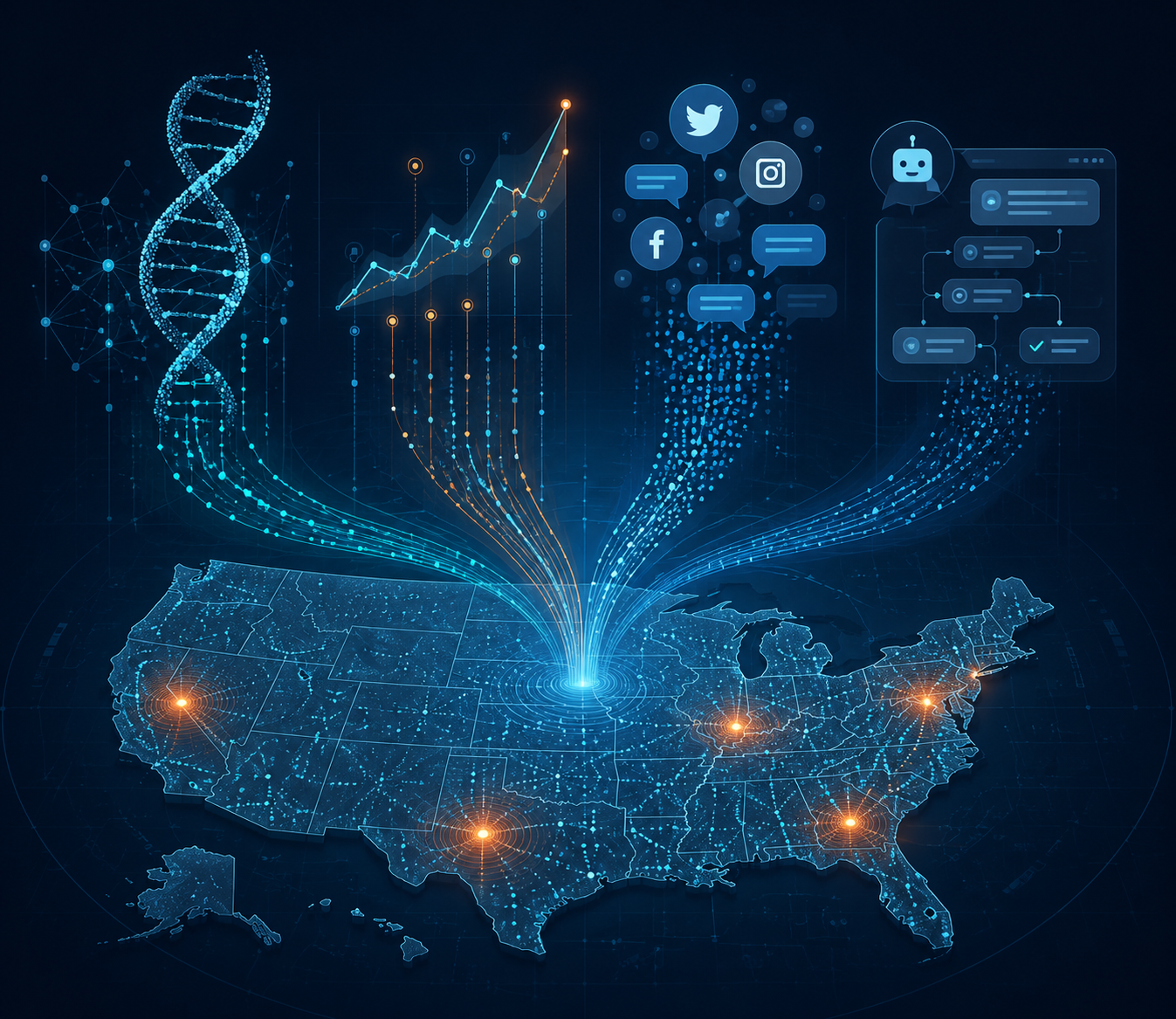
Four AI applications now matter most for foodborne outbreak detection: genomic machine learning around whole-genome sequencing, predictive models trained on surveillance records, natural language processing of social media posts, and large language model support for field investigation. They are converging on the same public health problem, but they are not at the same level of evidence maturity.
| AI approach | Primary data source | Where it touches the workflow | Evidence maturity in 2026 |
|---|---|---|---|
| Genomic ML and whole-genome sequencing | Pathogen genomes from clinical, food, and environmental isolates | Cluster detection, case linking, source tracing | Most operationally established, especially through PulseNet |
| Predictive surveillance modeling | Structured case and surveillance records | Flagging suspected outbreaks for review | Promising model performance, but workflow-specific validation matters |
| Social media NLP | Geolocated public posts mentioning illness or food exposure | Early signal generation and syndromic monitoring | Useful as an exploratory signal source, limited by representativeness |
| LLM-assisted investigation | Case notes, interview details, investigator prompts, contextual documents | Hypothesis generation and investigative support | Emerging operational use, not validated as stand-alone outbreak detection |
Genomic AI is strongest when it is attached to maintained surveillance infrastructure
The most mature AI-adjacent foodborne outbreak work is not the flashiest. It is the routine comparison of pathogen genomes through surveillance infrastructure that already moves specimens, laboratory data, and public health interpretation into the same workflow.
CDC describes PulseNet’s next-generation whole-genome sequencing technology as preventing about 270,000 illnesses annually and saving more than $500 million.[3] Those figures are not a benchmark score in a controlled experiment; they describe expected public health impact from a surveillance system built to connect laboratory methods with outbreak response.
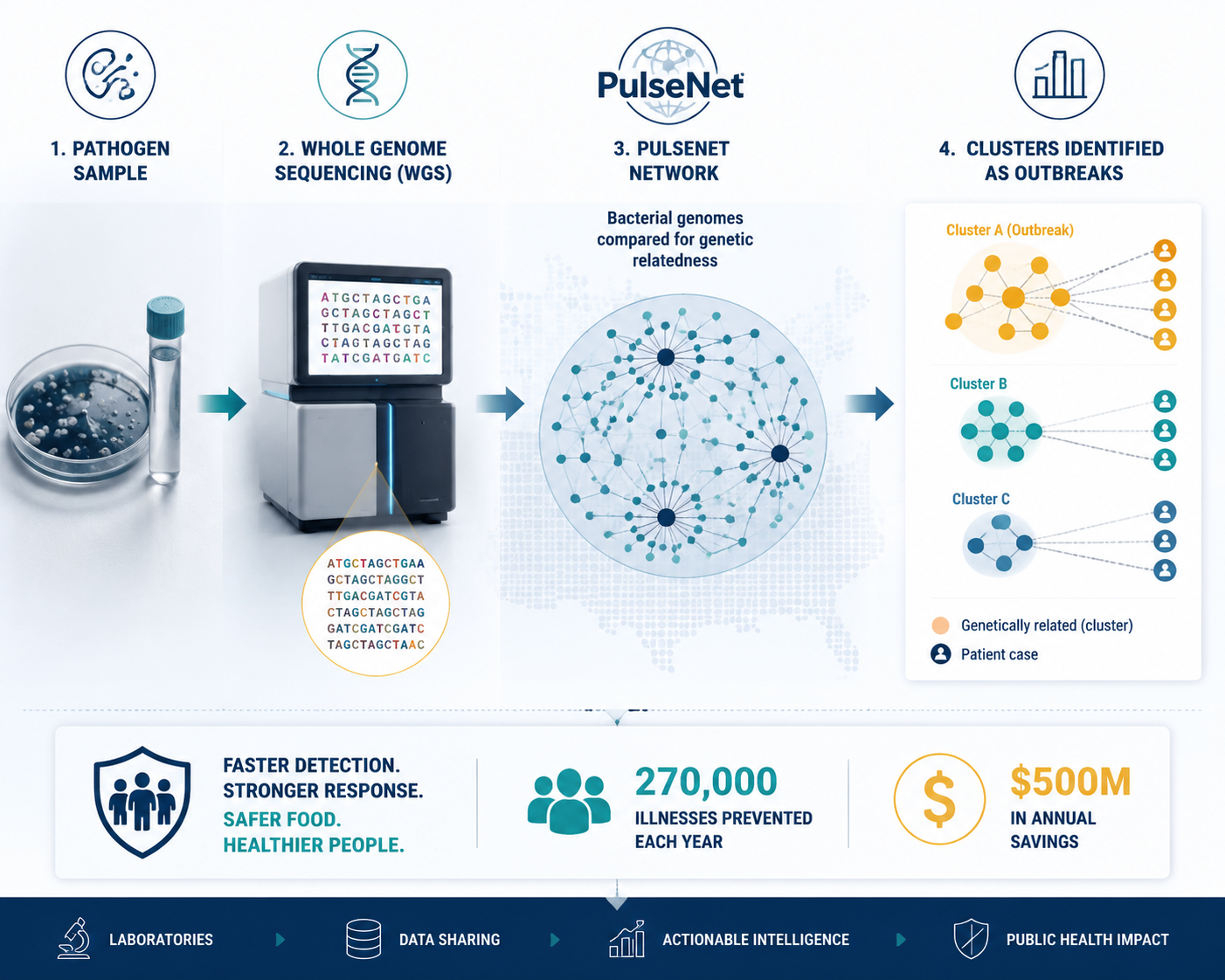
Whole-genome sequencing changes the detection problem. Traditional outbreak detection often begins with a looser association: people in different places report similar illness, eat similar foods, or have isolates that look related by lower-resolution typing. Genomic comparison allows public health teams to ask a sharper question: are the bacterial isolates genetically close enough to suggest a common source or transmission pathway?
That higher resolution matters because foodborne outbreaks rarely announce themselves cleanly. Cases may be scattered across counties or states. A contaminated product may move through distribution channels before interviews converge on a food exposure. Sequencing does not remove the need for epidemiologic interviews, traceback, or inspection, but it can narrow the field of cases that deserve to be investigated together.
Machine learning enters this genomic environment in several ways: clustering genomes, classifying pathogen subtypes, supporting source attribution, and helping investigators interpret genetic relatedness alongside epidemiologic evidence. A 2019 review of machine learning approaches for epidemiological investigations of foodborne outbreaks described this direction as a way to strengthen analysis of whole-genome sequencing data, although its tool landscape and database context predate later advances in routine sequencing systems.[4]
The important distinction is that genomic analysis is not merely a model running on a convenient dataset. It is embedded in a specimen-to-sequence-to-cluster pathway. A clinical isolate is sequenced. Its genome is compared with others. A cluster can trigger review across jurisdictions. Epidemiologists then ask whether the clustered cases share exposures, whether food or environmental isolates match, and whether regulatory or inspection action is warranted.
That operational chain is why PulseNet-style genomic surveillance deserves more confidence than many prototype dashboards. The workflow is imperfect, and it still depends on sampling, reporting, sequencing capacity, and jurisdictional coordination. But the model output has a defined place to land: it can change which cases are linked, which interviews are prioritized, and which product or facility becomes plausible enough to pursue.
Predictive surveillance models can flag outbreaks, but the comparator matters
Structured surveillance data are the natural next target for AI. If a system already receives case reports, exposures, symptoms, laboratory results, and administrative fields, a model can be trained to flag which records or clusters look like a suspected outbreak. In practice, that makes the model a triage tool: it moves some signals closer to human review and leaves others lower in the queue.
One of the stronger examples comes from Zhang and colleagues, who evaluated machine learning methods for identifying suspected foodborne disease outbreaks and confounding factors using China’s CFSA surveillance system. Their XGBoost model achieved a recall of 0.9699 and an F1-score of 0.9582 for identifying suspected foodborne disease outbreaks from surveillance data.[5]
Those are serious performance figures. High recall is particularly relevant in outbreak triage because missed clusters can cost time. A model that catches most suspected outbreaks may help analysts focus attention earlier, especially when routine review volumes are high.
But the result should be read inside its data environment. The study used China’s CFSA system, not a U.S. local, state, or federal reporting workflow.[5] Surveillance data structures are not interchangeable. Case definitions, reporting completeness, field coding, laboratory linkages, jurisdictional handoffs, and historical labeling practices can all affect whether a model trained in one system performs usefully in another.
The operational question is also more demanding than classification. After a model assigns high suspicion, someone still has to review the cases, judge whether the signal is coherent, request or interpret laboratory data, initiate interviews, coordinate across jurisdictions if needed, and decide whether public communication or inspection is justified. A model can shorten the list. It does not own the consequence of acting on the list.
For health departments considering this type of predictive surveillance, the most relevant validation is not only an internal train-test split or retrospective score. The model needs to be tested against the decisions analysts actually make: which alerts they opened, which clusters they escalated, which apparent signals were known duplicates or artifacts, and how much staff time the model saved or displaced.
Social media NLP widens the signal field, with a representativeness cost
Social media surveillance tries to detect illness before formal reporting has accumulated. That appeal is obvious: people may post about vomiting after a restaurant meal before they seek care, submit a complaint, or appear in a laboratory-confirmed dataset. Natural language processing can sort those posts at a scale no human analyst could manually read.
A recent system built around Twitter data illustrates both the promise and the limits. The researchers collected 430,000 geolocated tweets from 2017 through 2022, then used a RoBERTa model to classify 110,000 tweets as foodborne illness-positive. They then used logistic regression to predict outbreak periods against CDC National Outbreak Reporting System data, achieving 0.80 accuracy.[6]
The pipeline is worth spelling out because it is often compressed into “AI finds outbreaks from Twitter.” First, the system depends on posts that are public and geolocated. Second, an NLP model distinguishes illness-relevant posts from noise. Third, aggregated classified posts become a signal. Fourth, that signal is compared with outbreak periods in a formal reporting system.[6] Each step can introduce its own bias or failure mode.
Geolocated tweets are not a neutral sample of people with foodborne illness. They represent people who use the platform, post publicly, allow or provide location information, describe symptoms in recognizable language, and do so within a time window useful to surveillance. Changes in platform behavior, API access, slang, local food terminology, and media attention can all alter the signal without any real change in disease occurrence.
The 0.80 accuracy figure is therefore best understood as evidence that social media NLP can generate a useful surveillance signal under defined conditions, not as proof that it can replace complaint systems, laboratory reporting, or outbreak interviews.[6] Its most plausible near-term role is supplemental: pointing analysts toward possible clusters, unusual temporal patterns, or locations where other surveillance feeds should be checked.
Predictive models and social media NLP fail differently
The difference between predictive surveillance modeling and social media NLP is not simply that one uses structured data and the other uses text. They fail in different places.
- A structured surveillance model may inherit delays and blind spots from the reporting system, but its variables usually map more directly to public health case review.
- A social media NLP system may see complaints earlier, but it must translate noisy public language into a signal that is geographically, temporally, and epidemiologically meaningful.
- A high-performing structured model may still struggle when moved into another jurisdiction’s reporting workflow.
- A high-performing social media model may still struggle when platform use, population behavior, or data access changes.
That comparison matters for deployment. A local health department does not need an abstract promise of early warning; it needs to know whether the signal will arrive in a form someone can review, whether it duplicates existing complaint intake, and whether it creates more false leads than the staff can absorb.
LLMs are entering investigations as assistants, not validated detectors
Large language models sit later in the evidence chain. They are attractive because outbreak investigations are full of language-heavy work: interview notes, exposure histories, menus, timelines, environmental descriptions, and hypotheses that need to be generated and checked. But that does not make an LLM an outbreak detector.
CDC has documented 54 instances in which AI or machine learning supports operational public health work.[7] That count signals institutional movement, not uniform validation across all use cases. Operational AI can mean many things, from automation and analytics to decision support, and each use has to be judged by the data source, task, oversight, and consequences.
The Brown County, Illinois, Salmonella investigation is a more concrete example. In 2024, the local health department used ChatGPT during a county fair outbreak investigation to help hypothesize contaminated ice as a possible transmission pathway, and the use was disclosed in CDC’s Morbidity and Mortality Weekly Report.[7] The important word is “help.” The tool assisted hypothesis generation; it did not independently detect the outbreak or replace epidemiologic verification.
That is the right scale for LLM expectations in 2026. A model may help an investigator organize interview clues, think through exposure pathways, draft follow-up questions, or surface possibilities that deserve checking. The public health work remains in confirming facts, protecting privacy, avoiding unsupported leaps, and deciding whether a hypothesis is strong enough to drive action.
Adjacent regulatory momentum is real. FDA has been expanding the use of advanced AI for safety reviews and inspections, which reflects broader institutional interest in applying AI to food safety workflows.[8] But inspection support and safety review tools should not be treated as evidence that automated foodborne outbreak surveillance has been solved. They are part of the same ecosystem, not the same task.
What “detection” now means
The useful way to read AI in foodborne illness outbreak detection is to break detection into its working parts. One tool may connect genetically related isolates. Another may rank surveillance records for review. Another may scan public posts for weak early signals. Another may help an investigator reason through a confusing exposure history.
The evidence is strongest where the AI-enabled method is tied to structured, maintained surveillance infrastructure. That is why genomic analysis in the PulseNet and whole-genome sequencing context has the clearest operational claim. Predictive surveillance models and social media NLP are promising signal generators, but they still need jurisdiction-specific validation, attention to changing data feeds, and integration into review workflows. LLMs are best understood as investigative aids: useful in bounded tasks, risky if mistaken for autonomous detection.
No single AI method replaces traditional surveillance. Together, these tools are changing where public health teams look first, how quickly they can connect cases, and which signals deserve scarce investigative attention.
References
- Artificial intelligence in foodborne disease prevention, Exploration of Digital Health Technologies.
- CDC cuts back foodborne illness surveillance program, CIDRAP, University of Minnesota.
- PulseNet Next Generation Technology, CDC.
- Machine Learning Approaches for the Epidemiological Investigation of Foodborne Disease Outbreaks, Frontiers in Microbiology, 2019.
- High-Efficiency Machine Learning Method for Identifying Foodborne Disease Outbreaks and Confounding Factors, PMC, 2021.
- A Novel Foodborne Illness Detection and Web Application Tool Based on Social Media, PMC.
- Q&A: CDC makes major cuts to foodborne illness surveillance, Healio, 2025.
- FDA Expands Use of Advanced AI for Safety Reviews and Inspections, Civil Eats, Dec. 4, 2025.
Comments
Join the discussion with an anonymous comment.