
For children and adolescents, the question is not whether an AI meal plan sounds organized. It is whether the plan actually covers energy, keeps macronutrients in range, and holds up when a clinician checks the details. The current pediatric evidence says that unsupervised consumer use is not there yet.
Consumer chatbots miss the simplest clinical tests
The clearest head-to-head evidence comes from Bilen et al. In their 2026 Frontiers in Nutrition study, five consumer chatbots — ChatGPT-4o, Gemini 2.5 Pro, Claude 4.1, Bing Chat-5GPT, and Perplexity — each generated 12 meal plans for simulated adolescents, 60 plans in total. Across models, energy intake was underestimated by about 695 kcal per day compared with dietitian plans, a difference the authors reported as statistically significant (p < 0.001) and large in magnitude (Cohen's d = 1.79) [1].
The pattern did not stop at calories. Carbohydrate shares landed below the usual AMDR range at 32.4% to 36.3% versus 45% to 50%, while protein and fat were pushed too high. No model stayed consistently close to a dietitian across all 22 micronutrients assessed, and vitamin D, folate, calcium, and iron varied unpredictably from one system to another [1].
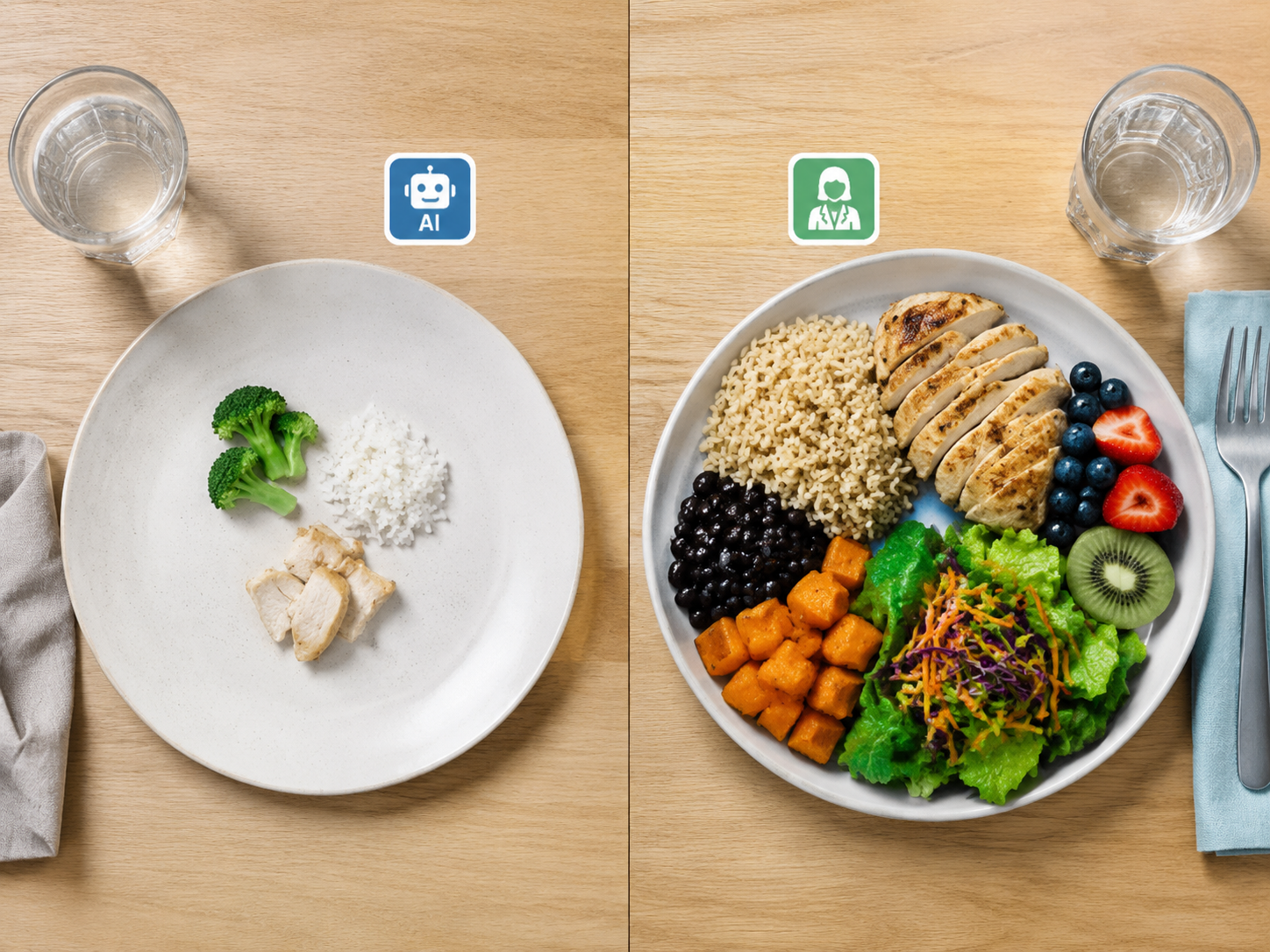
That matters because the failure mode is not a small rounding error. A plan can look clean on screen and still leave a child short on total energy, skewed toward protein or fat, and uneven on micronutrients that are easy to miss if the output is judged only by style.
A nutrient score can flatter a meal plan
The most useful counterpoint is not a study that rescues AI, but one that shows how much the readout matters. Lee et al.'s 2022 pediatric study focused on children ages 3 to 5 and compared reinforcement-learning and GAN-generated diets with human plans using Korean food data and Korean DRI standards. In the first survey, where expert evaluators saw only nutrient data, the RL diets were judged positively 86.7% of the time versus 43.7% for human diets. When the same evaluators saw meal names and could judge food variety, cooking methods, and color harmony, the result flipped: human diets were preferred 82.4% versus 43.7% for RL plans [2].
That split is important for pediatric nutrition work. Nutrient totals alone can make a generated plan look stronger than it will feel in real use, especially once a family has to serve it day after day. The Lee study is also a reminder not to overgeneralize from a Korean dataset to U.S. children, but the larger point still holds: a favorable nutrient table is not the same thing as a practical, child-acceptable meal pattern [2].

AI can help when the target is narrow and supervised
A more favorable result comes from a very different setting. Stanford's TPN 2.0 transformer model was trained on 79,790 total parenteral nutrition prescriptions from 5,913 NICU patients, then identified 15 standardized parenteral nutrition formulas. In blinded testing, physicians consistently preferred the AI-recommended regimens over the actual prescriptions, and the report said that when prescriptions diverged from the model's recommendations, mortality, sepsis, and bowel disease risk were significantly higher in that NICU population [3].
But this is not evidence that consumer meal-planning AI is ready for healthy children at home. Parenteral nutrition in premature infants is a tightly bounded clinical problem, the output is standardized, and expert oversight remains built into the workflow. That makes it a useful counterexample, not a license to treat everyday family meal plans as equally reliable [3].
What the evidence supports
Taken together, the pediatric evidence supports a narrow conclusion: current AI systems are not reliable for unsupervised pediatric meal planning because they systematically miss energy targets and distort macronutrient balance, with micronutrient performance that changes from model to model. The strongest use case is not autonomous planning but assisted planning under expert review, where a clinician or dietitian can check whether the output actually fits age-appropriate needs, AMDR alignment, and micronutrient completeness before it reaches a family.
References
- Artificial intelligence diet plans underestimate nutrient intake compared to dietitians in adolescents — Frontiers in Nutrition, 2026
- Challenges of diet planning for children using artificial intelligence — PMC, 2022
- Stanford TPN 2.0 — Stanford Medicine News, March 2025
Comments
Join the discussion with an anonymous comment.