
The cleanest way to answer how risky shark encounters are for divers is to start with the year people are likely to hear about in headlines. In 2025, the International Shark Attack File recorded 65 unprovoked shark bites worldwide and 9 fatalities. That was above the five-year average of 61 bites, below the ten-year average of 72 bites, and higher in fatalities than 2024, when 4 deaths were recorded.[1][2]
Those numbers deserve attention. A fatality count going from 4 to 9 is not something to wave away. But it also is not the same as saying the ocean became broadly more dangerous for every person entering it, and it is especially not the same as saying scuba divers face the same risk as swimmers, surfers, or people splashing at the surface.
The useful question is narrower: who was being bitten, and what were they doing when it happened?
The Activity Breakdown Changes The Picture
In the 2025 activity breakdown, swimmers and waders accounted for 46% of incidents, surfers for 32%, and snorkelers or free-divers for 15%.[1] That leaves a small remaining share for every other category, including scuba divers. ISAF’s public summary does not publish a precise scuba-only percentage within that residual group, so a careful answer should not pretend that it does.
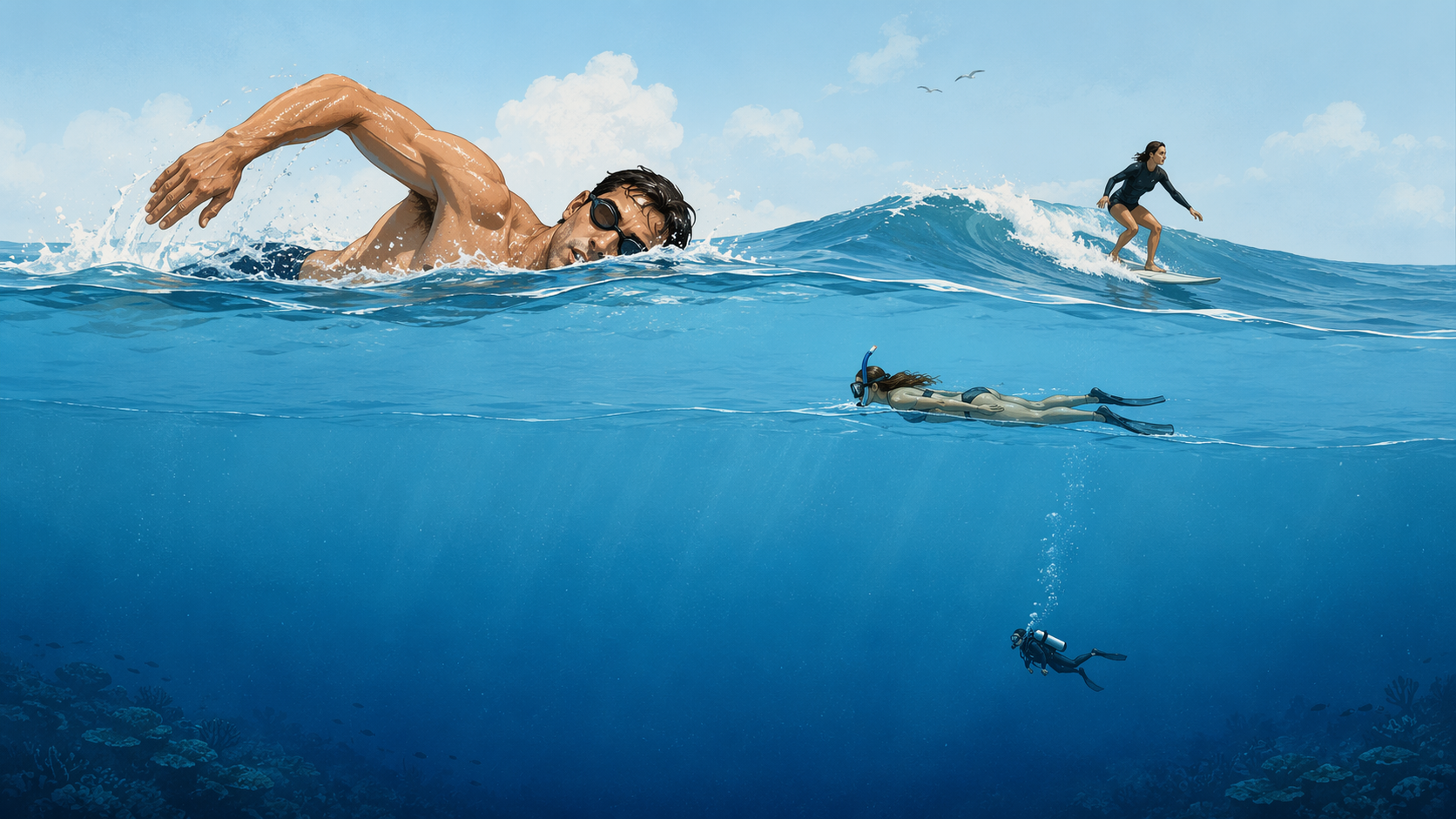
That distinction matters in a pre-dive briefing. “Shark attacks increased” sounds like one shared category of risk. The data describes several different ocean-use patterns. A swimmer or wader is at the surface, often in shallower water and without a large visual or acoustic profile. A surfer may look, from below, more like a surface animal. A snorkeler or free-diver moves between the surface and short breath-hold descents. A scuba diver is lower in the water column, louder, bulkier, slower, and usually with other divers.
Secondary dive-industry and shark-advocacy sources commonly describe scuba divers as a tiny fraction of shark incidents, with estimates around 3%.[3] That figure is useful as a scale marker, not as an ISAF-published statistic. The more defensible statement is simpler: scuba divers are not among the dominant activity groups in the 2025 ISAF breakdown, and the categories that do dominate are mostly surface or near-surface activities.
What “Low Risk” Means Numerically
One widely cited probability estimate places the chance of being bitten by a shark at about 1 in 11.5 million.[2] That is a population-level comparison, not a customized prediction for a specific diver on a specific reef at a specific hour. Still, it gives a useful order of magnitude: shark bite is an extremely rare event.
The comparison that usually lands hardest with divers is drowning. In the United States alone, drowning causes more than 4,000 deaths per year, and the same comparative framing places drowning risk at roughly 3,000 times higher than shark bite risk.[2] For scuba divers, that should shift attention toward the parts of diving that actually claim people: buoyancy problems, panic, separation, overexertion, poor gas management, medical events, surf exits, boats, current, and inadequate supervision.
This is not a comfort trick. It is risk triage. If a student is so focused on sharks that they miss the current briefing, skip a weight check, or understate anxiety before descent, the shark fear has made the dive less safe in a very ordinary way.
| Risk Statement | What The Evidence Supports |
|---|---|
| “Shark bites rose in 2025.” | Yes, compared with the five-year average; the total remained below the ten-year average. |
| “Fatalities increased.” | Yes. ISAF-linked reporting recorded 9 fatalities in 2025, up from 4 in 2024. |
| “Divers are a major victim group.” | No. The dominant 2025 activity categories were swimmers/waders, surfers, and snorkelers/free-divers. |
| “Scuba-diver risk is zero.” | No. The better conclusion is extremely low, with uncertainty around the exact scuba-only denominator. |
| “Drowning is a larger practical concern.” | Yes. Comparative risk framing places drowning far above shark bite risk. |
Why Scuba Divers Do Not Fit The Usual Bite Pattern
The activity numbers make more sense once the animal-behavior piece is brought in. Scuba divers do not move through the water like typical prey. They release bubbles. They make mechanical sounds. They travel slowly. They often hold position instead of fleeing. Their tanks, fins, hoses, masks, and lights create a silhouette most sharks do not read as a normal food item.
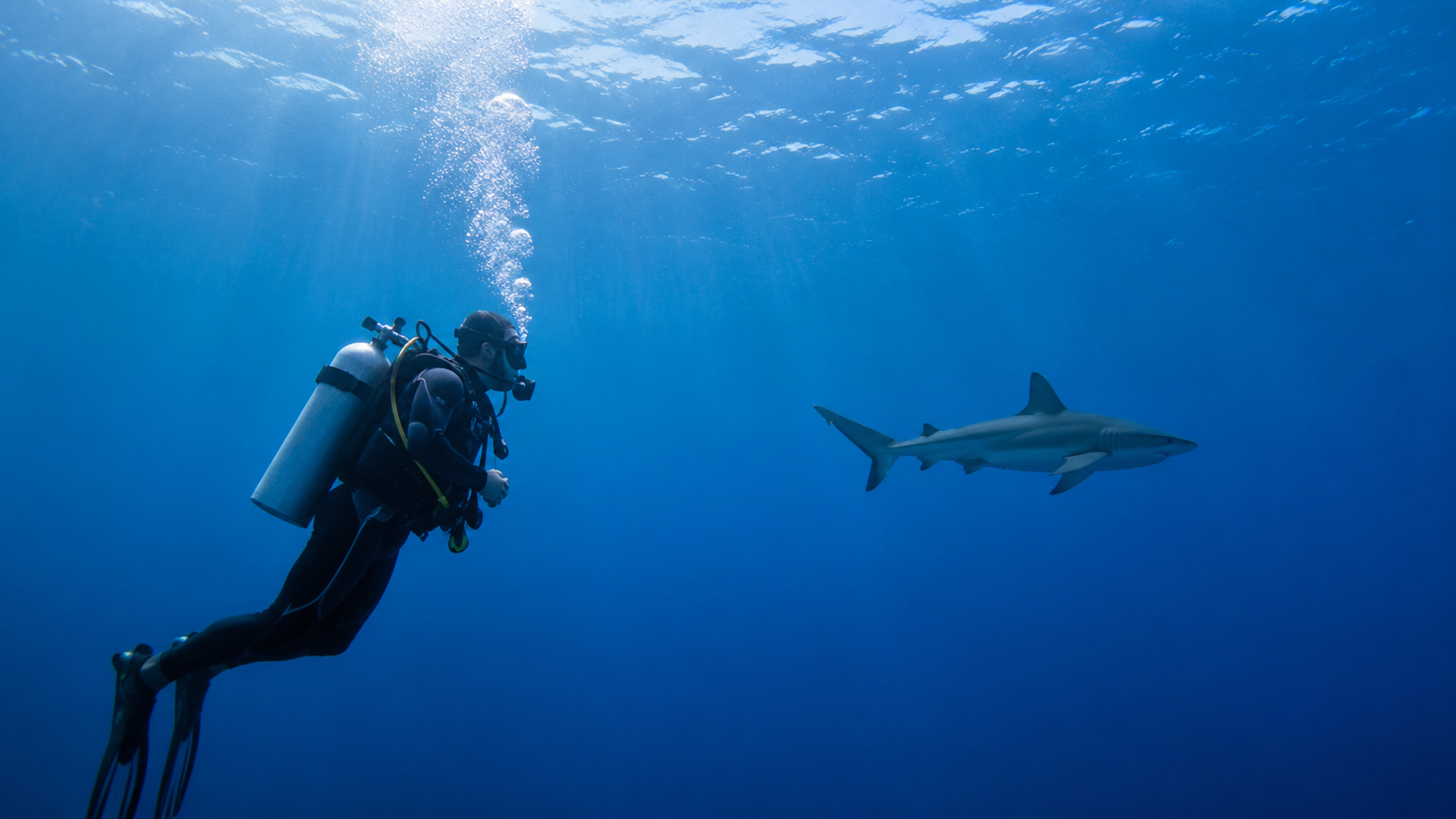
Dive operators often explain this as sharks not recognizing divers as prey, and that explanation is broadly consistent with ISAF guidance that treats diver behavior, group awareness, and shark body language as central to reducing risk.[3][4] The important point is not that sharks are harmless. It is that a scuba diver presents a very different set of cues than a seal, fish, turtle, splashing swimmer, or board rider.
Group shape matters too. A single isolated person at the surface is a very different visual problem for a shark than several divers descending together, bubbling continuously, watching the animal, and staying close enough to look like an awkward, noisy unit. Divers Alert Network’s shark encounter guidance emphasizes staying with the group, avoiding erratic behavior, and leaving the water calmly when conditions change.[5] That is practical guidance, but it also reveals the underlying logic: reduce the cues that make an encounter confusing, isolating, or predatory.
Most underwater shark encounters are observational or exploratory rather than attacks. A shark may pass, circle, investigate, or redirect. For a nervous diver, that can still feel enormous. Fear does not wait for a probability chart. But from a safety perspective, a calm, close group with neutral buoyancy is already doing several things that make a bite less likely.
Geography Explains Why The Headlines Feel Plausible
The global total is small, but it is not evenly distributed. In 2025, the United States accounted for 38% of global unprovoked bites. Australia recorded 21 bites, or 32% of the global total, and 5 of the 9 fatalities; those Australian fatalities were attributed to white sharks.[2][6]
That geography matters because many divers do not imagine “global shark risk.” They imagine a particular coastline, often one with white sharks, surf exposure, seals, seasonal changes, or a known history of incidents. A diver in a tropical reef channel and a surfer at a white-shark beach are both “people in the ocean” only at the loosest possible level. Risk assessment gets worse when those situations are collapsed into one mental picture.
Species matter as well. White, tiger, and bull sharks account for the vast majority of serious incidents in shark attack records.[4] Those species deserve respect, and local briefings should treat them as specific animals in specific conditions rather than as generic “sharks.” A reef shark passing a dive group on a wall and a large white shark in a high-energy coastal hunting area are not the same risk conversation.
One Useful Order-Of-Magnitude Check
A Western Australia risk assessment published in 2014 is useful because it did something most casual shark-risk conversations do not: it compared shark attack risk across specific recreational activities instead of treating water users as a single group. The paper found that offshore diving during winter and spring carried a risk comparable to recreational cycling, while summer beach bathing was at least 50 times safer than cycling.[7]
That study should not be used as an exact 2026 global scuba-diving risk calculator. It was location-specific, used data through 2013, and Western Australia is not a stand-in for every dive destination. Its value is methodological. It shows how much the answer changes when season, location, and activity are separated. The same word, “shark,” can cover a risk level that shifts by orders of magnitude depending on where a person is, what they are doing, and when they are doing it.
That is also why clean denominators are hard. Global shark files count incidents. They do not perfectly count every diver-hour, every surface swim, every shore entry, every baited dive, every spearfishing dive, or every low-visibility ascent. Without exposure data, a precise “per dive” global scuba-diver probability would be false precision.
What A Dive Briefing Should Keep
A good briefing does not need to tell divers that sharks are safe. It needs to tell them what the risk record actually shows and what behavior keeps the situation orderly.
- The 2025 global count was 65 unprovoked bites and 9 fatalities, not evidence of a runaway worldwide surge.[1][2]
- The dominant activity categories were swimmers/waders, surfers, and snorkelers/free-divers, not scuba divers.[1]
- The commonly repeated roughly 3% scuba-diver share is a secondary-source estimate, not an ISAF-published scuba-only statistic.[3]
- Drowning and ordinary dive-management failures deserve more practical attention than shark bite in most dive planning.[2]
- If a shark appears, the sensible response is to stay close, stay controlled, avoid frantic movement, monitor the animal, and follow the dive leader’s exit plan.[4][5]
The emotional job is harder than the numerical job. A diver who has never seen a shark underwater may hear “1 in 11.5 million” and still feel the old movie version arrive in the chest. That does not make the fear silly. It means the instructor has to translate the number into the scene in front of the group: depth, visibility, species expected, current, entry and exit, group spacing, and whether anyone is too anxious to dive well.
The best-calibrated answer is sober. Shark encounters are real. Serious incidents happen. Certain regions, seasons, and species change the risk profile. But for scuba divers, the measurable risk is extremely low, and the strongest available data places divers far outside the main activity categories in recorded bites. The diver who wants to be safer should spend less time rehearsing a shark attack in the imagination and more time staying close, breathing slowly, listening to the briefing, and managing the dive that is actually about to happen.
References
- Yearly Worldwide Shark Attack Summary, International Shark Attack File, Florida Museum.
- New ISAF Report Shows Increase In Global Shark Attacks In 2025, Forbes, February 18, 2026.
- Why Sharks Rarely Attack Divers, Epic Diving.
- Advice to Divers, International Shark Attack File, Florida Museum.
- Bites & Attacks, Divers Alert Network.
- Unprovoked shark attacks increase, The Guardian, February 18, 2026.
- Shark attack risk assessments for recreational water activities in Western Australia, PLOS ONE, 2014.
Comments
Join the discussion with an anonymous comment.