
If a humanoid robot patient is always available, always consistent, and interesting enough that learners will actually sit down with it, the first question is not whether it feels futuristic. The question is what kind of medical education it can safely carry today. For simulation programs, that distinction matters. A repeatable patient encounter can solve real operational problems: actor scheduling, case drift across student groups, fatigue over repeated runs, and the uneven improvisation that sometimes enters even well-trained standardized patient programs.
The current evidence for humanoid robots in education supports a cautious yes for supplementary practice. It does not yet support replacement of live standardized patients. The strongest case is for controlled diagnostic interviewing and clinical reasoning exercises where consistency, repetition, and learner engagement are the primary goals. The weakest case is high-stakes psychiatric education that depends on fast, nuanced, high-arousal affect.
What a robot patient can already offer
The practical appeal is easy to understand from inside a simulation schedule. A humanoid robot can present the same case repeatedly, at short notice, without negotiating availability or asking an actor to sustain identical emotional and verbal choices across a long teaching day. That does not make it educationally effective by itself, but it does make it worth testing.
Schwarz et al. tested the Ameca humanoid robot as a simulated patient for diagnostic training in medical and psychiatric education. The study was small: 12 medical, psychology, and nursing students participated, and the authors used descriptive statistics rather than a design powered for broad generalization. Even with that boundary, one adoption signal is useful: 67% of participants said they would use a robot patient as a supplementary training tool alongside actor-based videos.[1]
That 67% should not be inflated into proof of educational effectiveness. It is a signal of learner openness, not a demonstration that students become better clinicians. Still, for simulation directors, openness matters. A tool that learners reject on sight rarely survives long enough to be studied properly. A tool that learners see as a supplement has a more plausible path into curriculum, especially when the intended use is practice rather than assessment.
Diagnostic interviewing is the easiest fit
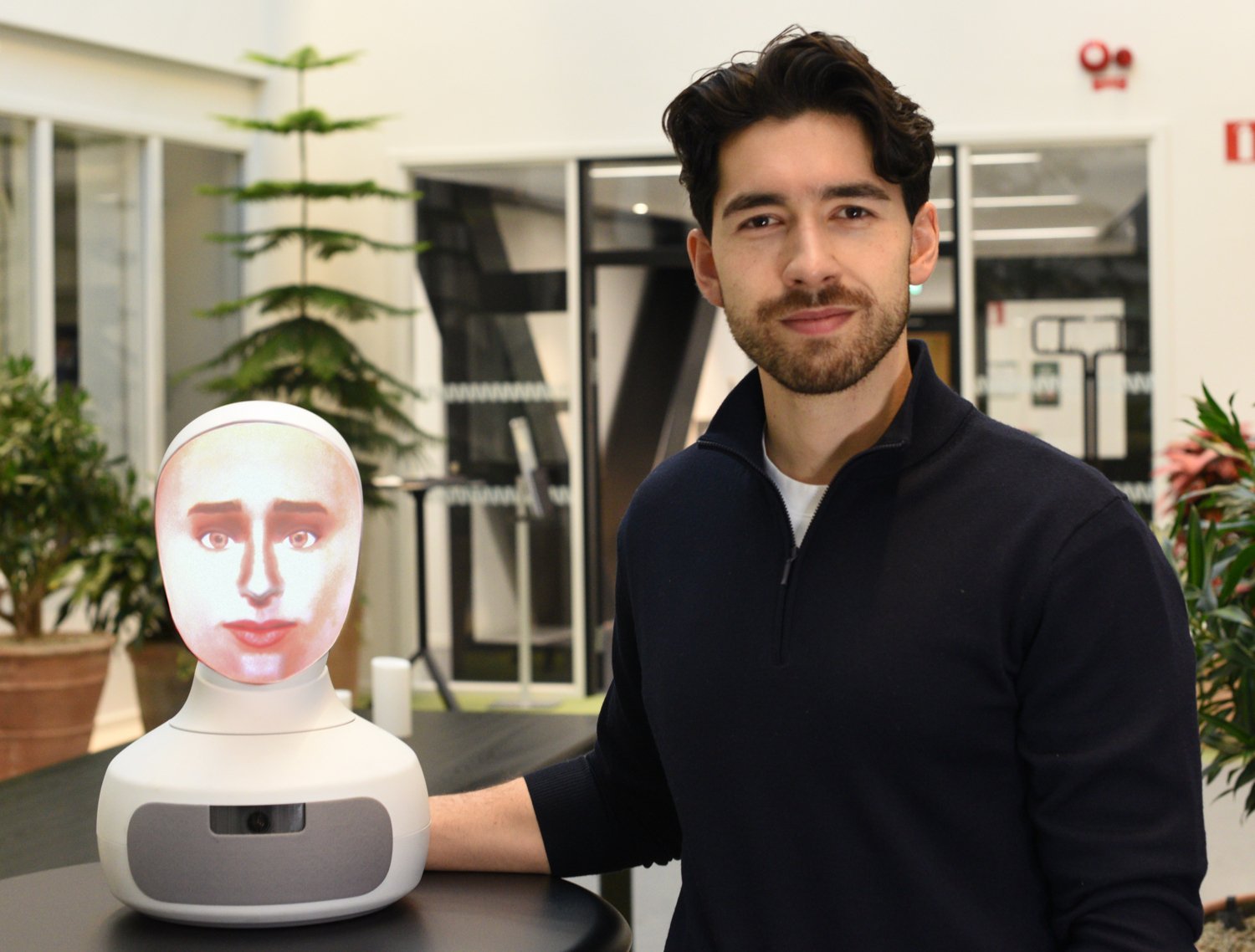
For early diagnostic interviewing, a robot patient has a defensible role. The learning task is bounded: introduce yourself, ask open and focused questions, follow a symptom timeline, notice inconsistencies, and practice differential diagnosis without making the patient into a moving target. A robot that delivers the same case to each student can make feedback more comparable. It also gives learners more repetitions before they enter a live standardized patient encounter.
This is where the word supplementary does real work. A robot patient can be useful before the learner meets an actor. It can also be useful after an encounter, when a student needs to repeat a missed section of history-taking without booking another session. The educational value is not that the robot is indistinguishable from a person. It is that the robot can hold a case stable while the learner practices a targeted skill.
That stability is also why robot patients should not be judged only against the most polished version of standardized patient teaching. In ordinary programs, faculty are often managing uneven room availability, different actors across days, and limited time for remediation. A system that can repeat a case on demand has a practical advantage before it has proven equivalence to human simulation.
Clinical reasoning evidence is promising, but still needs the full paper trail
The larger evidence signal comes from Borg’s 2026 PhD work at Karolinska Institutet, reported through a university release. The project deployed SARI, a social robot patient, with roughly 200 medical students. Students found the robot more authentic, engaging, and supportive of realism than text-based computer simulations, and the release reports that AI-generated feedback from the robot produced quantifiable improvements in clinical reasoning performance.[2]
That is a meaningful result for medical education, especially because clinical reasoning is not a decorative outcome. If a robot encounter can prompt students to collect information, organize it, commit to hypotheses, and receive feedback that improves subsequent reasoning performance, it belongs in the conversation. It also suggests that the most useful comparison may not always be robot versus actor. In many curricula, the real replacement target may be a text-only case, an underused virtual patient module, or an unobserved homework exercise.
The caution is equally important. The available summary is mediated through a university news release, not the full thesis text with methods, measures, and effect sizes in front of the reader. Until those details are verified, the responsible claim is narrower: SARI appears to have outperformed text-based simulation on authenticity and engagement in a large student deployment, with reported gains in clinical reasoning feedback. It should not be treated as proof that robot patients outperform live standardized patients.
| Educational use | What current evidence supports | What it does not yet show |
|---|---|---|
| Diagnostic interviewing | Robot patients can provide repeatable, supplementary practice with consistent case delivery. | No evidence here shows transfer to real patient encounters. |
| Clinical reasoning | SARI has been reported as more authentic and engaging than text-based simulation, with AI feedback linked to improved reasoning performance. | The full thesis details and exact effect sizes need verification before making precise claims. |
| Psychiatric affect-based encounters | Ameca can simulate several basic emotional expressions in a controlled setting. | High-arousal emotions such as anger and aggression remain a serious limitation. |
Psychiatric simulation raises the standard
A robot patient used for general history-taking can be somewhat stiff and still be educationally useful. Psychiatric education gives less room to hide. Learners are not only listening for content; they are reading timing, facial tension, voice-body coordination, shifts in arousal, and the difference between sadness, fear, irritability, anger, and threat. Those cues shape what students ask next and what they avoid.
This is where Schwarz et al. becomes more than a small learner-acceptance study. The authors used motion-tracking analysis to compare the robot’s emotional expressions with human actor expressions. Ameca could simulate basic emotional expressions, including sadness, happiness, fear, disgust, and surprise. But the robot’s facial expressions were slower and less varied than human actors’ expressions, with anger and aggression showing especially important limitations.[1]
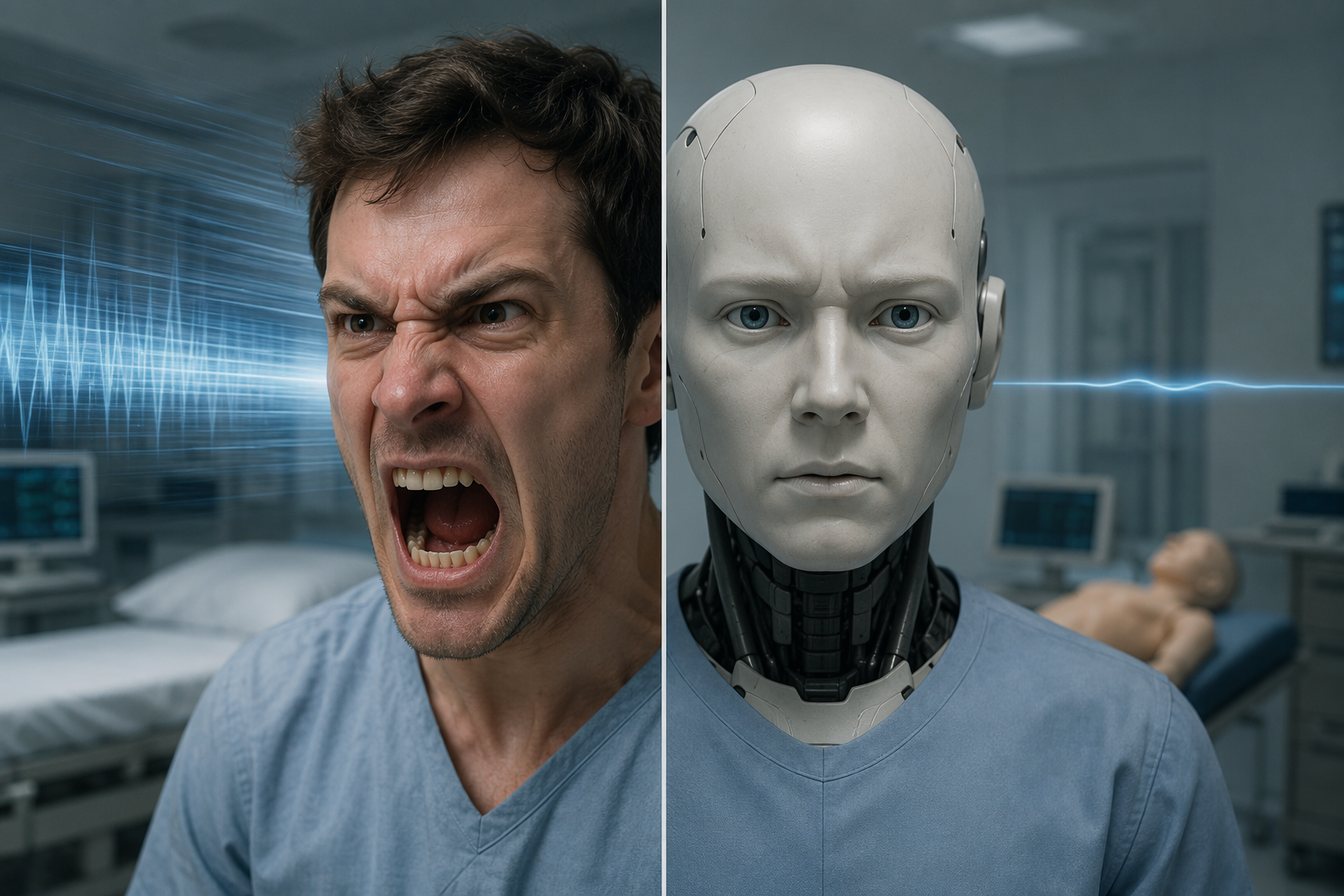
Anger and aggression are not fringe emotions in psychiatric interviewing. They are moments when learners need to manage safety, maintain rapport, avoid escalation, recognize risk, and tolerate their own discomfort. If the simulated affect is too slow, too flat, or too poorly differentiated, the student may practice the mechanics of a question without practicing the perception and timing that the clinical situation demands.
That does not make the robot useless for psychiatric education. It means the case design has to respect the robot’s expressive limits. A robot may be appropriate for practicing structured diagnostic questions, mental status examination wording, medication-history gathering, or low-arousal communication. It is much harder to justify as the main teaching tool for a volatile interview, a de-escalation scenario, or a high-stakes assessment of whether the learner can read and respond to affect.
Realism is not one variable
Simulation teams often talk about realism as if it can be raised or lowered like room lighting. Robot patients make that habit risky. A learner may rate the encounter as engaging because the robot is embodied, responsive, and novel compared with a text case. The same learner may still be receiving a thin version of emotional behavior. Engagement, authenticity, and expressive fidelity are related, but they are not interchangeable.
Some of the limitations are technical but educationally visible. Current constraints include lip-sync imprecision and the lack of automatic motion-transfer pipelines. In practice, that means expression and movement may need to be manually recorded and mapped onto the robot rather than fluidly transferred from human performance. A student does not need to know the engineering pipeline to notice when the face, voice, and body are not arriving together.
The educational question is not whether every cue is perfect. Standardized patients also vary, and no simulation reproduces clinical life completely. The question is whether the missing or distorted cues are central to the skill being taught. For a structured endocrine history, imperfect facial microtiming may be tolerable. For an interview where a patient’s anger shifts the whole room, it is not a minor defect.
The comparison that still matters
Neither of the current evidence anchors settles the question most simulation directors ultimately have to answer: do students who train with robot patients perform better with live standardized patients or real clinical patients? Schwarz et al. compared a robot patient with actor-based videos and gathered participant responses in a small sample. Borg’s SARI work, as currently available through the university release, compares robot-supported simulation favorably with text-based computer simulation. Those are useful comparisons, but they are not the same as live patient-facing transfer.[1][2]
Transfer is the hard endpoint. A robot can improve engagement with practice and still fail to change behavior in an OSCE room. It can improve performance on a reasoning exercise and still leave communication habits untouched. It can give every student equal exposure to the same case and still teach an incomplete response to affect. Those distinctions are not objections to using humanoid robots in education; they are the conditions for using them honestly.
A sensible curriculum would therefore place robot patients where their strengths match the task. Use them for repeated exposure, early diagnostic interviews, clinical reasoning drills, and feedback-rich practice that would otherwise happen through text cases or not happen at all. Keep live standardized patients for assessment, emotionally complex encounters, unpredictable interpersonal dynamics, and any scenario where the learner’s response to human affect is the skill under examination.
A bounded readiness judgment
Humanoid robots are ready for limited, supplementary medical education use when the goal is consistent practice rather than proof of clinical transfer. The evidence is strongest for learner receptiveness, engagement, reproducibility, and comparison with less embodied forms of simulation. It is not yet strong enough to claim that robot-patient training improves live standardized patient performance or real patient care.
For psychiatric education, the threshold is higher. The same robot that can support a diagnostic script may be inadequate for teaching students to recognize and respond to anger, aggression, and rapidly changing affect. That is not a reason to exclude humanoid robots from the curriculum. It is a reason to define the target skill before assigning the tool.
The responsible position in 2026 is neither dismissal nor replacement. Verify the full evidence, especially where results are reported through summaries. Name the skill being taught. Avoid claiming transfer until transfer has been measured. Treat current robot patients as controlled practice partners, not complete patient substitutes.
References
- Humanoid patient robot for diagnostic training in medical and psychiatric education, Frontiers in Robotics and AI, 2024.
- AI-driven robot patient can train medical students in clinical reasoning, Karolinska Institutet.
Comments
Join the discussion with an anonymous comment.