
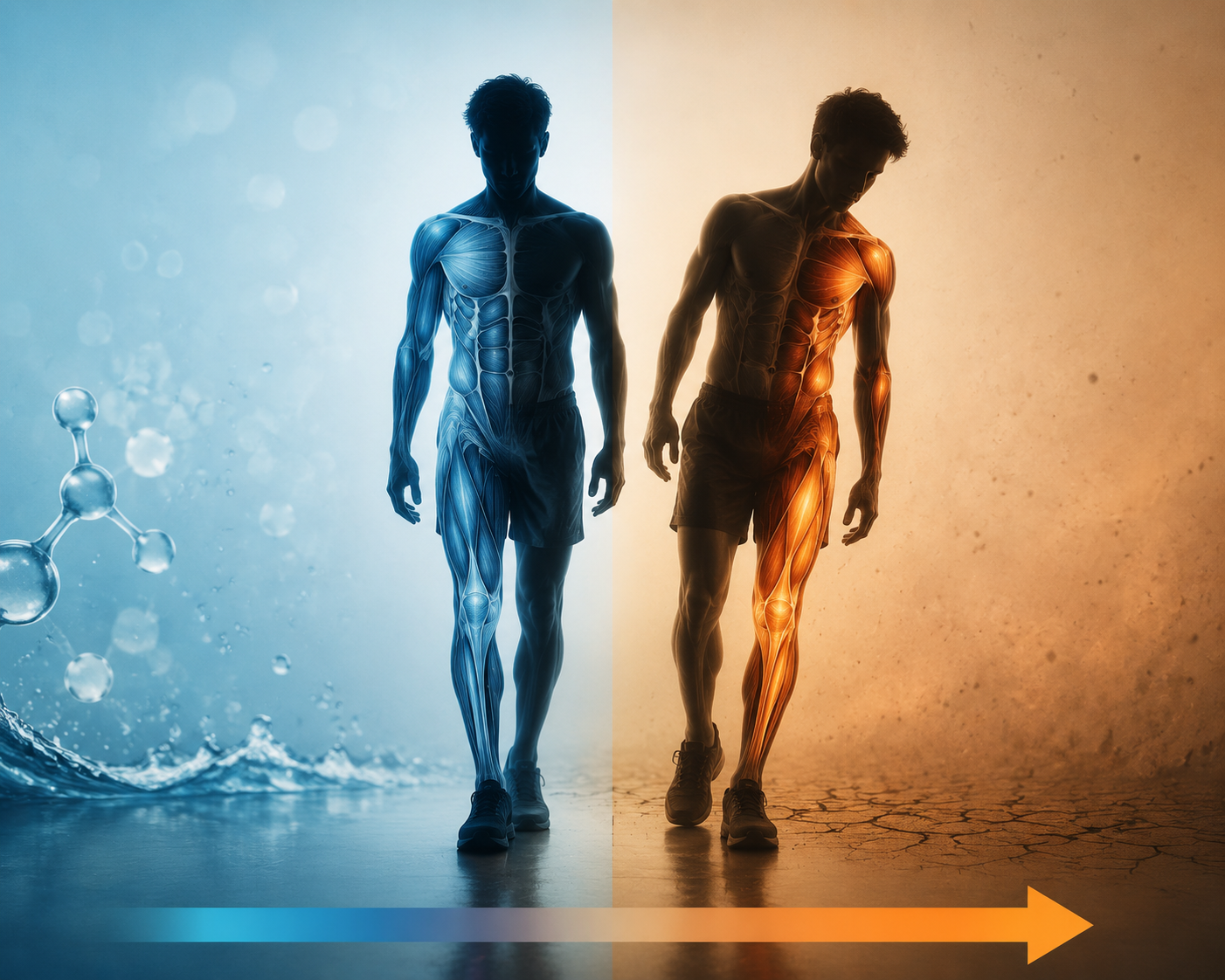
The most clinically useful claim about the impact of hydration on sports performance and athlete health is not that dehydrated athletes feel worse or tolerate heat less well. The sharper claim is that injury risk may rise in a dose-response pattern: Hammer et al. reported that each 1% of body mass lost was associated with an 11% higher hazard of soft tissue injury in Division I collegiate athletes, with the estimate reaching roughly 33% higher risk at 3% body mass loss (HR=1.11; 95% CI 1.03–1.19; p=0.005).[1] That figure is strong enough to change a pre-practice conversation, but it should not be treated as settled across all sports. The original BJSM paper and PMID assignment should be verified directly before publication because the available source trail flags a citation conflict around PMID 36150754.
That caveat matters. A single cohort does not become a universal rule because the hazard ratio is memorable. Still, the finding deserves attention because it shifts hydration from background advice into the same practical risk-screening space as prior injury, recent workload, sleep disruption, and neuromuscular control. An athletic trainer does not need a hydration dashboard to act on that kind of signal; she needs to know whether the signal is plausible, measurable, and low-risk to monitor.
What the cohort actually adds
The Hammer et al. study is the load-bearing evidence because it followed athletes prospectively rather than asking injured athletes to remember what they drank. The cohort is described as 67 Division I athletes observed across 7 seasons, with injury risk analyzed against degree of body mass loss before competition.[1] That design does not eliminate confounding, but it is closer to the decision environment clinicians care about: an athlete presents with a measurable change in mass, competes, and then injury events are tracked.
Body mass loss in this setting is a field proxy. It does not tell the clinician exactly how much intracellular or extracellular fluid was lost, and it does not separate fluid restriction from sweating, food restriction, glycogen changes, or other rapid weight-cutting behaviors. It does, however, describe something teams can measure without turning the athletic training room into a physiology lab: the athlete weighs less than expected over a short time window, and that loss is treated as a marker of dehydration risk.
The outcome also matters. The association was reported for soft tissue injury, not all medical events, not illness, and not a broad wellness score.[1] That specificity is why the result belongs in an injury-prevention discussion. Soft tissue injuries are the events that keep athletes out of training, alter load plans, and pull staff into the familiar sequence of imaging decisions, modified practice, rehabilitation, and return-to-play judgment.
Wrestling makes the interpretation both more compelling and more complicated. It is compelling because rapid weight cutting creates a wide enough spread in pre-competition body mass loss to detect a relationship. It is complicated because the same athlete who is dehydrated from weight cutting may also be under-fueled, sleep-deprived, fatigued, or exposed to behaviors that independently raise injury risk. Adjustment can reduce that problem, but it cannot make a weight-cutting cohort behave like a randomized hydration trial.
| Clinical question | What the current evidence supports | What it does not yet prove |
|---|---|---|
| Is hydration associated with soft tissue injury risk? | A prospective Division I cohort reported higher soft tissue injury hazard with greater body mass loss. | That dehydration independently causes injury across all sports and settings. |
| Is the relationship dose-responsive? | The reported estimate was HR=1.11 per 1% body mass lost, with about 33% higher risk at 3% loss. | That the same 11% increment applies to youth, recreational, professional, or non-weight-class athletes. |
| Can teams measure the exposure? | Short-term body mass change is feasible in field settings. | That body mass loss cleanly isolates fluid loss from nutrition, glycogen, and rapid weight-cutting practices. |
Why the hazard ratio is believable, not conclusive
A hydration-injury pathway does not require a dramatic collapse. Small degradations in force production, balance, reaction time, and tissue loading can be enough to change the way an athlete lands, cuts, absorbs contact, or recovers between high-intensity bouts. That is the useful middle ground: the mechanism literature does not prove that dehydration caused each injury in the cohort, but it makes the association biologically plausible.
The muscular performance evidence points in the same direction. Judelson et al. reviewed hydration and muscular performance and reported that hypohydration can impair strength, power, and high-intensity endurance, with strength declines described at roughly 2–5.5%.[2] Savoie et al. similarly found that hypohydration affects muscle endurance, strength, anaerobic power and capacity, and vertical jumping ability, with anaerobic power declines described at roughly 3–5.8%.[3] Those are performance measures, not injury endpoints. Their importance is that lower force output and poorer repeated-bout capacity can change how load is distributed when the athlete is still being asked to train or compete.
Balance data closes part of the gap between spreadsheet dehydration and visible movement control. Reported Balance Error Scoring System findings in collegiate wrestlers after weight cutting show measurable degradation in postural stability. That kind of change is easier to respect clinically because it looks like something staff already worry about: an athlete who is less reliable over the base of support, slower to correct, and more likely to accept force in a compromised position.
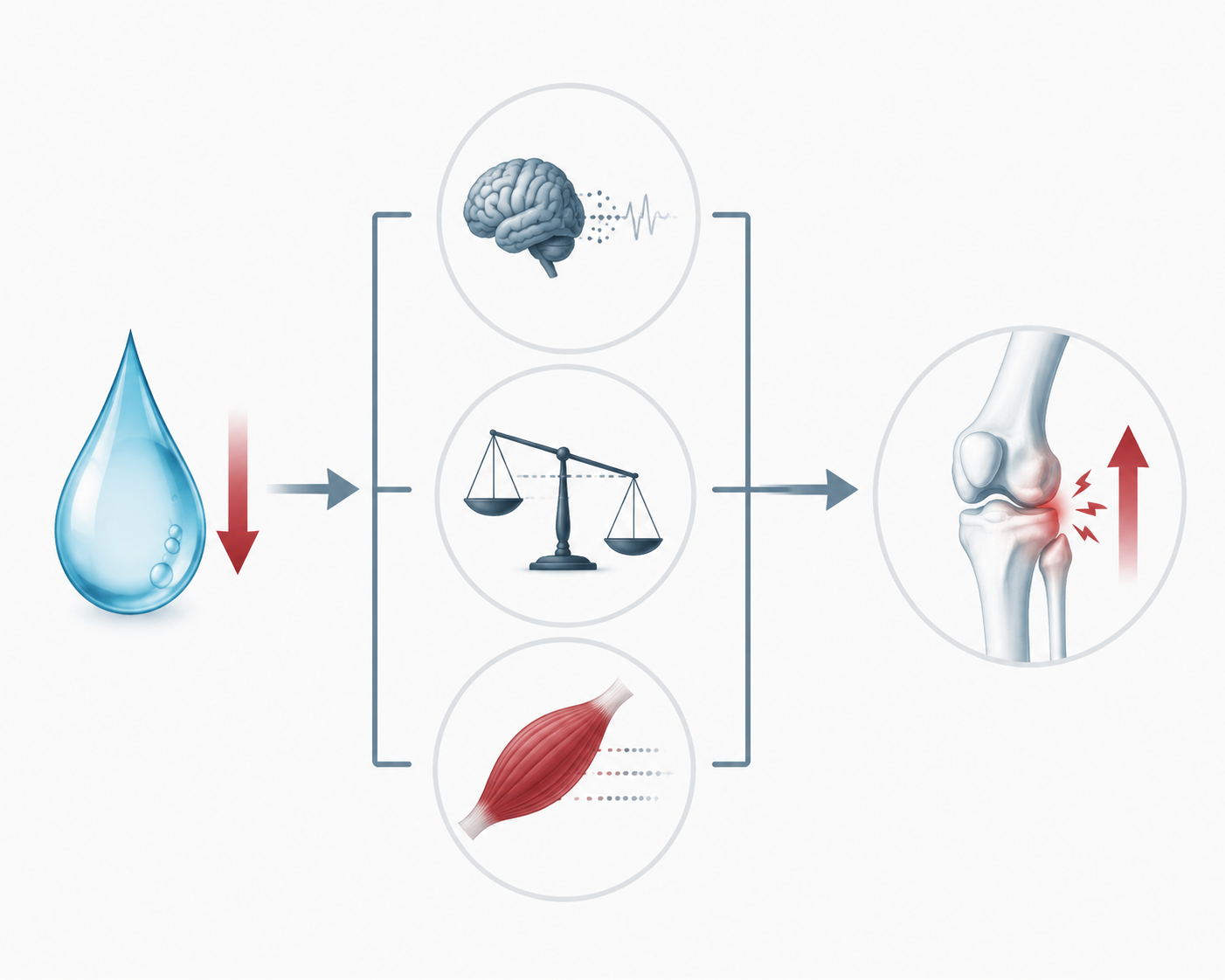
The brain and cardiovascular side of hydration should not be ignored, but it does not need to be inflated. GSSI’s Sports Science Exchange review summarizes emerging ideas about hydration effects on the athlete’s brain, heart, and muscles, including the possibility that fluid balance influences cognitive and neuromuscular function during exertion.[4] For injury prevention, the relevant question is not whether an athlete feels thirsty; it is whether perception, reaction, force timing, and postural correction become less dependable under training or competition load.
The plausible pathway is cumulative
No single mechanism needs to carry the entire argument. A mildly dehydrated athlete may generate slightly less force, make slightly slower corrections, and tolerate repeated high-intensity efforts slightly worse. In isolation, each decrement may look ordinary. In combination, during a late-practice deceleration, scramble, landing, or contact sequence, those small losses can push tissue loading into a less forgiving range.
- Reduced force production can limit how well the athlete absorbs load.
- Postural instability can increase error during landing, cutting, or contact.
- Anaerobic power loss can make repeated high-intensity efforts less mechanically consistent.
- Delayed reaction or poorer neuromuscular timing can narrow the margin for correction.
- Impaired recovery between bouts can leave the next repetition exposed to fatigue-related movement changes.
How to use the evidence without overusing it
The wrong response is to turn the 11% estimate into a universal cutoff. The better response is to add hydration status to the group of modifiable variables that already shape readiness decisions. If an athlete arrives down several percent from expected body mass, reports thirst, and shows dark urine or poor balance, that information should sit next to recent workload, soreness, sleep, prior injury, and planned session intensity.
The Weight-Urine-Thirst approach is useful because it is simple enough to survive a real team environment. The NATA position statement and IOC consensus materials cited in the research brief recommend WUT-style monitoring logic: weight change, urine appearance or concentration, and thirst are interpreted together rather than letting any single measure decide readiness.[5] That is the right level of ambition for most settings. It detects patterns, prompts follow-up, and avoids pretending that one morning number can diagnose the whole athlete.
| WUT element | What it can tell staff | Main limitation |
|---|---|---|
| Weight | Short-term body mass change can flag possible fluid loss. | It can be influenced by food intake, glycogen shifts, and intentional weight cutting. |
| Urine | Urine color or concentration can support concern when paired with other signs. | It can be affected by timing, supplements, and recent fluid intake. |
| Thirst | Athlete-reported thirst adds subjective context. | Athletes may underreport, normalize symptoms, or misjudge their own status. |
Wearable sweat sensors, urine color apps, and athlete-monitoring platforms can help collect pieces of that picture, but they should not become the story. Technology is only useful if it shortens the distance between a risk signal and a better decision. Teams already exploring broader monitoring systems may find the same practical tension described in ClinicalMind’s discussion of AI tools for athlete health during wildfire smoke: more data is not automatically better unless someone knows what action the data should change.
Where hydration fits in the injury-risk conversation
Hydration monitoring is most defensible when it changes the intensity of attention, not when it becomes a standalone prescription. A meaningful drop in body mass might lead staff to ask more pointed questions, repeat a balance screen, adjust the warm-up, watch early movement quality, or reconsider a planned high-risk conditioning block. It may also lead to a dietitian or physician conversation when the pattern suggests rapid weight-cutting behavior rather than ordinary training-related fluid loss.
That distinction is especially important in weight-class sports. If dehydration is part of a broader rapid weight-loss strategy, simply telling the athlete to drink more after weigh-in misses the risk environment. The clinician has to look at fueling, recovery, sleep, repeated cuts, and the culture around making weight. The hazard ratio may be attached to body mass loss, but the athlete arrives with a whole set of behaviors around that number.
For non-weight-class sports, the same estimate should be applied more cautiously. A soccer player after a hot double session, a sprinter after travel, and a wrestler after deliberate weight cutting may all show body mass loss, but the surrounding causes and risks are not identical. The current evidence supports asking better questions; it does not support copying one sport’s risk estimate into every roster.
The practical endpoint is integration. Hydration belongs beside neuromuscular training, workload management, sleep, recovery, and prior injury history as a modifiable risk factor. Larger and more diverse cohorts are still needed before the 11% per 1% body mass loss estimate is treated as universal across sports, ages, sexes, and competition levels. Until then, the number is best used as a credible warning signal: dehydration may not just reduce performance; it may narrow the athlete’s mechanical safety margin.
References
- Association of in-competition injury risk and the degree of rapid weight cutting prior to competition in Division I collegiate wrestlers. BJSM. 2023.
- Hydration and muscular performance: Does fluid balance affect strength, power and high-intensity endurance?. Sports Medicine. 2007.
- Effect of hypohydration on muscle endurance, strength, anaerobic power and capacity and vertical jumping ability: a meta-analysis. Sports Medicine. 2015.
- New Ideas About Hydration And Its Impact On The Athlete's Brain, Heart And Muscles. GSSI Sports Science Exchange #196.
- NATA position statement and 2022 IOC consensus (Racinais et al., BJSM 2023) recommending WUT (Weight-Urine-Thirst) approach.
Comments
Join the discussion with an anonymous comment.