
King Charles III’s December 2025 cancer treatment update landed because it said something public health teams have been saying for years, only with a different kind of reach: early diagnosis can change what treatment looks like. The King said early diagnosis had allowed his cancer treatment to be reduced in 2026, while also warning that about 9 million UK cancer screening appointments had been missed. He also pointed to the familiar but still blunt survival divide in bowel cancer: about 90% five-year survival when found early, compared with about 10% when found late. The palace has not disclosed his cancer type or regimen, so those details should not be treated as clinical evidence. His relevance here is different: he made missed screening and earlier diagnosis hard to ignore. [1]
The more operational question is what has to exist behind that message. A public figure can move people toward screening; a health system still has to turn attendance into imaging, imaging into risk assessment, risk assessment into biopsy, and biopsy into treatment fast enough to matter. That is where the January 2026 NHS pilot at Guy’s and St Thomas’ becomes more than another announcement about artificial intelligence.
The lung pilot is built around the gap screening often exposes
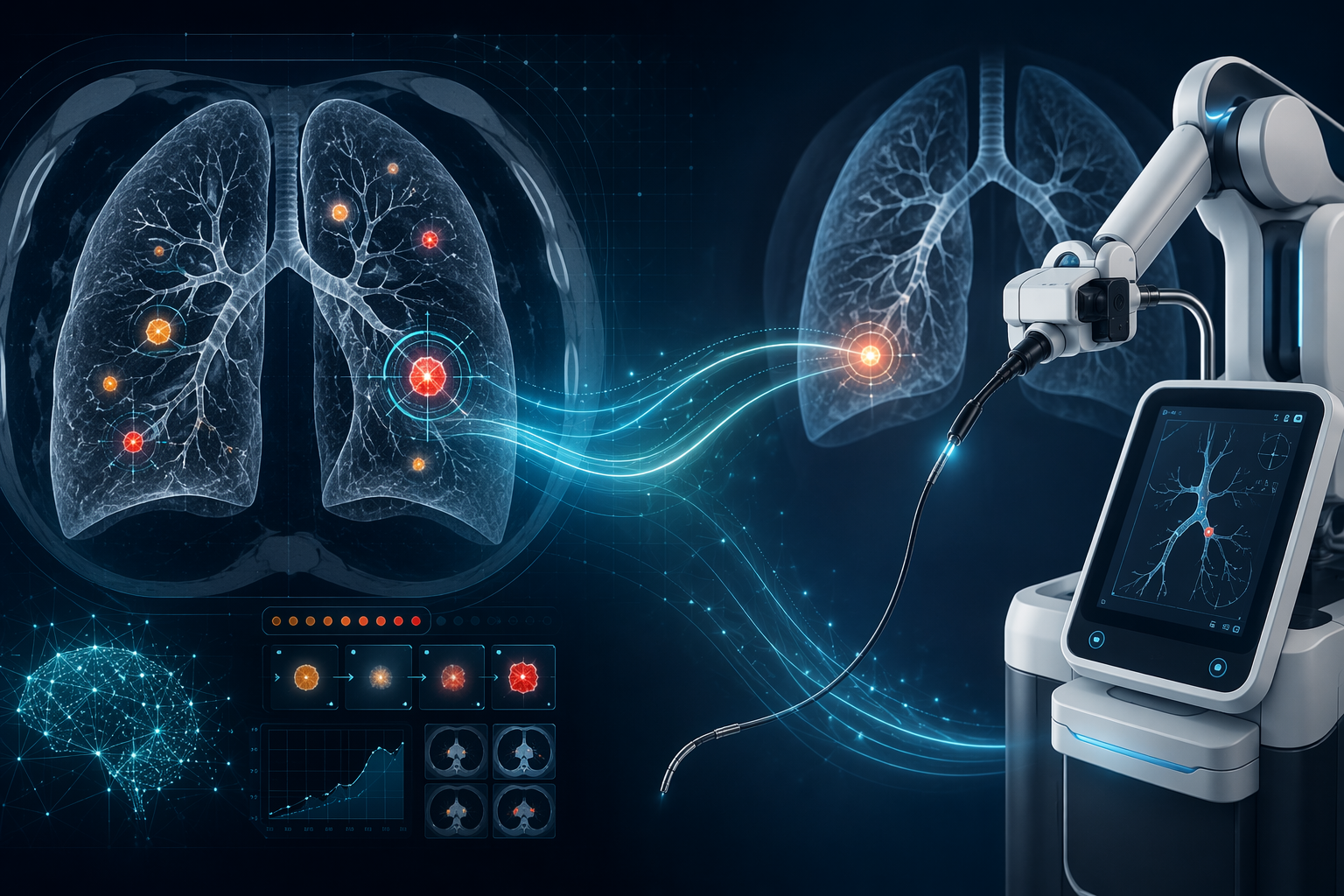
The NHS England pilot launched in January 2026 combines Optellum’s AI lung nodule risk stratification with Intuitive’s Ion robotic bronchoscopy system at Guy’s and St Thomas’. NHS England described it as the first end-to-end integration in the NHS of AI-supported lung cancer detection with robotic bronchoscopy for biopsy. The point is not simply that software flags a suspicious image. The point is that the pathway then has a tool capable of reaching small lesions for tissue diagnosis. [2]
That distinction matters. Lung screening can find nodules that are too uncertain to ignore and too difficult to act on cleanly. Some will be benign. Some will become cancers. Some sit in places that are awkward to sample. A radiology report alone does not start treatment; tissue diagnosis usually has to be obtained, reviewed, and routed through a multidisciplinary decision process. When early detection adds suspicious findings faster than the service can clarify them, patients wait in the gray zone.
In the Guy’s and St Thomas’ pilot, AI is used to help assess the risk of lung nodules identified on CT, while robotic bronchoscopy is used to access lesions for biopsy. NHS England said the Ion system can biopsy nodules as small as 6 mm. It also reported that around 300 robotic procedures had been performed and that 215 patients had gone on to receive cancer treatment. [2]
| Workflow question | What the pilot adds |
|---|---|
| Which nodules should be escalated? | AI-supported risk stratification of CT-detected lung nodules |
| Can the suspicious area be reached? | Robotic bronchoscopy designed to navigate to small peripheral lung lesions |
| Does detection lead to action? | Reported movement from robotic biopsy procedures into cancer treatment for 215 patients |
Those figures do not prove national effectiveness. They do, however, answer a practical deployment question that many AI screening stories avoid: what happens after a model generates concern? In this pilot, the model is not being presented as a self-sufficient diagnostic oracle. It is placed inside a pathway where the next step is an attempt to obtain tissue.
Why 6 mm nodules and robotic access matter
A 6 mm lung nodule is not a cancer diagnosis. It is a small finding that may need surveillance, risk assessment, or biopsy depending on the patient and imaging context. The clinical difficulty is that earlier disease often means smaller targets. Smaller targets are harder to sample, and a delayed or failed biopsy can blunt the practical value of finding the lesion early.
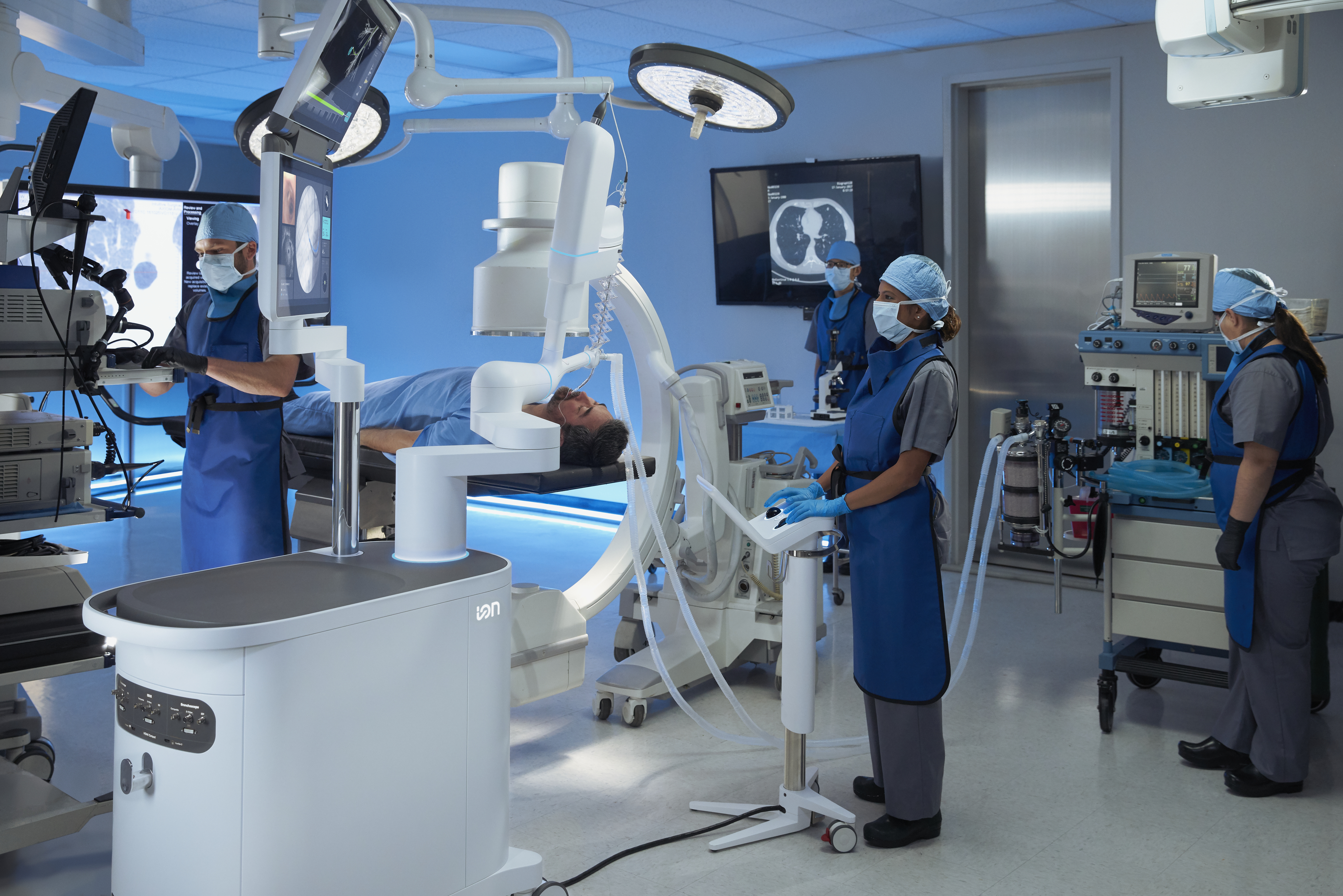
That is why the biopsy side of the pilot deserves as much attention as the AI side. In a screening program, the bottleneck is not always suspicion. It is often the sequence after suspicion: scheduling, lesion localization, procedural access, pathology, staging, and treatment planning. If a high-risk nodule is identified but cannot be sampled promptly, the program has produced anxiety before it has produced a treatment decision.
The reported 215 patients moving into cancer treatment is therefore the most clinically meaningful early operational number in the NHS announcement. It does not tell us the counterfactual — how many would have been diagnosed as quickly through existing pathways — and it does not establish population-level mortality benefit. But it does show the pilot is measuring more than image interpretation. It is tracking whether suspicious findings are converted into action. [2]
The AI evidence is promising, but it is not the same as screening proof
Optellum’s lung nodule risk stratification evidence includes a reported area under the receiver operating characteristic curve, or AUC, of 0.93. In plain terms, AUC is a measure of how well a model discriminates between cases with and without the target outcome across thresholds. A value of 0.93 is encouraging model-performance evidence. It is not, by itself, a verdict that AI improves a national screening program. [3]
The difference is not semantic. Screening programs are judged on outcomes across populations and pathways: who is invited, who attends, who is imaged, who is recalled, who receives invasive testing, who is diagnosed earlier, who is overdiagnosed, who is harmed, and whether mortality or stage distribution changes enough to justify the intervention. A strong model can still fail operationally if it increases false positives, overwhelms biopsy capacity, or performs differently outside the setting where it was developed.
That is also why the single-site nature of the Guy’s and St Thomas’ deployment matters. A pilot at a specialist center can show feasibility, workflow design, and early clinical throughput. It cannot automatically tell an NHS manager in another region whether they have the radiology staffing, bronchoscopy capacity, pathology turnaround, or referral discipline to reproduce the same results.
This is where AI in screening becomes less about model architecture and more about accountable deployment. The relevant question is not whether the software looks impressive in isolation. It is whether a defined group of patients moves through a safer, faster, and measurable diagnostic pathway than they would otherwise have had. That is the same evidence discipline behind broader concerns that AI in healthcare has an evidence problem when adoption runs ahead of clinical validation.
What the NHS is trying to scale
The pilot sits inside a much larger NHS lung cancer screening expansion. NHS England said more than 1.5 million lung health checks had been delivered since 2021. The service aims to invite 1.4 million people each year and to diagnose 50,000 cancers by 2035, including 23,000 at an earlier stage. [2]
Those targets explain why an end-to-end pathway matters. A national invitation program increases the front end of the funnel. It brings more people into eligibility assessment and imaging. If the diagnostic back end is not expanded with equal seriousness, earlier suspicion can become a queue rather than an earlier diagnosis.
For administrators, the Guy’s and St Thomas’ pilot is useful because it connects three usually separated conversations: screening uptake, radiology triage, and procedural diagnosis. The King’s warning about missed screenings addresses the first. AI risk stratification addresses part of the second. Robotic bronchoscopy addresses part of the third. None of these elements is sufficient alone.
- If people do not attend screening, the pathway never starts.
- If CT findings are not stratified well, services may under-escalate dangerous nodules or over-escalate benign ones.
- If biopsy capacity cannot keep up, earlier detection may not become earlier treatment.
- If evaluation does not measure downstream outcomes, the system may mistake activity for benefit.
Breast screening is the useful cautionary comparison
The UK’s AI screening picture is not a single national story in which every modality is moving at the same evidentiary speed. Mammography is the clearest caution. UK breast screening studies have reported promising findings, including AI detection of 25% of interval cancers missed by conventional screening and a 10.4% boost in detection. Those are meaningful signals and deserve continued study. [4]
But the UK National Screening Committee has concluded that evidence remains insufficient to recommend AI in the NHS Breast Screening Programme. That position should stop any easy claim that the NHS has already accepted AI screening as a settled population-level intervention. [5]
The comparison is useful because mammography has a large organized screening infrastructure and a strong commercial AI market. It is also an area where readers may have seen optimistic claims about reader workload, recall decisions, and cancer detection. A more detailed look at prospective mammography evidence, including systems such as Lunit INSIGHT MMG, shows why detection gains still have to be weighed against workflow design, arbitration rules, recall effects, and screening-program governance.
The lung pilot is different from breast screening in one important respect: it is not only testing whether AI can read or prioritize images. It is testing whether AI-supported risk assessment can be coupled to a procedural route for biopsy. That makes it operationally interesting. It does not exempt it from the same evidentiary standards.
What should be watched next
The next useful evidence from the lung pilot will not be a bigger adjective attached to AI. It will be evaluation data that shows how the pathway performed: time from CT finding to biopsy, biopsy yield, complication rates, cancer stage at diagnosis, false-positive burden, repeat procedures, treatment-start intervals, staffing requirements, and whether performance holds across broader NHS settings.
Procurement decisions should also separate the two technologies in the pathway. Optellum and Intuitive belong in the growing universe of artificial intelligence healthcare companies and device firms whose products are increasingly evaluated in live clinical services. But an AI risk score and a robotic bronchoscopy platform solve different problems. Buying one does not automatically create capacity for the other.
International claims about national AI screening mandates should be handled carefully unless they can be traced to primary policy documents. Within the verified evidence base here, the NHS story is specific: a single-site lung cancer pilot using AI risk stratification and robotic bronchoscopy, set against a national lung screening expansion and a screening committee that remains cautious in other cancer programs.
King Charles’ cancer treatment update explains why early diagnosis returned to public attention. It does not validate any AI system, and it does not tell us which screening technologies should be adopted. The real 2026 development is narrower and more useful: the NHS is testing whether AI plus robotic bronchoscopy can shorten the distance between a suspicious lung finding and an actionable diagnosis. That is worth watching closely, precisely because it has not yet been proven at national scale.
References
- King Charles says early cancer diagnosis enabled treatment reduction — BBC — December 2025 — link
- NHS launches trailblazing AI and robot pilot to spot lung cancer sooner — NHS England — January 2026 — link
- Optellum Virtual Nodule Clinic clinical evidence — Optellum — link
- UK breast screening AI studies on interval cancers and cancer detection — cited research studies — link
- UK National Screening Committee recommendation on artificial intelligence in breast screening — UK National Screening Committee — link
Comments
Join the discussion with an anonymous comment.