
The dangerous kratom case is not the one with a neat toxidrome and a helpful urine drug screen. It is the agitated patient with a seizure, persistent tachycardia, a widening QTc, a Brugada-like ECG pattern, or ventricular dysrhythmia risk, while the routine ED drug screen returns with nothing that explains the room. Mitragynine, the dominant kratom alkaloid, is not detected on standard urine drug screens; confirmation requires specialized testing such as LC-MS, which is not available in the acute decision window described in the clinical literature.[1]
That gap matters because the reported cardiac phenotype is not limited to palpitations. The strongest single bedside signal comes from a chemically confirmed kratom-only case with reversible Type 1 Brugada pattern and marked QTc prolongation to 654 ms, resolving over 31 hours as the alkaloid burden cleared.[1] That is the kind of case that changes the threshold for suspicion: not because it proves frequency, but because it proves plausibility under unusually clean conditions.

The Case That Should Make a Negative Screen Less Comforting
The March 2025 JACC case report is useful precisely because it removes some of the usual exits. Chemical analysis identified mitragynine, paynantheine, and speciogynine, without adulterants or other detected substances, in a patient whose ECG showed reversible Brugada pattern and QTc prolongation.[1] In kratom discussions, polysubstance exposure often muddies causality; here, the diagnostic problem is harder to dismiss.
The ECG changed over a clinically relevant time frame. The QTc reached 654 ms, the Brugada pattern resolved, and the report followed serial rhythm changes over 31 hours.[1] That timing is not an academic detail. In an ED or observation setting, it means the abnormality may be present long enough to catch, trend, and act on, but not necessarily long enough to survive delayed recognition or fragmented handoffs.
This does not turn every kratom exposure into an impending arrest. It does, however, give clinicians a concrete reason to treat an unexplained Brugada phenocopy or extreme QTc prolongation as a substance-related emergency even when the standard tox screen is unrevealing. The screen’s silence is a limitation of the assay, not reassurance about the exposure.
The Signal Is Broader Than One Case
Poison center data show that kratom-related medical calls have moved from an occasional curiosity to a recurring operational problem. A CDC MMWR analysis reported 14,449 kratom exposure reports to U.S. poison centers from 2015 through 2025, rising from 258 reports in 2015 to a record 3,434 in 2025, a 1,200% increase.[2] Multiple-substance exposures accounted for 38% of reports but 79% of deaths, which is an important boundary: many fatal cases are not kratom-only cases.[2]
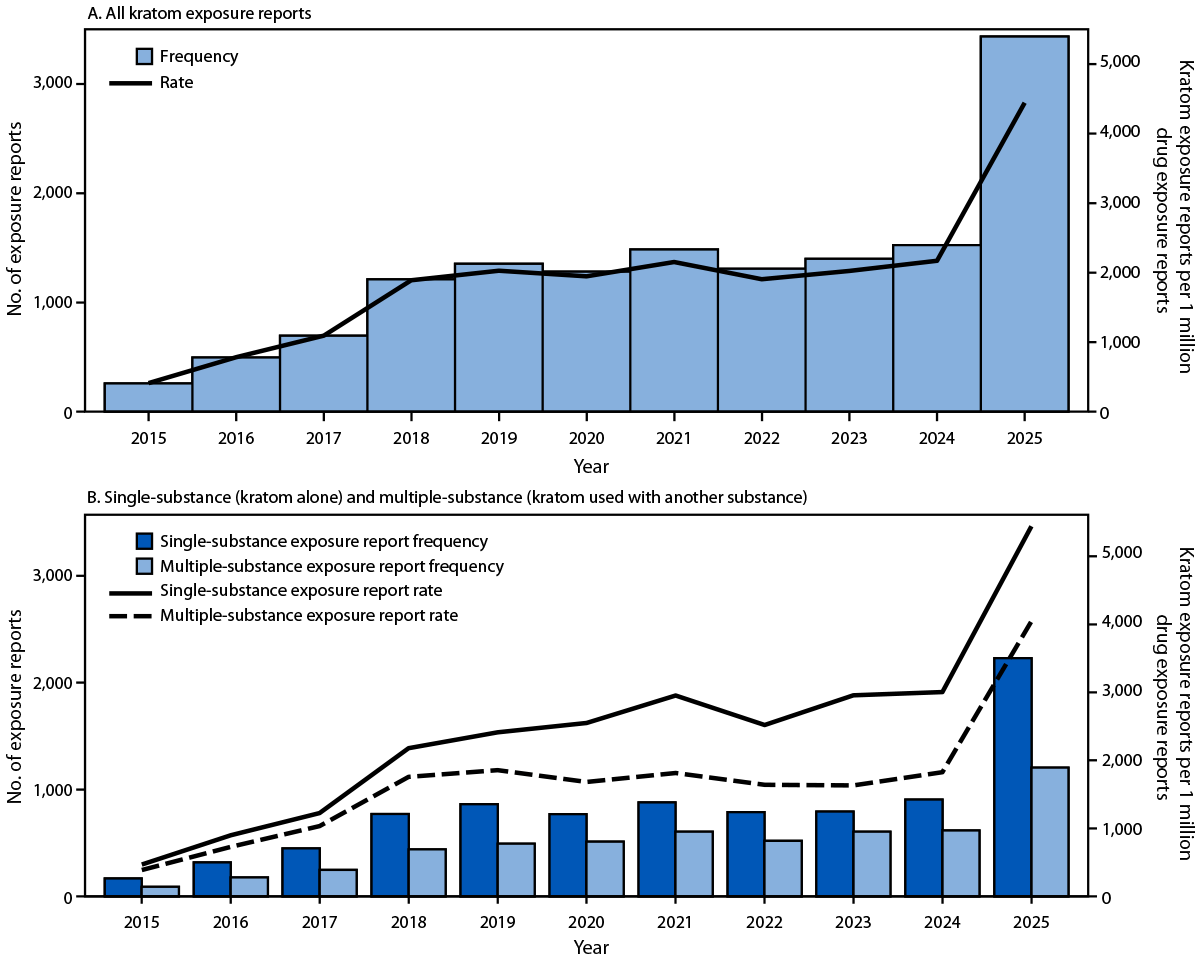
That distinction should not soften the emergency medicine concern. Polysubstance exposure is exactly how many patients arrive: uncertain product, uncertain dose, incomplete history, co-ingestions either denied or unknown, and an ECG that may be the most honest piece of data in the chart. The CDC report also found that adults aged 40–59 had the sharpest increase, which matters for risk framing because this is not only an adolescent experimentation problem.[2]
Human ECG data remain limited, but they point in the same direction. In a cross-sectional study of 100 regular kratom users and controls, regular users had eightfold higher odds of sinus tachycardia, and investigators described dose-dependent borderline QTc prolongation; the mean daily mitragynine intake among users was 434.28 mg.[3] The cohort was all male and Malaysian, so the result should not be overgeneralized to every U.S. product or population. It is still a real ECG signal, not just a poison center abstraction.
Earlier National Poison Data System analysis also captured cardiovascular findings among reported kratom exposures. In 1,807 reports from 2011 to 2017, tachycardia was reported in 21.4%, conduction defects in 2.8%, chest pain in 2.6%, and cardiac arrest in 0.4%.[4] Those percentages come from poison center reports, not a denominator of all kratom users, so they do not estimate population incidence. They do show the kinds of emergencies that clinicians and poison centers have already had to manage.
Why the ECG Findings Are Biologically Plausible
The mechanistic bridge is short but relevant. In vitro work has shown that mitragynine can inhibit hERG potassium channels, with reported IC50 values as low as 332.70 nM in studies summarized in a cardiotoxicity review.[5] hERG inhibition is a familiar route toward delayed repolarization and QT liability, even though in vitro channel activity does not automatically predict the severity or frequency of events in ED patients.
That is enough mechanism for clinical purposes. The point is not that every kratom exposure should be managed as a proven hERG-toxic ingestion. The point is that marked QTc prolongation after kratom exposure is not physiologically absurd, and a reversible Brugada pattern should not be waved away because the urine panel did not identify cocaine, amphetamines, or another more familiar culprit.
Where Decision Support Could Help First: The ECG
If AI belongs anywhere in this problem, it belongs first at the ECG, not in a chatbot explanation after the patient is dispositioned. The ECG is closest to the event, already part of emergency workflow, and capable of showing the abnormality even when the substance history is wrong or absent.
A useful system would not need to diagnose “kratom cardiotoxicity” outright. A narrower and more defensible target would be to flag patterns that should raise the clinician’s index of suspicion: dynamic QTc prolongation, a Brugada-like pattern that appears and resolves, ventricular ectopy in the wrong clinical setting, or serial ECG changes that are easy to miss when different clinicians read different tracings. That kind of alert would amplify what is already visible rather than invent a diagnosis from unsupported data.
Existing emergency guidance already emphasizes ECG acquisition and QTc monitoring in kratom presentations, but it does not provide kratom-specific AI support.[6] That leaves a practical opening: decision support could standardize attention to the same ECG hazards clinicians are already supposed to be watching, especially when the case is labeled as seizure, panic, stimulant-like agitation, syncope, or nonspecific intoxication.
Triage Models Would Need to Assemble Suspicion From Ordinary Data
The second plausible use case is not a kratom detector. It is a triage or early-warning model that notices combinations humans often process separately: unexplained tachycardia, seizure or altered mental status, agitation, negative routine drug screen, QTc prolongation, chest pain, and a history field that includes supplement, tea, powder, extract, gas station product, or pain self-treatment.
Adjacent work supports the feasibility of using routine ED triage data for substance-related risk detection. A 2025 study found that machine learning models using routine triage data could help flag opioid misuse in emergency care settings.[7] That does not validate the same approach for kratom cardiotoxicity. It only shows that ED data streams can support substance-use risk modeling when the target outcome, features, and workflow are carefully specified.
The translation problem is harder for kratom because the confirmatory label is scarce. If LC-MS testing is not routinely obtained in real time, many true exposures never become clean training examples. A model trained on weak labels such as “kratom mentioned in note” or “poison center consulted” would inherit documentation bias. That does not make the approach useless, but it means performance claims would need prospective validation before they deserve a place in clinical decision-making.
Adjacent work on AI for OUD screening in pragmatic emergency workflows is a better comparison point than general AI hype. The useful lesson is not that one substance model transfers to another; it is that workflow, labeling, and clinician trust determine whether a model survives contact with the ED.
NLP Fits the Handoff Problem, Not the First Five Minutes
Natural language processing sits farther from the bedside event, but it addresses a real failure mode. Kratom exposure may be documented once as “herbal supplement,” “kratom tea,” “extract,” “7-OH product,” or “gas station pill,” then disappear beneath problem lists that say seizure, intoxication, anxiety, or syncope. An NLP tool could surface those mentions across triage notes, nursing documentation, EMS narratives, prior visits, and poison center recommendations.
Its value would be pattern surveillance rather than bedside prophecy. Over multiple encounters, NLP could help identify clusters such as unexplained tachycardia plus seizure plus negative UDS plus supplement language, or recurrent ED visits after concentrated kratom products. That could support toxicology consultation, targeted confirmatory testing, or local quality review. It would not replace a clinician looking at a dangerous ECG.
Documentation quality is the limiting reagent. If no one asks about kratom, extracts, or 7-hydroxymitragynine products, there may be nothing for NLP to retrieve. If the patient is obtunded or the family brings no product container, the chart may only preserve physiology. That is another reason ECG-centered support is the cleaner first use case.
What Can Be Recognized Earlier
The practical recognition target is a pattern, not a single pathognomonic sign. Kratom should move higher on the differential when the clinical picture combines acute neurobehavioral symptoms, autonomic activation, seizure or altered mental status, chest symptoms, ventricular irritability, QTc prolongation, Brugada-like morphology, or cardiopulmonary collapse with a routine tox screen that fails to explain the physiology.
| Clinical clue | Why it matters in kratom-associated emergencies | Decision-support opportunity |
|---|---|---|
| Marked or dynamic QTc prolongation | A confirmed kratom-only case reached QTc 654 ms, and regular-user ECG data suggest dose-related borderline QTc effects.[1][3] | Serial ECG analysis could flag worsening repolarization even before the exposure is named. |
| Brugada-like ECG pattern | The JACC case documented reversible Type 1 Brugada pattern after chemically confirmed kratom exposure.[1] | ECG algorithms could prompt review for drug-induced Brugada phenocopy and repeat tracing. |
| Tachycardia with nonspecific intoxication or seizure | Poison center and ECG study data both include tachycardia signals, though they do not prove causality in every case.[3][4] | Triage models could combine vital signs, neurologic presentation, and negative UDS into a suspicion flag. |
| Negative routine urine drug screen | Standard ED screens do not detect mitragynine; specialized testing is required.[1] | Clinical decision support could remind clinicians that a negative panel does not rule out kratom. |
| Fragmented supplement history | Exposure may be recorded as kratom, herbal product, extract, or related product language. | NLP could retrieve prior mentions across notes and handoffs. |
This is where AI language has to stay disciplined. No peer-reviewed study has validated an AI or machine learning tool specifically for detecting kratom-related cardiotoxicity. ECG interpretation, triage ML, and NLP surveillance are plausible translational directions because they match the diagnostic blind spot, not because they are already proven for this exposure.
That evidence boundary is not a minor footnote. A model that flags QTc prolongation may be clinically useful without knowing the cause. A model that claims kratom-specific prediction would need a reliable exposure label, prospective testing, calibration across products and populations, and evidence that alerts improve care rather than adding noise. Those are different claims, and they should not be allowed to blur.
The present standard leaves clinicians doing the hardest part manually: recognizing that the story, ECG, and tox screen do not belong together. Kratom has a documented cardiac risk profile, including QTc prolongation, reversible Brugada pattern, conduction defects, tachycardia, ventricular arrhythmia concern, and reported cardiac arrest. Standard screening leaves the substance itself largely invisible in the acute window. Decision support could help by sharpening attention to what is already visible in ECGs, triage data, and chart text. It should not be sold as more than that until kratom-specific validation exists.
References
- Kratom Cardiotoxicity: Reversible Brugada Pattern and QTc Prolongation — JACC Case Reports, March 2025.
- Increases in Kratom-Related Reports to Poison Centers — National Poison Data System, United States, 2015–2025 — CDC MMWR, March 2026.
- Is Kratom Use Associated with ECG Abnormalities? — PubMed, 2021.
- Kratom exposures reported to US poison control centers: 2011-2017 — PubMed, 2019.
- A Critical Review of the Neuropharmacological Effects of Kratom: An Insight from the Functional Array of Identified Natural Compounds — PMC.
- Kratom in the ED: Pearls and Pitfalls — emDocs, 2026.
- Machine learning models using routine triage data showed feasibility in flagging opioid misuse — PMC, 2025.
Comments
Join the discussion with an anonymous comment.