
The most important finding in the latest evidence on medical coding AI is not that software found more billable diagnoses. It is that hospitals using AI coding tools billed acute posthemorrhagic anemia more often in maternity admissions where patients did not receive transfusions, a care pattern that raises a much sharper question: was the diagnosis clinically supported as a reportable complication, or did it become a payable code because it appeared somewhere in the record?
Blue Cross Blue Shield Association and Blue Health Intelligence analyzed tens of thousands of maternity admissions and reported that AI-enabled hospital billing was associated with higher rates of this anemia diagnosis without the corresponding transfusion signal. The analysis estimated that the pattern added $22 million to maternity admission costs at the analyzed hospitals in one year.[1]
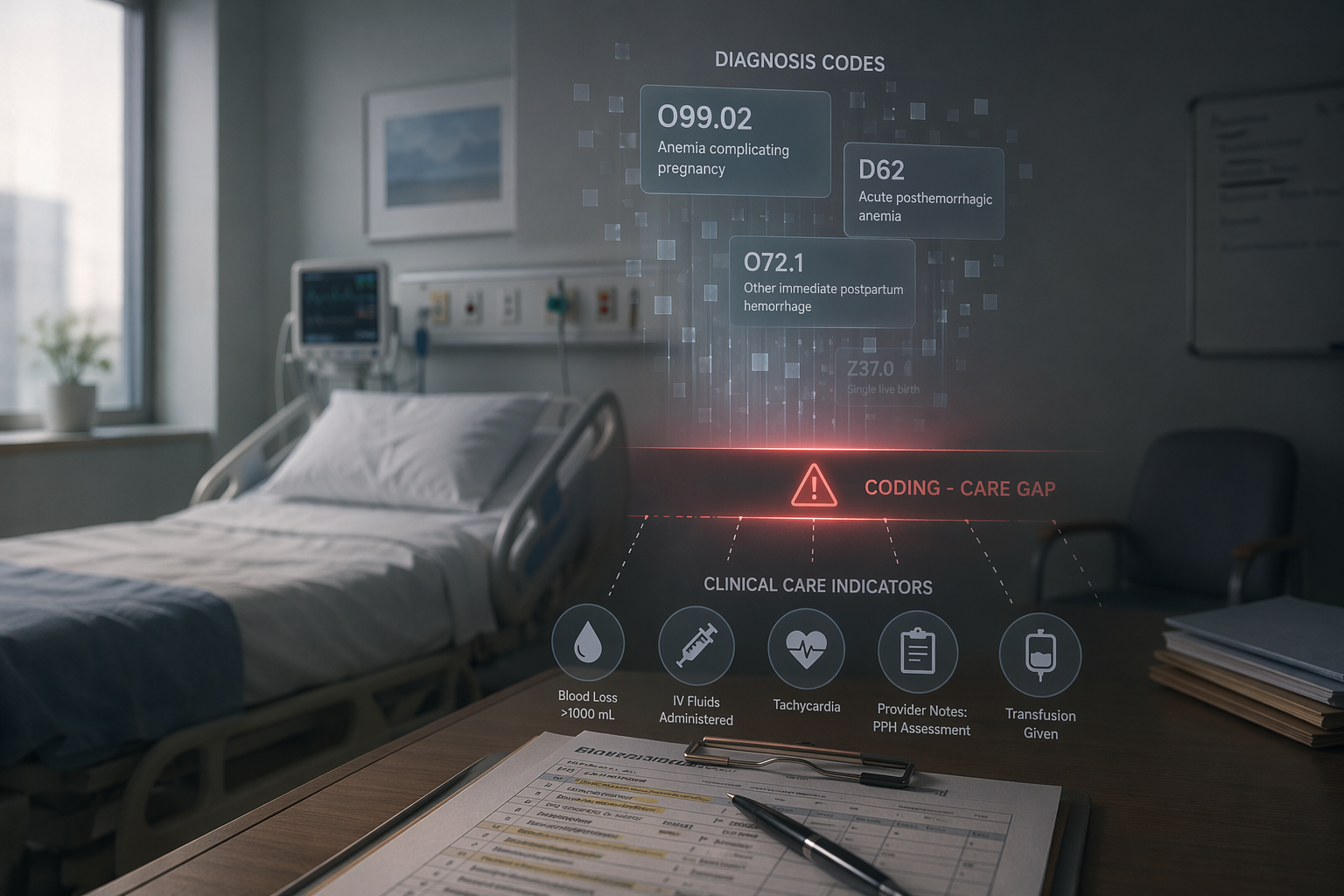
That is the kind of mismatch that matters in a claim file. Acute posthemorrhagic anemia can be clinically meaningful. It can also be financially meaningful when it changes severity, case mix, or reimbursement. The problem is not the presence of the words in a note by themselves; it is whether the condition was evaluated, monitored, treated, or otherwise clinically relevant enough to support the billed diagnosis.
What the BCBSA analysis found
The BCBSA/BHI work deserves more attention than a generic warning about automated billing because it ties a specific diagnosis pattern to a specific care proxy and then estimates the financial effect. The study did not simply say that hospitals using AI had higher coding intensity. It looked at maternity admissions, identified a diagnosis that should normally have some clinical footprint, and compared billing behavior at facilities associated with AI coding use.
The reported national estimates are large: $663 million in excess inpatient spending and $1.67 billion in excess outpatient spending tied to AI-enabled upcoding.[2] Those numbers should not be read as a court finding that every dollar was improper. They are estimates from one payer-side analysis. But they are large enough that compliance teams, payers, and regulators cannot treat the issue as a hypothetical implementation risk.
| Measure | Reported finding | Why it matters |
|---|---|---|
| Maternity admission cost effect | $22 million added at analyzed hospitals in one year | Connects the diagnosis pattern to actual spending, not only coding frequency |
| Estimated inpatient effect | $663 million in excess spending nationally | Suggests the issue may scale beyond the study sample |
| Estimated outpatient effect | $1.67 billion in excess spending nationally | Shows that the concern is not limited to inpatient DRG payment |
| Facility case-mix signal | One facility’s complexity rating rose 6.7% after adopting AI, compared with 0.9% among peers in the same state | Points to a facility-level change that would attract payer review |
The facility-level case-mix comparison is especially hard to ignore. BCBSA reported that one hospital’s complexity rating rose 6.7% after adopting AI, while peer facilities in the same state rose 0.9%.[2] A single facility does not prove a national pattern, and case mix can change for legitimate reasons. Still, a jump that large would normally trigger the same practical questions an auditor would ask without any AI involved: which diagnoses changed, which clinicians documented them, which coders accepted them, and which claims were reviewed before billing?
The issue is diagnosis support, not automation itself
There is a legitimate version of the hospital argument. Better coding tools can catch missed documentation, reduce backlogs, and surface complications that human coders might overlook. If a patient truly had a clinically significant condition that was documented and managed, capturing it is not upcoding. It is accurate coding.
The BCBSA finding sits on the other side of that line. A billed diagnosis that appears more often without a corresponding care signal is not automatically false, but it is not automatically defensible either. In maternity care, acute blood loss may be mentioned, estimated, trended, or watched without rising to the level of a separately reportable acute posthemorrhagic anemia diagnosis. The coding question turns on clinical significance, not word matching.
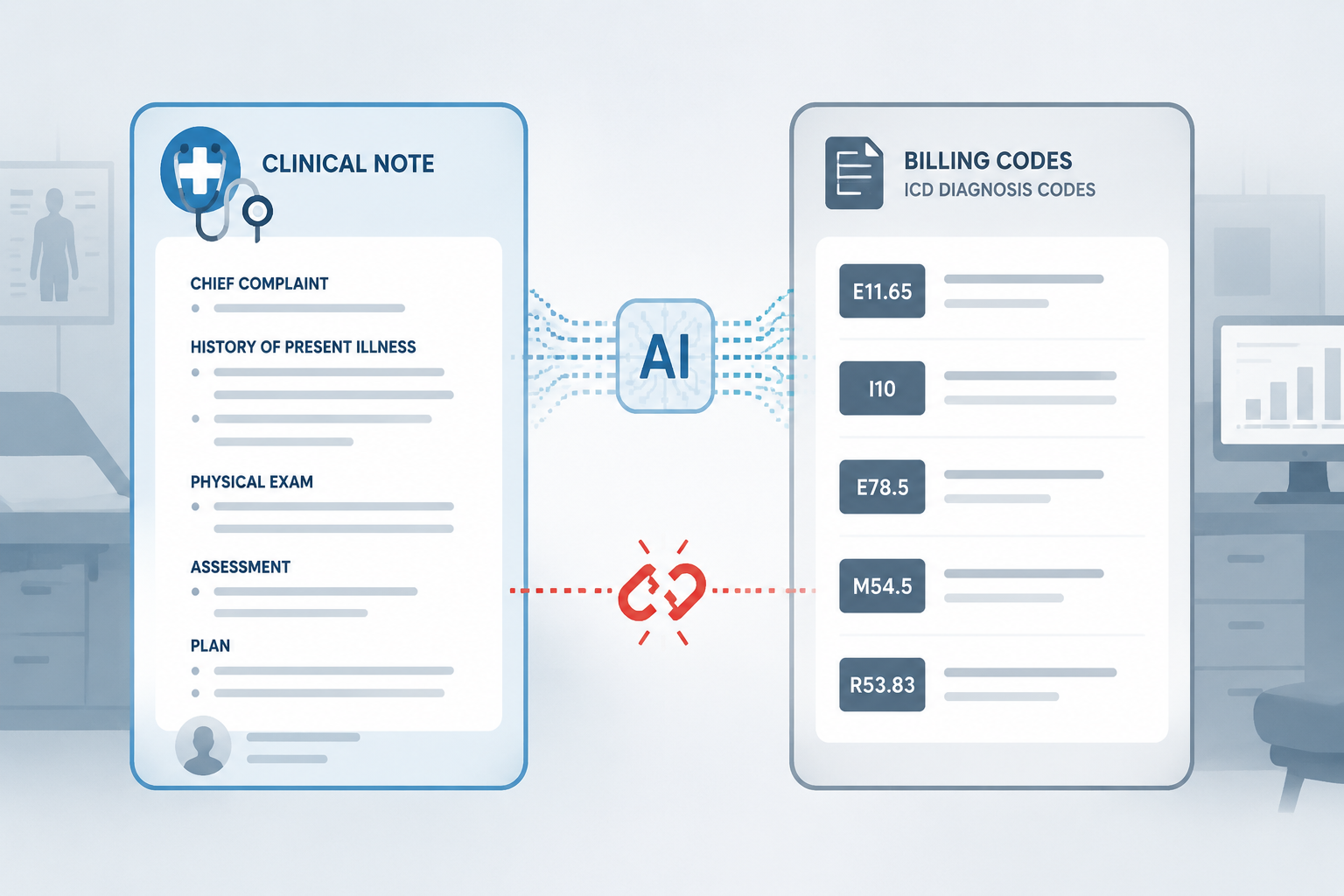
That distinction is where AI can create a billing-control problem. AI scribes, documentation assistants, and autonomous coding systems can make clinically adjacent language more visible to the billing process. A condition mentioned in passing, copied forward, listed in a differential, or noted as a possibility may become easier for a model to retrieve than it would be for a human coder moving through a queue. The billing risk appears when retrieval is treated as support.
What the study can prove, and what it cannot
The strongest version of the finding is narrow: in the BCBSA/BHI maternity admissions analysis, hospitals associated with AI coding use showed a concerning gap between billed acute posthemorrhagic anemia and a transfusion-based care proxy, with meaningful estimated cost effects.[1][2]
The weaker version would go too far: AI coding has been proven to cause improper billing across all hospitals and all service lines. The available evidence does not support that conclusion. The AI attribution in the BCBSA analysis is inferred from hospital disclosure patterns, not from randomized implementation, direct product logs, or a controlled before-and-after deployment study. That matters.
Other explanations remain possible. Hospitals that disclosed AI coding tools may also have changed documentation education, coder review practices, clinical query behavior, or internal coding policies. The maternity focus is also a boundary. Orthopedics, cardiology, oncology, emergency medicine, and general surgery have different documentation patterns and reimbursement dynamics. The anemia signal cannot simply be pasted onto every diagnosis category.
There is also a source limitation. This is a payer-side analysis, and payers have financial incentives of their own. That does not make the findings disposable; the diagnosis-level pattern and spending estimates are too specific for that. It does mean the result should be replicated by independent researchers, ideally with claim-level detail, facility implementation dates, product categories, chart review, and a clear separation between appropriate documentation capture and unsupported severity inflation.
Why adoption context changes the risk calculation
A coding pattern that appears at one hospital is a local audit issue. A coding pattern attached to widely adopted automation becomes a payment-system issue. BCBSA reported that AI use in hospital billing and coding has expanded quickly, with many hospitals now using AI in billing, coding, or claims workflows.[2]
That adoption context is important because reimbursement pressure does not require malicious intent. A model can be tuned to maximize capture. A coding team can be measured on productivity and missed revenue. A vendor dashboard can frame additional diagnoses as financial opportunity. None of those facts proves fraud. Together, they create an environment where unsupported codes can move from exception to pattern unless someone is sampling the output against the medical record.
For readers who need the broader compliance backdrop, AI medical coding compliance in 2026 is the more detailed place to track audit-trail expectations, False Claims Act exposure, CPT AI taxonomy changes, and state transparency rules. The short version for this issue is simpler: if the claim goes out under the hospital’s billing authority, the hospital still has to defend it.
Where controls should sit
The practical response is not to ban every AI coding tool or pretend manual coding is clean by default. Manual processes miss legitimate acuity, vary by coder, and create their own compliance exposure. The control question is whether the organization can identify where AI influenced the claim and reproduce why the final code was accepted.
- Track which claims, encounters, diagnoses, and coding decisions were touched by AI rather than treating the tool as invisible infrastructure.
- Sample high-impact complications and comorbidities against clinical indicators, treatment, monitoring, and discharge summaries.
- Separate documentation improvement queries from autonomous code suggestions so reviewers can see whether the record was clarified or merely harvested.
- Escalate diagnosis categories that materially change reimbursement, quality metrics, or risk adjustment when the care pattern is thin.
- Monitor facility-level case mix after AI deployment against peers and against the hospital’s own historical baseline.
The anemia example shows why these controls need to be diagnosis-specific. A generic accuracy score from a vendor does not answer whether acute posthemorrhagic anemia was clinically meaningful in a no-transfusion maternity admission. A productivity gain does not answer whether a payer medical reviewer will uphold the code. A revenue lift does not answer whether the audit trail survives a request for records.
How payers and regulators are likely to read this
Payers do not need a final federal AI rule to start reviewing claims. If a facility’s case mix jumps after AI adoption, or if a diagnosis rises without a matching treatment pattern, the review path is already familiar: targeted medical record requests, prepayment edits, post-payment audits, and contract disputes over documentation support.
Regulators are likely to care less about the brand name of the coding system than about accountability. Existing fraud-and-abuse logic does not become irrelevant because a model suggested the code. State disclosure requirements for healthcare AI are also emerging, although they are not yet standardized. The compliance burden is moving toward traceability: who used the tool, what it suggested, who accepted the code, and what documentation supported the billed claim.
That is why the BCBSA/BHI study should be treated as an early warning with teeth, not as a finished indictment. It gives payers a concrete target for scrutiny and gives hospitals a concrete reason to test their own AI-coded claims before someone else does. It also leaves room for a fair defense: if AI is improving legitimate capture, chart review should be able to show the clinical indicators and the care team’s response.
The defensible conclusion
The BCBSA/BHI maternity analysis is the strongest available evidence that medical coding AI may be producing systematic upcoding, because it links AI-associated billing to a named diagnosis, a care proxy, spending estimates, and facility-level case-mix changes. It is also correlational, payer-produced, maternity-specific, and not yet independently replicated.
That combination supports heightened payer scrutiny, hospital audit controls, and regulatory attention. It does not support treating every AI coding deployment as fraudulent. The line is still the same one revenue integrity teams have had to defend for years: if the code changes payment, the record needs to show why the diagnosis belonged on the claim.
Comments
Join the discussion with an anonymous comment.