
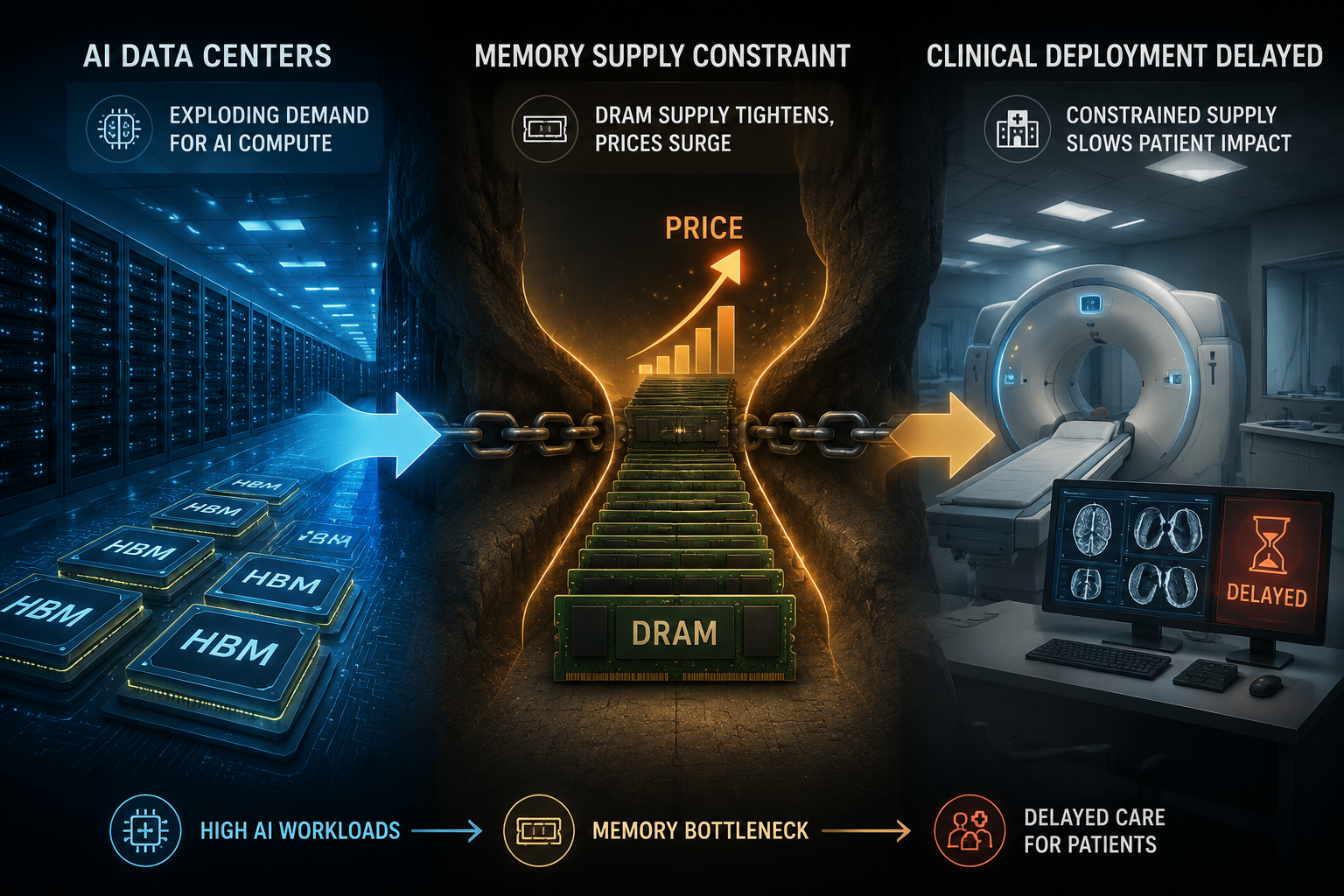
Radiology AI is usually described as software: an algorithm triages a worklist, flags a pulmonary embolism, segments a tumor, or drafts a measurement. In deployment meetings, however, it quickly becomes hardware. The model needs somewhere to run, memory to hold imaging data and model weights, bandwidth to move studies fast enough for clinical use, and an integration path into PACS, VNA, scanners, reporting systems, and security controls. That is where the memory chip shortage’s impact on AI in healthcare becomes operational rather than abstract: a clinically useful tool can be approved by a service line and still stall because the server, workstation, GPU node, scanner-adjacent appliance, or cloud compute contract no longer prices or ships as planned.
This is not the same as saying AI in healthcare has stopped. It has not. Cloud deployments still exist, large technology vendors reserved supply early, and many hospitals can still buy AI as a managed service. The problem is narrower and more consequential for imaging operations: the infrastructure assumptions behind radiology AI procurement have become less reliable. A budget built around a normal hardware refresh cycle may not survive a memory-driven price shock. A PACS-connected on-premise deployment may wait behind unavailable components. A scanner upgrade that was supposed to carry new AI capability may become tangled in delivery timing and capital review.

Radiology AI Runs on Memory Before It Runs on Workflow
The dependency is easy to miss because hospitals do not usually buy “memory” as a clinical product. They buy an AI module from an imaging vendor, an inference server from an integrator, a GPU-equipped workstation, a scanner upgrade, or a cloud subscription. Inside those options are different forms of memory. DRAM supports ordinary system operations and large imaging workloads. HBM, or high-bandwidth memory, sits closer to high-performance AI accelerators and is essential to the data center hardware now being built for large AI workloads.
That distinction matters because HBM and standard DRAM are not separate worlds. Manufacturers allocate capital, fabrication capacity, packaging capability, and product mix across memory categories. When AI data centers absorb HBM and related advanced memory capacity, the pressure can move into standard DRAM markets. The hospital may never place an HBM purchase order, but the server quote on a radiology AI project can still reflect the upstream scramble.
In a clean software story, demand for AI diagnostics would simply increase adoption. In the current infrastructure story, the same demand that makes imaging AI attractive also helps consume the memory supply needed to deploy it. That is the uncomfortable loop behind delayed installs, repriced hardware, and late-stage procurement revisions.
The Shortage Mechanism Is More Specific Than “Not Enough Chips”
The price movement is severe enough to change budget conversations. IEEE Spectrum, citing NCTA figures, reported DRAM prices rising 80–90% in Q4 2025 and 172% year over year. The same reporting cited DDR4 price increases of 700–800% year over year, a number that should be handled carefully because it may reflect volatile spot-market pricing rather than the contract prices paid by every medical device maker, hospital, or integrator.[1] Even with that caveat, the direction is not subtle.
The supply side is just as important as the price chart. SK Hynix reportedly sold out all of its 2026 capacity before the year began, and Intel CEO Lip-Bu Tan said he did not expect DRAM supply relief before 2028.[1] Reuters has also described the current crisis as being driven by AI demand for HBM and the resulting pressure across global memory supply chains.[2] For hospital buyers, those are the facts that matter: not whether a price spike softens for a week, but whether the production capacity needed to normalize quotes and delivery schedules is already spoken for.
There is also very little supplier redundancy. The global DRAM market is dominated by Samsung, SK Hynix, and Micron, which together control more than 95% of supply according to the research summarized in the shortage reporting.[1] Concentration does not automatically mean failure, but it does mean that healthcare procurement teams cannot treat memory as a broadly substitutable commodity when everyone else is trying to reserve the same capacity.
Industry estimates that data centers are consuming a very large share of memory output should be treated as estimates, not audited counts. Still, the market behavior is consistent with an allocation problem: hyperscalers and AI infrastructure buyers commit early, memory makers prioritize the most profitable and strategically important products, and downstream sectors discover that components once assumed to be routine have become gating items.
Where the Delay Lands in Radiology and Diagnostics
The first impact is on on-premise inference. Many imaging AI deployments still require local hardware for latency, data governance, uptime, cybersecurity, or integration reasons. A stroke triage tool that must return results fast enough to affect routing decisions cannot be treated like an ordinary back-office analytics job. If the needed GPU server, DRAM configuration, or validated appliance slips, the clinical go-live slips with it.
The second impact is on imaging infrastructure that is already under capital pressure. GPU-equipped workstations, PACS-connected servers, edge devices, pathology image analysis systems, and scanner-adjacent AI upgrades can all inherit memory and accelerator constraints. The delay may not appear on the invoice as “DRAM shortage.” It may appear as a revised quote, a longer lead time, a narrower hardware configuration, or an implementation slot that cannot be held because the equipment is not ready.
The third impact is strategic. Radiology Business reported that only 21% of healthcare leaders had implemented AI in medical imaging, while 62% planned to do so within five years.[3] That gap is not lack of interest. It is the distance between intent and installation. A memory-constrained hardware market threatens to widen that distance, especially for health systems that were already moving slowly because of governance, validation, cybersecurity review, and reimbursement uncertainty.
The earlier semiconductor shortage showed how quickly component problems can become clinical equipment problems. During the 2020–2023 cycle, Siemens Healthineers and GE HealthCare reported CT and MRI delivery delays, and AdvaMed survey data from that period found widespread disruption among medtech firms, including delays measured in weeks.[4] That precedent should not be casually pasted onto 2026 as if the numbers are current. Its value is more modest: radiology has already seen that semiconductor shortages do not stay inside the electronics industry.
Medtech Procurement Has Less Room for Substitution Than Consumer Tech
A hospital cannot respond to every component shortage by swapping in a near-equivalent part. Medical devices and clinical AI systems may be tied to validated hardware configurations, cybersecurity documentation, vendor support agreements, quality controls, and regulatory submissions. PwC’s June 2026 analysis of the semiconductor memory shortage for medtech emphasized requalification cycles and the operational risk of single-sourced components in medical technology supply chains.[5]
That is why the same memory constraint can be more disruptive in diagnostics than in a less regulated enterprise IT project. If a vendor changes memory modules, server platforms, or embedded components, the question is not only whether the replacement boots. The question is whether the product remains within its validated configuration, whether documentation changes, whether cybersecurity review must reopen, and whether the hospital’s own change-control process starts over.
Procurement teams feel this in the unglamorous middle of a project. The clinical committee has approved the use case. The finance team has penciled in the capital request. Imaging IT has reserved an integration window. Then the hardware quote changes, the vendor asks for a longer lead time, or the preferred configuration becomes unavailable. No one in that room is debating the promise of AI. They are trying to keep an implementation plan from unraveling.
The Helium Link Is Strange, but It Is Not a Gimmick
The most healthcare-specific complication is helium. Radiology AI Substack highlighted that Qatar supplies 64.7% of South Korea’s helium, tying a country central to global DRAM manufacturing to a gas that also matters for MRI magnet cooling.[4] Helium is used in semiconductor manufacturing and in MRI operations. A disruption does not mean every MRI scanner or memory fab immediately stops, but it exposes an uncomfortable overlap: radiology depends on the same fragile industrial inputs both for imaging equipment and for the chips that increasingly support AI-enabled imaging.

This should stay in proportion. Helium is not the whole memory shortage, and the available material does not support claiming that helium disruption is currently the dominant cause of radiology AI delay. Its importance is different: it shows why hospital infrastructure risk is no longer confined to hospital vendors. A supply shock in a gas market, a memory allocation decision in South Korea, and an MRI service schedule can sit closer together than a normal capital planning document admits.
Cloud AI Helps, but It Changes the Bargain
Cloud-based radiology AI is the obvious mitigation, and sometimes it is the right one. Hyperscalers reserved GPU and HBM allocations earlier than most healthcare buyers, so a managed cloud service can be less exposed to the immediate problem of finding hardware for an on-premise install. That is one reason the shortage should not be framed as a blanket shutdown of healthcare AI.
But cloud is not a free escape hatch. Forbes described healthcare AI leaders responding to GPU and memory cost escalation with strategies that include sovereign compute and more deliberate infrastructure planning.[6] HealthTech Magazine has likewise discussed GPU shortages in healthcare and the role of cloud dependency as a mitigation path.[7] Those discussions belong in procurement planning, not in a reassurance paragraph. If the hospital shifts inference to the cloud, it may reduce local hardware exposure while taking on variable compute costs, data movement constraints, vendor lock-in, and new contractual dependencies.
| Deployment choice | What it may reduce | What it may add |
|---|---|---|
| On-premise AI server | Ongoing cloud compute exposure and some data movement concerns | Hardware lead-time risk, memory price exposure, local support burden |
| Vendor-managed cloud AI | Local hardware procurement pressure | Usage-based cost exposure, lock-in risk, dependency on vendor and hyperscaler capacity |
| Hybrid model | Single-point dependency on either local or cloud infrastructure | More complex governance, routing, monitoring, and contracting |
The right answer varies by use case. A high-acuity triage algorithm, a pathology workload with very large images, a research model, and a background quality tool do not have the same latency, privacy, uptime, or cost profile. The point is not to prefer on-premise or cloud in principle. The point is to stop treating the hosting choice as a technical footnote after the clinical vendor has been selected.
Why 2028 Should Be in the Budget Conversation Now
The timeline is what turns a purchasing nuisance into a planning problem. If capacity were expected to normalize within a quarter or two, hospitals could wait out some of the volatility. The current source material does not support that level of comfort. Reported 2026 capacity commitments and the expectation of no DRAM supply relief before 2028 mean radiology AI projects entering review now may still be deploying inside the constraint window.[1]
Industry pressure is already visible outside healthcare. Tom’s Hardware reported on a coalition including medtech, automotive, and telecom firms urging the Trump administration to intervene as AI data center memory consumption threatened other sectors.[8] Advocacy letters are not neutral measurements of supply, and they should not be treated as such. They do, however, show that the allocation problem is being felt by industries with very different end markets and long planning cycles.
For a radiology department, the practical implication is that an AI project should not be budgeted as if hardware costs, delivery timing, and hosting architecture are stable background assumptions. The memory line may be invisible in the capital request, but it can still determine whether the project launches in the fiscal year in which it was approved.
What Procurement Teams Should Change
The response does not need to be dramatic. It needs to be explicit. Radiology chairs, imaging IT leads, and procurement managers should ask vendors to separate software licensing, hardware configuration, memory assumptions, accelerator availability, installation dependencies, and cloud usage pricing. A single bundled price may be convenient, but it hides the part of the project most likely to move.
- Build longer lead times into AI projects that depend on local servers, GPU workstations, scanner upgrades, or validated appliances.
- Ask whether quoted hardware is reserved, merely estimated, or subject to repricing before purchase order execution.
- Require vendors to disclose whether substitute components would trigger requalification, security review, or implementation delay.
- Model cloud AI costs under higher study volumes, expanded use cases, and longer retention or data-transfer requirements.
- Review supplier concentration for critical imaging and AI infrastructure, especially where a single hardware configuration supports multiple clinical workflows.
- Treat memory-driven volatility as a budget assumption through at least 2028 rather than as an exception to be explained after a quote changes.
Strategic buffer buys may make sense for some systems, but they should be handled carefully. Stockpiling the wrong configuration can create its own waste, and regulated or validated systems may not allow easy substitution later. The more useful discipline is earlier infrastructure review: decide whether the AI workload truly needs to run locally, whether a hybrid path is acceptable, what cloud costs look like at scale, and which parts of the vendor proposal are exposed to memory and accelerator markets.
FDA’s predetermined change control plan framework may help some AI-enabled products manage future modifications, but it does not remove the procurement problem. A product’s regulatory pathway and a hospital’s ability to obtain, install, secure, and afford the necessary infrastructure remain separate constraints. The shortage sits in that second category.
Through at least 2028, radiology AI procurement needs longer lead times, hardware contingency planning, cloud cost scrutiny, supplier-risk review, and explicit budget assumptions for memory-driven volatility. Clinical AI adoption is no longer only an evidence, workflow, and authorization problem. It is also an infrastructure allocation problem.
References
- How and When the Memory Chip Shortage Will End, IEEE Spectrum.
- The AI frenzy is driving a memory chip supply crisis, Reuters.
- Radiology Business AI medical imaging adoption reporting, Radiology Business.
- Radiology AI Substack analysis on memory shortage and radiology deployment, Radiology AI Substack.
- Semiconductor memory shortage for medtech, PwC, June 2026.
- Healthcare AI leaders’ response to GPU and memory cost crisis, Forbes, June 2026.
- GPU shortage in healthcare and cloud dependency mitigation coverage, HealthTech Magazine.
- Industry coalition letter on AI data center memory consumption crowding out other sectors, Tom’s Hardware.
Comments
Join the discussion with an anonymous comment.