The impact of a Microsoft outage on AI services is not best understood as a question of whether one chatbot answered slowly or one documentation tool missed a note. The sharper problem appears when different clinical systems stop behaving like different systems. On January 22, 2026, public reporting described a Microsoft 365 disruption lasting more than nine hours, with Microsoft attributing the event to North American infrastructure problems; a separate forensic reconstruction described the likely mechanism as a control plane failure during maintenance, though that reconstruction was not an official Microsoft root cause analysis.[1][2]
For a hospital, the important phrase is not “Microsoft 365.” It is “control plane.” That is the layer that helps decide whether users can authenticate, whether requests can be routed, whether services can be orchestrated, and whether dependent applications can reach the cloud resources they need. When that layer is unavailable, the outage does not politely stay inside email or Teams. Anything leaning on the same identity, routing, or orchestration path can begin failing at the same time.

The Shared Layer Under Clinical AI
Clinical AI is often presented at the application level: an ambient documentation product, a triage assistant, a telehealth workflow, a summarization feature inside the electronic health record. That is how clinicians experience it. But the operational dependency often sits one layer lower, where authentication, policy enforcement, model access, network routing, logging, and service orchestration are concentrated.
Azure OpenAI Service is the most obvious example. A hospital may experience it as a model endpoint used by a summarizer, coding assistant, patient-message draft tool, or internal chatbot. Operationally, the workload still depends on Microsoft cloud regions, access controls, request routing, quota enforcement, and service management. If those layers are impaired, a model can be perfectly capable and still unreachable.
Nuance DAX adds a more clinical face to the same problem. Ambient documentation works only if audio capture, transcription, summarization, identity, storage, and EHR handoff continue to move. When the shared cloud path is down, the clinical failure is not “AI became inaccurate.” It is that the note pipeline no longer returns usable work product while the clinician is still seeing patients.
Epic Nebula telehealth and Microsoft Cloud for Healthcare belong in the same dependency conversation. They are different from a scribe at the workflow level, but they can still rely on shared Microsoft infrastructure for parts of identity, communication, routing, analytics, or integration. There is no public audit that gives a precise count of clinical AI tools running on Azure, so the honest claim is narrower: Microsoft’s disclosed healthcare footprint and partnerships create plausible concentration risk, especially when multiple applications share the same cloud control surfaces.
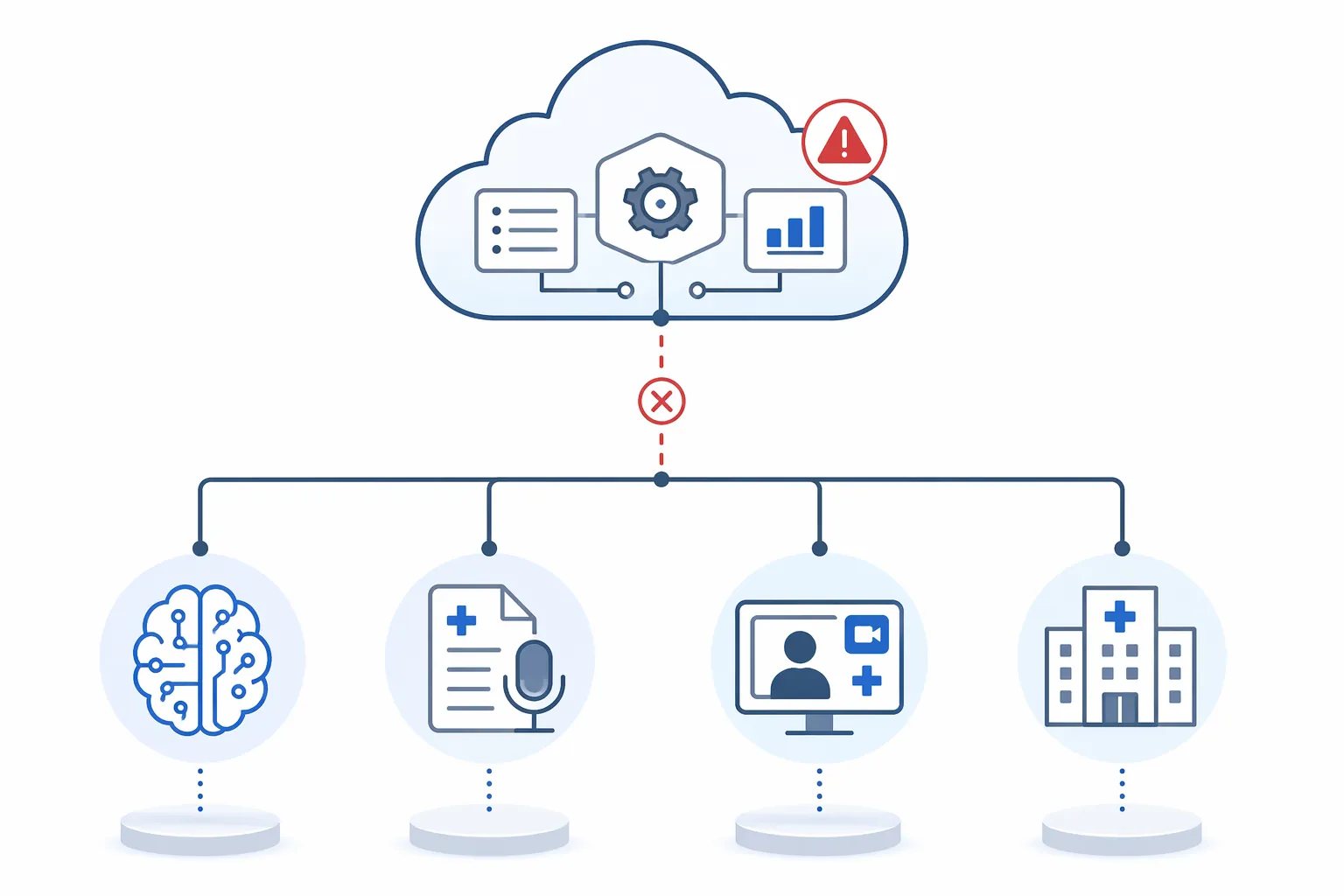
| Clinical workflow | What the user sees | Shared dependency to map |
|---|---|---|
| Ambient documentation | The visit note is delayed, incomplete, or unavailable | Identity, audio pipeline, transcription, model endpoint, EHR handoff |
| AI summarization or drafting | The assistant times out or returns no draft | Azure OpenAI access, routing, quota enforcement, application orchestration |
| Telehealth | Visits cannot launch or patients cannot connect reliably | Identity, session routing, communication services, traffic management |
| Cloud-hosted healthcare workflows | Scheduling, messaging, analytics, or care coordination tools degrade together | Authentication, policy control, APIs, cloud service management |
The map matters because it changes the downtime question. A health system that evaluates these products one contract at a time may believe it has diversified its clinical AI portfolio. In practice, several of those tools may be standing on the same operational floor. When the floor moves, the applications do not fail in the tidy order of the purchasing spreadsheet.
A Routing Failure Before the January Outage
The January 2026 event did not arrive without warning. In October 2025, an Azure outage tied to an Azure Front Door configuration error affected Microsoft 365, Outlook, Teams, Intune, and dependent services globally, according to contemporaneous reporting.[3] Azure Front Door is not a clinical application, but that is exactly why the incident is useful. Traffic-routing layers are easy to treat as invisible until they become the common cause of visible failures.
In a hospital incident bridge, the difference between an application outage and a routing-layer outage is immediately practical. An application outage lets teams isolate a workflow: use the downtime documentation form, switch one clinic to phone visits, hold one integration queue. A routing-layer outage produces ambiguity. Is the scribe down? Is the EHR integration down? Is authentication down? Is the patient portal down? The answer may be yes to several, because they are not independent at the layer that is failing.
What Patient-Care Disruption Looks Like
The strongest recent precedent is still the July 2024 CrowdStrike outage. It was not an AI outage, and it was not a Microsoft cloud control-plane outage in the same sense. But it showed what happens when a shared technical dependency suddenly enters clinical operations at scale. Microsoft said about 8.5 million Windows devices were affected globally, and Chartis estimated that more than 1 million of those devices were in healthcare.[4][5]
The downstream effects were not abstract. STAT reported that Mass General Brigham canceled all non-urgent surgeries, procedures, and medical visits during the disruption.[4] That is the part uptime percentages rarely convey: the work does not disappear. Patients wait. Schedulers rebuild calendars. Nurses and physicians re-sequence care. IT teams triage which systems are safe enough to bring back first.
The financial scale was also large, though it should be read carefully. A Parametrix estimate cited in public reporting put healthcare sector losses from the CrowdStrike event at about $1.9 billion; that is an insurance-industry estimate, not an audited ledger of every affected organization’s actual loss.[6] Even with that caveat, it is a useful reminder that technical outages in healthcare create costs far beyond vendor service credits.
When the AI Service Itself Is the Dependency
A few days after the January 22 Microsoft disruption, Azure OpenAI users reported production-impacting problems in Sweden Central on January 27 and January 28, 2026, including healthcare AI workloads dependent on the service.[7] Microsoft Q&A forum posts are not a sector-wide measurement, and they do not show how many hospitals were affected. They do show something more limited and still important: production AI workloads can be directly exposed when a regional AI service has availability problems.
That distinction matters. An unavailable AI service is not the same failure mode as a model that performs poorly. Poor performance raises validation, monitoring, bias, and clinical governance questions. Unavailability raises downtime, routing, staffing, and patient-safety questions. The fallback for a hallucinating chatbot may be to suppress the answer or require human review. The fallback for an unavailable documentation service is that someone must document another way, during or after the encounter, while the day’s clinical load continues.
ECRI’s 2026 health technology hazards list placed AI chatbot misuse at number one and IT outages at number two, a pairing that captures the split neatly.[6] One hazard is about unsafe output. The other is about the disappearance of the digital systems clinicians have been asked to depend on. Clinical AI programs need to govern both.
The Questions a Health System Should Be Able to Answer
The useful question after a Microsoft outage is not whether hospitals should abandon Microsoft. Managed cloud services, federated identity, and shared AI platforms can remove real drudge work from clinical teams. The safer question is more operational: what must the organization keep doing when the control plane, routing layer, or AI endpoint is unavailable?
- Which clinical workflows depend on Azure OpenAI, Nuance DAX, Microsoft 365 identity, Teams, Azure Front Door, or other Microsoft routing and orchestration services?
- Which of those workflows are patient-facing, clinician-facing, or revenue-cycle-facing, and which can safely pause?
- What is the documented fallback when the AI feature is unavailable but the clinic, inpatient unit, call center, or telehealth schedule remains open?
- Who has authority during an outage to turn off an AI feature, route work to a manual process, or shift encounters to another modality?
- How will the organization know whether the failure is local, regional, vendor-wide, identity-related, or model-service-specific?
A dependency inventory should be more concrete than a vendor list. “Uses Microsoft” is too broad to act on at 5:40 a.m. The inventory should name the service path: identity provider, network route, cloud region, model endpoint, integration engine, EHR handoff, storage location, monitoring console, and support contact. It should also name the clinical owner who can say what degraded mode is safe.
For organizations still comparing infrastructure options, the relevant exercise is not brand sorting. A comparison of AWS, Azure, and GCP for healthcare AI infrastructure is useful only if it reaches the failover design: whether a workload can move, whether identity can survive, whether data access remains compliant, and whether clinicians have a usable workflow while the preferred service is unavailable.
Failover Is a Workflow, Not Just an Architecture Diagram
Multi-cloud architecture can help, but only when it is tied to clinical workflow. A second model endpoint in another cloud does not solve much if clinicians still authenticate through the failed path, if the EHR integration cannot reach the alternate service, or if compliance review has never approved the secondary route. The same is true for a backup telehealth platform that no one has tested with scheduling, consent, interpreter services, and patient instructions.
Documentation deserves special treatment because it is often where AI quietly becomes operationally sticky. If an ambient scribe is unavailable, the fallback may be dictation, typed notes, templates, deferred documentation, or scribes for selected clinics. Each option has a different consequence: longer visits, after-hours work, delayed billing, weaker recall, or extra staffing. The downtime plan should say which one applies by setting, not leave every physician to improvise.
Telehealth needs the same specificity. A clinic may be able to convert some video visits to phone calls, but that does not automatically handle patient identity verification, consent, documentation, language access, remote monitoring data, or escalation to in-person care. A realistic downtime drill follows the patient, not the platform.
AI downtime drills should therefore include the services that are easiest to forget: authentication, messaging, routing, transcription, model access, EHR writeback, audit logging, and support escalation. A drill that only asks whether the model endpoint is up will miss the failure modes that actually strand clinical staff.
Procurement Should Ask About Degraded Mode
Procurement teams already ask about security, uptime, data use, subcontractors, and business associate terms. For clinical AI, they also need to ask how the product behaves when its shared cloud dependencies fail. The answer should not stop at an SLA table.
- Does the vendor provide a dependency map that identifies hyperscaler services, regions, identity providers, routing layers, and model providers?
- Can the product operate in read-only, queueing, local capture, alternate-region, or alternate-model mode during an outage?
- What clinical functions stop immediately, and which can continue with delayed synchronization?
- How quickly will the vendor disclose whether the outage is caused by its application, the hyperscaler, identity, routing, or a model service?
- Are downtime procedures tested with the health system, or only documented by the vendor?
A 99.9% uptime commitment sounds reassuring until it is translated into calendar time: it still permits about 8.76 hours of downtime per year. In a hospital, that can be an entire operating day, a full clinic block, or the difference between a manageable degradation and a queue that takes days to unwind. SLA credits may be contractually useful, but they do not approximate the operational cost of canceled procedures, manual recovery, delayed documentation, or patient rescheduling.
Forrester’s 2026 prediction, summarized by OpenMetal, warned that AI data center upgrades would trigger at least two major multi-day cloud outages in 2026 as hyperscalers invest heavily in GPU-centric infrastructure.[8] That is a forecast reported through a secondary source, not a guarantee. It is still worth taking seriously because clinical AI programs are being built at the same time cloud providers are reworking the infrastructure beneath them.
Clinical AI Can Stay, but the Dependency Must Be Named
The lesson from the January 2026 Microsoft outage is not that cloud-hosted clinical AI is inherently unsafe. The lesson is that a useful clinical tool can become a brittle clinical dependency when several workflows share the same control plane and no one has planned for that layer to disappear.
Hospitals do not need perfect independence across every digital service. They do need to know which failures will arrive together. If ambient documentation, telehealth, AI drafting, care coordination, and staff communication all depend on the same authentication and routing path, that path belongs in the clinical downtime plan, not just the cloud architecture diagram.
Clinical AI remains worth using when it reduces clerical load and helps staff spend more time on care. But shared cloud control planes have to be treated as clinical infrastructure dependencies. The failover plan should be designed, procured, drilled, and funded before the next outage begins.
References
- Microsoft 365 Nine-Hour-Plus Outage: 5 Things To Know. CRN.
- Microsoft 365 Outage 2026: Root Cause & Forensic Analysis. Medium.
- Microsoft Azure Outage Hits Microsoft 365, Outlook, and Teams Users Globally. Petri.
- Microsoft global outage forces hospitals to cancel appointments. STAT News.
- CrowdStrike outage exposes healthcare's IT vulnerabilities. Chartis.
- Chatbots, IT Outages, Devices Top 2026 Health Tech Hazards. BankInfoSecurity.
- Azure OpenAI Sweden Central outage reports. Microsoft Q&A. January 27–28, 2026.
- Forrester Predicts Two Major Cloud Outages in 2026. OpenMetal.
Comments
Join the discussion with an anonymous comment.