
The new military low testosterone testing policy is easy to read as a personnel-health directive: annual testosterone screening for service members aged 30 and older, announced in a July 15, 2026 memorandum. For the Military Health System, it is also a data event. If implemented across the active-duty and reserve population described in the policy discussion, the mandate would place repeated hormone measurements from roughly 1.3 million service members into the same health system record environment that is already under pressure to modernize its data architecture.
That distinction matters. A one-time screening campaign creates a backlog. A recurring screening mandate creates a longitudinal dataset. The first problem is scheduling, specimen collection, and result routing. The second is harder: defining denominators, normalizing lab values over time, linking results to symptoms and diagnoses, and deciding who is allowed to use the resulting data for operational analytics or AI development.

A Screening Mandate Meets a Digital Transformation Agenda
The timing is not incidental. In March 2025, the Military Health System published a Digital Transformation Strategy organized around four lines of effort, including a specific line to “integrate AI and data management.” The same Health.mil account of the strategy reported that the MHS Digital Policy Council was chartered in March 2025 and quoted the strategy’s warning that “failing to embrace digital transformation will hinder the MHS’s ability to effectively support the National Defense Strategy.”[1]
That strategy does not say the testosterone screening program has an AI architecture behind it. It should not be treated as a technical blueprint for hormone analytics. But it does establish the institutional direction of travel: the MHS wants better data management, more integrated digital systems, and a clearer way to govern AI across a health system that must serve both clinical and readiness functions.
Annual testosterone testing would put that ambition under ordinary clinical pressure. A lab result is not automatically an AI-ready feature. The record needs specimen timing, assay context, patient age, medication exposures, comorbidities, body composition measures, symptoms, repeat testing status, and clinician interpretation. Missing any one of those fields does not make the result useless for care, but it can make the result hazardous as a training label.
This is where the program becomes interesting for health IT. The MHS is not a small specialty clinic trying to retrofit a spreadsheet into a model. It is a large, relatively bounded health system with an electronic health record infrastructure, a defined beneficiary population, and command-level ability to standardize a screening requirement. If the annual testing data are captured consistently, the system could accumulate a longitudinal endocrine dataset that civilian care rarely produces at comparable scale or regularity.
The AI Question Starts Before Model Development
A 2024 analysis of artificial intelligence in the Military Health System concluded that the MHS “is behind its civilian counterparts in advancing AI.” The same analysis identified opportunities for better service member access to care and more precise resource allocation, while also noting that military medicine carries privacy and regulatory obligations beyond those in civilian settings.[2]
The testosterone mandate lands directly in that gap. It could give MHS analysts a recurring, systemwide stream of biomarker data. It could also expose how far the organization has to go before a mandated screening program can support prediction, triage, or population-health modeling without creating false confidence.
The temptation will be to ask whether AI can predict low testosterone from the rest of the record. That is a reasonable research question, but it is not the first operational question. The first question is whether the record can reliably distinguish a screening result, a diagnostic workup, a repeat confirmatory test, a symptomatic patient, and a patient already receiving treatment. In a longitudinal dataset, those distinctions determine whether the system is learning a clinical signal or learning the artifacts of policy implementation.
| Data element | Why it matters for AI validation |
|---|---|
| Test date and collection time | Testosterone varies during the day, so timing affects whether values are comparable. |
| Repeat testing status | Diagnostic standards require confirmation rather than reliance on a single low value. |
| Symptoms and clinical indication | Low laboratory values and testosterone deficiency are not identical clinical labels. |
| Age, BMI, race, and related demographic fields | Baseline hormone patterns differ across groups, so model performance must be checked for bias. |
| Comorbidities and common biomarkers | Prediction models may use routine clinical variables, but those variables can reflect population-specific risks. |
| Military occupational and deployment context | Service-specific exposures may alter endocrine patterns and affect generalizability from civilian data. |
This is not a clerical concern. If an annual screening field is treated as a clean diagnostic outcome, every downstream model inherits the error. A service member with one low afternoon value, no symptom documentation, and no repeat test should not become the same training label as a patient with two properly timed low morning measurements and compatible symptoms.
Why a Civilian Prediction Model Is Useful but Not Portable
The most concrete AI comparison point is the Novaes et al. machine-learning study described in 2021. In a civilian sample of 3,397 people, the study reported that testosterone deficiency could be predicted using six clinically accessible variables: age, abdominal circumference, triglycerides, HDL, diabetes, and hypertension, without requiring serum testosterone measurement.[3]
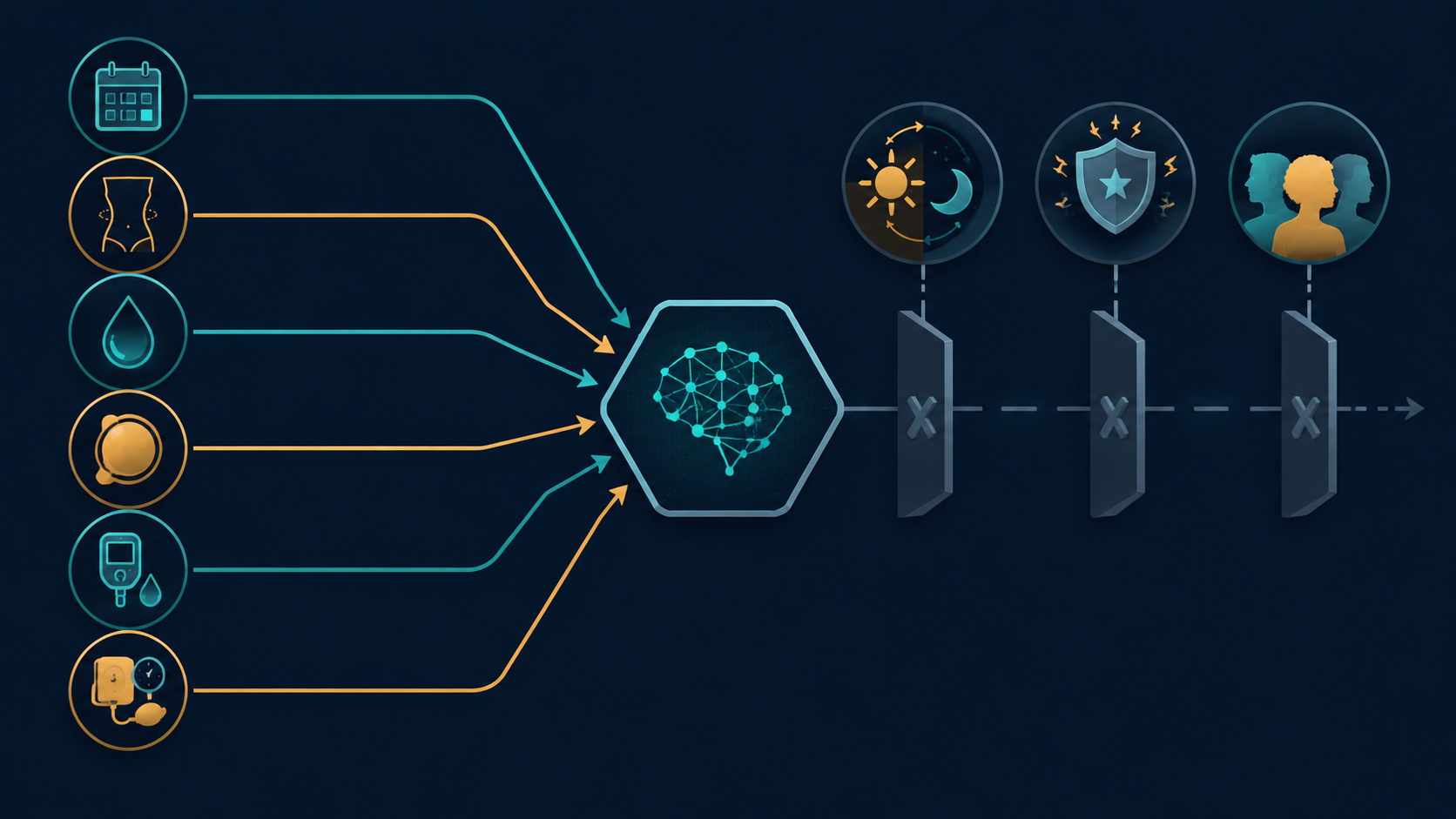
That finding is important because it makes the AI question practical. It suggests that routine clinical data may contain enough metabolic and demographic signal to estimate testosterone deficiency risk before ordering or interpreting a serum testosterone test. In a large health system, such a model could theoretically help identify who needs confirmatory testing, which clinics will see demand rise, or where abnormal results cluster.
But the study does not prove that the DoD can predict testosterone deficiency in service members. Its reported sample was civilian, and the available description does not indicate validation in a military population. The difference is not cosmetic. A force population has selection effects, fitness standards, occupational exposures, deployment histories, sleep disruption, stress injuries, medication patterns, and care-seeking behavior that may not match the population from which a civilian model learned its associations.
Even the six inputs that make the Novaes model attractive need scrutiny in this setting. Age is straightforward until analysts compare a 31-year-old special operator, a 43-year-old reservist, and a 52-year-old senior enlisted service member in the same annual screening denominator. Abdominal circumference may be captured differently across clinics or readiness assessments. Diabetes and hypertension may be coded consistently enough for quality measurement but still vary in onset, treatment status, and documentation completeness. Triglycerides and HDL may depend on fasting status and lab timing. The fact that these variables are clinically accessible does not make them automatically interoperable.
The Diagnostic Standard Is Stricter Than a Single Prediction
The American Urological Association guideline is a useful brake on overinterpretation. It recommends using a total testosterone level below 300 ng/dL as a reasonable cutoff, but the diagnosis should be made only after two total testosterone measurements taken on separate occasions, both conducted in an early morning fashion. The guideline also states that the clinical diagnosis requires both low total testosterone levels and symptoms or signs associated with testosterone deficiency.[4]
Those requirements are exactly where a mass screening program can generate misleading data if the workflow is not built carefully. Annual testing can produce a valuable first measurement. It does not, by itself, produce a diagnosis. If the first low value does not trigger a repeat early-morning test, or if symptoms are not captured in structured form, the EHR will contain a large number of incomplete diagnostic episodes.
For AI/ML development, this creates a label-definition problem. A model trained to predict “testosterone below 300 ng/dL on an annual screen” is answering a different question from a model trained to predict guideline-concordant testosterone deficiency. The first may be useful for operational planning. The second would require repeat results, specimen timing, symptom correlation, and exclusion or adjustment for confounders.
The distinction should shape governance from the beginning. A risk score that helps a clinic prepare for confirmatory testing is not the same as a diagnostic algorithm. A dashboard that shows abnormal annual results by unit or region is not the same as a clinical decision support tool. The same source data can support different products, but each product needs its own validation target.
Military Confounders Are Not Edge Cases
The military population also brings endocrine confounders that do not sit neatly inside a civilian metabolic-risk model. Operator Syndrome, documented by Frueh et al. in 2020, is one military-specific factor that may affect hormone interpretation. That is not a reason to abandon modeling. It is a reason to avoid pretending that a general population model has already crossed the validation bridge.
A model that performs well overall could still underperform in subgroups defined by age, race, BMI, occupation, deployment exposure, or injury history. Known demographic differences in baseline testosterone levels make this more than a fairness talking point. If a model overpredicts deficiency in one group and underpredicts it in another, the consequences could include unnecessary follow-up testing for some service members and missed evaluation for others.
The governance burden is heavier because military health data can affect more than a patient’s next clinic visit. Even when a hormone result is clinically routine, the surrounding institution includes readiness decisions, command structures, occupational qualification, and privacy sensitivities that civilian systems do not replicate. The 2024 MHS AI analysis is useful here because it does not merely say the military is behind on AI; it points to the additional regulatory and privacy obligations that make military deployment different from civilian implementation.[2]
What the Dataset Could Actually Prove
The strongest version of the testosterone program is not an instant diagnostic AI system. It is a disciplined learning environment. With repeated annual measurements, the MHS could study how testosterone values change over time, how often low screening values are confirmed on repeat morning testing, which clinical variables predict confirmed deficiency, and whether those predictors behave differently across demographic and occupational groups.
That kind of work would be unusually valuable because it begins with a mandated clinical process rather than a convenience sample. Civilian datasets often reflect who happened to seek care, who had insurance coverage, who received testing, and which clinicians ordered labs. A military screening mandate could reduce some of that selection bias by testing a defined age group on a recurring schedule. It would not remove bias altogether. It would change which biases have to be measured.
The operational questions are concrete. Are annual results recorded in a way that distinguishes screening from diagnostic follow-up? Are morning draws consistently identifiable? Are repeat tests linked to the original abnormal result? Are symptoms captured as structured data, free text, or not at all? Are assays comparable across facilities? Are reservists and active-duty members represented similarly in the data? Can analysts identify who was eligible for screening but did not receive it?
Without those answers, scale becomes a liability. A dataset covering more than a million people can produce narrower confidence intervals around the wrong outcome. It can also make local documentation habits look like biological patterns. The denominator matters as much as the numerator: a rate of abnormal screens means little if the system cannot say who was due, who was tested, what time specimens were collected, and who had confirmatory evaluation.
Governance Has to Arrive Before the Model
The MHS Digital Policy Council gives the system a plausible venue for exactly these decisions, but a council charter is not the same thing as dataset governance. For testosterone screening data to support AI responsibly, the system would need clear rules for data access, secondary use, model development, subgroup performance review, clinical escalation, and separation between care delivery and nonclinical use.
The most useful governance questions are not abstract. Who approves a model trained on screening results? What outcome is the model allowed to predict? Can a risk score be shown to a clinician before confirmatory testing? Does the model treat a single low value as an outcome, or only a guideline-concordant diagnosis? How are false positives and false negatives audited by age, race, BMI, and military role? What happens when a model performs well in the aggregate but poorly in a subgroup?
There is also a workflow test. A prediction model that adds alerts to an already crowded EHR without clarifying next steps will not improve care. In this use case, a useful tool would have to fit into specimen collection, result review, repeat testing, symptom assessment, referral pathways, and patient communication. If it cannot distinguish “needs repeat morning test” from “meets diagnostic criteria,” it is not ready for clinical decision support.
The Pentagon has not released implementation details such as cost, timeline, or phased rollout, so those questions should remain open. What is already visible is the shape of the informatics challenge. A policy memo can create a testing requirement quickly. It cannot, by itself, create validated labels, harmonized lab metadata, subgroup fairness checks, or clinically usable AI.
A Proving Ground, Not a Shortcut
The DoD’s annual testosterone screening program may become one of the most consequential real-world tests of AI governance in a large health system precisely because it is not a clean AI use case. It combines a top-down mandate, repeated laboratory data, a defined population, clinical diagnostic nuance, demographic variability, military-specific confounders, and an institution that has publicly acknowledged the need to integrate AI and data management.
If the MHS treats the program as a source of clean diagnostic labels, it will overlearn from an imperfect screening workflow. If it treats the program as longitudinal infrastructure that must be verified, normalized, governed, and clinically validated, it could generate evidence that civilian health systems would have difficulty producing. The mandate is not proof that AI can diagnose testosterone deficiency at military scale. It is a serious test of whether a large health system can turn mandated screening data into bias-aware, clinically valid, operationally governed AI.
References
- MHS GENESIS and Digital Transformation Strategy reinforce DOD’s commitment to health care modernization, Health.mil, May 19, 2025.
- Artificial Intelligence in the Military Health System, PubMed, 2024.
- Low Testosterone & AI: How Artificial Intelligence Is Redefining Testosterone Diagnostics, REGENX Health, 2021.
- Testosterone Deficiency Guideline, American Urological Association.
Comments
Join the discussion with an anonymous comment.