
The most persuasive case for ai in menopause health management is not a chatbot, a symptom tracker, or a wellness dashboard. It is a risk model for low bone mass in menopausal women that can be tested against a hard clinical concern: who is likely to have osteopenia or osteoporosis before a fracture makes the answer obvious.
In 2026, Chen and colleagues reported an XGBoost model for predicting low bone mass in menopausal women. The model was trained and internally validated in 3,738 women and externally validated in 1,008 women, achieving an AUC of 0.918 internally and 0.910 externally. It also outperformed logistic regression, random forest, support vector machine, and K-nearest neighbor models in the same study.[1]

That is the right place to start because the study combines strong performance, external validation, and a clinically relevant target, while still showing why research performance does not automatically translate into a deployable clinical tool.
The osteoporosis model is the strongest evidence so far
Osteoporosis is a useful test case for machine learning in menopause-associated care because the clinical problem is familiar: many women cross into higher skeletal risk during and after the menopause transition, but formal assessment often happens late or inconsistently. A model that can identify low bone mass earlier could, in principle, help decide who should receive dual-energy X-ray absorptiometry, closer follow-up, or more intensive risk-factor review.
Chen et al. began with 62 candidate features and retained a smaller predictor set led by weight, free thyroxine, age, thyroid-stimulating hormone, and bone turnover markers.[1] The final model used XGBoost, a gradient-boosted decision-tree method that builds an ensemble of sequential trees, with later trees correcting errors made by earlier ones. In practical terms, it can capture nonlinear relationships and interactions that a conventional regression model may miss, though that flexibility also increases the need for careful validation.
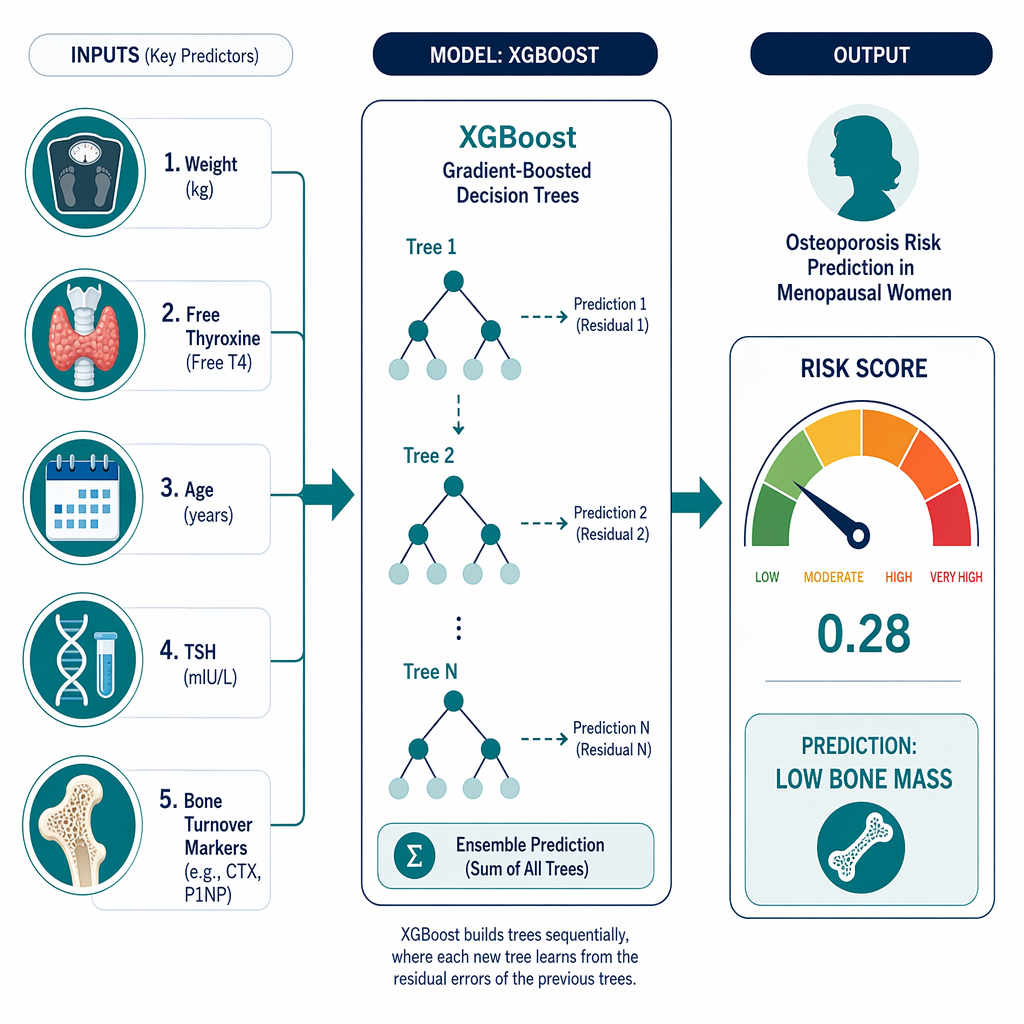
The reported discrimination is clinically interesting. An AUC of 0.918 means the model separated women with and without low bone mass well in the internal validation set; the external AUC of 0.910 suggests the signal was not confined to the development sample.[1] That second number is particularly important. Too many prediction models look impressive only inside the population and workflow that produced them.
| Readiness question | What Chen et al. contributes | What still limits deployment |
|---|---|---|
| Was there external validation? | Yes. The model was externally validated in 1,008 women. | The validation remained within Chinese populations, limiting confidence in multi-ethnic transfer. |
| Did it improve on simpler methods? | Yes. It outperformed logistic regression, random forest, SVM, and K-nearest neighbor models in the study. | Better discrimination does not by itself establish better clinical outcomes. |
| Are predictors clinically recognizable? | Yes. Age and weight are ordinary clinical variables; thyroid and bone turnover measures are biologically plausible and interpretable. | Free thyroxine, thyroid-stimulating hormone, and bone turnover markers may not be routinely ordered in primary care screening workflows. |
| Is it ready for routine care? | It provides one of the clearest menopause-associated ML risk models currently available. | It still needs prospective, multi-ethnic validation and a regulatory pathway before use as a clinical device. |
The predictor list is where implementation becomes less elegant than the model. Age and weight are already available in most outpatient records. Thyroid-stimulating hormone may be available for some women, depending on local practice and symptoms. Free thyroxine and bone turnover markers are more variable. If a risk tool depends on laboratory inputs that primary care does not routinely collect, then someone has to decide when to order them, who pays for them, and what to do when the result generates an intermediate-risk score rather than a clear action.
That does not weaken the scientific result. It changes the implementation claim. The Chen model is not just a statistical exercise; it is a plausible research-grade risk stratifier. But its clinical value would depend on whether it can improve decisions already made in bone health care: referral for bone-density testing, timing of repeat assessment, preventive counseling, and treatment discussions for women whose risk is otherwise underestimated.
A good AUC is not the same as a care pathway
The gap between model performance and clinical use is not a technicality. If the model flags a woman as high risk, a clinician needs to know the next step. Does she receive DXA sooner? Does the threshold differ by age group? Does the score add value beyond existing fracture-risk assessment and ordinary clinical judgment? Would a false-positive result lead to unnecessary testing, anxiety, or treatment? Would a false-negative result delay evaluation in a woman whose risk was already concerning?
Those are prospective questions. Retrospective discrimination can show that a model recognizes patterns in existing data. It cannot prove that using the model improves fracture prevention, clinic efficiency, medication decisions, or patient understanding. This is the recurring issue across AI models for menopause-associated comorbidities: many are beginning to identify meaningful risk signals, while far fewer have been tested as interventions inside the workflows where women actually receive care.
Cognitive decline: accessible inputs, earlier evidence
The cognitive decline work is less mature than the osteoporosis evidence, but it addresses an access problem that matters. In January 2025, The Menopause Society reported machine learning models that used questionnaire-based variables to identify severe subjective cognitive decline during the menopause transition in data from more than 1,200 women.[2] The variables included sociodemographic, menstrual, lifestyle, and mental health factors rather than laboratory tests or imaging.[2]
That feature strategy deserves attention. Cognitive complaints during the menopause transition are common in clinical conversations, but the boundary between expected symptoms, mood and sleep contributions, and clinically meaningful decline is not always clear at the first visit. A questionnaire-based model, if validated, could be easier to embed into primary care, gynecology, or midlife health visits than a tool requiring imaging or specialized biomarkers.
The evidence should not be inflated. The available source is a press release, and the work had not appeared as a peer-reviewed validation study as of Q3 2026. The design is described as cross-sectional in the available materials, which means it can identify associations with severe subjective cognitive decline, not prove that the model predicts future cognitive trajectory. Subjective cognitive decline is also not the same endpoint as objective neuropsychological impairment, dementia, or Alzheimer’s disease.
Still, the approach points toward one of the more plausible near-term uses of machine learning in menopause care: structured triage. A tool based on low-burden questionnaire data could help identify who needs more detailed cognitive, mood, sleep, medication, or vascular risk assessment. The clinical promise lies less in producing a definitive diagnosis and more in reducing the chance that a woman’s escalating symptoms are dismissed as nonspecific midlife distress.
Cardiovascular risk remains the thinnest menopause-specific evidence
Cardiovascular disease is the outcome many clinicians most want to predict better during and after the menopause transition, but the menopause-specific AI evidence available here is less concrete than the osteoporosis evidence. Reviews of AI in menopause management describe cardiovascular applications, including AI-enhanced electrocardiography and imaging-based approaches, as part of a broader field of risk assessment and individualized care.[3][4]
There are good reasons for interest. ECG signals and mammography-derived vascular or tissue features may contain risk information that is not fully used in routine interpretation. A model that could extract that information reliably for postmenopausal women might help identify cardiovascular risk earlier, especially when conventional risk calculators underweight sex-specific or menopause-related factors.
But the available material does not provide the same level of performance specificity seen in Chen et al.’s osteoporosis model. Without clear AUCs, calibration results, sensitivity and specificity at clinically meaningful thresholds, external validation details, and subgroup performance, cardiovascular AI should be described as emerging rather than ready. It may be one of the most important destinations for the field, but it is not yet the best-supported example in this evidence set.
The recurring limits are clinical, not only computational
Across osteoporosis, cognitive decline, and cardiovascular risk, the same readiness questions keep returning. The first is population transfer. The strongest osteoporosis study was conducted entirely in Chinese populations.[1] That does not make the model weak; it makes its next validation step obvious. Weight, thyroid measures, bone turnover markers, menopause timing, comorbidity patterns, treatment exposure, and access to screening can vary across populations and health systems. A feature ranking that performs well in Zhejiang or Hangzhou should not be assumed to behave identically in a multi-ethnic U.S. primary care network.
The second is design. Retrospective and cross-sectional studies are useful for model development and early signal detection, but they are not the same as prospective testing. A prospective study asks what happens when clinicians and patients actually receive the score: whether ordering changes, whether follow-up improves, whether high-risk women are found earlier, and whether harm is introduced through over-testing or misclassification.
The third is variable availability. Models built from routinely collected information are easier to imagine in practice than models requiring new laboratory panels, imaging extraction, or specialty-only measurements. This is why the cognitive decline work is intriguing despite its weaker evidentiary status, and why the osteoporosis model, despite its stronger validation, still raises workflow questions. A prediction tool cannot help at scale if the inputs are missing for most of the women it is supposed to screen.
The fourth is regulatory status. As of Q3 2026, there is no FDA 510(k), De Novo authorization, or CE-marked AI device specifically cleared for menopause risk prediction. That absence matters because these tools would influence clinical decisions about testing, referral, surveillance, or treatment. A model can be useful for research and still not be appropriate for unsupervised clinical deployment.
What would make these models clinically credible?
The field does not need less ambition. It needs cleaner evidence. For osteoporosis, the next step is not another small internal comparison among algorithms; it is prospective, multi-ethnic validation with predefined thresholds and clinically meaningful endpoints. The model should be tested against the decisions clinicians already make: who receives DXA, who is referred, who is counseled more intensively, and whether the score improves classification beyond simpler tools.
For cognitive decline, the immediate need is peer-reviewed reporting with transparent methods, validation, and clear endpoint definitions. A questionnaire-only model could be valuable precisely because it is low burden, but that advantage should not be used to excuse weak validation. It must be clear whether the model identifies current severe subjective cognitive decline, predicts future decline, or simply captures correlated distress, sleep disruption, mood symptoms, and demographic factors.
For cardiovascular applications, menopause-specific performance reporting is essential. A model demonstrated in postmenopausal women should show how it performs in that group, how it compares with conventional risk assessment, whether calibration is acceptable, and whether performance differs by race, ethnicity, age, hormone therapy exposure, diabetes, hypertension, or prior cardiovascular history. Without those details, the technology remains interesting but difficult to act on.
Where the evidence stands in 2026
Machine learning is beginning to reveal measurable patterns in menopause-associated disease risk. The osteoporosis evidence is currently the strongest example: a defined model, a defined population, external validation, comparator performance, and identifiable predictors. Cognitive decline screening is promising because it may be feasible with questionnaire-based inputs, but the available evidence is earlier and not yet peer-reviewed. Cardiovascular risk modeling is clinically important but, in the materials available here, less specific and less deployment-ready.
The responsible conclusion is neither enthusiasm nor dismissal. These models are becoming good enough to justify prospective validation studies, but they are not yet cleared clinical instruments for routine menopause risk prediction. Until multi-ethnic prospective validation and regulatory review catch up, machine learning in menopause health management remains a serious research tool with clinical potential, not a finished layer of care.
References
- Development and validation of a machine learning model for predicting low bone mass in menopausal women. Scientific Reports, 2026.
- AI helps to identify subjective cognitive decline during the menopause transition. The Menopause Society, January 2025.
- Revolutionizing Menopause Management. PMC.
- Preparing for the future. Climacteric.
Comments
Join the discussion with an anonymous comment.