
The striking fact about MLB’s AI dugout ban is not that Major League Baseball suddenly discovered generative AI in the dugout. It is that the league acted while the existing rules were still being followed. MLB issued a memo on June 11, 2026, made the restriction effective on July 15, 2026, and did so after a league review found clubs compliant with the rules then in place.[1]
That timing matters. A regulator did not wait for a public controversy, a disputed postseason decision, or a finding that a team had crossed a formal line. It redrew the line before the old one failed.
The mechanism was narrow. MLB did not remove iPads from dugouts. It did not ban analytics. It removed the “custom tab” from a three-tab iPad system that some clubs had used to surface real-time generative AI recommendations. Teams retained access to static pre-game data, delayed video, and Statcast analytics.[1]
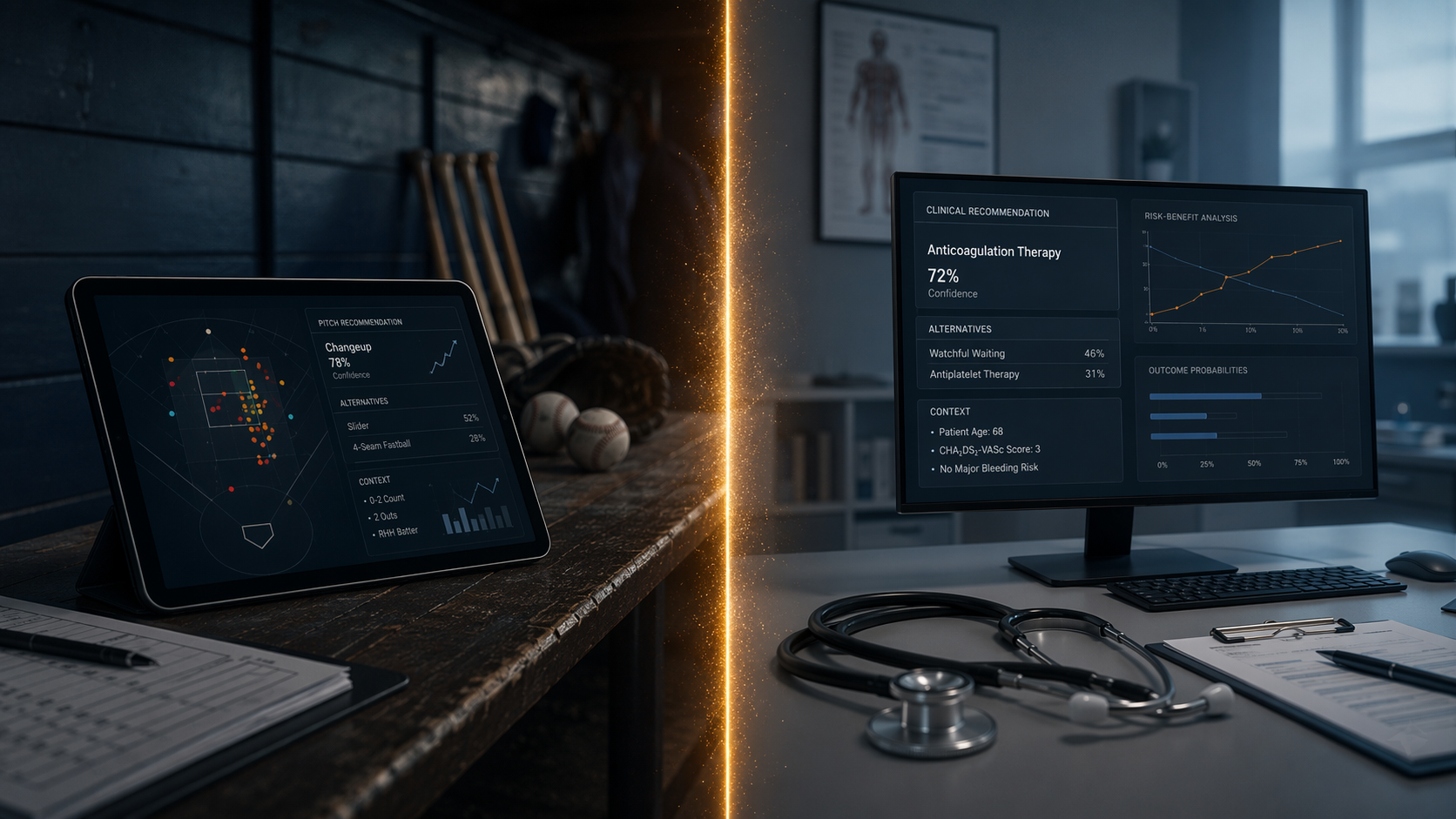
That is the useful part for healthcare leaders. The ban was not a rejection of computation. It was a rejection of allowing a live recommendation engine to occupy the space where a coach, catcher, or manager traditionally makes a time-sensitive judgment.
What MLB Actually Removed
The reported uses of the custom tab are familiar to anyone who has watched decision support move from retrospective analysis into the workflow: pitch-calling recommendations, substitution suggestions, and defensive positioning prompts.[1] AP reported that as many as six teams were using AI for pitch-calling specifically, while The Athletic described use by as much as a third of the league for any AI dugout purpose.[2][1]
Those figures should not be collapsed into one claim. “As many as six” refers to a narrower use case. “As much as a third” refers to a broader category of dugout AI use. The uncertainty is part of the governance lesson: regulators often act before the installed base is cleanly mapped, because waiting for perfect visibility can mean waiting until the practice is already embedded.
The league’s stated concern was the integrity of decisions “traditionally made by players and coaches,” and one front-office executive summarized the posture as an effort to “stop the cheating before there’s cheating.”[1] That phrase is blunt, but it captures a regulatory temperament that healthcare is now seeing in its own statutes and guidance: define the non-delegable human act before a tool converts a workflow habit into a de facto automated decision.
Adam Ottavino publicly confirmed that the Mets were among the teams using AI for pitch-calling.[2] That confirmation does not prove misconduct. It clarifies the character of the intervention. MLB was not responding to a rogue system operating outside the rules. It was deciding that the next version of a compliant workflow would create the wrong allocation of judgment.
The Boundary Is Assistance Versus Substitution
Healthcare has its own version of the custom tab problem. A model that organizes information, drafts a summary, flags a chart, or proposes options can sit comfortably inside many clinical and administrative workflows. A model that effectively decides whether care is covered, whether a patient receives treatment, or which intervention is selected occupies different ground.
Georgia’s SB 544 is unusually clear on this point. The law permits AI to “automate tasks, reduce administrative burdens, participate in decision-making,” but bars AI from issuing adverse determinations without review by a licensed provider.[3] The phrasing is worth sitting with because it rejects a lazy binary. AI is not outside the process. It may participate. But participation is not authority.
That distinction is where many “human in the loop” claims become thin. A licensed professional who clicks approval on a recommendation they cannot inspect, challenge, or realistically overturn is not a meaningful loop. They are a liability transfer point. In both the dugout and the clinic, the question is not whether a human is nearby. It is whether the human retains the practical ability and institutional obligation to make the judgment.
| Permitted role | Restricted role |
|---|---|
| Organize information before the decision | Make the final time-sensitive decision |
| Surface relevant data or options | Issue an adverse determination without licensed review |
| Support professional judgment | Autonomously determine a specific treatment recommendation |
| Operate in a supervised testing channel | Diffuse informally into high-stakes workflow |
The MLB rule is cleaner than most healthcare implementation will ever be. Removing a custom tab from a dugout iPad is administratively simpler than redesigning prior authorization, clinical decision support, documentation, utilization management, and patient communication workflows across a health system. But the line being drawn is recognizable: keep AI close enough to inform the accountable human, and far enough away that it cannot quietly become the accountable actor.
Healthcare Law Is Moving Toward the Same Line
In 2026, at least five states enacted laws prohibiting health insurers from using AI as the sole basis for denying, delaying, or downcoding claims without licensed professional review: Washington SB 5395, Indiana HB 1271, Georgia SB 544, Alabama SB 63, and Maryland legislation.[3] The shared concern is not that insurers use software. It is that an automated system might become the decisive basis for an adverse outcome while the human reviewer becomes ornamental.
The consequence lands on a named person and a real patient. If an adverse determination blocks or delays care, a compliance team cannot satisfy the governance problem by saying that AI was only one input if no licensed reviewer meaningfully evaluated the medical facts. The law requires review that can change the outcome, not merely review that documents the output.
Maine’s HB 2082, enacted in April 2026, goes further in one particularly sensitive context by barring mental health professionals from using AI for therapeutic communications or treatment decisions.[3] That is closer to MLB’s dugout rule than to a general AI governance framework. It does not say AI can never be useful around the practice. It says certain human exchanges and decisions should not be delegated to the tool.
FDA’s January 2026 clinical decision support guidance draws the same boundary in federal regulatory terms. Software that informs clinician judgment may fall outside device regulation, while software that autonomously determines specific treatment recommendations is treated differently.[4] The distinction turns on what the software does to the clinician’s role. If the clinician can independently review the basis for the recommendation and exercise judgment, the system is functioning as support. If the system determines the specific treatment path, the posture changes.
This is why broad claims about AI improving efficiency are not enough for governance. Efficiency is not the same question as delegation. A tool may shorten review time, reduce clerical work, or synthesize more information than a person could comfortably hold in working memory. None of that answers whether the final decision remains reviewable, contestable, and owned by the licensed professional or accountable organization.
Preemptive Regulation Is Becoming Less Exceptional
The uncomfortable part of the MLB case is that it denies the usual institutional excuse for delay. The league did not need a proven scandal to decide that real-time generative recommendations in the dugout changed the character of the game decision. It treated the presence of the capability as enough reason to define a boundary.
Healthcare regulators are increasingly acting with similar impatience. The state insurance laws do not wait for a settled record of AI-caused denials in every jurisdiction before restricting sole-basis determinations. Maine’s therapeutic communication restriction does not wait for AI-mediated therapy to become routine before naming a protected zone. FDA’s decision support framework does not assume that every recommendation tool is harmless until a patient is injured.
The parallel should not be overstated. MLB is not healthcare, and a bullpen decision is not a coverage denial or a treatment plan. Baseball governance answers to competitive integrity; healthcare governance answers to patient safety, professional licensure, benefit obligations, and public trust. But both domains are confronting the same operational drift: once AI recommendations appear inside the live workflow, the difference between “the system suggested” and “the system decided” can narrow quickly.
That drift is especially easy to miss when the interface is elegant. A custom tab is not a robot replacing a coach. A prior authorization recommendation screen is not, on its face, an autonomous denial. A treatment suggestion embedded in a clinical workflow may look like one more decision support prompt. Governance has to look past the visual modesty of the interface and ask what the system is doing to the human’s responsibility.
Supervision Is Not the Same as Permission Everywhere
Not every proactive model is a ban. Utah’s AI Policy Act regulatory sandbox, operational in 2026, is a different governance instrument. It creates a supervised channel for testing, including an autonomous prescription renewal pilot, rather than simply prohibiting the activity outright.[4]
That sandbox should be treated carefully. It is not proof that autonomous prescription renewal is safe, scalable, or ready for broad deployment. It is evidence of another regulatory instinct: if high-stakes AI systems are going to be tested, they should be tested in a defined environment with supervision rather than allowed to seep into ordinary workflow through procurement, pilot enthusiasm, or local workaround.
For healthcare leaders, the practical implication is that “allowed somewhere” will not mean “allowed generally.” A system may be acceptable as administrative automation, unacceptable as the sole basis for denial, permissible in a sandbox, restricted in therapeutic communications, and regulated as a device if it autonomously determines a specific treatment recommendation. The same model family can cross multiple legal categories depending on the decision it touches.
What Leaders Should Expect Next
The near-term governance pattern is not a wholesale AI prohibition. It is a narrowing of where AI may sit when the decision is high-stakes, time-sensitive, and historically assigned to a trained human. Rules will continue to distinguish between systems that prepare, summarize, retrieve, rank, or recommend and systems that effectively decide.
That means healthcare organizations should expect sharper questions from boards, regulators, contracting teams, and clinical governance committees:
- Which decision does the AI touch, and is that decision adverse, therapeutic, time-sensitive, or traditionally licensed?
- Can the responsible professional see enough of the basis for the recommendation to disagree with it?
- Is human review capable of changing the outcome, or is it mainly a signoff step?
- Who is accountable when the recommendation is wrong: the vendor, the institution, the reviewer, the clinician, or some unclear combination?
- Does the workflow record why the human accepted, modified, or rejected the AI output?
Those questions are less dramatic than a ban announcement, but they are where the actual boundary is enforced. A policy that says “human in the loop” without defining review rights, override expectations, documentation, and accountability will not satisfy the direction of 2026 AI governance.
The MLB example is useful precisely because it is outside healthcare. It strips the issue down to its governance form. A central authority saw real-time AI recommendations entering a protected decision space, left adjacent analytics intact, and removed the feature that most directly threatened human judgment. Healthcare regulators are drawing more complicated versions of that same line.
MLB did not import healthcare policy, and healthcare regulators are not copying baseball. Both are reacting to the same 2026 problem: AI can assist a human decision so seamlessly that, unless the boundary is set early, substitution may arrive before anyone formally approves it.
References
- MLB bans AI from dugout iPads, The Athletic, July 16, 2026.
- MLB bans AI from dugout iPads, AP News.
- States Continue Efforts to Regulate AI in Healthcare, Holland & Knight, May 2026.
- The 2026 Guide to Healthcare Generative AI Regulations, Frameworks, and Compliance for Leaders, Nixon Law Group.
Comments
Join the discussion with an anonymous comment.