
The clean version of an injured-list activation fits in one transaction line: a player returns, the roster is whole again, and the club has one fewer problem. The less clean version is usually printed right after it. A pitcher with options goes out. That second name is where the bullpen impact actually starts.
When the Reds activated Nick Lodolo in 2026, the corresponding move was Jose Franco being optioned to the minors. BlogRedMachine framed the move plainly: Cincinnati got a starter back, but created a “good-sized hole” in a bullpen where most relievers were being used for one inning at a time.[1] That is the kind of transaction that looks administrative until the next short start arrives.
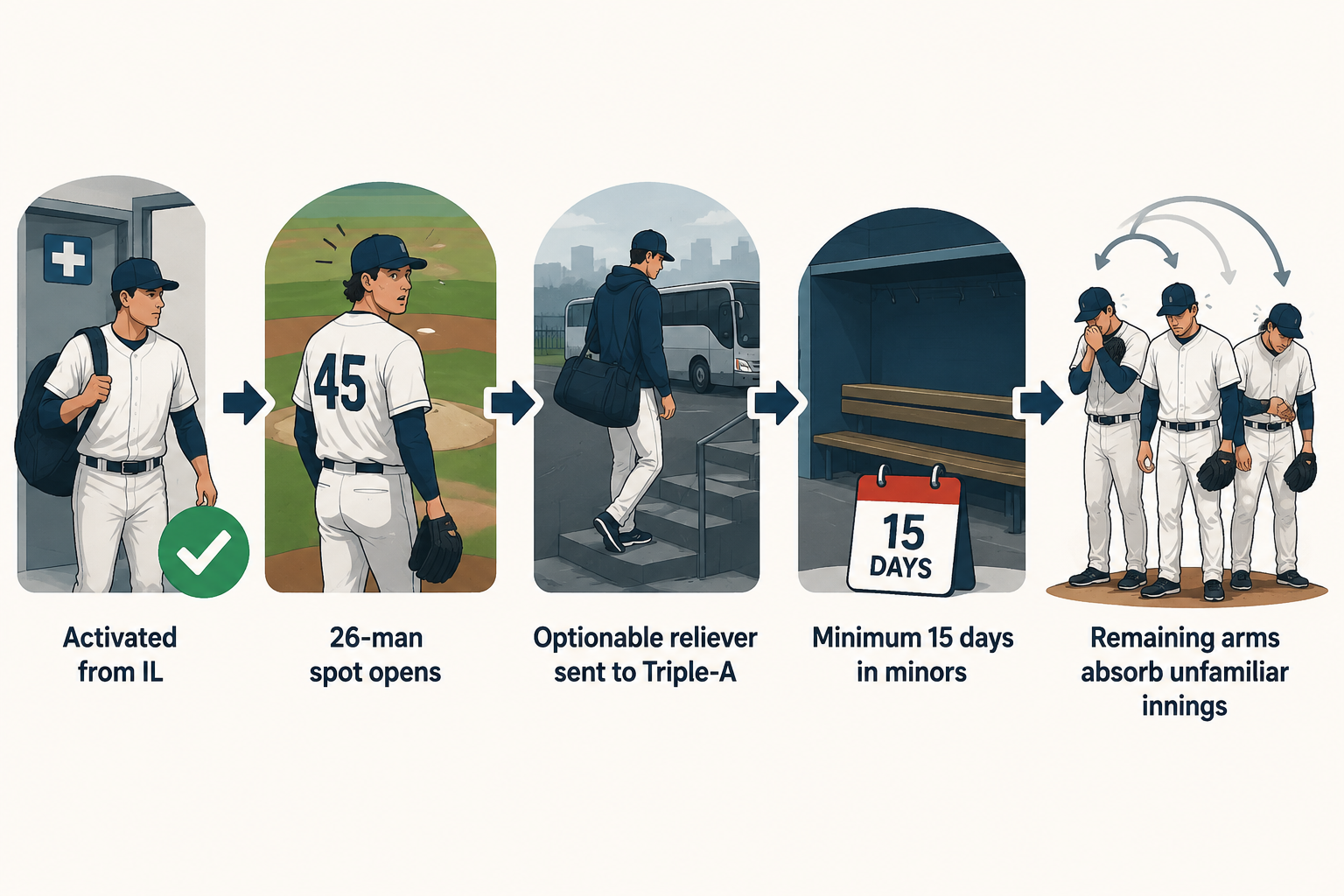
The corresponding move is not just paperwork
A player returning from the 15-day injured list has to be restored to the active roster. That means a 26-man spot has to open. For pitchers, MLB’s 15-day injured list is the standard injured-list category, and minor-league option rules create the more important aftershock: once a pitcher is optioned, he generally cannot return for at least 15 days unless replacing an injured player or under another permitted exception.[2][3]
That minimum stay is why the bullpen cost is sticky. If a club sends down its eighth reliever on Monday, it has not merely created space for Monday night’s starter or position player. It has removed a pitcher from the next series, the next off-day calculation, and the next game in which the starter exits after four innings.
| Transaction step | Bullpen consequence |
|---|---|
| A non-reliever is activated from the injured list | A 26-man roster spot must open |
| The club chooses an optionable reliever | The least protected bullpen role disappears first |
| The pitcher is optioned | He usually must stay down for at least 15 days |
| The next short start or extra-inning game arrives | Remaining relievers inherit innings outside their normal lanes |
The roster logic is easy to understand and hard to absorb. Starters are rarely sent out if they are part of the rotation plan. Position players are protected by lineup needs, platoon balance, defense, and bench coverage. Relievers with minor-league options become the pressure valve because they can be moved without exposing them to waivers. The move is rational. It can still leave the major-league bullpen worse prepared for the least tidy innings on the schedule.
What disappears when the optioned pitcher leaves
The reliever who gets optioned is often described by what he is not. He is not the closer. He is not the primary setup arm. He is not the starter being celebrated on the activation line. That wording misses the actual job. The optioned pitcher may be the only arm the manager is willing to ask for two innings in a five-run game, the first call after a starter’s pitch count spikes in the third, or the bridge that keeps higher-leverage relievers from warming before the game has a leverage point.
The Reds example is useful because it is specific. Lodolo’s return strengthened the rotation. Franco’s departure reduced a form of bullpen coverage that does not show up in the same headline. BlogRedMachine’s conclusion should not be stretched into a leaguewide measurement; it is a fan-site reading of one roster move. But it aligns with the official transaction structure: the club needed a 26-man spot, chose an optionable pitcher, and then had to live with the option clock.[1][3]
The role lost is usually not glamorous because the innings are not glamorous. Bulk relief after a starter gets clipped early. Low-leverage coverage after the offense falls behind. A sixth inning taken quietly so the seventh- and eighth-inning arms do not have to work for the third time in four days. Those are the innings ordinary coverage treats as fungible until there is no one left to absorb them.
That is also why the effect is not always visible the same night. The activated starter may throw well. The bullpen may need only two innings. The roster cost appears later, when the next starter labors, when a reliever warms twice and enters once, or when the manager has to choose between using a leverage arm down three runs or letting a tired pitcher stretch beyond his usual assignment.
Reliever activations are the boundary case
Not every injured-list activation damages the bullpen. When the returning player is a reliever, the roster math can work in the other direction. The Red Sox activated Justin Slaten from the injured list in 2026 and optioned Jack Anderson. Interim manager Chad Tracy said Slaten’s return “slides some really good arms back a little earlier in the game,” a description of a bullpen getting deeper at the front end rather than thinner at the back end.[4]
That case matters because it prevents the lazy version of the argument. An IL activation is not automatically a bullpen loss. If a late-inning reliever returns, the club may shorten the game, reduce forced leverage for other arms, and put pitchers back into cleaner roles. The bullpen still loses someone from the active roster, but the pitcher coming in belongs to the same unit and may upgrade the hierarchy.
The sharper distinction is between reliever-for-reliever activations and non-reliever activations. When a starter or position player returns, the bullpen often pays for a roster improvement elsewhere. The club may be better overall. The relief corps can still be less flexible by the seventh inning.
The 15-day option clock changes the manager’s week
The option minimum for pitchers is the rule that turns a clean roster fit into a workload problem. If the optioned reliever could return after one game, the club could treat the move as a temporary squeeze. Because the normal minimum is 15 days, the manager and bullpen coach have to reassign innings across multiple turns through the rotation.[3]
A bullpen without its bulk arm does not stop needing bulk innings. It just buys them differently. A one-inning reliever takes four outs. Another enters earlier than planned. A leverage arm becomes available only in the narrowest version of the game script. The freshest pitcher may be asked to finish a loss because he is the only one who can do it without damaging the next day’s plan.
This is where the transaction log and the bullpen card start talking to each other. The optioned pitcher’s absence is not measured only by his own innings. It is measured by the inning he would have taken from someone else, the warm-up he would have prevented, and the leverage arm he would have kept seated until the game actually deserved him.
The Athletic’s 2022 analysis of reliever usage found that teams operating with shorthanded bullpens because of roster constraints tended to pile up the most back-to-back-to-back appearances.[5] That study is not a 2026 measurement and predates later MLB rule changes. It still identifies the right stress signal: when the roster leaves fewer usable relief paths, the same arms begin showing up on consecutive days.
The quiet extra layer: the 60-day injured list
Most activation coverage focuses on the 26-man roster because that is where the nightly bullpen lives. The 60-day injured list adds another layer. A player on the 60-day IL does not count against the 40-man roster, so when he returns, the club must also create a 40-man spot.[6]
That does not always mean another reliever is directly removed from the active bullpen. The 40-man move can involve a designation, transfer, or other roster mechanism depending on the club’s situation. But it raises the transaction cost of the return. A club is no longer only asking, “Who leaves the 26-man roster tonight?” It is also asking, “Who can we afford to remove from the broader inventory?”
For bullpen depth, that broader inventory matters. The next optionable arm, the next shuttle candidate, and the next emergency call-up all live on that 40-man map. A 60-day IL activation can therefore tighten both the current bullpen and the reserve list behind it, even when the visible corresponding move is somewhere else.
Why the least famous pitcher can be the most relevant name
The activated player is usually the better story. A starter returns to the rotation. A regular bat goes back into the lineup. A late-inning reliever restores order. Those things matter, and clubs do not make these moves because they enjoy thinning the bullpen. They make them because the roster requires a choice.
The mistake is treating the corresponding move as clerical. If the optioned player is a short-burst reliever with no defined role, the bullpen may absorb the loss without much trouble. If he is the arm trusted to cover the innings nobody wants until they arrive, the activation has moved stress from one part of the roster to another.
That stress usually reveals itself in small decisions rather than dramatic failures. A reliever works a third straight day. A setup arm enters in a lower-leverage inning because there is no softer bridge. A manager leaves a tired pitcher in to protect tomorrow. None of those moments will be labeled as the cost of last week’s activation, but the line can run through the optioned name.
So the bounded claim is simple enough: IL activations are not automatically bullpen damage. Reliever activations can strengthen the group. But when the returning player is a starter or position player, the corresponding move often removes exactly the pitcher a club needs when the next game gets messy. The activated name tells you who came back. The optioned name tells you who is no longer available to clean up the innings that do not fit the plan.
References
- Reds finally activate Nick Lodolo but quietly weakened bullpen depth, BlogRedMachine, 2026.
- 15-day Injured List, MLB.com Glossary.
- Minor League Options, MLB.com Glossary.
- Justin Slaten activated from injured list, MLB.com, 2026.
- How MLB teams are managing relievers when back-to-back-to-backs become problematic, The Athletic, 2022.
- 60-day Injured List, MLB.com Glossary.
Comments
Join the discussion with an anonymous comment.