
A health system evaluating AI chatbot applications in healthcare and patient engagement in Q3 2026 starts with an awkward regulatory fact: the FDA’s public list of more than 1,200 AI-enabled medical device authorizations does not identify an authorized generative AI conversational agent for patient engagement.[1] That does not end the procurement conversation. It changes the questions.
The pitch may sound operationally modest: reduce call-center burden, answer post-discharge questions, remind patients what to watch for, route concerns to the right team. Those are attractive use cases. But the moment a patient-facing chatbot moves from “Your appointment is Tuesday” to “Your symptoms may be expected after surgery,” the system buying it needs a sharper file than a demo deck and a general statement that the product is “not a medical device.”

The FDA Baseline Is Still Empty for Generative Patient Chatbots
The FDA’s AI-enabled medical devices list is often the first stop because it gives procurement and compliance teams a grounded view of what has actually received authorization. The list includes more than 1,200 AI-enabled device authorizations, but the available record identifies zero entries indicated as generative AI conversational agents for patient engagement.[1]
That matters for two reasons. First, it prevents a common category error: treating “AI in healthcare” as if all tools have moved through the same regulatory channel. A radiology algorithm on the FDA list and a large-language-model chatbot answering recovery questions are not interchangeable regulatory objects. Second, it leaves health systems without the ordinary shortcut procurement teams prefer: a cleared indication, a predicate or De Novo pathway to study, labeling to compare against claims, and a more familiar post-market obligation structure.
The list also has limits. Absence from it does not prove that a chatbot is unsafe, illegal, or clinically useless. Many patient engagement tools may sit outside FDA device regulation if they do not make clinical claims or drive patient-specific diagnosis, treatment, or management decisions. But absence does mean the health system cannot treat FDA authorization as part of the assurance package unless the vendor can point to a specific authorized device record and match the marketed use to the authorized indication.
For broader context on what FDA clearance does and does not imply about evidence quality, ClinicalMind’s discussion of clinical proof for FDA-cleared AI devices is useful background. For this question, however, the more immediate point is simpler: there is no currently identified FDA-authorized generative AI chatbot for patient engagement in the FDA AI-enabled device list.[1]
Why RecovryAI Matters, and Why It Is Not Clearance
The March 3, 2026 report that RecovryAI received FDA Breakthrough Device Designation for an LLM-powered post-surgery recovery chatbot is important precisely because the baseline is otherwise empty.[2] It is a formal signal that FDA is engaging with at least one patient-facing conversational AI product as a device candidate, rather than leaving the entire category outside visible regulatory pathways.
But Breakthrough Device Designation is not FDA clearance, not approval, and not marketing authorization. It is a designation intended to expedite development and review for certain devices that may provide more effective treatment or diagnosis of life-threatening or irreversibly debilitating diseases or conditions. The practical consequence for a health system is that the designation may justify closer attention; it does not justify treating the product as FDA-authorized for deployment.
This is where sales language can become operationally expensive. “FDA Breakthrough” may appear in a slide as if it occupies the same procurement lane as clearance. It does not. A compliance review should separate at least four statuses: no FDA submission disclosed, Breakthrough Device Designation, pending FDA review, and FDA clearance or authorization for a stated intended use. Those statuses create different risk discussions, different contract terms, and different escalation paths if something goes wrong.
| Regulatory status | What it supports | What it does not support |
|---|---|---|
| No FDA authorization identified | The product may be operating outside device regulation or may not yet have completed review | A conclusion that the product is safe, unsafe, legal, or illegal |
| Breakthrough Device Designation | FDA has granted an expedited-review designation for a device candidate meeting program criteria | Marketing authorization, clearance, approval, or permission to represent the product as FDA-cleared |
| FDA clearance or authorization | Use within the cleared or authorized indication and labeling | Unreviewed claims, broader patient populations, or materially different chatbot functions |
The RecovryAI designation also does not answer the category-wide question. It is one reported product, one regulatory milestone, and one emerging pathway signal.[2] It does not establish that all post-discharge chatbots need FDA review, nor that all patient-facing LLM tools can avoid it. Procurement teams still have to examine the specific intended use, claims, workflow, data handling, oversight model, and patient-facing outputs.
Market Pressure Is Real, but It Is Not Regulatory Evidence
The urgency is not imaginary. One industry guide projects the healthcare conversational AI market rising from $13.68 billion in 2024 to $106.7 billion by 2033.[3] That kind of estimate helps explain why vendors are arriving faster than governance committees can write intake forms. It should not be mistaken for evidence that the tools are clinically validated, FDA-authorized, or operationally ready for unsupervised patient advice.
Market projections are pressure indicators. They tell a health system that the queue of requests will grow, that service lines will ask for pilots, and that patients may soon encounter similar tools outside the system’s walls. They do not tell the privacy officer whether protected health information is being retained for model improvement. They do not tell counsel who is responsible when a chatbot’s reassurance delays a patient’s escalation. They do not tell the CMIO whether the tool’s content is locked, retrieved, generated, or continuously updated.
The Useful Distinction Is Not Chatbot Versus No Chatbot
A patient-facing healthcare chatbot can sit in very different regulatory positions depending on what it is intended to do. Treating the category as one bucket creates bad decisions in both directions: over-regulating a scheduling assistant as if it were clinical software, or under-reviewing a symptom-guidance tool because it arrives under a patient engagement budget line.
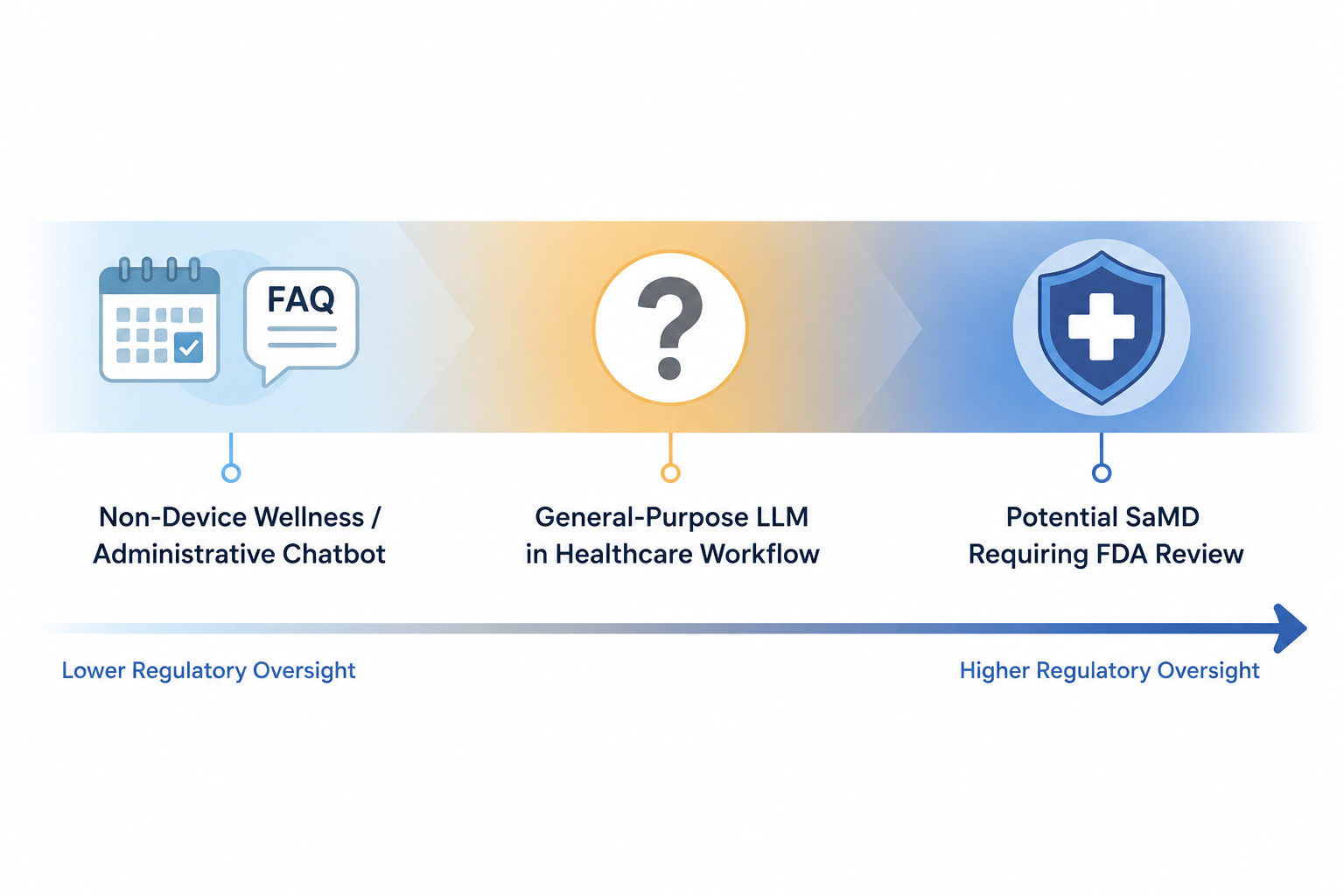
At the low-risk end are administrative or general wellness tools: appointment reminders, parking instructions, insurance navigation, basic preparation checklists, or scripted education that does not personalize clinical recommendations. These still need privacy, accessibility, security, and patient-experience review, but they may not raise the same FDA device question if they avoid clinical decision-making claims.
The middle zone is where most difficult procurement reviews live. A general-purpose LLM may be embedded in a healthcare workflow, wrapped in a vendor interface, connected to patient-specific context, and described as “education” or “engagement.” If it generates answers about symptoms, recovery expectations, medication concerns, wound appearance, or whether to seek care, the operational risk changes even before anyone has decided whether FDA review is required.
At the higher-risk end are tools that appear closer to software as a medical device: software intended to support diagnosis, treatment, triage, monitoring, or disease management for an individual patient. A chatbot does not avoid SaMD analysis simply because its interface is conversational. The relevant questions are what the sponsor claims, what the software does, how patient-specific the output is, whether clinicians rely on it, and what a reasonable patient may do after receiving the answer.
CADTH’s horizon scan on chatbots in health care is useful here because it treats chatbots as a range of tools rather than a single clinical category, with roles that may include information provision, navigation, symptom checking, and support functions.[4] That range is exactly why a one-line vendor answer rarely settles the review.
The intended-use file has to be specific
A usable procurement file should say, in plain language, what the chatbot is allowed to answer, what it must refuse, when it escalates, and what it tells the patient about its role. “Patient engagement” is not specific enough. “Post-operative education for adult orthopedic patients using pre-approved discharge content, with escalation to a nurse line for red-flag symptoms” is at least reviewable.
The same product can change regulatory posture when the intended use changes. A chatbot that reminds a patient to read discharge instructions is not doing the same thing as a chatbot that interprets new symptoms after discharge. A tool that retrieves clinician-approved content is not the same operational object as one that generates new advice from an LLM in response to patient-specific details. A human-reviewed message queue is not the same risk profile as an always-on autonomous answer.
What Procurement Should Ask Before a Patient-Facing Rollout
The first procurement task is not to win an abstract debate about whether the chatbot is “regulated.” It is to force the product into operationally testable commitments. If the vendor cannot describe the model, data flows, escalation logic, monitoring plan, and claims boundaries, the health system will inherit ambiguity after go-live.
- Intended use: What patient population, clinical context, and question types are in scope, and which claims are explicitly prohibited?
- FDA status: Is there no submission, a Breakthrough Device Designation, an active review, or clearance or authorization for a specific indication?
- LLM functionality: Does the tool retrieve approved content, generate new text, summarize records, personalize guidance, or combine these functions?
- Human oversight: Which outputs are reviewed, which are automatic, and which patient statements trigger escalation to licensed staff?
- Privacy and data handling: Is protected health information processed under HIPAA-compliant terms, and is patient data used for training, tuning, evaluation, or vendor analytics?
- Monitoring: How are unsafe answers, biased performance, hallucinations, missed escalations, and model updates detected and governed?
Contract language should follow the same discipline. A vendor representation that the product is “not intended to diagnose or treat” is weak if marketing materials, implementation workflows, and chatbot responses encourage patients to make care decisions. The agreement should attach the approved intended use, prohibited claims, escalation requirements, audit rights, data-use limits, change-control obligations, and indemnity terms that actually match the deployment.
The FDA guidance stack for AI/ML-enabled SaMD remains important background for teams tracking where device review may evolve. ClinicalMind’s FDA AI/ML SaMD guidance status as of June 2026 can help teams separate current policy from expected policy. For patient-facing generative chatbots, that distinction matters because teams are often buying into future-facing vendor narratives while their current liability starts on the go-live date.
The Liability Problem Arrives Before FDA Clarity
The unresolved liability question is not theoretical. If a chatbot tells a patient that a symptom is expected, and the patient delays urgent care, the health system will need to explain why that answer was allowed, who approved the content boundary, what escalation rules existed, and how performance was monitored. A disclaimer may help set expectations; it will not substitute for a governance record.
This is especially important for post-discharge and between-visit use cases. Patients may interact with the tool when clinics are closed, when anxiety is high, or when they are deciding whether to call, wait, upload a photo, seek emergency care, or ignore a symptom. Even if the chatbot is framed as engagement, the patient may experience it as part of the care system.
Bias monitoring also belongs in the initial review, not in a later AI ethics appendix. Patient-facing language tools can fail unevenly across literacy levels, languages, disability contexts, cultural communication patterns, and access to follow-up care. If the chatbot is deployed only in English, or if escalation pathways assume phone access during business hours, the system should document those limits and decide whether the deployment is acceptable for the population served.
Model updates create another governance burden. A scripted chatbot can be regression-tested against a stable content library. A generative system may change because of prompt revisions, retrieval-source changes, vendor model substitutions, guardrail updates, or new clinical content. Procurement should require notice and approval thresholds for changes that affect clinical messaging, escalation behavior, PHI processing, or performance monitoring.
A Governed Gray-Zone Decision
The current evidence and regulatory record do not support a blanket answer for health systems evaluating patient-facing generative AI chatbots. The FDA’s AI-enabled device list does not currently show an authorized generative AI chatbot for patient engagement.[1] RecovryAI’s Breakthrough Device Designation is a meaningful signal, but it is not clearance.[2] Market growth estimates explain why this decision is showing up in procurement meetings, not why a particular product is ready for patients.[3]
Deployment is possible, but only as a governed gray-zone decision. A health system should not treat Breakthrough Device Designation as FDA authorization. It should not treat absence from FDA records as proof of safety or proof of illegality. It should require explicit intended-use boundaries, HIPAA-aligned data controls, escalation pathways, bias and safety monitoring, change control, patient transparency, and contractual accountability before a patient-facing rollout.
For teams that need a wider market view, ClinicalMind’s AI in Healthcare 2026 evidence assessment can sit alongside the regulatory file. The purchasing decision itself should stay narrower: what exactly will this chatbot say to patients, under whose authority, with what safeguards, and with what consequences when the answer is wrong?
References
- FDA AI-Enabled Medical Devices List, FDA, accessed 2026.
- STAT News (March 2026) on RecovryAI Breakthrough Device Designation, STAT News, March 2026.
- DruidAI Conversational AI in Healthcare Guide (2026), DruidAI, 2026.
- CADTH Horizon Scan on Chatbots in Health Care, CADTH.
Comments
Join the discussion with an anonymous comment.