
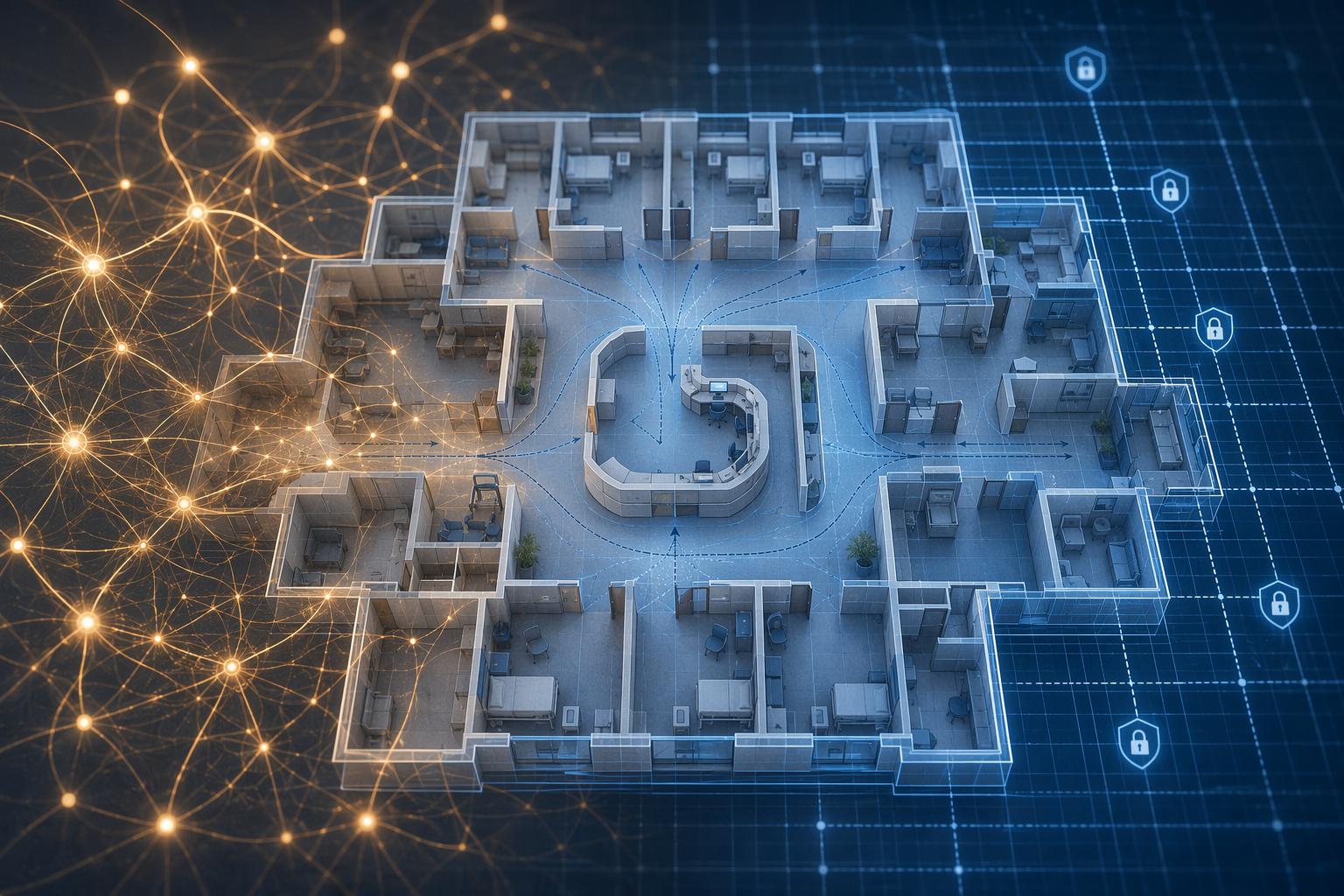
Psychiatric hospital design is built on trade-offs that do not stay tidy for long: the plan has to support safety, a therapeutic atmosphere, and daily operational flow at the same time, while ordinary CAD workflows usually leave the team with too few alternatives to know whether the chosen layout is actually the best one. That is where AI becomes relevant, not as a novelty layer, but as a way to reduce the uncertainty that hangs over schematic design when sightlines, ligature risk, daylight, acoustics, and staff movement all have to be reconciled in one plan.
A framework that matches how planning actually happens
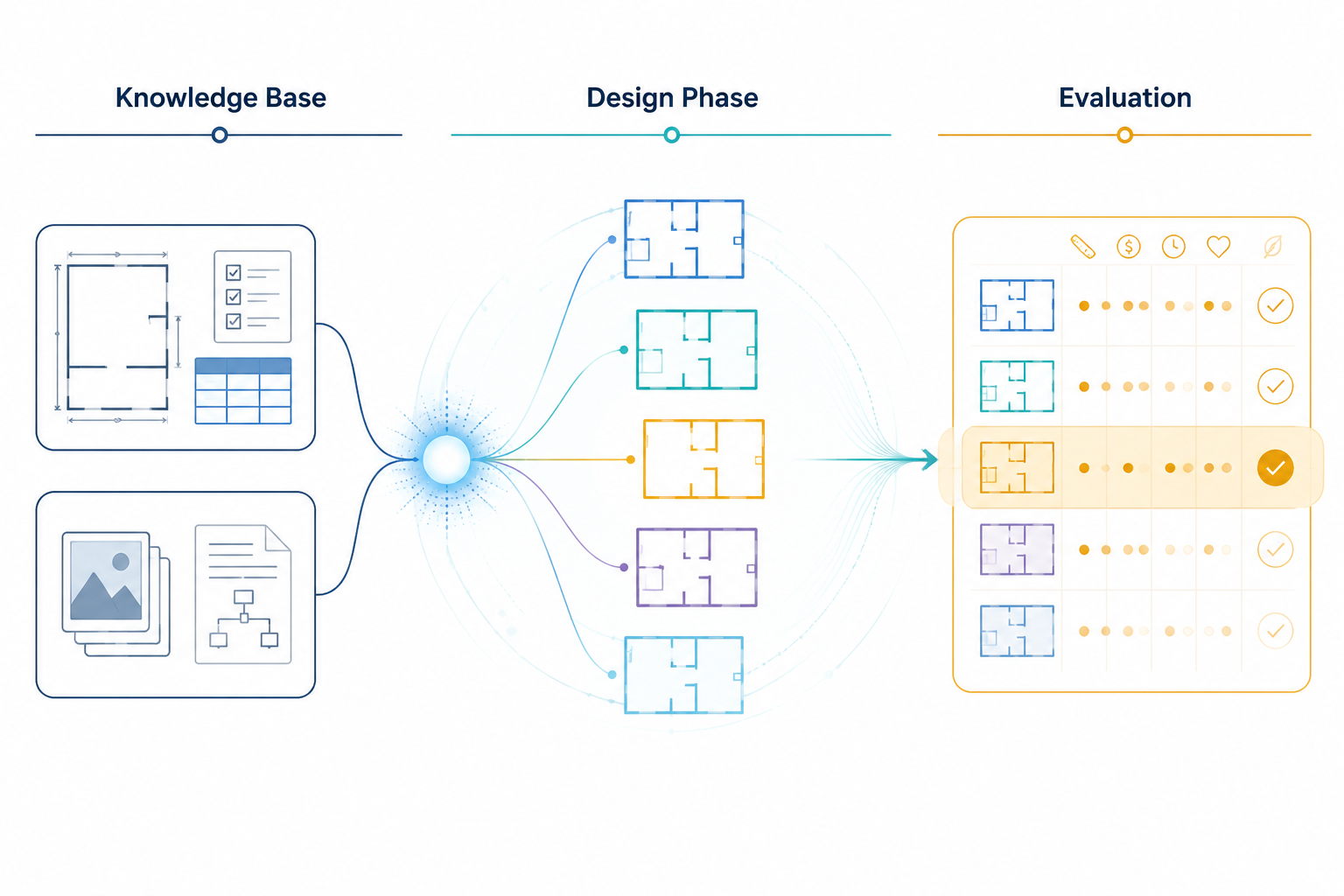
The clearest way to think about AI in psychiatric hospital design and construction is through the three-stage hospital-design model proposed by Fattahi Maassoum et al. in 2025: a pre-design knowledge base, a design-phase synthesis step, and a post-design evaluation step [1]. That sequence is useful because it mirrors real planning work. First comes structured input such as room dimensions and regulations, plus unstructured material such as images and workflow documents; then the model generates candidate layouts; then those layouts are scored against the design parameters that matter [1].
That study is not psychiatric-specific, so the leap to behavioral health is an inference rather than a direct claim of clinical validation. Even so, the framework fits the planning problem unusually well. Psychiatric layouts are not just about placing rooms; they are about sorting through many plausible arrangements until the team finds one that holds up under visibility, safety, and workflow scrutiny.
Why the neuro-symbolic split matters
The strongest part of the argument is the neuro-symbolic method. In the study, that hybrid strategy is identified as the best fit for hospital design because the neural side handles pattern recognition and generative variation, while the symbolic side enforces the rules that cannot be relaxed without creating a bad plan [1]. For psychiatric hospitals, that division is exactly what the architect needs: enough generative power to explore many layouts, but enough rule enforcement to reject schemes that fail on ligature safety, line-of-sight, or circulation logic.
| Psychiatric design concern | What a neuro-symbolic system can do |
|---|---|
| Line-of-sight from nurse stations | Test whether patient areas stay visible without opening unsafe direct access. |
| Ligature-safe fixture placement | Filter out locations and assemblies that create avoidable anchor points. |
| Daylight and biophilic access | Explore orientation and adjacency options that improve light without losing control. |
| Acoustic zoning | Separate patient rooms, group therapy spaces, and quiet rooms before they interfere with one another. |
| On-stage and off-stage circulation | Keep staff routes efficient while preventing unnecessary overlap with patient movement. |
| Neighborhood clustering | Group related rooms so supervision, service access, and therapeutic function stay coherent. |
This is where purely neural and purely symbolic methods each fall short. A purely neural system can suggest varied plans, but without explicit rule enforcement it cannot be trusted to protect non-negotiable constraints. A purely symbolic system can check rules, but it tends to be too rigid to search widely enough across the design space. Neuro-symbolic AI is attractive because it can do both jobs at once: expand the field of candidates, then prune that field against the constraints that matter.
Why BIM integration matters more than a futuristic interface
The method becomes more credible when it stays inside existing practice. If AI-generated layouts can move through Revit or similar Autodesk workflows, the output does not become a detached experiment; it becomes part of the same coordination chain that architects, engineers, and facility teams already use. That matters because behavioral-health design is usually settled in a conversation among room data, adjacency logic, code review, and clinical review, not in a single pass from a model.
The practical barrier is data readiness. These systems depend on structured inputs such as room dimensions, standards, fixture libraries, and workflow documents that many firms have not organized in a way a model can use cleanly. They also depend on interdisciplinary collaboration, because the rules that matter in psychiatric design are spread across architects, clinicians, facilities staff, and sometimes computer scientists. Without that shared base, the tool can produce candidates, but it cannot produce confidence.
What the evidence still does not show
The evidence is still framework-level. The material reviewed does not include controlled trials or built-project comparisons showing that AI-generated psychiatric layouts outperform carefully designed human ones in practice. That gap matters, and it should keep expectations disciplined. The strongest claim available now is narrower and more useful: neuro-symbolic AI looks like the most promising design-assistance strategy for high-stakes behavioral-health planning because it can generate more options, enforce more rules, and reduce the uncertainty that conventional CAD workflows leave on the architect's desk.
References
- AI-Generative Design for Psychiatric Hospital Layouts: From Neuro-Symbolic Strategies to Evidence-Based Behavioral Health Planning. PMC. 2025. https://pmc.ncbi.nlm.nih.gov/articles/PMC12335195/
Comments
Join the discussion with an anonymous comment.