
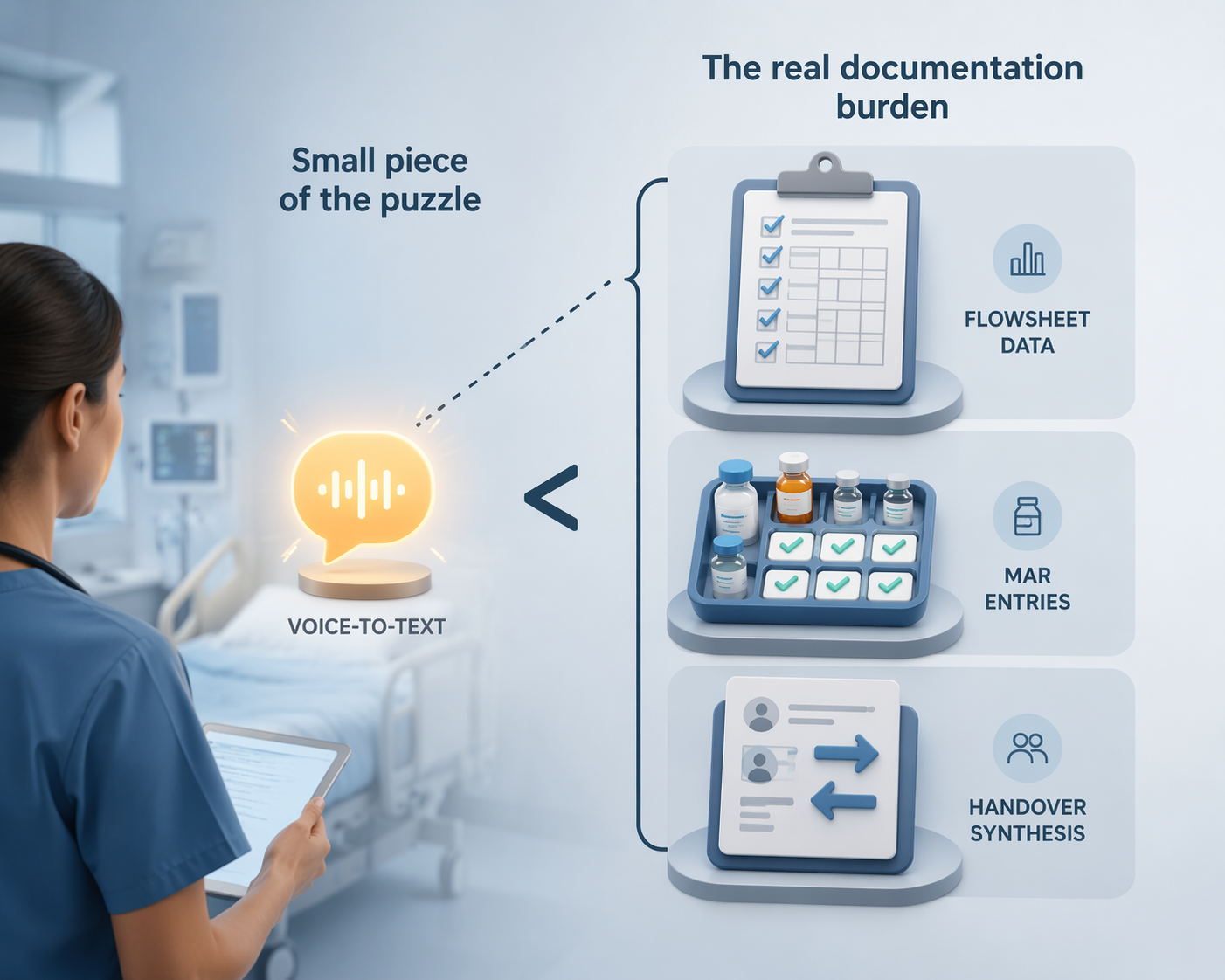
The first procurement mistake in nursing documentation AI is treating documentation as if it were mostly a dictated note waiting to be cleaned up. Some of it is narrative. Much of it is not. On a 12-hour shift, the work is more often a steady sequence of vitals, scores, risk screens, checklist confirmations, intake and output entries, medication timing, reassessments, and end-of-shift synthesis. A better voice-to-text tool may help with a narrow slice of that burden, but it does not touch the clicks that keep returning every few minutes.
The scale is not trivial. Nursing documentation has been reported at 25–40% of shift time, with morning shifts reaching 50.4% in one cited study, and Cleveland Clinic has estimated about 144 minutes per shift spent on documentation. NYU Langone research summarized in 2026 reported 631–875 flowsheet entries in a 12-hour nursing shift, which is roughly one entry per minute when spread across the shift. Those figures should not be lifted into every hospital as a universal constant; unit type, staffing model, shift timing, patient acuity, and EHR configuration change the experience. But they do show why “make the note easier to write” is too small a frame for the problem.[1]
The Heaviest Work Is Often Structured, Not Narrative
Flowsheet work looks small from a distance because each entry is small. That is exactly why it gets underestimated. A single pain score, fall-risk confirmation, wound measurement, intake value, or reassessment field does not look like a documentation crisis. Hundreds of them, distributed through admissions, rounds, escalation events, and handoff preparation, change the shape of a shift.
The NYU Langone flowsheet figure matters because it points away from the most glamorous AI demo. If a nurse is making 631–875 flowsheet entries in a 12-hour shift, the main design question is not whether an AI system can draft a polished paragraph. It is whether it can pre-populate the right structured field, at the right time, from data already present or newly captured, while leaving a clear path for nurse review and correction.[1]
That difference changes the evaluation criteria. A narrative generator can sound fluent and still be irrelevant to the densest documentation tasks. A structured-documentation assistant may look less impressive in a sales meeting, but if it reduces duplicate entry, carries forward verified values safely, detects missing required fields before the nurse reaches handoff, and stays inside the EHR rather than a side panel, it is closer to the work that actually accumulates.
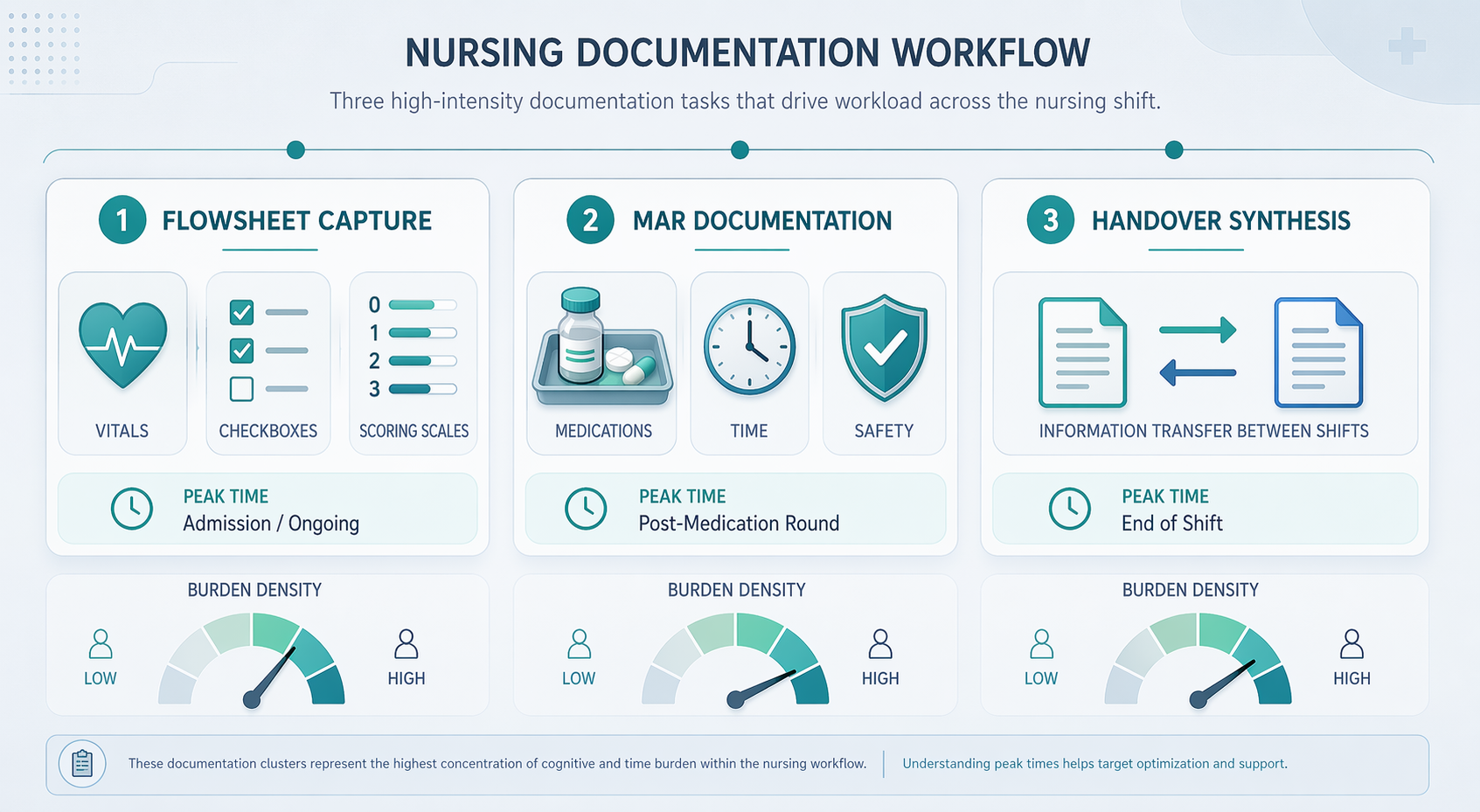
| Task cluster | Peak window | Data type | AI fit to evaluate first |
|---|---|---|---|
| Admission documentation and flowsheet capture | Admission and early-shift stabilization, then recurring reassessments | Mostly structured fields, scores, checklists, vitals, assessments | Pre-fill, validation, duplicate-entry reduction, missing-field detection |
| Medication administration record support | Medication rounds and post-round cleanup | Timed entries, confirmations, exceptions, reconciliation-related updates | Context-aware prompts, timing support, exception capture, nurse-controlled review |
| End-of-shift handover synthesis | Pre-handover and transfer of responsibility | Structured data plus selected narrative events | Summaries grounded in EHR data, uncertainty display, source traceability |
Admission Documentation Is Where Small Fields Start Governing the Shift
Admission documentation deserves more attention than it usually gets in AI discussions because it is both front-loaded and downstream-facing. The admission record is not just a record of arrival. It seeds risk scores, care plans, medication reconciliation work, precautions, education needs, skin assessments, belongings documentation, discharge planning signals, and the first version of what the next nurse will inherit.
The practical AI opportunity here is not to write an eloquent admission note. It is to reduce the number of times the nurse has to re-enter or re-confirm information that already exists somewhere else, while still protecting the nurse’s responsibility to verify what matters clinically. Demographics, prior history, device presence, isolation status, allergies, fall-risk elements, and baseline functional information may come from different places and arrive with different levels of reliability. AI that treats all imported content as equally true creates cleanup work. AI that labels source, freshness, and confidence gives the nurse something usable.
Admission is also where bad automation can spread. If an assistant fills a structured field incorrectly, the mistake may travel into care plans, reminders, dashboards, and handoff summaries. Procurement teams should therefore ask vendors less about “documentation automation” in the abstract and more about field-level behavior: Which fields can be pre-populated? Which fields require nurse confirmation? Which values are blocked from auto-fill? How are corrections logged? What happens when imported data conflict?
The best admission-focused tools will probably feel modest. They will collapse duplicate questions, surface missing required fields before the nurse leaves the room, and keep the admission record aligned with existing EHR structures. That is not a lesser ambition. It is the difference between helping the nurse complete the record and asking the nurse to reconcile a second version of the record.
MAR Support Needs a Safety Frame, Not a Speed Frame
Medication administration record work sits closer to patient safety than many documentation tasks, so it should not be evaluated as a simple time-saving category. The MAR is tied to what was due, what was given, when it was given, what was held, what required reassessment, what needed clarification, and what still needs attention after the round. AI can help here, but the help has to be deliberately constrained.
The post-medication-round period is one of the places where documentation pressure becomes visible. Nurses may be moving between bedside care, patient questions, pharmacy messages, provider communication, reassessments, and late entries. A useful AI layer might flag incomplete documentation tied to a recent administration, remind the nurse that a required reassessment is approaching, or help distinguish routine completion work from an exception that needs a clearer note. None of that requires the system to invent narrative. It requires it to understand timing, medication context, and documentation state inside the EHR.
This is also where accountability has to be explicit. If AI suggests that a field is complete when it is not, or prompts the wrong follow-up, the burden falls back on the nurse at the worst possible moment. A safe MAR assistant should make its role visible: it can cue, organize, and draft structured support, but it should not obscure the nurse’s final review or blur whether the record reflects an observed action, a pending action, or a system inference.
That distinction matters for hallucination risk. A handoff sentence that overstates certainty is dangerous in one way; a medication-related prompt that misrepresents timing or completion status is dangerous in another. For MAR-related AI, health systems should test against real workflow states: held medications, late administrations, partial documentation, patient refusal, reassessment requirements, pharmacy changes, and interruptions during the round. A tool that performs well only on clean, completed medication events has not yet been tested against the work nurses actually do.
Handover Is Summarization Under Responsibility
End-of-shift handover is where accumulated documentation becomes a transfer of responsibility. The receiving nurse does not need a literary summary of the last 12 hours. They need the current risks, unresolved tasks, recent changes, abnormal trends, pending labs or consults, medication issues, mobility or safety concerns, family dynamics when relevant, and the small details that explain why the next two hours may be difficult.
AI is well suited to some parts of this work. It can scan structured data for changes, pull recent vitals and scores, identify overdue or pending items, and assemble a draft from information already in the chart. It can also reduce the scramble that happens when the nurse is trying to prepare handoff while still answering call lights, closing medication documentation, and responding to last-minute changes.
But handover synthesis is not the same as free-form generation. The system should show where each statement came from, avoid turning absence of documentation into evidence that something did not happen, and mark uncertainty when the chart is incomplete. “No pain reported” and “no pain documented” are not the same claim. A receiving nurse may act differently depending on which one is true.
For procurement, the test is whether the handover assistant can produce a concise, source-grounded draft that the outgoing nurse can edit quickly. If it creates a second handoff workspace that must be reconciled with the EHR, it adds another place for drift. If it buries sources, it asks nurses to trust a synthesis they cannot audit. If it writes with more confidence than the chart supports, it may make handoff smoother while making responsibility less clear.
Adoption Is Moving Faster Than Embedded Workflow
Nurses are not waiting for perfect enterprise architecture before trying AI. McKinsey’s 2026 Nursing AI Insights Survey of 521 nurses found that 65% were using more AI than a year earlier, while only about 2% described AI as fully embedded. That is adoption context, not proof that AI is improving documentation outcomes. It says the appetite and exposure are growing while the harder work of integration remains unfinished.[2]
That gap explains why ambient scribes and dictation tools can attract attention without resolving the central burden. They are easier to understand because everyone can picture speech turning into text. They may help when nurses need to capture patient education, unusual events, family conversations, or clinical reasoning that does not fit neatly into a checkbox. They are not useless. They are just not the whole workflow.
A documentation strategy built around dictation first risks optimizing the visible paragraph while leaving the repetitive structured work untouched. For a physician visit, the note may be the dominant artifact. For a bedside nursing shift, the record is often assembled through many small confirmations and updates. AI has to meet that rhythm or it becomes another application the nurse manages between tasks.
What Procurement Teams Should Ask Before Buying
The most useful purchasing questions are task-level questions. A vendor may say it reduces documentation time, but the next question is which documentation, in which shift window, for which role, and against which baseline. A tool that saves minutes in narrative drafting may still miss the admission, MAR, and handoff pressure points that nurses feel most acutely.
- Name the task: admission fields, ongoing flowsheet entries, MAR follow-up, reassessment reminders, or handover synthesis.
- Identify the data type: structured field, time-stamped event, checklist, score, free text, or mixed-source summary.
- Locate the workflow peak: admission, medication round, post-round cleanup, pre-handover, or transfer.
- Define the EHR behavior: pre-fill, prompt, summarize, validate, route for review, or block unsafe automation.
- Assign accountability: who confirms, who corrects, who sees the audit trail, and who is notified when AI output is wrong.
Measured outcomes should be just as specific. Time saved is useful, but it is not enough. A pilot should track duplicate entries avoided, late documentation reduced, missing required fields caught before handoff, correction rates, nurse review time, and whether the tool creates new after-the-fact cleanup. For MAR-related support, safety and exception handling need separate review. For handover, source traceability and nurse edit burden matter more than how polished the generated prose sounds.
Time Savings Need a Governance Decision
The KLAS Arch Collaborative’s 2025 reporting, summarized in secondary sources, found that 40% of more than 80,000 acute care nurses intended to leave by 2029, with documentation burden described as one contributing factor. That should not be turned into a single-cause burnout story. Nurses leave or stay for many reasons, and documentation is one part of a larger operating environment. Still, documentation work is one of the burdens health systems can redesign with some precision.[1]
A 2025 International Journal of Nursing Studies discussion paper estimated that AI could reduce charting time by 25–50%, but that figure should be treated as a projection rather than a measured result from controlled deployment. The same discussion raised the governance problem that matters most after a tool works: efficiency gains can be captured by throughput expectations instead of returning to direct patient care or recovery between tasks.[1]
That decision cannot be left until after rollout. If an AI tool reduces documentation time, a health system should define what happens to the recovered time. Does it support more bedside assessment, patient teaching, earlier escalation, cleaner handoff, or simply a higher assignment load? Nurses will notice the answer quickly. So will managers trying to staff a unit under pressure.
The strongest first targets for AI in nursing documentation workflow are not the flashiest. They are the tasks dense enough to matter, structured enough to support reliable assistance, close enough to the EHR to avoid parallel work, and consequential enough to justify careful governance: admission and flowsheet capture, MAR documentation support, and end-of-shift handover synthesis.
References
- Tandem Health 2026 synthesis, Tandem Health, 2026.
- McKinsey 2026 Nursing AI Insights Survey, McKinsey, 2026.
Comments
Join the discussion with an anonymous comment.