
Brittney Roberts’ Facebook post about the hurtful messages she had received during her son Will’s cancer treatment landed with a sentence that many pediatric oncology teams will recognize, even if they hear it in a quieter room: “You don’t have to agree with every decision we’ve made.” The reported messages came while the family was publicly documenting Will’s stage 4 osteosarcoma battle, including treatment decisions that had already demanded more from them than any comment thread ever could.[1]
That line matters because it is not a request for universal approval. It is a boundary. Families who post during pediatric cancer treatment are often trying to update relatives, reach donors, find other parents, ask about logistics, or keep a record when days are blurring together. Once a child’s illness becomes visible, though, the family can be treated as if visibility has waived their right to privacy, uncertainty, or clinical complexity.
The available reporting on Will Roberts describes a 15-year-old from Alabama with stage 4 osteosarcoma who underwent amputation and other treatments. His family’s public campaign drew wide attention after a video plea for access to Mifamurtide, also known as Mepact, accumulated more than 6 million views.[2]
The Mepact detail should be handled carefully. This was not simply a story about a family chasing an internet cure. Mifamurtide had been approved by the European Medicines Agency since 2009, while the US Food and Drug Administration had denied approval in 2007.[2] Reporting also described Dr. Mehmet Oz, in his role at the Centers for Medicare and Medicaid Services, helping facilitate access to treatment in California.[2] Families may still need clear counseling about evidence, risks, and access pathways, but an EMA-approved, FDA-unapproved drug sits in a different category from unsupported alternative cancer cures.
That distinction does not protect a family from online judgment. In public view, nuanced treatment access questions often collapse into accusations: a parent is doing too much, not enough, the wrong thing, the selfish thing, the gullible thing. The caregiver is left holding both the medical decision and the emotional cleanup.
Why Families Post Anyway
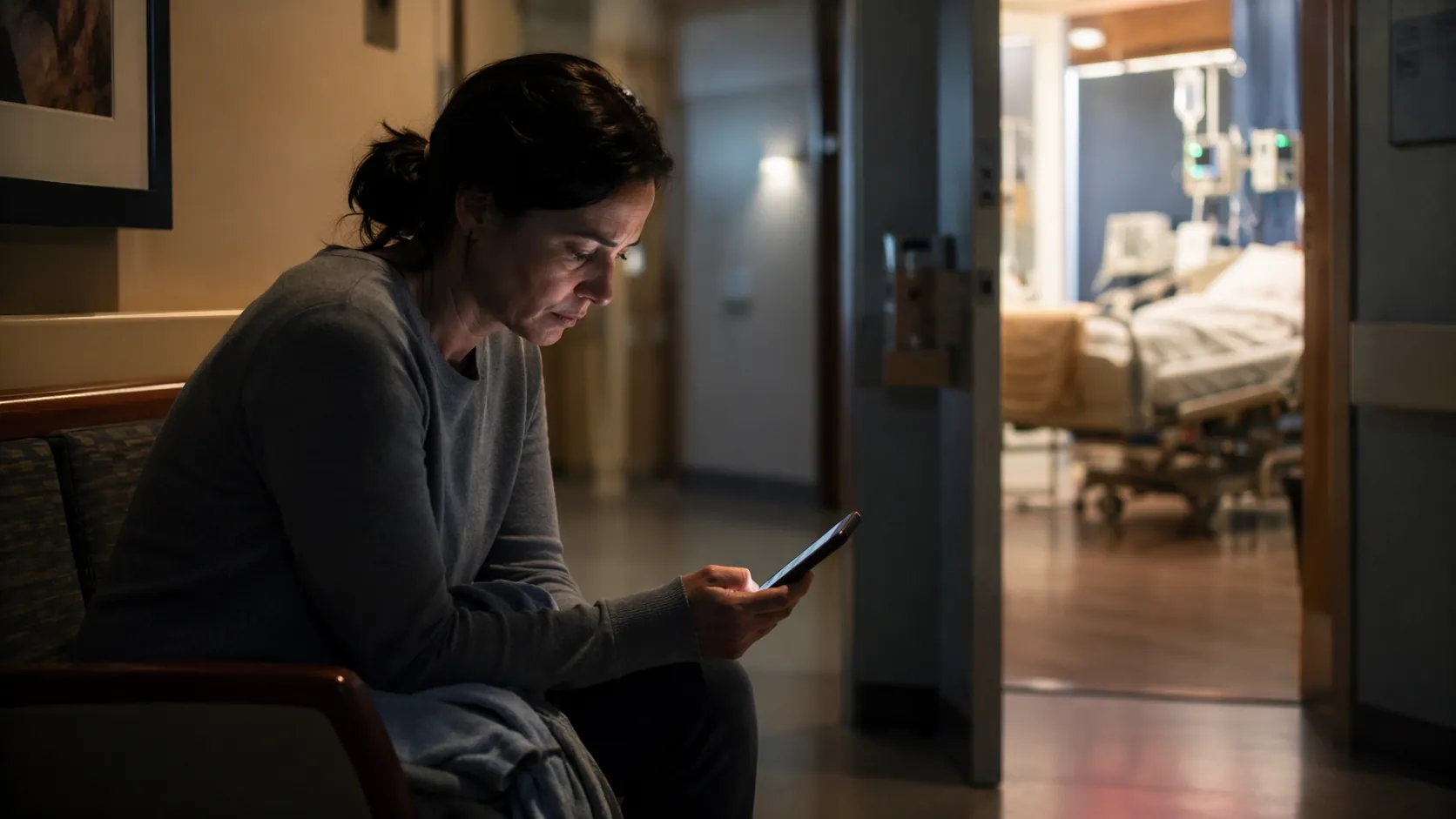
The easiest advice is also the least useful: just don’t post. Pediatric cancer families use social media because treatment reorganizes ordinary life. One parent may be sleeping in the hospital while another is managing siblings, work, insurance calls, school communication, and a phone full of people asking for updates. A single post can prevent 40 separate conversations. A group can answer practical questions that no discharge packet anticipates.
Research supports what families have been showing clinicians for years. In a study of caregivers of children with cancer, 74% used social media for cancer-related support.[3] That number should change the clinical posture. Online sharing is not an eccentric add-on to care for most families; it is one of the places where they seek social, informational, and emotional scaffolding.
The same study found that caregivers used social media for different support needs, including connecting with others and gathering information.[3] Those functions can become especially important when a child has a rare diagnosis, a complicated treatment course, or a question that seems too small to page the oncology team but too frightening to sit with alone.
For clinicians, the point is not to celebrate social media as inherently therapeutic. It is to recognize the trade-off families are already making. When a caregiver posts, she may gain meal trains, prayer networks, travel help, fundraising support, and another parent who knows what the first night after amputation can feel like. She may also gain strangers who believe they are entitled to audit her judgment.
| What families may be seeking | What can arrive through the same channel |
|---|---|
| Updates without repeating painful details | Demands for more information or proof |
| Peer support from families with similar diagnoses | Pressure to follow another family’s treatment path |
| Help with travel, costs, meals, and logistics | Public scrutiny of spending, choices, or caregiving |
| Information to discuss with the oncology team | Misinformation, alternative-treatment claims, or fear-based advice |
Support Spaces Can Turn on Treatment Decisions
The painful part of Brittney Roberts’ reported experience is not only that people were cruel. It is that the criticism focused on decisions made under the pressure of a life-threatening pediatric cancer diagnosis. Treatment decisions are already emotionally loaded inside a family. Once they enter a social feed, they can be treated as debate material by people who do not have to sit through the consent conversation, manage side effects, or comfort the child afterward.
Lazard and colleagues’ 2021 study of 45 young adults with cancer gives language to this darker side of online cancer support. Participants described support spaces where members could become “very aggressive or very harassing” about treatment choices, and the authors identified a “dark” side of online cancer communities alongside their benefits.[4]
That finding is easy to underestimate if online toxicity is imagined as random insults from strangers. In cancer spaces, aggressive pushback can come wrapped in concern. Someone may insist that a family must refuse chemotherapy, must try a supplement, must travel to a certain clinic, must distrust the oncologist, or must explain why they did not choose the path another patient chose. The emotional force is often strongest when the message borrows the language of rescue.
Parents of children with cancer are particularly vulnerable to that kind of pressure because their decisions are proxy decisions. They are not only weighing survival probabilities, toxicity, access, pain, and quality of life; they are doing so on behalf of a child. A message that says “you are choosing wrong” can land as “you are failing your child,” even when the sender has no clinical relationship to the case.

Misinformation Is Not Separate From Harassment
In clinic, it can be tempting to separate the problems: emotional harassment on one side, misinformation on another. Families rarely experience them so neatly. The same post asking for prayers may attract an old friend offering comfort, another parent sharing practical advice, a stranger condemning the treatment plan, and a link to a cancer claim that sounds urgent enough to disturb the rest of the night.
A 2023 JMIR Cancer survey of 603 US adults found that 55.9% reported seeing cancer misinformation on social media. Exposure was higher among cancer patients, at 70.6%, and 48.6% of cancer patients reported receiving advice about alternative treatments.[5] Those figures measure exposure and advice, not whether people acted on the information. But exposure alone can still consume attention, create doubt, and force families to spend scarce energy sorting claims.
Johnson and colleagues examined the quality and potential harm of cancer misinformation shared on social media and found that 77% of cancer misinformation articles in their sample contained potentially harmful information.[6] The National Cancer Institute has also warned about the challenge of cancer misinformation online, including false claims about treatments and prevention.[7]
For a family like the Roberts family, this is the danger of becoming visible. A public plea for access to a regulated drug with a real approval history can move through the same platforms where unsupported cancer claims circulate. The family may be trying to solve an access problem, while the comment section treats the situation as an open invitation to promote certainty.
Clinicians do not need to respond by policing every post. They do need to ask better questions before the crisis point: Where are you getting cancer information online? Are people sending you treatment suggestions? Is anyone pressuring you or making you feel unsafe? Do you want help deciding what to answer, what to ignore, and what to bring back to the team?
What the Care Team Can Anticipate
A family’s online exposure should be part of psychosocial assessment, especially when a child’s story has become public. The question is not whether the parent made a wise public-facing choice. The question is what new burdens the parent is now carrying because the illness has an audience.
Useful anticipatory guidance can be simple. A social worker, nurse, physician, or child life specialist can normalize that many families seek support online and that some receive hostile or misleading responses. The team can invite caregivers to bring screenshots of confusing medical claims. They can help the family decide who will post updates, who will read comments, who will block or delete messages, and which questions should be redirected to the treating team.
- Give families permission to set boundaries without treating boundary-setting as rudeness.
- Distinguish peer experience from treatment recommendation: “That helped their family” is not the same as “this is right for your child.”
- Offer a route for reviewing online claims, especially when the claim involves stopping standard treatment, delaying care, or paying for an unverified intervention.
- Ask whether public attention has increased distress, conflict, sleep disruption, or fear of making the wrong decision.
- Protect the caregiver from becoming the sole filter for every message, donation question, treatment suggestion, and accusation.
Scripts can help because exhausted parents should not have to invent language while they are being criticized. A family might say, “We are making treatment decisions with Will’s oncology team and are not discussing them in comments,” or “We appreciate support, but we are not accepting medical advice through messages.” The exact wording matters less than the relief of having a prepared sentence before the next message arrives.
Digital literacy guidance should also avoid shaming. If a parent asks about a video, a supplement, a clinic, or a drug access pathway, the clinical response should make it easier to ask the next question, not harder. Families who feel embarrassed may keep the next claim to themselves, and the next claim may be more dangerous.
The Limits of the Public Record
There are limits to what can be responsibly said about the Roberts family’s private messages. The reported quote from Brittney Roberts and the description of hurtful messages come from coverage of her Facebook post; the original messages were on a personal Facebook page and are not publicly indexed.[1] The 1819 News page containing the quote was not fully accessible at the time of review, so the wording should be understood as reported rather than independently verified from the primary post.[1]
Will Roberts’ story was also ongoing as of July 2026. Public reporting may not reflect later clinical developments, family decisions, or outcomes. That uncertainty is important. It prevents the story from being turned into a finished parable about what the family should or should not have done.
The broader evidence does not depend on making the Roberts family stand in for every pediatric cancer family. Their situation shows, in unusually visible form, a bind that research already documents: caregivers use social media because they need support, information, and access to community, while the same spaces can expose them to aggressive treatment commentary and misinformation.[3][4][5][6]
When a mother says, “You don’t have to agree with every decision we’ve made,” she is naming a boundary that care teams should help protect. Digital exposure is now part of the psychosocial terrain of pediatric cancer care. It affects who feels supported, who feels judged, who sleeps, who spirals, and who has enough emotional bandwidth left for the next appointment.
References
- Mother of Will Roberts shares hurtful messages amid son's cancer battle. 1819 News.
- Will Roberts' story. Tuscaloosa Thread.
- Social Media Use Among Parents and Caregivers of Children With Cancer. Journal of Pediatric Oncology Nursing. 2018.
- Young adults report harassment and aggressive behavior in cancer support spaces. JMIR Cancer. 2021.
- Scale of cancer misinformation exposure on social media. JMIR Cancer. 2023.
- Cancer misinformation articles shared on social media. Journal of the National Cancer Institute. 2022.
- Cancer Misinformation and Harmful Information on Social Media. National Cancer Institute.
Comments
Join the discussion with an anonymous comment.