
The practical impact of the OpenAI breaches on healthcare AI applications starts with a dull but important fact: the most useful data in the 2025 Mixpanel incident was not a medical record or a prompt transcript. It was identifying and routing material around OpenAI API use — names, email addresses, coarse location, operating system and browser information, and organization and user IDs tied to API customers.[1] For a hospital security team, that is not harmless just because it is not diagnosis text. It tells an attacker who may build, administer, or support an AI integration.
OpenAI said the exposure came through Mixpanel, an analytics vendor, after a smishing campaign against Mixpanel. OpenAI later ended its relationship with Mixpanel after discovering the breach.[1] The original framing centered on API customers, but OpenAI’s updated scope clarified that some ChatGPT users were also affected if they had logged into platform.openai.com or submitted help-center tickets. That matters in healthcare because help-center contact, platform access, and API administration often sit near the people who connect a vendor’s system to real workflows.
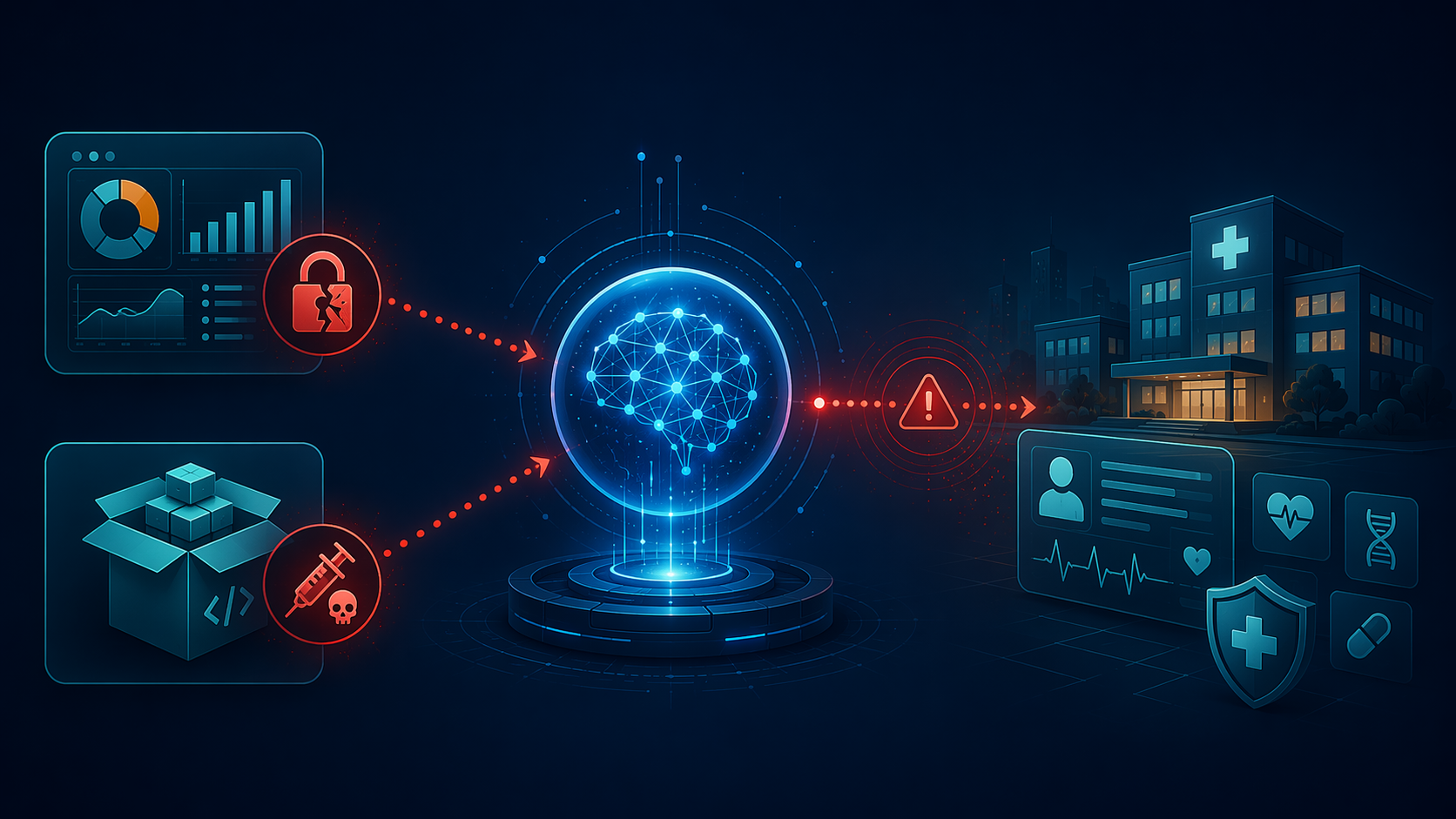
Then came a different kind of problem. In May 2026, reporting on OpenAI’s latest code security issue described a TanStack npm supply-chain attack in which 84 malicious packages were published in six minutes. OpenAI said two employee devices were compromised, some credentials from code repositories were stolen, and certificate rotation was forced as part of the response.[2] This was not the same failure mode as Mixpanel. That is the point.
One incident ran through an analytics partner. The other ran through the open-source software supply chain. Neither requires a theory that OpenAI’s core model infrastructure collapsed. Both still change the vendor-risk conversation for healthcare organizations using AI APIs, clinical assistants, patient messaging tools, revenue-cycle automation, or developer-facing AI services.
The Exposed Data Is Operationally Useful
Healthcare teams sometimes relax when an incident notice says no chats, passwords, payment details, API keys, or model requests were exposed. That distinction matters, and it should not be blurred. But the remaining data still has value.
A name, work email, organization ID, user ID, device context, and help-center history can help an attacker write a credible message to the right engineer, integration analyst, data-science lead, or vendor-management contact. In a hospital, those people may have access to API gateways, identity providers, test environments, service accounts, ticketing systems, or deployment pipelines. The damage path is not “the attacker read a patient chart.” It is “the attacker now knows who to pressure next.”
That is why the Mixpanel incident should be read as more than a privacy footnote. It exposed the connective tissue around OpenAI platform use. In healthcare, connective tissue is often where vendors, internal IT, clinical operations, and compliance all meet.
Two Compromise Paths, One Vendor-Risk Lesson
The Mixpanel and TanStack episodes should not be collapsed into a single generic “OpenAI breach” story. They point to different control questions.
| Incident | Compromise Path | Healthcare Vendor-Risk Question |
|---|---|---|
| Mixpanel analytics breach | Third-party analytics vendor compromised after a smishing campaign | Which analytics, support, telemetry, and customer-success tools receive identifiers or usage metadata tied to our organization? |
| TanStack npm supply-chain attack | Malicious open-source packages and compromised employee devices, with limited credential theft from code repositories | How does the vendor control package provenance, developer endpoints, repository credentials, certificate rotation, and build integrity? |
A mature AI vendor can have strong model-security work, enterprise controls, and public trust documentation while still inheriting risk from analytics vendors, npm packages, developer laptops, repository credentials, and support systems. Vendor due diligence that stops at SOC reports and encryption claims is too narrow for this environment.
This is also where healthcare differs from a normal SaaS evaluation. An AI API may not merely sit in a back-office productivity tool. It may summarize intake notes, draft patient messages, support care navigation, assist coding, help triage administrative queues, or feed a clinical workflow that humans then review. Even when the vendor does not store protected health information, the integration pattern can still create operational risk.
Healthcare Risk Does Not Stop at the Vendor’s Perimeter
The field is already moving in this direction. The Health Sector Coordinating Council published an AI third-party risk guide in April 2026, giving healthcare organizations a more formal way to question AI vendors about governance, security, privacy, transparency, and ongoing oversight. The timing is not incidental. AI procurement has moved faster than many organizations’ third-party review programs.
The narrow lesson from the OpenAI incidents is not that healthcare organizations should stop using AI systems powered by large platforms. The defensible lesson is that the unit of review has changed. The platform vendor is only one layer. Below it sit subprocessors, analytics tools, logging systems, open-source packages, model-evaluation vendors, support portals, cloud services, identity integrations, and code dependencies. Some of those layers may touch only metadata. Some may touch credentials. Some may affect availability. All of them can matter when the AI application is embedded in clinical operations.
This distinction also prevents overclaiming. The public sources do not show that the OpenAI incidents directly caused hospitals to pause or cancel deployments. The impact is better understood as a change in the questions security and procurement teams should ask before they renew, expand, or approve AI use.
What Changes in Procurement
Procurement teams should stop treating “Who is the AI model provider?” as the final risk question. It is only the start. For any AI application that uses OpenAI or another foundation-model provider through an API, the review needs to reach the vendor’s dependency map and the vendor’s own vendor-management process.

The useful questions are concrete:
- Which subprocessors receive customer identifiers, organization IDs, user IDs, support-ticket content, telemetry, or usage metadata?
- Which analytics and product-observability tools are active for healthcare customers, and can they be disabled or segmented?
- Does the vendor maintain a software bill of materials for components used in the product and developer tooling?
- How does the vendor detect malicious package publication, dependency confusion, compromised maintainer accounts, and build-pipeline tampering?
- What triggers customer notification: confirmed access to protected health information, exposure of customer metadata, credential theft, code-signing compromise, or support-system exposure?
- Who is contractually responsible for notifying the healthcare organization when a fourth party, not the direct vendor, is the source of the incident?
Those questions belong in the buying process, but they also belong in renewals. A point-in-time security questionnaire completed before deployment will not catch a new analytics integration, a changed package-management practice, or a revised subprocessor list six months later.
Contracts Need to Reach the Failure Mode
A contract that says the vendor will protect customer data is not enough if it does not describe what happens when an analytics partner or open-source dependency fails. Healthcare buyers should look for language covering subprocessor disclosure, advance notice of material subprocessor changes, minimum security obligations for subprocessors, audit rights or third-party assurance reports, and incident-notification duties tied to metadata and credentials as well as regulated health data.
Business associate agreements matter where the AI vendor creates, receives, maintains, or transmits protected health information for a covered entity or business associate. They do not solve every risk. A BAA may define HIPAA duties, but it does not automatically answer whether a product analytics provider receives organization IDs, whether a support portal stores ticket attachments, or whether repository credentials were rotated quickly enough after a developer-device compromise.
Notification Terms Should Include Metadata
Many incident-notification clauses are still written as if the only meaningful trigger is unauthorized access to sensitive content. The Mixpanel incident is a useful test case because the exposed data was not the obvious crown jewel. Healthcare organizations should require notice when identifiers, administrator contact information, organization IDs, user IDs, authentication-adjacent information, support tickets, or integration metadata are exposed by the vendor or by a vendor’s subprocessor.
The operational response is different from a medical-record breach, but it is still real: warn targeted staff, raise phishing monitoring, review privileged accounts, check support-ticket contents, rotate affected credentials where needed, and verify whether exposed identities map to production systems.
Monitoring Has to Continue After Approval
The TanStack event is a reminder that open-source risk is not confined to the software the hospital installs. It can sit inside the vendor’s development process. When malicious packages are published and consumed quickly, the customer may have no direct visibility until the vendor detects, contains, and discloses the issue.
Healthcare organizations do not need to run the vendor’s build pipeline. They do need evidence that the vendor has one under control. That evidence can include signed builds, dependency pinning, package integrity checks, maintainer-account protections, endpoint detection for developer devices, repository secret scanning, rapid credential rotation, and tested incident playbooks. The response details reported in the TanStack incident — compromised employee devices, limited repository credential theft, and forced certificate rotation — are exactly the kind of mechanics customers should expect to see addressed in post-incident communications.[2]
Continuous monitoring also means watching the vendor’s public trust center, security advisories, subprocessor pages, release notes, and customer notices. If an AI application is connected to patient-facing workflows or clinical operations, that monitoring should not live only in procurement. Security operations, privacy, compliance, legal, and the application owner all need a defined handoff when the vendor posts a material update.
OpenAI’s Safeguards Still Matter
A serious risk review should also account for the controls OpenAI has put forward. Reporting on ChatGPT Health described isolated and encrypted health-data controls, physician review, and enterprise safeguards intended to support healthcare use cases.[3] OpenAI has also been active in health AI policy discussions, including recommendations meant to expand use of AI in healthcare.[4]
Those facts do not cancel the Mixpanel or TanStack incidents. They do change how the risk should be calibrated. A healthcare organization should distinguish between a vendor that has no meaningful healthcare controls and a vendor that has healthcare-specific architecture, review processes, enterprise controls, and contractual options. The right conclusion is not “trust OpenAI” or “avoid OpenAI.” It is to test whether the controls cover the actual dependency paths that failed.
There is also a useful counterpoint in the security community: some analysts argued after the Mixpanel disclosure that the larger practical threat was infostealer malware and the misuse of exposed account data, rather than a direct compromise of OpenAI itself.[5] That view is worth taking seriously. It reinforces the same procurement lesson from a different angle: identity, endpoint security, session hygiene, and phishing resistance around AI administration are part of AI vendor risk.
How to Apply This to an OpenAI-Powered Healthcare Application
For a healthcare organization already using an OpenAI-powered application, the first step is not a panic review of every AI project. Start by separating applications by workflow consequence.
| Use Pattern | Risk Review Priority |
|---|---|
| General staff productivity with no patient data and no integration to clinical systems | Confirm account governance, data-use settings, user training, and phishing controls |
| Administrative automation using patient or member information | Review BAA status, data flows, subprocessors, access controls, logging, and incident notification |
| Developer-built API integration touching clinical workflow, patient communication, triage, or documentation support | Add dependency review, service-account controls, API gateway monitoring, rollback planning, and vendor subprocessor scrutiny |
| Patient-facing or clinician-facing AI embedded in care operations | Require stronger assurance, human review controls, availability planning, escalation paths, and legal review of vendor obligations |
The highest-risk applications deserve the most specific follow-up. Ask the application vendor whether it sends telemetry, customer identifiers, logs, prompts, attachments, or support content to OpenAI or to other subprocessors. Ask whether OpenAI is used directly or through another cloud, orchestration, model-monitoring, or analytics layer. Ask whether the vendor can produce a current subprocessor list and explain what changed after the Mixpanel and TanStack events.
Then move from vendor answers to internal controls. Limit who can administer AI platform accounts. Put those accounts behind strong phishing-resistant authentication where available. Review whether API keys are scoped, stored in a secrets manager, rotated on a schedule, and monitored for unusual use. Keep support tickets free of unnecessary patient information. Make sure the incident-response plan covers exposure of vendor metadata, not only exposure of clinical content.
The Standard Has to Be Evidence
The OpenAI incidents are not proof that healthcare AI cannot be secured. They are proof that brand strength does not remove dependency risk. A well-resourced AI vendor can still be exposed through a product analytics partner. It can still be affected by malicious open-source packages. It can still have employee devices, repositories, credentials, and certificates become part of the incident story.
For healthcare buyers, that changes the standard of review. The question is no longer whether the vendor looks mature. The question is whether the vendor can show how it manages third parties, how it limits data shared with analytics and support systems, how it controls software dependencies, how quickly it notifies customers, and how much damage is possible when the next dependency fails.
References
- OpenAI discloses API customer data breach via Mixpanel vendor hack, BleepingComputer.
- OpenAI says hackers stole some data after latest code security issue, TechCrunch, May 14, 2026.
- OpenAI Launches ChatGPT Health with Isolated, Encrypted Health Data Controls, The Hacker News, January 2026.
- OpenAI wants to 'have their cake and eat it too' with health AI policy recommendations, STAT News, May 6, 2026.
- No, OpenAI Wasn't Breached—The Real Threat Comes from Infostealers, Kela Cyber.
Comments
Join the discussion with an anonymous comment.