
The Sunshine Protection Act is no longer a seasonal annoyance story. H.R. 139 passed the House on July 14, 2026, and awaits Senate action, placing a live federal choice in front of clinicians, schools, and families: make daylight saving time permanent, or choose permanent standard time instead.[1] For students, the health question is not whether changing clocks twice a year is irritating. It is which fixed clock exposes children and adolescents to less circadian strain when they have to wake, commute, sit in class, and regulate attention and mood on school schedules.
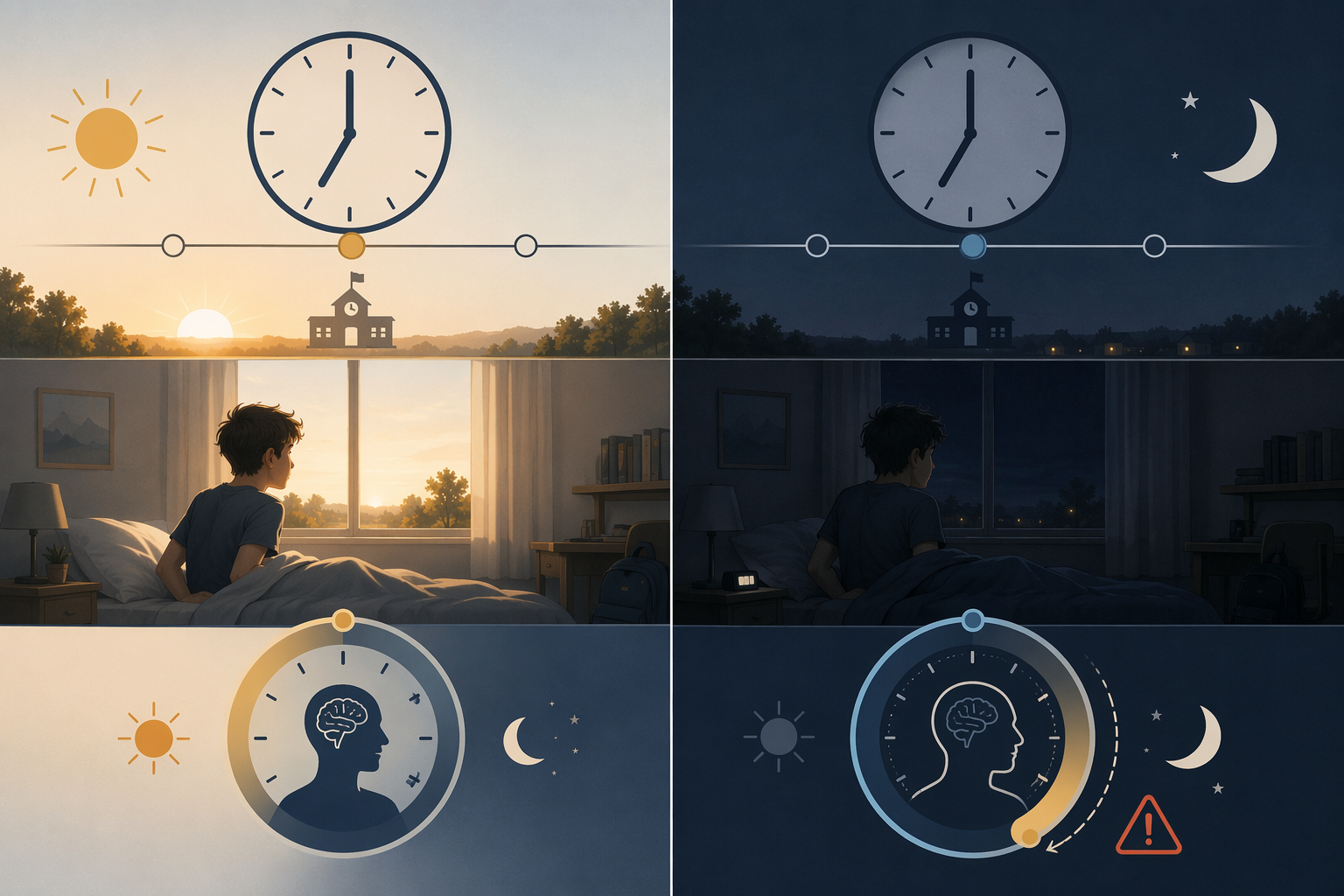
That distinction matters because “more evening light” is politically simple and biologically incomplete. Permanent daylight saving time would move civil time one hour later relative to the sun year-round. In winter, that means later sunrise, darker school mornings, and a greater mismatch between adolescent biology and institutional start times. Permanent standard time does the opposite: it keeps social time closer to solar time, giving morning light a better chance to do the work the circadian system needs it to do.
The clinical issue is morning light, not clock preference
Human circadian timing is not set mainly by what adults prefer after work. It is strongly anchored by light exposure, especially morning light. Daylight saving time delays that morning light relative to clocks, and when the delay becomes permanent it can create chronic social jet lag: a persistent gap between the body’s internal clock and required social schedules.
Rishi and colleagues describe this burden as falling especially on intermediate and late chronotypes, which together make up about 85% of the population; morning larks, about 15%, are the group most likely to benefit from the earlier-clock alignment of daylight saving time.[2] Adolescents are the wrong population in which to minimize that imbalance. Puberty shifts circadian timing later, even before homework, phones, sports, jobs, anxiety, and early buses are added.
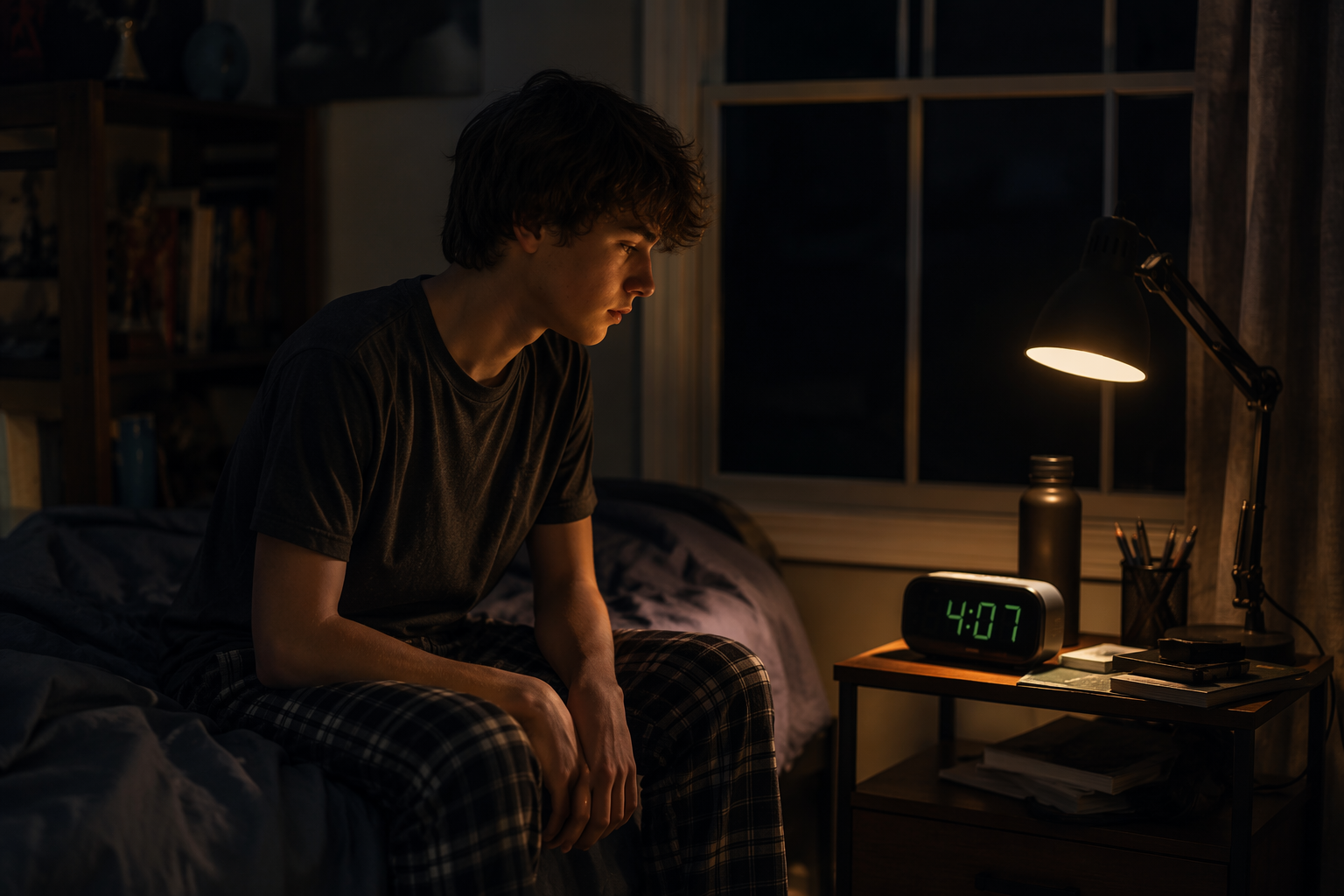
A teenager asked to wake in darkness is not simply being inconvenienced. The strongest wake-promoting environmental signal is arriving late, while the school schedule arrives on time. The result is a familiar clinical pattern: shortened sleep, harder morning alertness, later evening sleepiness, and more strain placed on mood, attention, and behavior.
Measured adolescent sleep loss is not a matter of opinion
The spring daylight saving transition offers a smaller, short-term version of the exposure permanent daylight saving time would extend: darker mornings and a clock schedule pushed earlier relative to the body. In an actigraphy study of 35 high school students, Krieger and colleagues documented 32 minutes less sleep per night after the spring transition, accumulating to 2 hours and 42 minutes of sleep loss across the school week.[3] The study was small, but its importance is that it measured sleep rather than asking students whether they liked the clock change.
That evidence should not be inflated into a claim that every student loses exactly the same amount of sleep under permanent daylight saving time. A one-week transition study is not a year-round policy trial. But it does show that adolescents do not simply adapt without consequence when the clock abruptly moves against morning light. In a population already running short on sleep, half an hour per night is not trivial.
The mechanism also explains why permanent daylight saving time is not just a longer version of a rough Monday. If sunrise remains delayed through winter, the body’s corrective signal keeps arriving after students have already been required to wake and often after they have already started traveling. That is where a temporary sleep disruption becomes a chronic scheduling exposure.
The strongest pro-DST model still favors standard time
The most serious argument for permanent daylight saving time cannot be dismissed as nostalgia for evening sunlight. Weed and Zeitzer’s 2025 PNAS modeling study projected that permanent daylight saving time could reduce obesity by 0.51%, corresponding to 1.7 million fewer cases, and reduce stroke by 0.07%, corresponding to 220,000 fewer cases.[4] Those are not anti-DST results.
But the head-to-head comparison is the clinically relevant part. In the same modeling framework, permanent standard time produced nearly double the projected reductions in obesity and stroke compared with permanent daylight saving time.[4] Even the model that credits permanent daylight saving time with population health gains finds larger gains when the clock is aligned to standard time.
The assumptions also matter. The model used idealized light-exposure patterns, including a 10 p.m. to 7 a.m. sleep window and outdoor light exposure before and after work; the authors noted that real-world habits are “probably much worse.”[4] For adolescents, that caveat is not a footnote. Many students do not control their wake time, commute time, school start time, or morning outdoor exposure. A model that still favors standard time under cleaner assumptions should not be used to sell permanent daylight saving time as the safer pediatric option.
Learning outcomes are harder to measure, but the signal is concerning
Academic performance is not a direct biomarker of circadian alignment. It is affected by poverty, school quality, test access, family resources, language, disability, and many other factors. That is why the Indiana SAT finding should be handled carefully. In a 10-year study, Gaski and Sagarin found that students in daylight-saving-observing areas scored lower on SATs, with a 49-point gap for low-income students compared with an 8-point gap for high-income students.[5]
One state study cannot carry a national education policy argument by itself. Still, its pattern is clinically plausible: the burden of morning misalignment is not evenly distributed. Students with fewer resources have less room to compensate for lost sleep with flexible transportation, quiet mornings, later schedules, tutoring, or clinical support. When a clock policy makes wake time harder, the consequences do not land on a neutral population.
Mood data point in the same direction
The adolescent mood evidence is not as abundant as clinicians would like, but the available precedent is difficult to ignore. A seven-year Russian study comparing permanent daylight saving time, permanent standard time, and seasonal daylight saving time found the highest rates of seasonal depression in adolescents during permanent daylight saving time and the lowest during permanent standard time.[6]
That finding does not prove that a U.S. permanent daylight saving policy would reproduce the same rates. Geography, latitude, school schedules, cultural routines, and measurement methods all matter. But it does fit the biological concern: delaying winter morning light in a phase-delayed adolescent population is not a benign exposure, especially when mood regulation and sleep regularity are already clinically intertwined.
Dark school mornings are a safety exposure
The United States has already tested permanent daylight saving time in living memory. The 1974 experiment was abandoned within a year after public opposition grew, including alarm over dark morning travel; eight Florida students were fatally struck by vehicles on dark morning roads within weeks.[7] That episode should not be treated as if it alone settles modern policy. It does, however, make the exposure concrete: children were being asked to move through traffic before daylight.
The broader safety evidence gives that concern a present-day frame. NHTSA data show that school-age pedestrian deaths concentrate during the 6 a.m. to 8 a.m. commute window.[7] Separately, Gentry and colleagues found that people living where sunrise is at least 30 minutes later than the time-zone meridian have 21.8% higher motor vehicle fatality rates.[8] That geographic analysis is not the same as a randomized trial of permanent daylight saving time, but it is consistent with the danger of later sunrise imposed on fixed morning travel.
For schools, the relevant question is practical. Who is waiting at the bus stop? Who is crossing an arterial road? Who is driving a younger sibling, or driving themselves, while sleep restricted and pre-dawn? A clock policy that makes winter mornings darker increases the number of students placed into those conditions before the school day even begins.
The burden depends on where a child lives
Permanent daylight saving time is often discussed as if the country experiences one clock. It does not experience one sunrise. Under permanent daylight saving time, sunrise would be delayed past 8 a.m. for 106 to 169 days per year depending on location, and in northern cities winter-solstice sunrise would approach 9:30 a.m.[9] In Connecticut, one estimate found that students would wake in darkness about 251 days per year under permanent daylight saving time, compared with about 141 days under current policy.[9]
Those differences are not decorative map trivia. Western edges of time zones, northern latitudes, rural bus routes, and communities with less transportation flexibility can experience a permanent-DST policy as a much heavier morning-darkness mandate than places with earlier sunrise or more schedule control. The same federal clock can produce very different pediatric exposures.
| Policy choice | Student-relevant effect |
|---|---|
| Permanent daylight saving time | Later sunrise, darker school mornings, more circadian delay pressure, greater concern for winter commutes |
| Permanent standard time | Earlier sunrise relative to clock time, stronger morning circadian anchoring, lower modeled health burden |
| Seasonal switching | Avoids the worst permanent winter darkness but retains acute transition-related sleep disruption |
Why medical societies favor permanent standard time
The American Academy of Sleep Medicine’s updated 2023 position statement, endorsed by more than 20 medical and scientific organizations, states that permanent daylight saving time would be worse for health than continuing seasonal time changes and recommends permanent standard time instead.[10] The consensus also includes organizations such as the American Medical Association, American Academy of Pediatrics, American Academy of Neurology, Sleep Research Society, and Society for Research on Biological Rhythms.[10]
That position is sometimes caricatured as a defense of clock switching. It is not. The clinical preference is for eliminating the seasonal transitions by choosing the fixed clock that best aligns with circadian physiology. Standard time is favored because morning light is the more useful anchor for human biological timing, and because adolescents already carry a developmental delay in sleep timing before policy makes sunrise later.
The evidence is not uniform in design or strength. Actigraphy data are small but objective. The SAT study is geographically specific. The Russian depression study is an international precedent, not a U.S. prediction. The 1974 experience is historical, not a modern controlled study. The Stanford model is powerful but assumption-dependent. What matters is that these different materials do not point randomly. They converge on the same clinical concern: permanent daylight saving time shifts light away from the morning hours when students most need circadian support.
The policy conclusion for student health
Abolishing seasonal clock changes may still be a reasonable public-health goal. The mistake is treating any permanent clock as an improvement. For students, permanent daylight saving time would make winter mornings darker, push social schedules farther from solar time, and place the largest burden on adolescents whose biology is already shifted later and on communities with less flexibility to absorb sleep and transportation strain.
As of Q3 2026, the Senate decision remains pending. The clinically safer framing is not “stop changing the clocks at any cost.” It is this: if the clock becomes permanent, choose the one that imposes the smaller circadian burden on students. The evidence favors permanent standard time.
References
- H.R.139 - Sunshine Protection Act of 2025, Congress.gov.
- Debunking myths about daylight saving time, PMC, 2023.
- Adverse Effects of Daylight Saving Time on Adolescents' Sleep and Vigilance, Journal of Clinical Sleep Medicine, 2015.
- Health effects of permanent daylight saving time and permanent standard time, PNAS, 2025.
- Detrimental Effects of Daylight-Saving Time on SAT Scores, Journal of Neuroscience, Psychology, and Economics, 2011.
- Chronobiological characteristics of adolescents in different time zones, PubMed, 2015.
- Permanent Daylight Saving Time: A Bad Idea, Save Standard Time.
- Time zones, daylight saving time, and motor vehicle deaths, Time & Society, 2022.
- Permanent Daylight Saving Time: Sunrise and School Start Times, Craig Canapari, MD.
- Permanent standard time is the optimal choice for health and safety: an American Academy of Sleep Medicine position statement, Journal of Clinical Sleep Medicine, 2023.
Comments
Join the discussion with an anonymous comment.