
The impact of philanthropy on healthcare innovation is easiest to misread when the money is treated as a substitute for government funding or venture capital. In AI-driven medicine, its more important role is narrower and more structural: paying for the base layer before there is a validated product, a reimbursement code, or a clean clinical trial endpoint.
That base layer is expensive. It includes shared datasets, cell atlases, benchmarking systems, computational biology platforms, model-development environments, and the painstaking work of making biological data usable across labs. These are not usually the things that make an investor memo exciting. They are also not always a comfortable fit for grant panels that must defend incremental feasibility. Yet without them, much of healthcare AI remains trapped in the familiar cycle of promising demos, narrow validation, and fragile translation.

The scale is now large enough that it has to be part of the healthcare AI funding map. A 2024 analysis in Scientific Reports estimated philanthropic funding for science at roughly $30 billion per year, a level the authors described as rivaling the scale of the National Institutes of Health budget.[1] Giving to health reached $56.58 billion in 2023, the highest inflation-adjusted value recorded in the Giving USA health subsector analysis, with a 4.4% real increase over 2022.[2] The Milken Institute has framed philanthropy as only about 4% of total medical R&D spending, while still capable of outsized impact because it can support high-risk, pre-competitive work that helps de-risk later public or private investment.[3]
Those numbers should not be mistaken for a simple ranking of funders. NIH, venture capital, and philanthropy are built to do different jobs. The question is not which one is largest in every setting. The question is which one is willing to pay for the part of AI-enabled healthcare innovation that is scientifically necessary but institutionally awkward.
The Funding Gap Beneath Healthcare AI
Government science funding is indispensable, especially for investigator-initiated research, clinical studies, and large public programs. But public grantmaking often rewards problems that can be scoped, reviewed, and justified through existing scientific categories. That does not make it timid by definition. It does mean that projects asking for years of support to build a shared AI biology platform can face a hard burden of proof before the platform has already shown its downstream uses.
Venture capital has a different constraint. It can move quickly and tolerate technical risk, but it eventually needs a company-shaped answer: proprietary advantage, a market, a buyer, and a route to return. Many healthcare AI infrastructure projects create value precisely by being shared. A clean benchmark, a broadly accessible cell dataset, or an open computational biology tool may make the entire field more capable without producing a defensible product in the near term.
| Funding pathway | What it is usually built to reward | Where foundational healthcare AI can strain the model |
|---|---|---|
| Government grants | Reviewed scientific merit, feasibility, public mission, accountable use of funds | Long-horizon platforms may look too speculative before downstream users and clinical applications are clear |
| Venture capital | Scalable products, proprietary advantage, near- or medium-term return potential | Open datasets, benchmarks, and shared computational tools may create broad value without a direct business model |
| Philanthropy | Mission-aligned risk, field-building, institutional bets, non-dilutive support | Impact depends heavily on donor priorities, access networks, governance, and whether resources remain broadly usable |
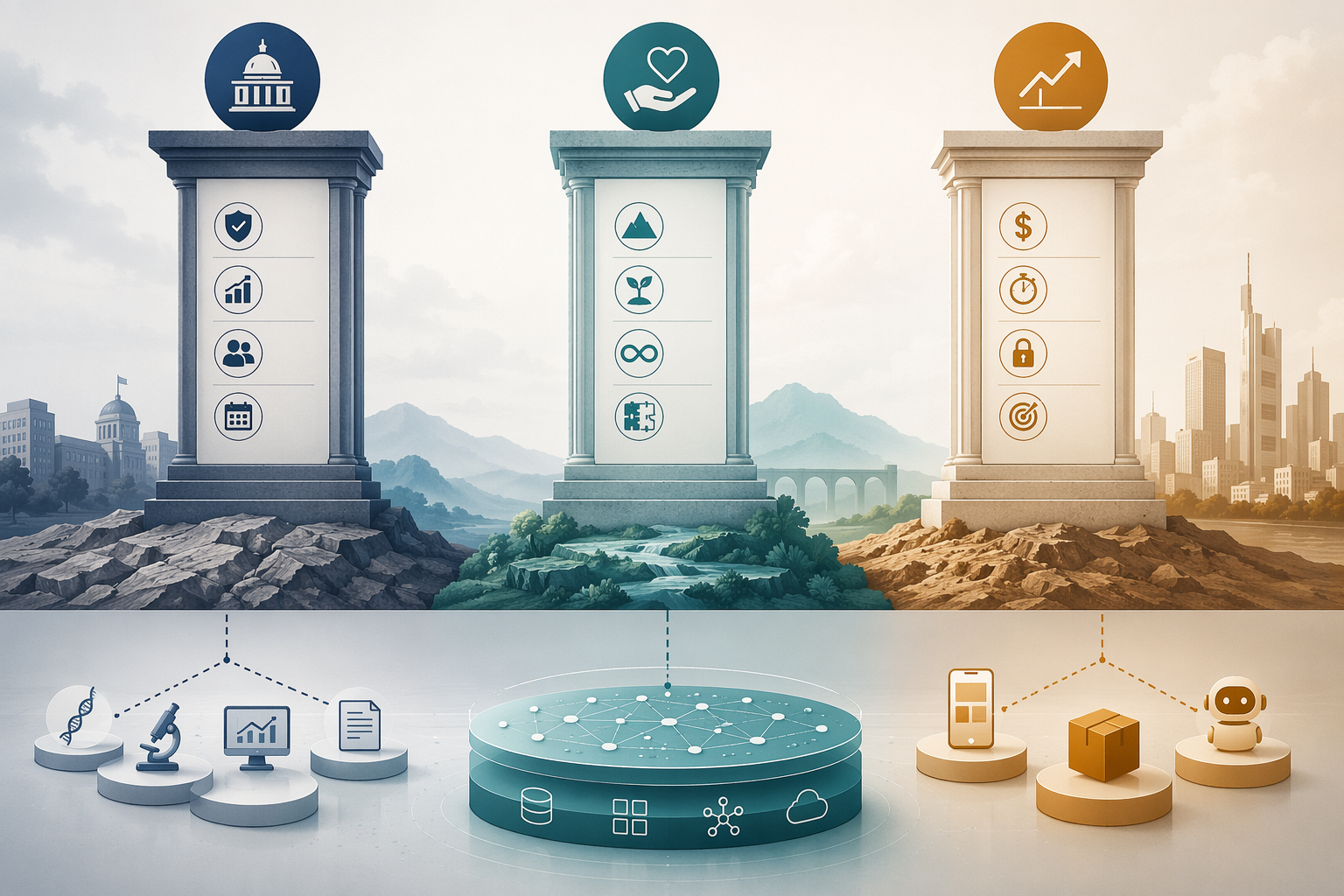
This is where philanthropy becomes unusually consequential. It can fund a scientific commons without asking it to become a company. It can make a grant before the evaluation metrics are settled. It can back an infrastructure bet because the field needs a substrate, not because the substrate has already produced a fundable clinical endpoint.
CZI and the Philanthropic Bet on AI Biology Infrastructure
The Chan Zuckerberg Initiative is the clearest current example of philanthropy moving into the foundational layer of AI-biomedical research. CZI has described a $3.4 billion, 10-year science commitment centered on AI-driven biology, including the Chan Zuckerberg Biohub Network and work toward predictive models of cells and biological systems.[4] Science reported the expansion as a dramatic increase in CZI’s funding ambitions, with AI at the center of the effort.[5]
The important feature is not only the size of the commitment. It is the kind of work being funded. Virtual cell models, shared single-cell data resources, and computational biology platforms sit upstream of many possible applications. They may eventually influence drug discovery, target selection, diagnostics, disease modeling, or trial design. But at the moment of funding, they are often closer to scientific infrastructure than to clinical product development.
CZI’s science program includes tools and resources such as CELLxGENE, which supports exploration and analysis of single-cell datasets, and the Billion Cells Project, a large-scale effort tied to making cellular data more useful for biological discovery.[4] These are the kinds of investments that can change what later researchers are able to ask. A lab with access to better harmonized data and computational tools starts from a different place than a lab trying to assemble a one-off dataset for a single paper.
That distinction matters for healthcare AI because model performance is often discussed as if the decisive bottleneck were only architecture or compute. In biomedical settings, the bottleneck is frequently data quality, biological context, metadata, interoperability, and the ability to compare results across systems. Philanthropic funding does not solve those problems automatically, but it can pay for the patient engineering and coordination work that many other mechanisms underfund.
CZI also shows why comparison is not straightforward. Its structure includes philanthropic and nontraditional organizational elements, which makes it difficult to compare cleanly with traditional private foundations. That does not erase the relevance of the commitment. It does mean analysts should be careful about treating every large science pledge as equivalent in governance, payout rules, transparency, or public accountability.
What Philanthropy Buys That Other Capital Often Does Not
The distinctive value of philanthropic capital in healthcare AI is not that it is morally purer than other funding. It is that it can be structurally patient. A donor or foundation can support a platform that will be judged by field adoption over many years, not by the next financing round. It can make non-dilutive awards to academic groups and nonprofit teams that would lose the point of the work if they had to convert everything into proprietary assets.
That flexibility is especially relevant in computational biology. The Milken Institute’s Science Philanthropy Accelerator for Research and Collaboration has highlighted AI in health as a focus area, including $14 million in computational biology grants through SPARC-related work.[6][7] The amount is modest beside multibillion-dollar commitments, but the mechanism is worth attention: grants aimed at computational methods and scientific infrastructure can help researchers build tools before there is an obvious commercial sponsor.
The same logic applies to AI health tools for low-resource settings. The Gates Foundation’s reported AI health commitments, including work with model developers and initiatives focused on low-resource environments, point to a problem that venture capital does not reliably prioritize: clinically meaningful tools for users who may not represent the most attractive early market. The relevant distinction is not whether AI can be useful in these settings. It is whether anyone will pay for development, validation, localization, and deployment before the business case is obvious.
Low-resource health AI also forces a different definition of innovation. A model that depends on continuous specialist oversight, high-end infrastructure, or extensive local data engineering may be impressive and still be poorly matched to the setting. Philanthropic funding can support the less glamorous work of adaptation: workflow fit, language and context, local disease priorities, and evaluation under constrained conditions. Those steps rarely carry the shine of a new model release, but they determine whether a tool can be useful outside elite institutions.
This is the stronger argument for philanthropy’s role in healthcare innovation. It is not that foundations can do everything faster. It is that they can fund categories of work whose value is distributed, delayed, or hard to own. In AI-enabled medicine, that includes pre-competitive datasets, open or semi-open tools, shared standards, risky biological hypotheses, and infrastructure for populations that commercial markets usually reach late.
Why the Base Layer Changes the Innovation Pipeline
Foundational funding changes the healthcare AI pipeline by changing the cost and risk of later work. If a public dataset exists, a team does not need to spend its first year negotiating access before asking a scientific question. If benchmarks are credible, weak claims become easier to identify. If computational biology tools are reusable, a discovery group can test a hypothesis without building every component from scratch.
The downstream beneficiaries may not look philanthropic at all. A startup can build on a field-standard dataset. A health system can evaluate a tool using a benchmark that came from nonprofit infrastructure. An academic lab can publish a method paper because another group maintained the data resource that made comparison possible. This is why philanthropic impact can be larger than its share of total R&D spending suggests: the first dollars can alter what later dollars are able to do.
The Milken Institute’s argument about outsized impact depends on this sequencing. Philanthropy is not the dominant source of medical R&D capital by volume, but it can enter early enough to make a field legible to government agencies, companies, and later investors.[3] In healthcare AI, that early legibility often means turning messy biological or clinical information into something that can be queried, modeled, validated, and reused.
There is a practical consequence for institutions seeking AI partnerships. A foundation-funded platform may be as strategically important as a company announcement, even if it does not arrive with a product launch. The better question is what dependency it reduces. Does it lower the cost of data access? Does it make model comparison more honest? Does it broaden participation beyond a small group of well-resourced sites? Does it create a tool that survives beyond a single grant cycle?
The Uneven Geography of Philanthropic Science
The case for philanthropy becomes weaker when it is made as if donor capital naturally produces equitable access. The same Scientific Reports study that estimated the scale of science philanthropy also found that 49% of philanthropic science funding stayed in the funder’s home state and that 69% of grant relationships repeated year over year.[1] Those patterns do not prove that individual grants are poorly chosen. They do show how philanthropic science can reinforce geography and existing institutional relationships.
For healthcare AI, that matters. If foundational datasets, platforms, and AI biology centers cluster around already powerful institutions, the field may get better tools while still narrowing who gets to shape them. Researchers outside favored networks can find themselves using infrastructure they had little role in designing. Health systems serving different populations may discover that supposedly general resources encode assumptions from places with more funding, more data staff, and better-connected investigators.
There is also a measurement problem. Philanthropic commitments vary in structure, timing, governance, and transparency. A traditional foundation grant, a donor-advised fund, an LLC-backed science program, and an advocacy-linked initiative may all be described under the broad language of philanthropy. They do not necessarily operate under the same constraints. That makes simple dollar-for-dollar comparison attractive and often misleading.
The Scientific Reports analysis is also limited to U.S. philanthropic giving, so its findings should not be stretched into a global map of science philanthropy.[1] Global health AI funding may follow different patterns, especially where international donors, multilateral agencies, and local public health systems interact. The narrower conclusion is still important enough: in the U.S. data, philanthropic science funding is large, sticky, and geographically concentrated.
A Third Pathway, Not a Replacement
Healthcare AI needs public funding, private investment, and philanthropy for different reasons. Government agencies remain central to biomedical research legitimacy, public accountability, and broad scientific capacity. Venture capital remains powerful where an AI tool can become a scalable product with a plausible market. Philanthropy is most useful where the work is too early, too shared, too infrastructural, or too commercially uncertain for the other two pathways to carry alone.
That is why CZI’s AI biology infrastructure, SPARC’s computational biology grants, and low-resource AI health commitments belong in the same funding conversation even though they differ in scale. Each points to a version of innovation that begins before the product boundary is clear. Each treats models, data, and biological infrastructure as field-building assets rather than only as proprietary technology.
The balanced view is not especially romantic. Philanthropy can accelerate healthcare AI by paying for foundational resources that other systems routinely leave stranded. It can also concentrate opportunity, repeat familiar institutional relationships, and make public-interest science depend on private priorities. In 2026, it is not replacing government or venture capital. But for the shared infrastructure beneath AI-driven healthcare innovation, it has become too important to treat as background generosity.
References
- Science philanthropy indicators: mapping trends in private funding for basic science, Scientific Reports, 2024
- Giving USA 2024: A Closer Look at the Health Subsector, Stelter, October 9, 2024
- The Outsized Impact of Philanthropy in Biomedical Research, Milken Institute
- Science, Chan Zuckerberg Initiative
- AI drives dramatic expansion of Chan Zuckerberg Initiative’s funding to end all diseases, Science
- Science Philanthropy Accelerator for Research and Collaboration: Science Philanthropy Ecosystem, Milken Institute
- AI in Health, Science Philanthropy Alliance
Comments
Join the discussion with an anonymous comment.