
Counseling after thoracic outlet decompression is most useful when it starts with a simple question: return to what, and by when? Published athlete cohorts land in a favorable band, but not a guaranteed one. In adolescent series, venous TOS returned to sport at 94.4% and neurogenic TOS at 73.9%; in broader competitive-athlete follow-up, neurogenic TOS still sat in the 73% to 81% range [1][2].
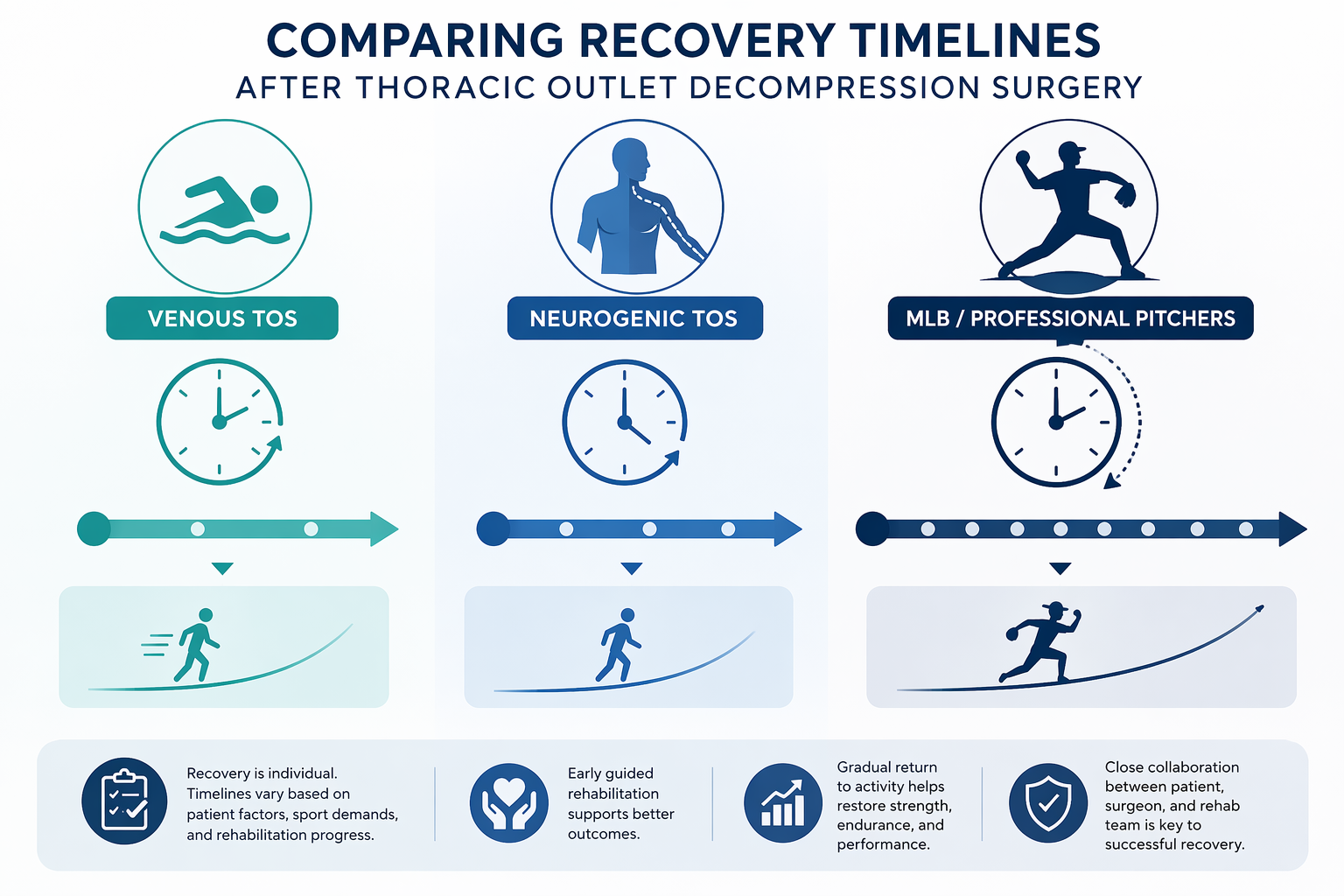
Time is just as subtype-dependent. One high-performance athlete cohort reported a median 4.4 to 4.7 months to competitive-level sport, but MLB pitchers often need about 9.5 to 10 months before game-level pitching is realistic [3][4]. That difference matters because return to participation is not the same thing as return to the specific load that defines the athlete's sport.
What the cohorts actually show
| Group | Reported recovery | Practical read |
|---|---|---|
| Venous TOS in adolescent athletes | 94.4% return to sport; 83.3% complete symptom resolution [1] | The most favorable athlete subgroup in the published data |
| Neurogenic TOS in adolescent athletes | 73.9% return to sport; 75% complete symptom resolution [1] | Still favorable, but clearly less uniform than venous TOS |
| Competitive athletes with nTOS | 73% to 81% return to sport; 77% no ADL limitations versus 56% in non-athletes [2] | Athletes can do better functionally than non-athletes, even when symptoms do not disappear completely |
| MLB pitchers | About 9.5 to 10 months to game-level pitching [4] | A generic return-to-sport date would understate the demands of pitching |
The pattern is more important than any single number. Venous TOS reads as the more forgiving recovery story, neurogenic TOS remains favorable but less predictable, and pitchers sit on a longer sport-specific clock because throwing volume and competitive stress do not come back on the same day that an athlete is allowed back to practice. The evidence is also weighted toward throwing athletes, so the cleanest counseling data come from baseball and softball rather than swimming, volleyball, or tennis.
Rehab has to be gated, not scheduled

Rehabilitation is where recovery after thoracic outlet surgery in athletes either becomes believable or drifts into calendar-based optimism. In overhead athletes, only 27% to 34% may respond to physical therapy alone, and as many as 60% ultimately require surgery, which is why the post-operative plan matters so much [5].
- Mobility: restore shoulder girdle and thoracic motion without chasing symptoms.
- Motor control: reduce compensatory neck and scapular strategies before load goes up.
- Progressive loading: rebuild strength, then overhead volume, then sport-specific work.
- Example gate criteria: about 90% strength dynamometry and 80% passive ROM before progression [6].
A structured overhead-athlete model uses those checkpoints to decide whether the athlete is ready to advance. In one Division I softball case report, that approach supported full participation at 18 weeks after evaluation, which is useful as a worked example but not as a universal benchmark for all athletes [6].
That is the main rehabilitation lesson: a good timeline does not fix a poor movement pattern, and a good movement pattern still has to earn the next layer of loading.
Prediction tools help, but they do not settle the decision
The Johns Hopkins NTOS calculator reports an AUC of 0.8 for predicting postoperative improvement after transaxillary first rib resection, and the underlying model identified hand weakness, older age, workers' compensation, and dominant-hand symptoms as negative predictors [7]. A separate random forest model distinguished neurogenic TOS from carpal tunnel syndrome with 85% accuracy [8].
Those numbers are promising, but they are not the same as athlete-specific external validation. These tools come from general-population or single-institution settings, so they can support counseling but should not replace subtype, sport demand, and rehabilitation milestones when the patient is a competitive overhead athlete.
For now, the most defensible counseling is still subtype-first and sport-specific: venous TOS generally looks most forgiving, neurogenic TOS remains favorable but less uniform, MLB pitchers recover on a longer game-level clock, and return decisions are better anchored to function than to a calendar or an unvalidated calculator [1][2][3][4][5][6][7][8].
References
- Adolescent athletes can get back in the game after surgery for thoracic outlet syndrome — PubMed
- Midterm and long-term follow-up in competitive athletes undergoing thoracic outlet decompression for neurogenic thoracic outlet syndrome — PubMed
- Thoracic Outlet Syndrome in High-Performance Athletes — J Vasc Surg
- Thoracic Outlet Syndrome in Major League Baseball Pitchers: Return to Sport and Performance Metrics After Rib Resection — PubMed
- Thoracic outlet syndrome in the overhead athlete: Diagnosis and treatment recommendations — PMC
- Rehabilitation in Overhead Athletes With Thoracic Outlet Syndrome — PMC
- Development and validation of a prediction model for outcomes after transaxillary first rib resection for neurogenic thoracic outlet syndrome — Johns Hopkins
- Machine learning can aid in the differential diagnosis of neurogenic thoracic outlet syndrome — PubMed
Comments
Join the discussion with an anonymous comment.