
A poor-air-quality episode becomes a hospital operations problem when the warning arrives before the patients do. The question is not only whether particulate matter or ozone can worsen respiratory illness. Emergency departments already see the downstream version of that risk: more wheezing children, more inhaled treatments, more pediatric beds under pressure, more respiratory therapists stretched across units. The more useful question is whether AI can turn health risks from poor air quality and air quality alerts into a forecast with enough lead time to change staffing, bed planning, and escalation protocols.
The short answer is cautious but real: current evidence suggests that machine-learning models can forecast respiratory utilization from environmental and clinical variables with operationally interesting accuracy, especially in pediatric respiratory care. The strongest directly clinical evidence comes from a 2025 São Paulo pediatric hospital study using XGBoost to predict respiratory visits and admissions from pollution, climate, and patient factors. It reported 85% accuracy and an AUC of 0.81 for predicting pediatric hospital care related to respiratory disease, with forecasts extending 1 to 30 days ahead.[1]
That is not the same as saying hospitals can now buy an FDA-cleared air-quality admission predictor and plug it into the command center. The field is still closer to validation and pilot design than routine clinical decision support. But a forecast window measured in days rather than hours is a different class of tool from a public AQI alert. It gives bed managers and pediatric service lines time to decide whether the likely problem is tomorrow’s inhaler demand, next week’s admission pressure, or a staffing mismatch that will be obvious only after the waiting room is full.

Why the Forecast Matters Before the Model Does
Air pollution carries enough population-level burden to justify attention from health systems, but population burden does not automatically prove that a local prediction model will work. Globally, the State of Global Air 2025 report attributed 7.9 million deaths in 2023 to air pollution, with 86% of that burden from noncommunicable diseases.[2] In the United States, the American Lung Association’s 2025 State of the Air report found that 156 million people, or 46% of the population, lived in counties receiving failing grades for ozone or particle pollution, an increase of 25 million people from the prior year.[3]
The U.S. distribution is also uneven. The same American Lung Association report found that people of color were more than twice as likely as white people to live in the most polluted communities.[3] That matters for clinical AI because exposure risk and data quality do not always travel together. The communities with the greatest pollution burden may also have fewer dense, reliable monitoring networks, especially where hospital catchment areas include rural, low-income, or historically under-resourced neighborhoods.
For a hospital, that creates a practical distinction. A general air quality alert tells the public that exposure risk is rising. A clinical operations forecast would need to say something narrower: given local pollution, weather, demographics, and prior utilization patterns, respiratory demand is likely to rise in a way that should change staffing, beds, supplies, or outreach. The second claim is much harder, and much more useful.
What the São Paulo Pediatric Model Actually Predicted
The Cabral-Miranda et al. study is the strongest evidence here because it tested the problem in a care setting rather than stopping at environmental classification. The investigators analyzed one year of data from a pediatric hospital in São Paulo, covering 24,366 visits and 2,973 admissions for respiratory disease.[1] The model incorporated clinical, pollution, and climatic factors, including PM10, ozone, temperature, and humidity.[1]
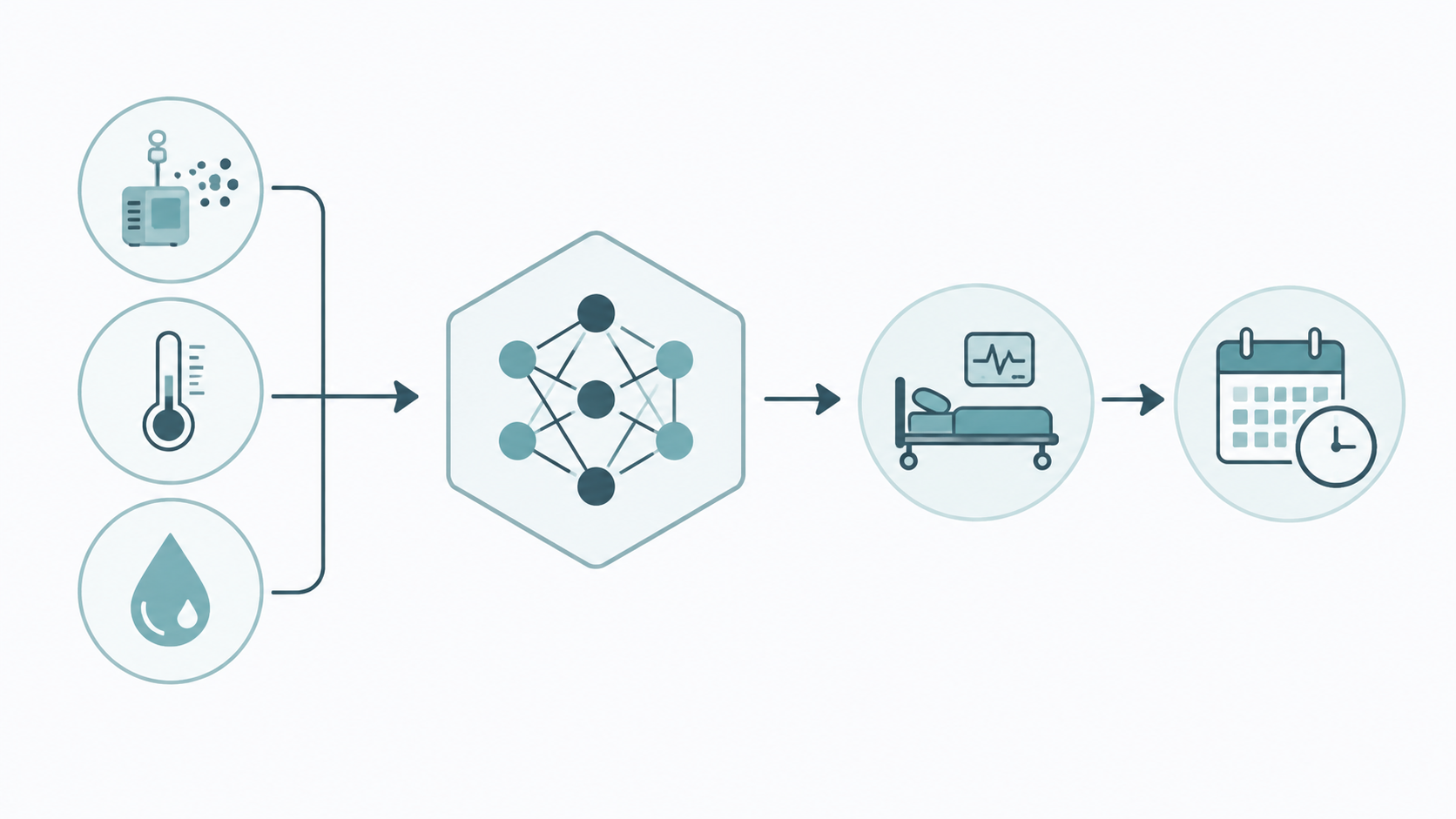
The choice of inputs is clinically plausible without being exotic. PM10 and ozone capture pollution signals; temperature and humidity help account for weather conditions that shape both exposure and respiratory vulnerability. When these variables are paired with clinical-demographic data, the model is not merely forecasting bad air. It is estimating whether a specific pediatric care environment is likely to experience respiratory visits or admissions after those environmental conditions occur.
| Element | What It Means Operationally |
|---|---|
| 24,366 pediatric visits | The model was trained and tested against actual hospital utilization, not only environmental readings. |
| 2,973 admissions | The outcome included inpatient demand, which matters for bed planning and staffing. |
| PM10, ozone, temperature, humidity | The model combined pollution and climate signals that can precede respiratory demand. |
| 85% accuracy; AUC 0.81 | Performance was strong enough to justify validation work, but not enough on its own to support unsupervised deployment. |
| 1–30 day prediction window | The lead time could support scheduling, bed management, supplies, and targeted alerts if validated locally. |
The 1-to-30-day forecast horizon is the most operationally interesting part of the study.[1] Same-day alerts can be useful for public messaging, but they often arrive too late for hospital capacity decisions that depend on staff schedules, inpatient throughput, respiratory therapy coverage, and pediatric bed availability. A several-day signal gives leaders a chance to ask concrete questions: Do we need more respiratory therapy coverage? Should pediatric leaders review bed projections? Should the ED prepare for longer bronchodilator treatment runs? Should outpatient teams push guidance to high-risk families before the ED becomes the default access point?
The model architecture also fits the use case. XGBoost is not a black-box flourish added for effect; it is well suited to structured tabular data and nonlinear interactions among variables such as pollutant levels, weather conditions, and patient characteristics. In this context, the clinical question is not whether the model understands pathophysiology. It is whether it can consistently detect patterns early enough to improve preparation.
What 85% Accuracy Does and Does Not Buy
An 85% accuracy figure should get attention, but it should not end the conversation.[1] Hospital leaders need to know what kind of errors the model makes. A false negative could leave a pediatric ED underprepared for a respiratory surge. A false positive could lead to extra staffing, unnecessary escalation, or alert fatigue. The AUC of 0.81 suggests useful discrimination in the study setting, but it does not reveal by itself whether a particular threshold would be safe or efficient for a hospital’s command center.[1]
Threshold choice is where a research model becomes an operations decision. A children’s hospital might accept more false positives if the action is a low-cost internal readiness notice. It would need a higher bar if the action involves canceling elective capacity, calling in staff, or sending patient-facing warnings. The same prediction can be reasonable for one workflow and too weak for another.
The study’s one-year temporal scope also matters.[1] Respiratory demand is shaped by season, school calendars, viral circulation, smoke events, heat, humidity, local transportation patterns, and access to outpatient care. A model that performs well across one year in São Paulo has not yet shown that it can handle interannual variation or a different region’s pollutant mix and utilization behavior.
From AQI Alerts to Clinical Demand Signals
Air quality alerts and respiratory admission forecasts are related, but they are not interchangeable. An AQI alert classifies environmental conditions. A hospital forecast needs to estimate utilization consequences. The first asks whether the air is hazardous; the second asks whether a particular care system should expect more respiratory encounters, admissions, treatments, or bed days.
Jalali et al. helps show what the alert-system side could look like. Their 2025 work described a scalable AI-driven air quality forecasting and classification platform using a Random Forest ensemble, reporting 99.96% AQI classification accuracy and a real-time Django-based system with SHAP and LIME explainability tools.[4] That is useful infrastructure context: fast classification, real-time delivery, and some explanation of model outputs are all prerequisites for practical public health alerting.
Still, high AQI classification accuracy does not prove that a hospital can forecast admissions. The Jalali et al. platform addresses environmental classification and public health applications, while the São Paulo pediatric study ties pollution and climate signals to actual pediatric respiratory hospital care.[1][4] For hospital operators, that distinction is not academic. An air-quality dashboard may explain why risk is rising; an admission model must help decide who needs to be on shift and which beds may be needed.
Where Hospitals Could Use the Signal
If locally validated, an air-quality respiratory forecast would fit best where the action is preparatory rather than diagnostic. It should not tell a clinician that an individual child’s wheeze was caused by ozone. It could tell an ED, pediatric unit, or respiratory therapy department that demand is likely to rise over a defined window and that current schedules or bed assumptions deserve review.
- ED staffing: adjust charge nurse planning, fast-track coverage, and respiratory treatment capacity when the forecast points to increased respiratory arrivals.
- Pediatric bed management: review expected admissions earlier, especially when baseline occupancy is already high.
- Respiratory therapy coverage: anticipate bronchodilator treatments, oxygen needs, and cross-unit workload before the shift begins.
- Supply readiness: check inhaled medications, spacers, nebulizer equipment, oxygen delivery supplies, and discharge education materials.
- Targeted outreach: send validated guidance through existing patient portals or population health channels when the health system has an appropriate high-risk cohort.
The safest early uses are internal and reversible. A forecast that triggers a leadership huddle, a staffing review, or a respiratory therapy capacity check carries less clinical risk than one that changes patient-level triage or treatment. That staging matters because the evidence is not yet strong enough for broad, automated clinical decision support.
The Deployment Problems Are Mostly Local
The first barrier is generalizability. São Paulo’s pollutant profile, pediatric population, hospital referral patterns, climate, and admission practices may not match those of a U.S. children’s hospital, a European mixed adult-pediatric center, or a rural regional ED. A model that performs well in one setting can lose reliability when the relationship among exposure, care-seeking behavior, and admission thresholds changes.
The second barrier is environmental data density. These models depend on the quality and proximity of pollution and weather measurements. If a hospital serves neighborhoods with sparse monitoring, the model may be forced to infer exposure from distant sensors or coarse regional estimates. That can weaken prediction precisely for patients living in places where pollution burden is highest.
The third barrier is clinical data depth. The current evidence described here uses structured environmental, climatic, and demographic inputs; it does not incorporate unstructured EHR notes, medication details, laboratory results, or clinician documentation. Those data may improve prediction, but they also create additional problems: extraction quality, privacy controls, bias auditing, governance, and integration into existing clinical systems.
The fourth barrier is workflow ownership. A forecast is only useful if someone knows what to do with it. ED leadership, pediatric hospital medicine, respiratory therapy, bed management, and informatics would need agreed thresholds, escalation paths, and review processes. Without that, the model becomes another dashboard that looks persuasive after the census has already changed.
What Validation Should Prove Next
The next useful studies are not simply larger versions of the same experiment. They need to test whether forecasts hold across multiple hospitals, climates, pollutant profiles, age groups, and care delivery patterns. They also need to report performance in the units that operators use: lead time, false-alert rate, missed-surge rate, calibration, threshold behavior, and effect on staffing or bed decisions.
- External validation: test the model in hospitals outside the original São Paulo setting before assuming transportability.
- Prospective evaluation: run predictions forward in time rather than only testing historical records.
- Operational endpoints: measure whether forecasts changed staffing, bed availability, ED throughput, or respiratory therapy readiness.
- Equity checks: compare performance across neighborhoods with different pollution burdens and sensor coverage.
- Governance review: define whether alerts are administrative, clinical, patient-facing, or research-only.
Regulatory posture is part of that governance. The systems described in the available evidence remain research or pilot-stage tools, not cleared clinical products. No described model has FDA clearance or CE marking for routine clinical deployment. Until that changes, hospitals should treat these systems as decision-support candidates requiring local validation, human oversight, and clear limits on use.
How Ready Is AI for Air-Quality Respiratory Alerts?
AI is ready enough to justify serious pilots in health systems that have reliable environmental data, linked clinical utilization data, and operational leaders willing to define actions before the alert fires. The Cabral-Miranda study gives a credible proof point: a structured XGBoost model using pollution and climate variables predicted pediatric respiratory care with 85% accuracy and an AUC of 0.81 in a real hospital dataset.[1]
It is not ready to be treated as standard clinical decision support. The evidence is still too narrow, the validation base too local, and the regulatory path unresolved. For now, the disciplined use case is local forecasting for preparedness: earlier staffing conversations, earlier bed planning, earlier respiratory therapy readiness, and more honest awareness that an air quality alert may become tomorrow’s admission pressure.
References
- Artificial intelligence platform to predict children’s hospital care for respiratory disease using clinical, pollution, and climatic factors, PMC, 2025.
- State of Global Air 2025, Health Effects Institute, 2025.
- State of the Air 2025, American Lung Association, 2025.
- Scalable AI-driven air quality forecasting and classification for public health applications, Springer, 2025.
Comments
Join the discussion with an anonymous comment.