
If an at-risk adult is missing in Florida, the first sorting question is not the color of the alert. It is whether the person fits Silver Alert criteria first. A Purple Alert is available only when the missing adult does not qualify for a Silver Alert, which makes the two systems mutually exclusive rather than interchangeable.[1]
That distinction matters in the first phone call. Families and caregivers cannot activate either alert themselves; they report the disappearance to local law enforcement, and law enforcement decides whether the legal and operational criteria are met before requesting state assistance.[2]
A note for regular ClinicalMind readers: this is a Florida public-safety policy explainer, not a healthcare AI article. The practical issue here is administrative classification during a missing-person response.
Purple Alert vs. Silver Alert in Florida
| Question | Florida Silver Alert | Florida Purple Alert |
|---|---|---|
| Who is it for? | Primarily people age 60 or older with Alzheimer’s disease, dementia, or another irreversible deterioration of intellectual faculties; also adults 18–59 if law enforcement determines they lack capacity to consent.[2] | Adults 18 or older with a qualifying intellectual or developmental disability, brain injury, or other physical, mental, or emotional disability that is not dementia-related.[1] |
| Is dementia included? | Yes. Dementia-related impairment is central to the usual Silver Alert category.[2] | No. Purple Alert excludes a missing adult who has Alzheimer’s disease or a dementia-related disorder.[1] |
| Can the same person qualify for both? | No. If Silver Alert criteria apply, the case belongs in the Silver Alert lane. | No. The statute requires that the person not qualify for a Silver Alert.[1] |
| Is age alone enough? | No. Being 60 or older is not enough without the required cognitive condition and threat assessment.[2] | No. Being 18 or older is only the age threshold; the disability and safety criteria still matter.[1] |
| Does substance abuse qualify? | The Silver Alert materials focus on irreversible deterioration of intellectual faculties and capacity, not substance abuse alone.[2] | No. Purple Alert excludes disabilities that are solely caused by substance abuse.[1] |
| Who activates it? | Law enforcement evaluates the case and contacts FDLE’s Missing Endangered Persons Information Clearinghouse, known as MEPIC.[2] | Law enforcement evaluates the case and contacts FDLE’s MEPIC; the 2024 law also separates local and statewide Purple Alert activation.[2][3] |
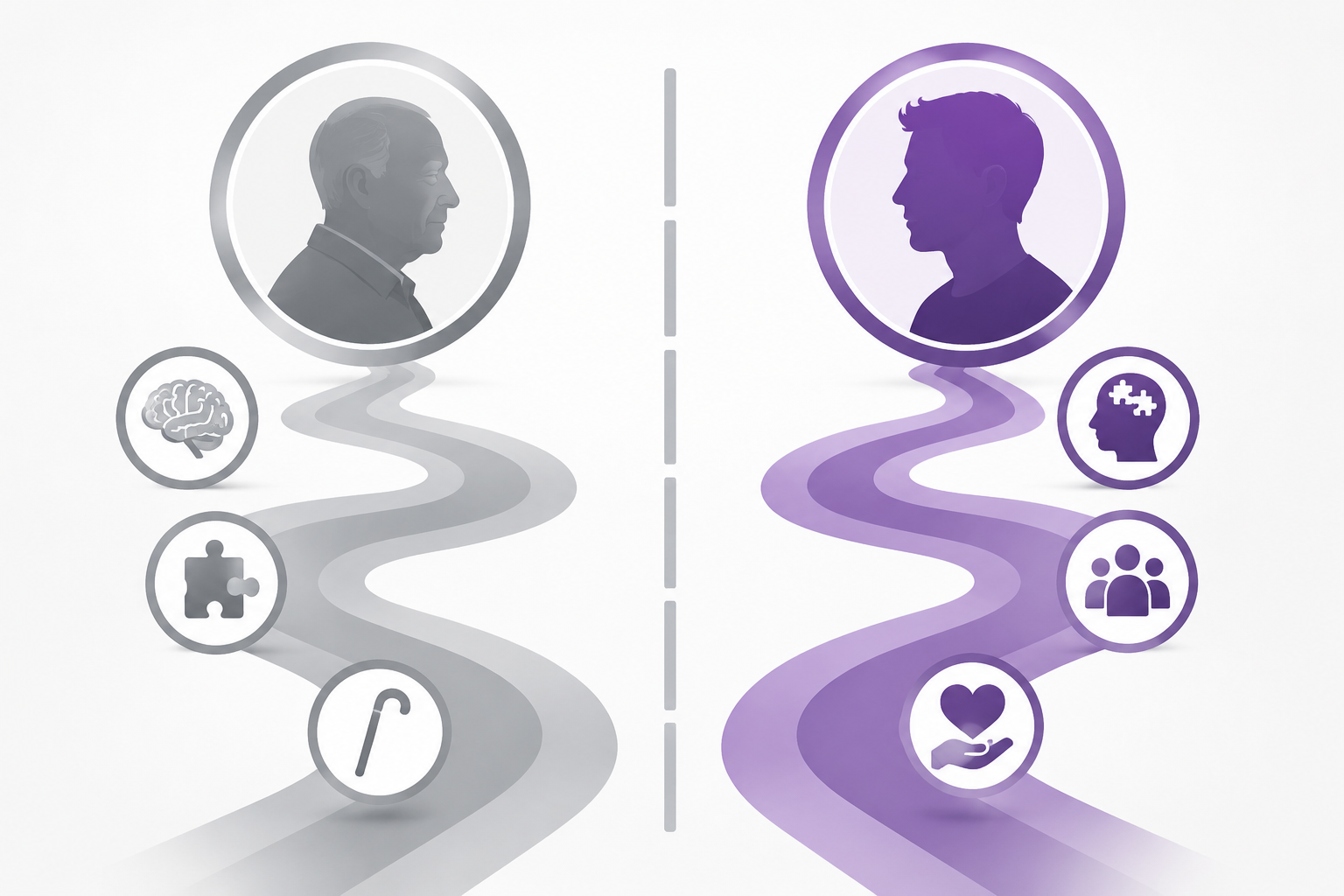
The short version is this: Silver Alert is the Florida system most readers should associate with dementia-related missing adult cases. Purple Alert is for a different adult population: people 18 and older whose disability makes them vulnerable, but whose case is not covered by Silver Alert.
That is why “vulnerable adult” is too broad to be useful by itself. It may be true, but it does not tell a dispatcher or officer which public alert program can legally be used.
The Silver Alert Lane
Florida’s Silver Alert is generally for a missing older adult with Alzheimer’s disease, dementia, or another irreversible deterioration of intellectual faculties. Public summaries of Florida’s alert system describe the main category as a person age 60 or older with that kind of impairment, with a separate path for adults ages 18 to 59 when law enforcement determines the person lacks capacity to consent.[2]
The age threshold is often the detail people remember. It is not the whole test. A missing 60-year-old is not automatically a Silver Alert case. The alert is tied to the person’s cognitive condition, the circumstances of the disappearance, and law enforcement’s assessment that the person is endangered.
Silver Alert also should not be treated as a general alert for every missing adult who may be confused, intoxicated, unreachable, or in conflict with family. In the 18–59 category especially, the point is not family concern alone; law enforcement must determine that the person lacks capacity to consent.[2]
The Purple Alert Lane
Florida’s Purple Alert statute covers a missing adult who is 18 or older and has an intellectual or developmental disability, a brain injury, or another physical, mental, or emotional disability, when the remaining statutory criteria are met.[1]
The exclusions are as important as the inclusions. The disability cannot be Alzheimer’s disease or a dementia-related disorder, and it cannot be solely caused by substance abuse.[1] The person also must not qualify for a Silver Alert.[1]
That last requirement is the guardrail people miss. Purple Alert is not a younger Silver Alert. It was created for missing adults whose vulnerability may be serious and immediate, but whose condition does not fit the dementia-centered Silver Alert framework.
The statute also requires law enforcement to determine that the disappearance poses a credible threat of immediate danger or serious bodily harm, and that enough descriptive information is available to help recover the person.[1] An alert is a public broadcast tool; if there is no usable description, vehicle information, route, location, or other actionable detail, the public system has less to work with.
What Families Should Do First
The first step is not to decide the alert color. The first step is to contact the local police department or sheriff’s office where the person went missing. Florida alert activation runs through law enforcement, not through a family form or a public self-reporting portal.[2]
When making that report, the useful words are concrete: diagnosis or disability, age, last known location, time last seen, clothing, transportation, phone access, known destinations, medications or medical risks, and why the disappearance creates immediate danger. If the person may be driving, the vehicle description and license plate can change how widely and how quickly information moves.
After local law enforcement evaluates the case, the agency can contact FDLE’s MEPIC at 1-888-FL-MISSING, or 356-4774, to request alert activation.[2] That state-level step is why accurate classification matters. A report that clearly explains dementia-related impairment points in one direction; a report that clearly explains a non-dementia-related developmental, intellectual, cognitive, or other qualifying disability may point in another.
- Say whether the person has Alzheimer’s disease, dementia, or another irreversible deterioration of intellectual faculties.
- Say whether the person has a non-dementia-related intellectual, developmental, cognitive, physical, mental, or emotional disability.
- Explain the immediate danger in observable terms, not only in general fear.
- Give vehicle information if there is any chance the person is driving or riding in an identifiable vehicle.
- Do not wait to report because you are unsure which alert applies; law enforcement makes that determination.
Why Some Purple Alerts Are Local and Others Go Statewide
A 2024 Florida law changed the Purple Alert system by creating two activation levels. A local Purple Alert applies when the missing person is believed to be on foot and information is directed to local media and officers. A statewide Purple Alert applies when the person is associated with an identifiable vehicle, allowing broader distribution through tools such as highway signs and lottery terminals.[3]
That update is a practical correction, not just a bureaucratic footnote. A person walking away from a home, facility, workplace, or public place creates a different search problem than a person who may be moving across counties by vehicle. Statewide broadcasting is most useful when the public can look for a specific car, plate, or direction of travel.
Silver Alerts and statewide Purple Alerts can use public-facing channels such as highway message signs, lottery terminals, and text or email alerts through Florida’s alert notification systems.[2][3] The point is not that every channel fires in every case. The point is that the distribution method follows the facts law enforcement can verify and share.
Why Florida Has Two Adult Alert Systems
The two systems came from different policy moments. Florida’s Silver Alert was created by executive order on October 8, 2008, according to the Florida Sheriffs Association.[4] Purple Alert was later signed into law in 2021 and became operational on July 1, 2022.[1][5]
The later program filled a gap. Before Purple Alert, Florida had a more familiar public category for missing older adults with dementia-related impairment, but not an equivalent statewide framework for adults with other disabilities who might be in immediate danger and unable to safely return or seek help.
The systems are active, not ceremonial. According to FDLE data compiled by the Florida Missing Children’s Day Foundation, Florida issued 404 missing person alerts in 2024, including 190 State Silver Alerts and 121 State Purple Alerts.[6] Those figures come through a foundation page citing FDLE data, rather than a directly retrieved FDLE release, so they are best read as a reliable operational snapshot rather than a full performance audit.
Purple Alert recovery figures have also been reported publicly. USA TODAY Network reporting cited FDLE data showing that in the program’s first two years, 447 Purple Alerts were issued and 438 individuals were recovered, about 98 percent.[7] That is encouraging, but it should not be stretched into a promise about any individual case. It says the system has been used often and has often ended with recovery; it does not prove that the alert alone caused each recovery.
Common Misclassifications
The most common mistake is treating Purple Alert as the default for any missing adult under 60 with a disability. That skips the statutory exclusions. If the case is dementia-related, Purple Alert is not the right fit. If the person qualifies for Silver Alert, Purple Alert is unavailable.[1]
A second mistake is assuming Silver Alert is only for people 60 and older. The main public association is older adults with Alzheimer’s disease or dementia, but Florida summaries also describe a route for adults ages 18 to 59 when law enforcement determines they lack capacity to consent.[2]
A third mistake is using either alert as a substitute for an ordinary missing-person report. The alert is a later decision inside the response. The report is what starts the process, creates the record, and gives law enforcement the facts needed to decide whether an alert can be requested.
A fourth mistake is assuming public concern is enough. Both systems require more than a worried family and a missing adult. The case must meet program criteria, including a law-enforcement assessment of danger and enough information to make public notification useful.[1][2]
The Practical Difference
Use Silver Alert as the first reference point when the missing adult’s vulnerability is tied to Alzheimer’s disease, dementia, or another irreversible deterioration of intellectual faculties. Use Purple Alert as the reference point when the missing adult is 18 or older, has a qualifying non-dementia-related disability, faces immediate danger, and does not qualify for Silver Alert.
In a real disappearance, families should not spend critical time trying to self-select the perfect category. Call local law enforcement, describe the person and the danger precisely, and let the agency determine whether Silver Alert, Purple Alert, or another missing-person response applies.
References
- Florida Statutes Section 937.0205, Florida Senate, https://www.flsenate.gov/laws/statutes/2023/937.0205
- AMBER Alerts aren’t the only type of emergency alert in Florida. Here’s a breakdown, NBC 6 South Florida, https://www.nbcmiami.com/news/local/amber-alerts-arent-the-only-type-of-emergency-alert-in-florida-heres-a-breakdown/3050972/
- New law makes changes to Florida’s Purple Alert missing person reporting system, Florida Voice News, https://flvoicenews.com/new-law-makes-changes-to-floridas-purple-alert-missing-person-reporting-system/
- Emergency Phone Alerts: What You Need to Know, Florida Sheriffs Association, https://flsheriffs.org/blog/entry/emergency-phone-alerts-what-you-need-to-know/
- Florida Purple Alert Program Begins July 1, 2022, Bradenton Police Department, https://www.bradentonpd.com/newsreleases/florida-purple-alert-program-begins-july-1-2022
- Florida Alerts, Florida Missing Children’s Day Foundation, https://www.fmcdf.org/florida-alerts
- Purple alert Florida missing person, Jacksonville.com / USA TODAY Network, https://www.jacksonville.com/story/news/2025/04/09/purple-alert-florida-missing-person/82996470007/
Comments
Join the discussion with an anonymous comment.