Quantum computing in healthcare AI now deserves attention, but not the kind of attention that treats every partnership, cloud workflow, or stock valuation story as clinical progress. The evidence has moved beyond pure theory: funded programs are running, named teams are reporting measurable outputs, and quantum hardware is being applied to molecular biology problems that were previously discussed mostly in abstractions. The evidence has not crossed the clinical line. As of Q3 2026, the cited record does not show an FDA-cleared quantum computing medical device, a quantum-discovered therapy in human trials, or a completed clinical validation study demonstrating patient benefit.
That distinction matters because the phrase “quantum computing stock valuation and healthcare AI potential” pulls two conversations together that move at different speeds. Valuation responds to expectation. Clinical medicine responds, or should respond, to validation. Quantum methods may someday matter in healthcare AI; they plausibly might. The useful question is where the work sits on an evidence ladder today.
The current evidence map
| Application area | What has been shown | Evidence stage | What has not been shown |
|---|---|---|---|
| Molecular simulation and drug discovery | Structured programs have simulated cancer photodynamic therapy workflows on 100 qubits and reported large protein-structure simulation work on quantum hardware. The Wellcome Leap Q4Bio Challenge awarded a $2M prize to the Algorithmiq/Cleveland Clinic/IBM project after a $40M program narrowed 12 teams to 6 finalists. [1] | Computational demonstration to preclinical computational validation | No quantum-discovered drug has entered human trials in the cited evidence. |
| Genomics and DNA encoding | University of Oxford and the Sanger Institute encoded the Hepatitis-D genome on IBM Quantum Heron r2, described as a world first with a one-order-of-magnitude improvement over prior DNA representation efforts. [1] | Single-case computational demonstration | No broad clinical genomics validation or diagnostic deployment has been shown. |
| Biomarker discovery | Infleqtion, the University of Chicago, and MIT used IBM Heron r2, with more than 50 qubits and more than 1,000 gates, to identify novel cancer biomarkers from multimodal data. [1] | Proof of concept | No independently validated biomarker panel or clinical decision tool has been shown. |
| Clinical trial optimization | Quantum annealing has been discussed for patient matching and scheduling. | Theoretical or computational only | No published clinical trial outcomes from quantum-optimized recruitment, matching, or scheduling are cited. |
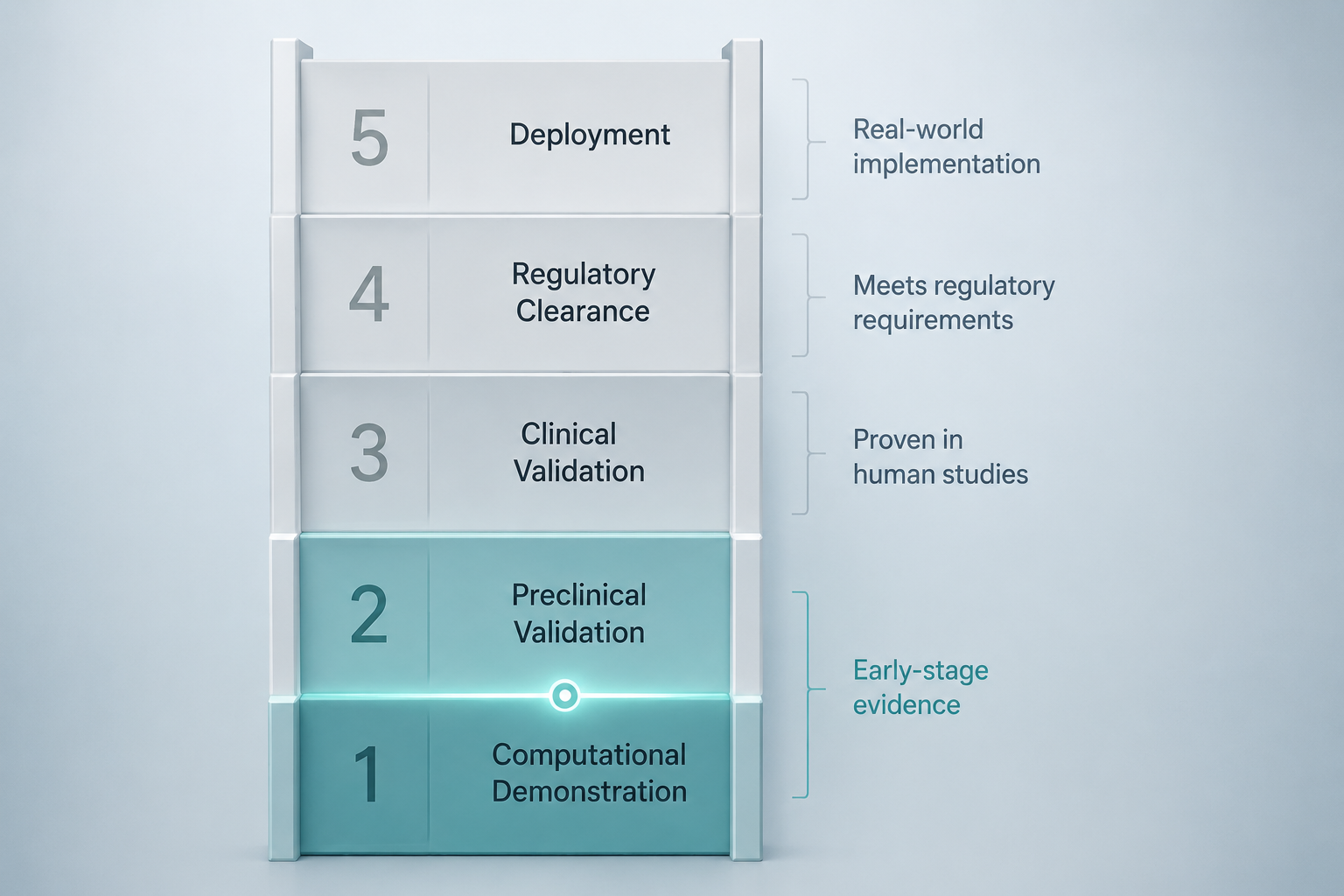
A simple evidence ladder keeps the claims in proportion. “Computational demonstration” means the method ran and produced a biologically relevant output. “Preclinical validation” means the output has been compared against accepted experimental or computational references in a way that supports further translational work. “Clinical validation” would require performance in patient-relevant settings. “Regulatory clearance” and “deployment” would require still more: defined intended use, safety and performance evidence, and real workflows in which clinicians or patients bear consequences.
Market forecasts show accumulated expectation, not clinical readiness
The commercial numbers explain why the subject is becoming more visible. MarketsandMarkets estimates the quantum computing in healthcare market at $191 million in 2024 and projects it to reach $1.32 billion by 2030. [2] Fortune Business Insights gives a different baseline and horizon, estimating $269.5 million in 2026 and $4.56 billion by 2034. [3]
Those figures should not be averaged into a false consensus. They likely differ because the firms use different scopes, category boundaries, and forecasting methods. A market model may include hardware access, cloud services, consulting, software tooling, research partnerships, and early pharmaceutical workflows. None of those categories is equivalent to a validated medical product.
The timeline framing is also sober when read carefully. BCG describes a three-phase progression: a noisy intermediate-scale quantum period to 2030, broader quantum advantage from 2030 to 2040, and full fault tolerance after 2040. [4] Nvidia’s CEO has publicly framed practical quantum computing on a 15- to 30-year horizon, a reminder that near-term research progress and near-term clinical use are not the same claim. [5]
Why molecular simulation is the most serious healthcare use case so far
The strongest part of the evidence base is molecular simulation for drug discovery. That does not mean it is clinically proven. It means the work has a recognizable translational structure: defined biological problems, institutional programs, measurable computational outputs, and teams that include both quantum specialists and biomedical researchers.
The Wellcome Leap Q4Bio Challenge is the cleanest example. It was a $40 million program involving 12 teams, later narrowed to 6 finalists. The winning project from Algorithmiq, Cleveland Clinic, and IBM simulated photodynamic therapy for cancer on 100 qubits using a hybrid quantum-classical framework and received a $2 million prize. [1]
Several details are worth separating. The work addressed a cancer-relevant mechanism, not a generic benchmark. It used a hybrid quantum-classical approach, which is how much serious near-term quantum work is likely to proceed while hardware remains limited. It reported a concrete qubit scale. It emerged from a challenge structure rather than an isolated demonstration. Those are real signs of maturation.
They are not, however, the same as therapeutic evidence. A simulation of photodynamic therapy can help evaluate whether quantum methods may represent complex molecular behavior in useful ways. It does not show that a patient’s tumor responded, that a new drug candidate is safe, or that an oncology workflow improved. The output sits before animal efficacy, before early human dosing, and well before any regulatory review of a therapy.
Cleveland Clinic and IBM add a second important piece: institutional continuity. Their Discovery Accelerator has more than 50 projects over 5 years, making it one of the more structured clinical-research frameworks for quantum and AI work in healthcare. [6] That matters because translational computing fields rarely advance through one-off demonstrations alone. They need repeated problem selection, shared infrastructure, domain scientists who can reject irrelevant outputs, and enough program stability for negative results to be learned from rather than quietly forgotten.
The Cleveland Clinic/IBM protein simulation report is also notable. The team reported simulation of a protein structure with more than 12,000 atoms on quantum hardware, described in the research brief as the largest known quantum protein simulation. [7] Scale is not validation by itself, but it is a meaningful technical threshold because protein modeling forces computational methods toward the messy structures that biomedical researchers actually care about.
The translational question is what the simulation changes downstream. Did it predict a binding state that conventional methods missed? Did it guide a wet-lab experiment? Did it reduce the search space for a target or candidate compound? Did another group reproduce the result on different hardware or with an independent workflow? The cited materials show credible movement into biologically relevant simulation; they do not yet answer those clinical-development questions.
Other drug-discovery infrastructure signals point in the same direction. IonQ, AstraZeneca, AWS, and NVIDIA announced a June 2025 collaboration for quantum-accelerated chemistry workflows, and Kipu Quantum was selected for the Cleveland Clinic Catalyzer Program for protein-folding algorithms. [6] These are worth tracking because pharmaceutical chemistry and protein folding are computationally demanding domains where even incremental improvements could be useful. But collaboration announcements and accelerator selection are infrastructure evidence, not evidence of clinical effect.
Genomics: a real encoding milestone, still a narrow claim
The University of Oxford and Sanger Institute Hepatitis-D genome work is interesting because it moves quantum computing from abstract data representation toward a concrete viral genome. The work encoded the Hepatitis-D genome on IBM Quantum Heron r2 and was described as achieving a one-order-of-magnitude improvement over prior DNA representation efforts. [1]
For genomics, encoding is an upstream accomplishment. It can be necessary for later quantum-enabled analysis, but it is not the same as diagnosing infection, predicting disease severity, selecting therapy, or discovering a clinically actionable variant. The useful reading is narrow: quantum hardware was used to represent a real viral genome at improved scale. The cited evidence does not establish a general quantum genomics platform for clinical sequencing.
Biomarker discovery has proof-of-concept evidence, not clinical-grade evidence
The biomarker case is similarly promising but early. Infleqtion, the University of Chicago, and MIT used IBM Heron r2, with more than 50 qubits and more than 1,000 gates, to identify novel cancer biomarkers from multimodal data. [1] That is a concrete technical report in an application area where healthcare AI already has obvious demand: integrating heterogeneous data to find signals that may stratify patients or disease states.
Biomarkers have a high bar. A candidate signal must survive replication, analytical validation, clinical validation, and, depending on use, evidence that acting on it improves decisions. A quantum workflow that identifies candidate biomarkers has reached the hypothesis-generation or proof-of-concept stage. It has not created a clinically usable cancer biomarker until independent validation shows that the marker measures what it is supposed to measure and changes care in a defined context.
Clinical trial optimization remains mostly conceptual
Clinical trial optimization is the thinnest evidence area in the current brief. Quantum annealing has been proposed for patient matching and scheduling, both of which are legitimate operational pain points. Matching protocols to eligible patients can be slow, and trial scheduling can become a constrained optimization problem with many competing requirements.
The cited evidence does not show published clinical outcomes from quantum-optimized trial recruitment or scheduling. Without those outcomes, this remains a computational idea rather than an implementation lesson. A hospital or sponsor considering this area should look for evidence that a quantum method improved enrollment speed, reduced screen failures, improved site efficiency, or maintained fairness and protocol compliance in a real trial setting. That evidence is not yet present here.
The evidence boundary clinicians should use
The practical boundary is not whether a result used quantum hardware. It is whether the output has moved from computation into biomedical validation. For a molecular simulation, that may mean experimental confirmation that a predicted state, reaction, or interaction is biologically meaningful. For a biomarker, it means replication and clinical validation. For trial optimization, it means performance in actual trial operations. For a medical device or clinical decision tool, it means a defined intended use and regulatory evidence.
| Claim type | Reasonable interpretation | Clinical interpretation to avoid |
|---|---|---|
| A molecule, protein, genome, or dataset was encoded on quantum hardware | A data-representation or workflow milestone | A diagnostic or therapeutic advance |
| A simulation ran on 50, 100, or more qubits | A technical scale and feasibility result | Proof that patient outcomes will improve |
| A challenge prize or accelerator program selected a team | A sign of structured investment and expert review | Independent clinical validation |
| A company or institution announced a partnership | Infrastructure and strategic intent | A deployable healthcare product |
| A market forecast projects rapid growth | Evidence of expectation and spending | Evidence of clinical effectiveness |
This is where the valuation conversation can mislead medical readers. A stock narrative rewards optionality: if the technology might open a large market, the story has value. A clinical evidence narrative asks who has tested the output, against what standard, in which population or biological system, and with what consequence. Both conversations can be internally coherent, but they should not be treated as interchangeable.
Access patterns also reinforce the current stage. The field is still largely mediated through cloud platforms such as AWS Braket, Azure Quantum, and IBM Quantum Network rather than hospital-owned quantum systems. That is not a flaw; cloud access is a sensible way to share scarce hardware. It does mean that most healthcare organizations are not evaluating a device they can deploy tomorrow. They are evaluating whether to participate in research partnerships, computational pilots, or early translational programs.
What would count as the next evidence step?
The next meaningful advance would not necessarily be a larger market forecast or a louder “world first.” It would be a result that connects quantum output to an accepted biomedical standard. In drug discovery, that might be a wet-lab experiment showing that a quantum-assisted simulation correctly prioritized a molecular state or candidate interaction. In biomarker discovery, it would be an independently validated marker set in a defined cancer context. In genomics, it would be a workflow that improves a sequencing or interpretation task beyond representation alone. In trial optimization, it would be prospective evidence that recruitment or scheduling improved without compromising protocol integrity.
Fault-tolerant hardware is a separate but related issue. The DOE Quantum Genesis program targets fault tolerance by 2028, but such targets are aspirational rather than guaranteed. [5] Even if hardware improves quickly, healthcare translation would still require validation work. Better machines may make better experiments possible; they do not remove the need for evidence.
The most calibrated comparison is healthcare AI around 2015–2017. There were credible teams, serious papers, early demonstrations, and a growing sense that the tools would matter. There were also many claims that had not yet survived clinical validation, workflow integration, or regulatory review. Quantum computing in healthcare AI now sits in a similar posture: enough signal to monitor closely, enough structure to take seriously, and not enough clinical evidence to treat as deployable medicine.
References
- How IBM Quantum is enabling healthcare and biology research, IBM Newsroom, April 16, 2026.
- Quantum Computing in Healthcare Market, MarketsandMarkets.
- Quantum Computing in Healthcare Market, Fortune Business Insights.
- Quantum Computing Could Create Up to $850 Billion of Economic Value by 2040, BCG, July 18, 2024.
- Quantum Computing Valuation: Navigating the Hype and the Future, SpinQ.
- Cleveland Clinic and IBM Forum Highlights Advancements in AI and Quantum Computing for Healthcare Research, Cleveland Clinic Newsroom, June 15, 2026.
- Cleveland Clinic protein simulation, arXiv.
Comments
Join the discussion with an anonymous comment.