
Revenue cycle management AI is no longer a side experiment. It is the largest reported category of current healthcare AI use cases, representing 24% of healthcare AI use cases in KLAS-referenced 2025 data covering more than 1,700 organizations.[1] That sounds like a market arriving.
The same market contains the harder number buyers should keep on the first page of every procurement packet: only 1 organization out of more than 3,000 reportedly had agentic AI in production.[1] In other words, AI is already doing useful revenue cycle work, but the broadest claims about autonomous, enterprise-wide RCM are still far ahead of production evidence.
That distinction matters because revenue cycle teams do not buy adjectives. They inherit work queues. They reconcile eligibility mismatches, review edits, validate coding suggestions, appeal denials, answer finance when cash is late, and explain to IT why a supposedly autonomous workflow still needs an Epic integration fix. The right question in 2026 is not whether AI can help revenue cycle management. It can. The question is which functions are mature enough to buy, scale, and govern without turning automation into another queue that somebody has to babysit.

A Readiness Framework for RCM AI in 2026
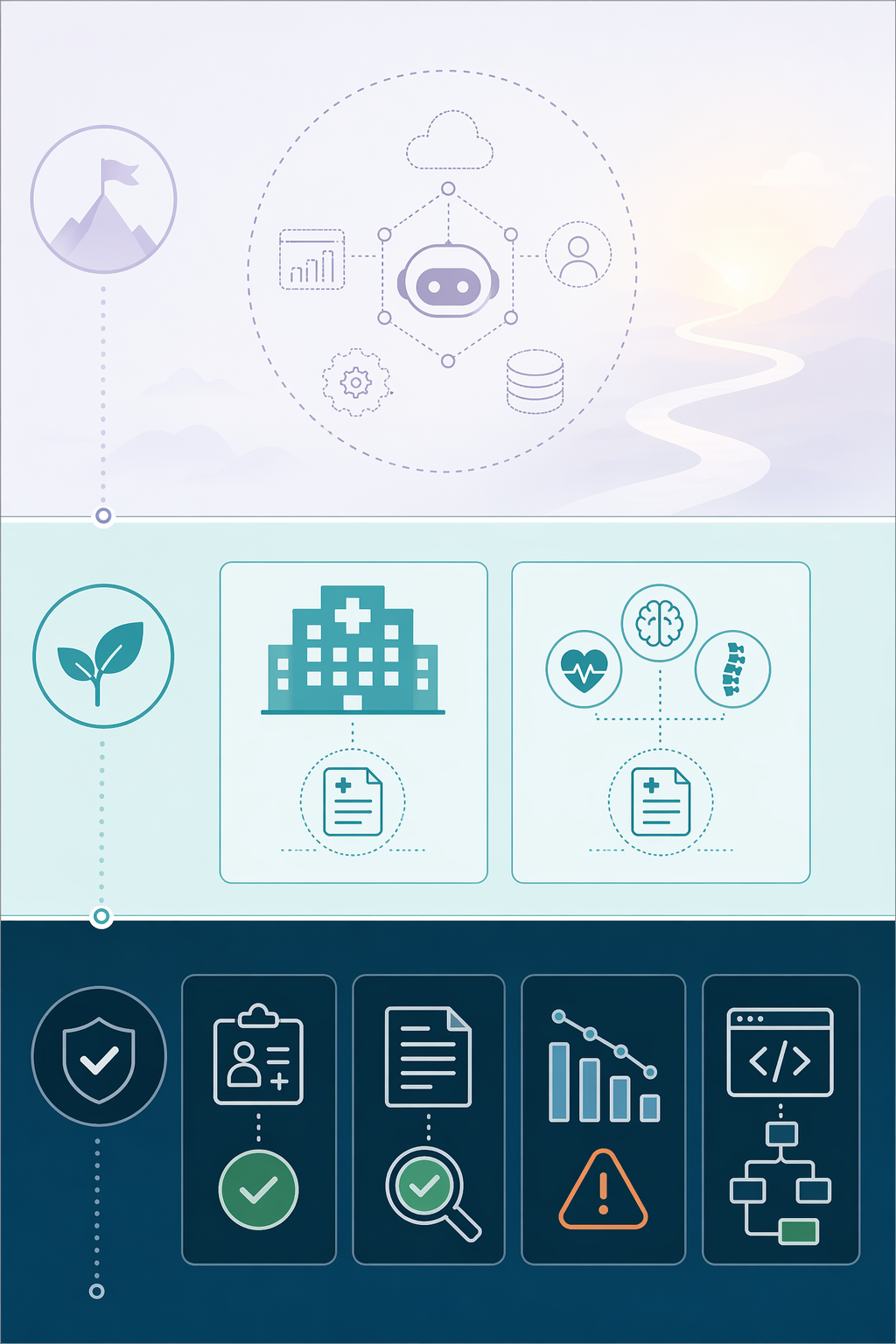
The most useful way to sort revenue cycle management AI is by production readiness, not by the labels vendors put on their platforms. A tool that checks eligibility against rules and returns an auditable result belongs in a different buying category from a platform claiming to orchestrate the entire revenue cycle through autonomous agents.
| Readiness tier | Functions that fit | What buyers should demand |
|---|---|---|
| Production-ready or near production-ready | Eligibility verification, claim scrubbing, denial prediction, outpatient professional coding, radiology coding, selected ED coding | Audited production metrics, integration evidence, exception volumes, pre/post workflow impact |
| Emerging | Inpatient coding, complex specialty coding, broader prior authorization automation, more advanced denial prevention | Narrow scope, human review model, payer-specific performance data, compliance oversight |
| Aspirational | Enterprise agentic RCM, end-to-end autonomous platforms, broad self-correcting revenue cycle orchestration | Proof of production use, not pilots; governance model; implementation burden; audited financial impact |
HFMA’s February 2026 survey of 95 finance leaders gives a useful but limited snapshot of adoption: 46% of hospitals reported using AI in revenue cycle, 27% reported deployment at scale, and 53% were piloting.[2] The sample is not large enough to treat those percentages as the whole market, but it does reflect what many finance teams are seeing: pilots are everywhere, scaled production is more selective, and the most credible deployments are concentrated in narrower workflows.
Where AI Is Production-Ready Enough to Evaluate Seriously
The strongest 2026 case for revenue cycle AI sits in structured, rules-governed workflows where the input is known, the expected output can be audited, and the operational consequence is measurable. These are not the most glamorous use cases, but they are the ones most likely to survive month-end.
Eligibility Verification and Front-End Edits
Eligibility verification is a natural fit for production AI because the workflow already depends on structured data, payer rules, plan status, coverage timing, and exception handling. The operational value is not that the tool sounds intelligent. The value is that staff stop spending as much time discovering coverage problems after the service has already moved downstream.
A buyer should be able to see exactly what changed: fewer registration-related denials, fewer manual checks, cleaner handoffs to authorization and billing teams, and a smaller population of accounts needing rework. If a vendor cannot distinguish automated resolution from automated routing, the claim is too broad. Moving an account from one queue to another is not the same as resolving it.
Claim Scrubbing and Denial Prediction
Claim scrubbing and denial prediction have a clearer evidence path than broad end-to-end automation. Claims are submitted, accepted, rejected, denied, appealed, paid, or written off. Those outcomes leave a trail. A model that predicts which claims are likely to fail can be evaluated against clean claim rate, manual rework, preventable denial rate, appeal workload, and net revenue impact.
BerryDunn described a 900-bed hospital that integrated AI denial prediction with Epic and reported a 40% reduction in manual claim rework and a 94% clean claim rate.[3] The same BerryDunn article described a multi-state system reporting a 33% year-over-year denial reduction and an $8 million net revenue improvement using AI predictive analytics.[3] Those are case outcomes from a consulting publication, not independent randomized evidence, but they are still the kind of operationally specific evidence buyers should be asking to see.
The important procurement move is to ask what sits behind the headline. Which denial categories improved? Were payer mix and volume stable? Did the system change staff workflows at the same time? Were claims routed before submission, after rejection, or after denial? A denial reduction that survives those questions is worth more than a larger savings estimate with no operational map.
Coding Workflows and the DNFB Test
Coding is where AI can either relieve a real staffing bottleneck or quietly create a second review burden. The difference shows up in DNFB, coder productivity, coding quality, and the percentage of encounters that still need manual review. If coders spend their day correcting low-quality suggestions, automation has not freed them for higher-complexity work. It has changed the shape of the backlog.
The Auburn Community Hospital case reported by HFMA is useful because the stated outcomes are tied to revenue cycle operations rather than abstract efficiency. The hospital reported a 50% DNFB reduction, more than a 40% coder productivity gain, and more than $1 million in ROI at 10 times investment using AI that linked clinical documentation and coding.[2] Those results should not be generalized to every hospital, but they show what a credible production return looks like: fewer accounts waiting for coding, more coder capacity, and a measurable financial effect.
For buyers, the coding question should be framed by encounter type. Outpatient professional coding, radiology, and selected emergency department coding are much closer to production maturity because they often involve more repeatable documentation patterns and narrower coding choices. Inpatient and complex specialty coding remain a different risk class. The clinical record is longer, the coding judgment is more layered, and the compliance exposure is higher.
That does not mean inpatient coding AI has no value. It means the buying standard changes. In complex coding, the safest near-term role is often assistive: surfacing documentation gaps, prioritizing accounts, suggesting codes with evidence links, or helping quality review teams focus attention. Calling that full autonomy before the audit evidence exists invites the exact failure mode revenue integrity teams know too well: speed on the front end, cleanup on the back end.
Prior Authorization Is Urgent, but Not Automatically Mature
Prior authorization deserves its own caution because the pressure is real. CMS-0057-F has made electronic prior authorization and interoperability a structural requirement rather than a nice-to-have technology direction. That increases the urgency for automation, especially where teams are still chasing documentation, payer portals, status checks, and denial follow-up manually.
Urgency, however, is not the same as maturity. Prior authorization is payer-specific, policy-specific, documentation-dependent work. AI can help identify requirements, assemble supporting information, monitor status, and reduce avoidable denials. It cannot make payer behavior uniform, and it cannot compensate for missing clinical documentation unless the workflow brings that gap back to the right person before submission.
The AHA Center for Health Innovation described a Fresno community health network that reported 22% fewer prior-authorization denials, 18% fewer service denials, and 30 to 35 hours per week saved after using AI in revenue cycle workflows.[4] Those results are promising and operationally meaningful, but they should be read as a case example, not as proof that prior authorization automation is uniformly mature across payers and service lines.
The practical buyer standard is narrower: ask vendors to show performance by payer, service category, authorization type, and exception reason. A tool that works well for routine imaging authorizations may not perform the same way for specialty drugs, post-acute care, or procedures with payer-specific medical necessity criteria. The saved time also needs a destination. If nurses, referral staff, or authorization specialists save hours, the operating plan should say whether that time goes to complex cases, faster submissions, appeal prevention, or staffing relief.
Why Agentic and End-to-End RCM Claims Need a Higher Bar
The phrase “agentic AI” is doing too much work in the revenue cycle market. In some demos, it means a system can follow a multi-step workflow with limited human prompting. In others, it means a rules engine, a bot, and a dashboard have been repackaged under a newer label. For a CFO, CIO, or revenue cycle VP, the label matters less than one question: is the system making and executing decisions in production, across real accounts, with auditable controls and known exception paths?
This is where the KLAS-referenced adoption gap should stop the room. RCM may be the largest current healthcare AI use-case category, but only 1 organization out of more than 3,000 reportedly had agentic AI in production.[1] That does not mean agentic approaches will fail. It means enterprise claims should be treated as architectural direction, not established operating reality.
End-to-end autonomous RCM is especially difficult because the revenue cycle is not one process. It is a chain of payer contracts, clinical documentation, registration accuracy, medical necessity rules, coding judgment, clearinghouse edits, payer behavior, patient responsibility, appeals, underpayment review, and accounting controls. Weakness in one segment becomes somebody else’s exception queue.
That is why broad savings estimates should be handled carefully. William Blair has discussed AI’s growing importance in the RCM marketplace and cited large potential savings opportunities, while other commonly cited healthcare AI and administrative simplification estimates use different scopes and methodologies.[5] Those numbers may be useful for market context. They are not a substitute for audited denial, cash, productivity, and rework metrics inside a buyer’s own operating environment.
The Evidence Buyers Should Require Before Scaling
A credible revenue cycle AI evaluation should look less like a software demo and more like an operating review. The vendor should be able to explain which work queue changes, which staff touch the exceptions, which claims bypass manual work, which accounts still require review, and which metrics were audited before and after implementation.
- Scope: the exact payer, encounter type, location, specialty, and revenue cycle function included in the result.
- Baseline: pre-implementation denial rate, clean claim rate, DNFB, productivity, appeal volume, or manual rework.
- Production status: whether the result came from live operations, a pilot, a retrospective model test, or a vendor-supervised implementation.
- Exception handling: the percentage of accounts routed to humans and the skill level required to resolve them.
- Integration burden: how the tool connects with Epic, clearinghouses, payer portals, document systems, and reporting workflows.
- Auditability: whether users can trace recommendations back to source data, payer rules, documentation, and final disposition.
The distinction between adoption and effectiveness belongs in the same review. A hospital may be using AI in the revenue cycle and still have no material reduction in denials. A coding tool may improve productivity in outpatient clinics while remaining inappropriate for complex inpatient accounts. A denial prediction model may identify risk accurately but fail to improve cash if no one redesigns the intervention workflow.
The best implementations usually remove brittle, repetitive work from humans and reserve human attention for judgment-heavy cases. Eligibility mismatches, obvious claim edits, repetitive coding patterns, and predictable denial risks are good places to start. Complex medical necessity disputes, ambiguous documentation, underpayment strategy, and high-risk coding decisions still need accountable human oversight.
What Production-Ready Means in 2026
Production-ready revenue cycle management AI in 2026 is mostly task-specific, rules-governed, integrated into existing workflows, and judged by operational metrics that finance and revenue integrity teams already understand. It reduces DNFB. It improves clean claim performance. It lowers preventable denials. It decreases manual rework. It increases coder productivity without shifting unmeasured cleanup to auditors or billing staff.
The strongest buying cases are eligibility verification, claim scrubbing, denial prediction, and coding workflows with structured inputs and measurable outputs. Autonomous coding is credible in narrower areas such as radiology, outpatient professional coding, and selected ED use cases, while inpatient and complex specialty coding still require sharper boundaries and human review. Prior authorization automation is becoming structurally necessary, but payer variation keeps it in a careful, evidence-by-workflow category.
Enterprise agentic automation is not ready for the same procurement treatment. The architecture may advance quickly, but the current production evidence does not support buying it as if the revenue cycle can be handed over end to end. A pilot can be promising and still not be production. A workflow can be automated and still not be autonomous. A vendor can be innovative and still owe the buyer audited evidence.
The Mayo Clinic principle cited in the HFMA discussion is the right place to end the evaluation: AI should “elevate, not eliminate,” and organizations should “never put AI on top of a broken process.”[2] In revenue cycle work, that is not a soft cultural point. It is an operating control. Automation layered on a broken eligibility process, a weak documentation workflow, or an unmanaged denial backlog will not rescue the revenue cycle. It will only move the breakage faster.
References
- AI Revenue Cycle Management 2026, AccuCode AI.
- The revenue cycle of the future: AI boom and workflow redesigns accelerate rev cycle transformation, HFMA.
- AI in denials management and prevention: a strategic imperative, BerryDunn, June 2025.
- 3 ways AI can improve revenue cycle management, AHA Center for Health Innovation Market Scan, June 4, 2024.
- The Growing Importance of AI in the Revenue Cycle Management Marketplace, William Blair.
Comments
Join the discussion with an anonymous comment.