
Football now has the cleaner television picture: an offside line arrives quickly, a skeletal model of the attacker appears, and the assistant referee receives an automated alert before the argument has really warmed up. Rugby league still has the harder-looking room: Bunker officials at screens, comparing angles, judging whether a chaser was in front of the kicker or whether defenders had retreated 10 meters before the play-the-ball.
That contrast is why AI in rugby league video refereeing for offside calls sounds, at first, like an overdue upgrade rather than a difficult governance problem. If football can semi-automate one of the most disputed calls in sport, why is the NRL still asking humans to pause, zoom, scrub, and infer?
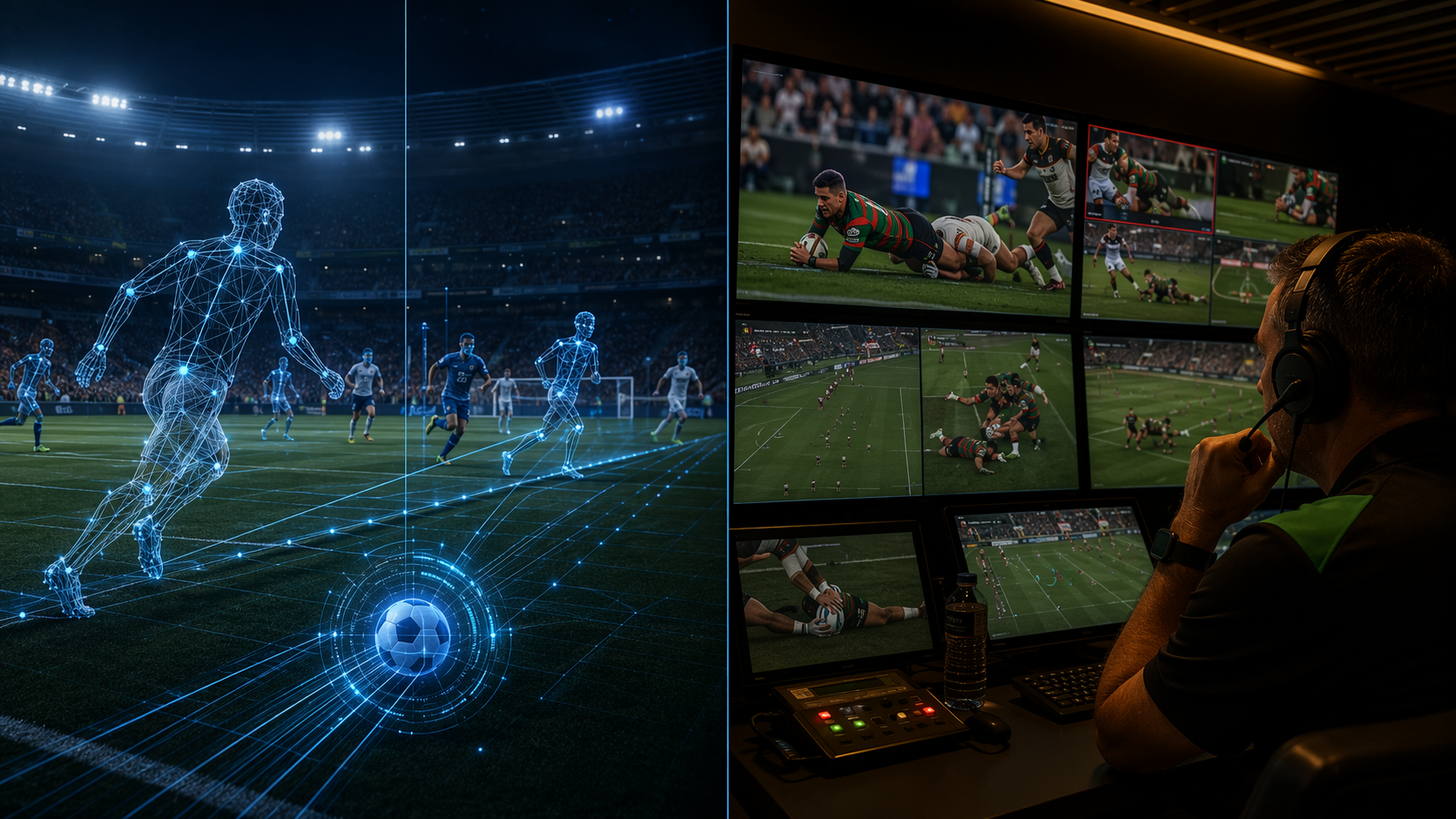
The short answer is that football did not merely add AI to a broadcast feed. It built a decision environment around the call: calibrated tracking cameras, body-point models, ball-event timing, referee alerts, replay visualization, and a protocol that gives the system a defined place in the officiating chain. Rugby league has parts of that environment, especially high-end replay operations, but not the complete set of rule definitions, capture standards, and authority settings that would let an offside model carry match-night responsibility.
Football’s offside system is a production pipeline, not a camera trick
At the 2026 World Cup, semi-automated offside technology uses 16 optical tracking cameras in each stadium, tracks 29 body pose points per player at 50 frames per second, and generates three-dimensional player reconstructions in seconds. The system sends an “offside” voice alert to assistant referees through an earpiece when a player is more than 10 centimeters offside, while marginal decisions produce a “delay” alert rather than an immediate confirmation.[1][2]
The public sees the graphic. The more important part is what had to happen before the graphic could be trusted. For the 2026 World Cup, all 1,248 players underwent a one-second full-body 3D scan in a photogrammetry chamber to create AI-enabled digital avatars.[1] That is not a decorative feature. It is hidden standardization: the system is being fed consistent assumptions about player bodies before it ever judges a live offside line.
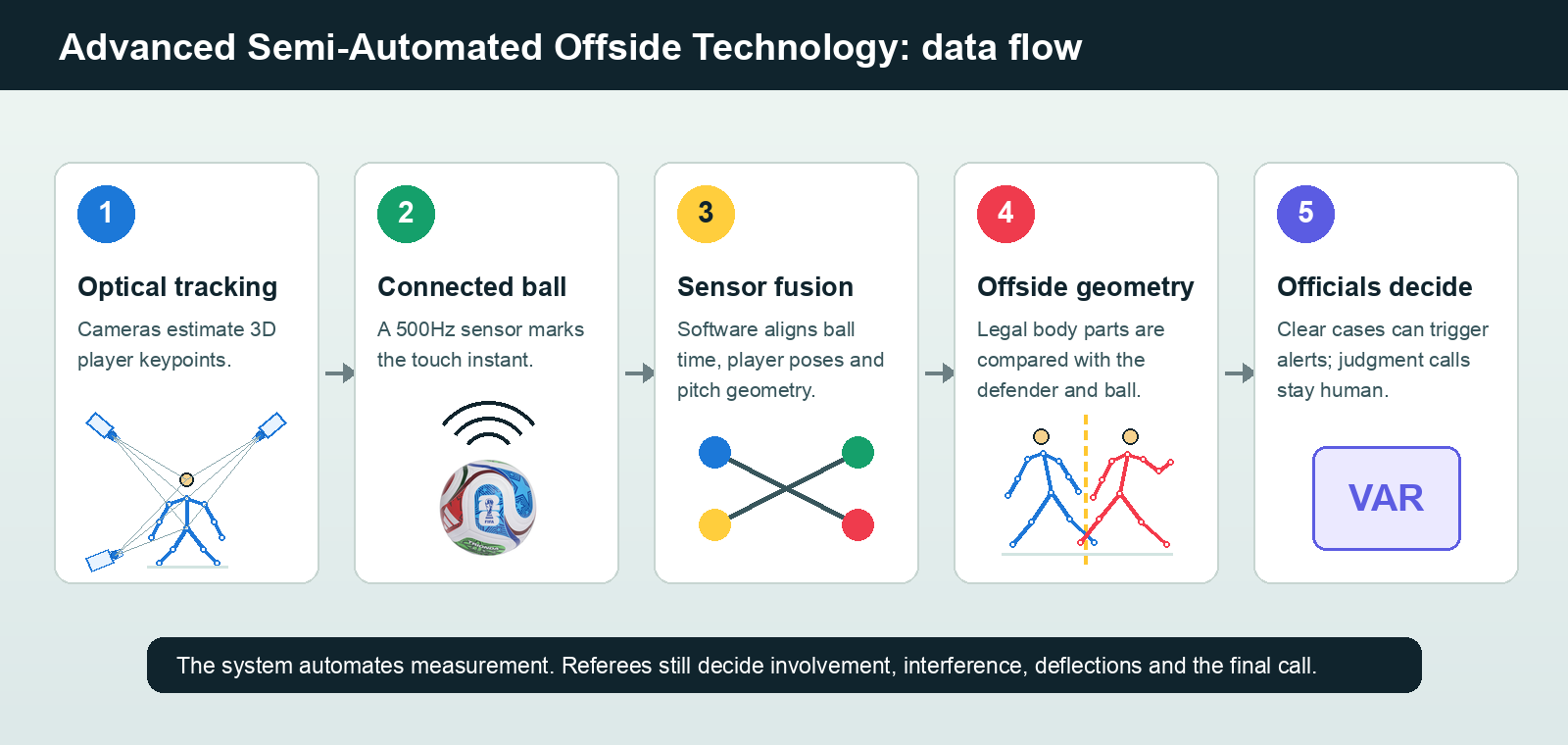
That stack matters because football’s offside question has a stable geometry. At the moment the ball is played, the system compares the attacker with the second-to-last defender and the ball. There are difficult edge cases, but the question is structurally well suited to synchronized spatial measurement: where were the relevant body parts at a specific moment?
The reward is speed. Published reporting on SAOT describes review times falling from around 70 seconds under manual VAR to under 20 seconds with semi-automated review.[3] That speed is not just a product of faster image recognition. It comes from reducing the number of things a human operator must establish by hand: frame selection, line placement, player limb position, and event timing.
The Bunker is powerful, but it is still a replay room
The NRL Bunker is not primitive. Its published operations material describes 57 monitors, 20 high-definition camera feeds per stadium, and Hawk-Eye multi-angle review technology.[4] That is a serious match-control environment, and anyone who has sat near a replay wall knows the difference between “many angles” and “automatic truth.” More feeds give officials more evidence. They do not, by themselves, define the line, synchronize the decision event, or decide what the protocol allows the official to rule on.
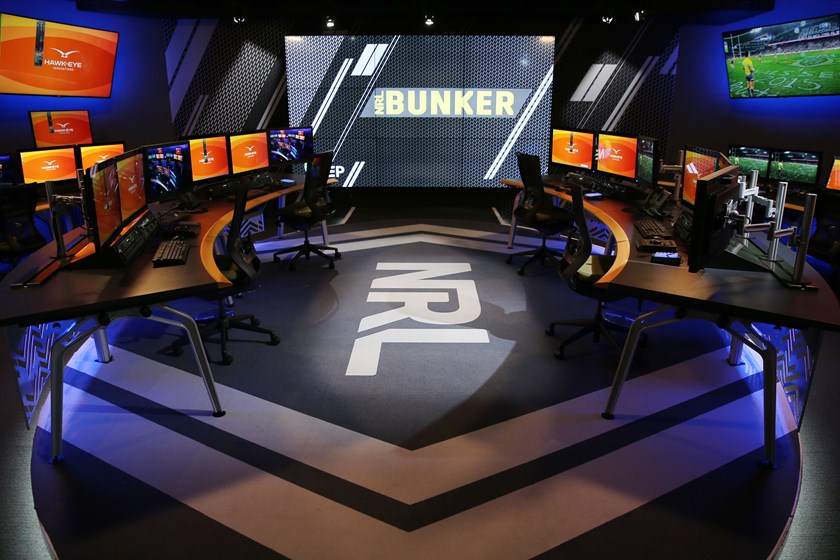
The league has looked at automated help before. NRL reporting in 2019 described Hawk-Eye offside technology trials that included virtual offside lines and 3D scans of suburban venues to account for uneven pitch geometry, with the possibility that the system could arrive as soon as the following season.[5] The fact that it did not become the visible standard is more revealing than embarrassing. Rugby league had already found the awkward part: the line is not only a graphic. It has to survive the ground, the camera, the rule, and the review protocol.
In the current model, when the Bunker checks a try from a kick, the official is generally reading a sequence: the kicker’s contact, the relative position of chasers, the receiving contest, the grounding, and any interference or obstruction around it. The offside component may be visible, but it is embedded in a rugby league passage rather than isolated as a single freeze-frame geometry problem.
Rugby league offside is a different measurement problem
Football’s offside line follows the defender. Rugby league’s offside logic changes with the phase of play. Around the ruck, defenders must retreat 10 meters from the play-the-ball. On kicks, chasers must be judged against the kicker and then against subsequent actions that can put them onside. The system would need to identify not only bodies and lines, but the event that starts the obligation.
| Decision element | Football SAOT | Rugby league offside review |
|---|---|---|
| Main spatial reference | Second-to-last defender and ball | 10-meter retreat line, kicker position, or teammate position depending on phase |
| Key timing event | Moment the ball is played | Play-the-ball timing, kick contact, and subsequent onside actions |
| System dependency | Calibrated player tracking and ball-event timing | Calibrated field geometry, ruck/kick detection, and sport-specific phase recognition |
| Human review task | Confirm system output and communicate decision | Interpret multiple camera angles inside a broader try-scoring sequence |
That difference is where many AI arguments become too casual. A model that can detect a player, or even place a virtual line on a field, has not yet solved the rugby league question. It must know which line matters. It must know when the line begins to matter. It must know whether a player who appears in front of the kicker is actually active in the play, has been put onside, or is irrelevant to the try decision.
Published computer-vision work in football does not close that gap. Available sources identify no published computer-vision study specific to rugby league offside detection. Football studies, including work on automated offside detection using single-camera broadcast footage, are useful proof that the broader toolset exists, but they do not validate a rugby league model on rugby league footage, rugby league camera positions, or rugby league rule events.[6]
The missing inputs are not glamorous
An AI-assisted rugby league offside system would need a dependable answer to a plain operational question: what is the timestamp of the decision event? For a kick chase, that means the instant of boot-to-ball contact. For a defensive line, it means the play-the-ball event and the 10-meter reference from it. If that timestamp is inferred from broadcast frames alone, the review room has inherited a source of dispute before the line is even drawn.
Football’s SAOT deployments increasingly rely on connected-ball or ball-event timing signals alongside optical tracking.[1][2] Rugby league has not publicly mandated an equivalent connected-ball input for Bunker offside decisions. Without that kind of event signal, the system either asks a human to select the frame or asks a model to infer the event from vision. Both may be useful. Neither has the same authority as a specified sensor-and-protocol standard.
The venue problem is just as stubborn. A fixed football-grade SAOT installation assumes a stadium environment where cameras can be mounted, calibrated, maintained, and audited to a common standard. The NRL plays across a broader venue footprint, including suburban grounds that do not all resemble a World Cup stadium from a cabling, gantry, sightline, or camera-height perspective. The 2019 virtual-line trials’ use of 3D scans for suburban venues is an important detail because it admits the untelevised work: the field surface and the camera geometry have to be known before the line can claim precision.[5]
A useful system would probably start as assistance, not replacement
The most plausible first version of AI in rugby league video refereeing offside calls is not a fully automated verdict. It is an assisted Bunker layer that proposes calibrated lines, identifies candidate offside players, flags the relevant timing frame, and leaves the match official to accept, reject, or request another angle. That is less spectacular than an automated announcement, but it matches the actual state of the problem.
Such a system would need at least four decisions before it should be put near a live try review:
- Define the event: specify whether the system is judging play-the-ball retreat, kick-chase offside, or both, and define the exact frame or sensor event that starts the measurement.
- Mandate the capture standard: state the minimum camera positions, frame rates, calibration process, field model, and acceptable failure modes for each venue.
- Validate on rugby league footage: train and test against match situations that include rucks, kick pressure, bodies crossing lines, variable field markings, and broadcast obstruction.
- Write the review protocol: decide whether the Bunker treats the system as advisory, presumptive, or determinative, and what happens when the model and the official disagree.
The second item is where the administrative burden becomes real. Estimates cited for football-grade SAOT infrastructure put costs at roughly $2 million to $4 million per stadium.[6] Even if a rugby league version were cheaper or narrower, the league would still be choosing between a partial deployment that creates unequal evidence across venues and a league-wide standard that carries a serious capital and operations cost.
Partial deployment is not a small governance issue. A system used at one ground but unavailable at another changes the evidentiary basis of the competition. A try from a kick at a well-instrumented venue could be judged with calibrated assistance; the same shape of play at an older or lower-equipped venue could return to human angle comparison. That may be acceptable during trials, but it is a poor endpoint for a national competition.
The forward-pass paradox is a warning light
The Bunker’s authority problem is not limited to offside. Rugby league has long carried a visible inconsistency: video officials can review offside in try-scoring movements, but forward passes have remained outside the Bunker’s review powers. Andrew Voss criticized that inconsistency in 2016, and Graham Annesley later identified the same structural tension in 2019.[7]
That matters because adding automation to one review category can make neighboring exclusions harder to defend. If an AI-assisted system can tell the Bunker that a chaser was marginally ahead of the kicker, spectators will ask why a pass in the same attacking movement cannot be reviewed with comparable seriousness. The technical answer may be valid: forward-pass judgment involves ball trajectory, player momentum, camera perspective, and rule interpretation in ways that are not identical to offside. But the governance answer still has to be written plainly.
This is where automation can deepen distrust if it is introduced as a gadget rather than a rule change. The Bunker official should not be left explaining, under pressure, why one AI-generated line is binding while the next obvious-looking infringement is invisible to the protocol. The authority of the tool has to be matched by the authority of the review framework.
What would have to change before the Bunker could trust it
A credible NRL offside automation program would not begin with a public accuracy claim. It would begin with a specification. The league would need to state which offside decisions are in scope, which sensors and cameras create the evidence, which venues meet the standard, how models are validated, and how the Bunker is instructed to use the output.
The testing standard should also avoid borrowing football numbers too casually. A football model performing well on football offside does not prove performance on rugby league offside. Rugby league has different player spacing, different restart mechanics, different line-speed behavior, and a different set of moments when offside becomes relevant. Any published performance claim would need to separate detection of bodies from detection of the correct legal event.
The operational trial should be boring in the right ways. It should run silently in the background across venues, compare model outputs with Bunker decisions, record cases where camera views are blocked, record cases where the play-the-ball or kick timing cannot be established cleanly, and disclose the categories of failure. The league does not need a perfect machine before learning from it. It does need to know whether the machine fails in ways officials can understand and manage.
That distinction is important. A Bunker official can work with a system that says, in effect, “candidate offside: player 5, kick frame uncertain, camera calibration valid.” A Bunker official cannot responsibly work with a black-box verdict that hides uncertainty behind a clean line on a screen. Match-night technology has to make doubt visible, not just decisions faster.
The delay is less about AI than about standardization
Rugby league is not waiting because AI cannot see players. It is waiting, or at least it should be waiting, because the sport has not yet created the full decision environment that would make automated offside calls reliable and legitimate. Football’s SAOT is impressive precisely because so much of its work happens before the referee hears the alert: body models, calibrated cameras, timing inputs, stadium consistency, and a protocol that tells officials what the system means.
The NRL could pursue AI-assisted offside detection. The technical ingredients exist in neighboring sports and in replay systems the league already understands. But before the Bunker can trust an automated line, rugby league has to define the decision event, mandate the capture infrastructure, validate models on rugby league footage, and resolve what the video referee is allowed to adjudicate. Until then, human eyes remain in the loop not because they are more glamorous than AI, but because they are still carrying the rule and infrastructure gaps the machine has not been authorized to close.
References
- World Cup 2026: Fifa adds new offside technology to help VAR, BBC Sport, June 2026.
- How AI helps World Cup referees make the call, University of Rochester, June 2026.
- AI Refereeing, FC Business.
- The Bunker, NRL.com.
- 2020 vision: Revolutionary Hawkeye offside technology could land in NRL next year, NRL.com, July 2019.
- YOLOv8 computer vision for automated offside detection, Nature Scientific Reports, May 2026.
- Vossy's Verdict, Fox Sports, 2016.
Comments
Join the discussion with an anonymous comment.