
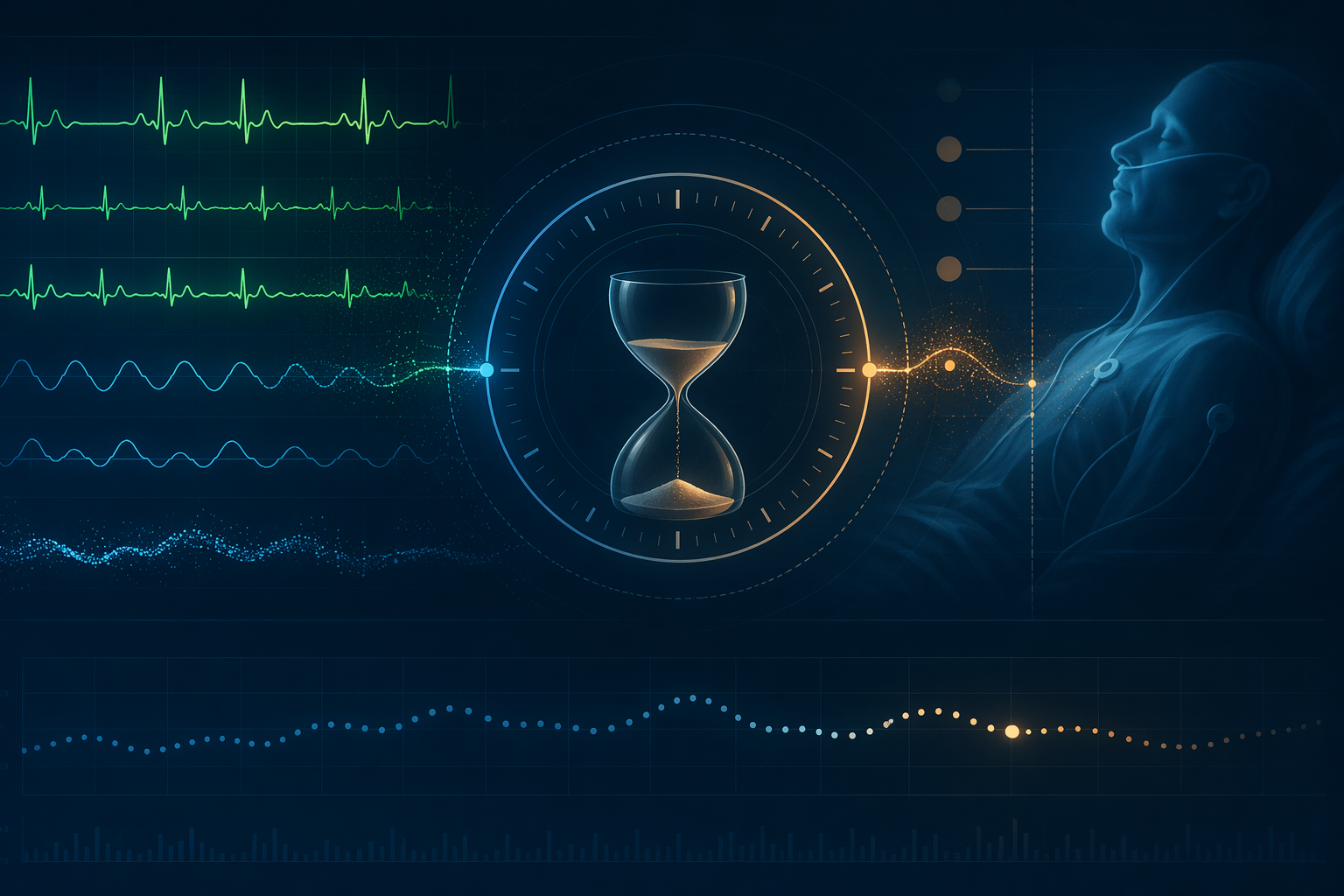
A sepsis prediction model can fire at 09:10, send a nurse back into the chart, nudge a hospitalist toward fluids or cultures, and still not have its cleanest outcome signal until one to three days later. Blood culture turnaround commonly sits in the 24–72 hour window, which means the monitoring team is trying to supervise a time-sensitive system before the most authoritative label has arrived.[1]
That delay is where ordinary clinical AI monitoring starts to fray. A readmission model can wait for a 30-day outcome. A radiology classifier can often compare prediction against an interpreted study or downstream adjudication. Sepsis prediction lives in a less tidy interval: the patient is changing, clinicians are responding, labs are pending, documentation is accumulating, and the model’s operating environment may shift before the confirmed label is available.
This is why AI sepsis prediction model monitoring should not be treated as a slightly more urgent version of a general drift program. The monitoring design has to accept three facts at the outset: labels arrive late, routine drift may be manageable with modest retraining windows, and some shifts in the meaning of “sepsis” cannot be patched with incremental tuning.
The monitoring problem starts before the label exists
The wrong monitoring question is, “Did the model’s AUROC change today?” In most live sepsis deployments, that number is not knowable today. The better question is, “Did anything change today that makes yesterday’s model behavior less trustworthy while we wait for the outcome batch?”
That moves the first layer of surveillance away from confirmed outcomes and toward proxies: vital sign distributions, missingness patterns, lactate ordering behavior, SOFA score trajectory, infection-season mix, unit-level alert volume, and the relationship between alert thresholds and bedside response. These are not substitutes for outcome monitoring. They are the signals available soon enough to prevent a quiet degradation from running unexamined through several shifts.
The general institutional machinery still matters. A health system should already have ownership, escalation rules, model inventory, and lifecycle controls; those belong in a broader clinical AI model drift monitoring program. But the sepsis layer needs its own clock. It has an intraday clinical clock for alert burden and workflow safety, a daily or weekly proxy clock for feature and process drift, and a delayed batch clock for discrimination, calibration, and threshold performance once labels mature.
| Monitoring layer | What it can see | Why it matters in sepsis | Typical review |
|---|---|---|---|
| Real-time operational surveillance | Alert volume, alert routing failures, response delays, override patterns | Detects unsafe workflow behavior before confirmed outcomes are available | Shift, daily, or command-center review depending on deployment risk |
| Near-real-time proxy monitoring | Vital sign distributions, missingness, lactate ordering, SOFA trajectory, unit mix | Catches covariate and process changes while cultures and adjudication are pending | Daily to weekly clinical informatics and MLOps review |
| Delayed outcome monitoring | AUROC, AUPRC, calibration, Brier score, sensitivity and specificity at alert thresholds | Confirms whether model performance changed after labels arrive | Batch review after label maturation |
| Periodic concept review | Definition changes, documentation policy changes, coding changes, care pathway redesign | Determines whether the old target still means the same clinical event | Governance review when clinical or coding definitions change |
What to monitor before outcomes mature
A useful sepsis monitoring program separates drift by the kind of evidence that can detect it. The categories are not academic decoration; they determine whether the next action is an investigation, a recalibration, a retraining job, or a model rebuild.
Covariate shift: the patient stream and measurements change
Covariate shift is the most monitorable early signal because it does not require a final sepsis label. In a deployed sepsis model, the team should watch the distributions of the features that actually drive predictions: temperature, heart rate, respiratory rate, blood pressure, oxygen saturation, white blood cell count, lactate availability, age mix, admission source, service line, unit location, and missingness indicators.
For continuous variables, the Kolmogorov-Smirnov test can flag a distribution shift between the current batch and a reference period. For categorical or binned variables, the Population Stability Index is often easier to operationalize. Censinet’s 2025 vendor guidance describes a PSI value above 0.25 as a signal of significant drift warranting further investigation, but that threshold should be treated as a trigger for review rather than proof of model failure.[2]
The operational detail matters. If the respiratory rate distribution shifts because a unit changed documentation practice, retraining on the new feed may hide a workflow problem. If lactate availability drops because ordering changed, the model may become less informed exactly when clinicians expect it to be more helpful. A PSI dashboard that does not show which unit, interface, or documentation field moved is too clean to be trusted.
Label shift: documentation and coding change the apparent outcome
Label shift is harder because sepsis is partly mediated through clinical recognition and documentation. A coding initiative, a new CDI query, or a change in sepsis bundle documentation can alter the observed outcome rate without the underlying physiology changing in the same way. The model may look worse, better, or merely different depending on which label the monitoring team uses.
This is where the monitoring plan needs surveillance beyond model outputs. Track sepsis diagnosis rates, suspected infection flags, culture orders, antibiotic timing, lactate ordering, SOFA-related components, and coding-rule changes in the same review packet. If the outcome rate moves but proxies do not, the first meeting should include coding, clinical documentation, and clinical informatics before anyone authorizes retraining.
Concept shift: the target stops meaning the same thing
Concept shift is the expensive one. If the institution changes from one sepsis definition to another, or if a surveillance definition changes enough to alter which patients count as positive cases, the old label and the new label are not interchangeable training material. Rahmani et al. simulated data drift effects in clinical sepsis prediction using data from four U.S. hospitals and found that, in a concept shift scenario such as a change in sepsis definition, mixing old and new labels for incremental training did not produce the desired result; the model required a full overhaul.[1]
That finding should change governance behavior. A definition change is not a routine drift ticket. It should pause the assumption that the current target is stable, reopen phenotype design, and force explicit decisions about whether historical labels remain usable. If the answer is no, then a smaller learning rate or a few more recent cases will not solve the problem.
Performance drift: what to measure once labels arrive
Once the outcome batch matures, the monitoring team can return to the familiar performance metrics, but with sepsis-specific emphasis. AUROC remains useful for discrimination, and AUPRC is often more informative when the event rate is low or changes over time. Calibration curves and Brier score matter because sepsis alerts are rarely interpreted as abstract rankings; clinicians and committees want to know whether a displayed risk level still corresponds to observed risk. Threshold-level sensitivity and specificity matter because they determine missed cases, alert volume, and bedside workload.
A five-domain metric framework can help keep those measures organized, but the sepsis program should not confuse metric completeness with useful supervision. The review packet should show the metrics that correspond to actual decisions: whether to keep the threshold, recalibrate probabilities, retrain the model, or escalate to governance. For a broader metric reference, see Clinical AI Model Evaluation Metrics.
A practical sepsis monitoring workflow
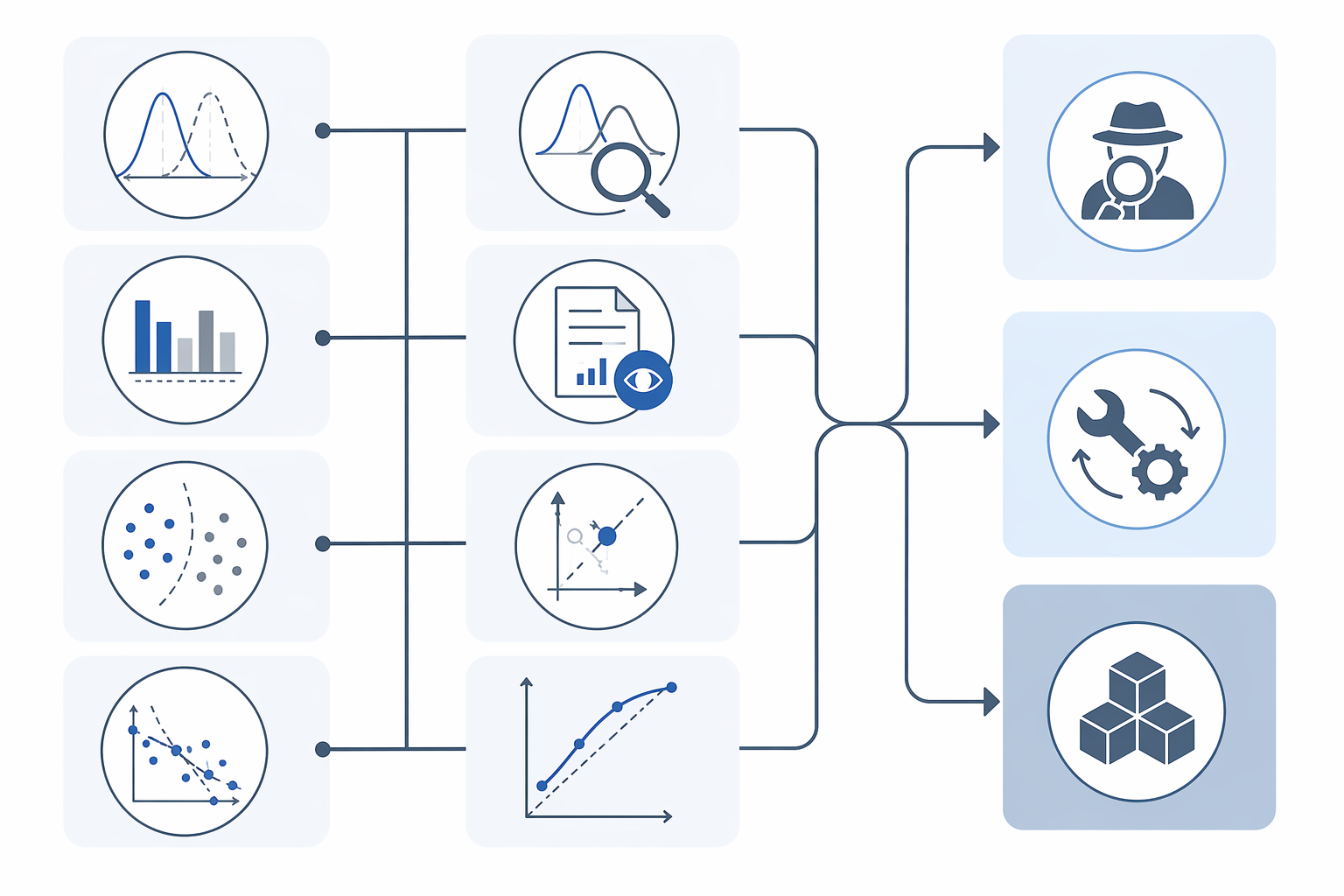
The workflow should be written before the model goes live. It should name the reference dataset, the current monitoring window, the proxy signals, the delayed outcome metrics, the alerting thresholds, the reviewers, and the allowed update types. If those pieces are not specified, the first drift signal will turn into a meeting about process rather than a decision about patient safety.
| Signal | Detection method | Likely interpretation | First action |
|---|---|---|---|
| Vital sign or lab distribution changes | KS test, PSI, missingness trend | Covariate shift, documentation change, interface change, seasonal mix change | Investigate source system, unit mix, and feature pipeline before retraining |
| Sepsis rate changes without matching proxy movement | Outcome-rate trend, coding and documentation surveillance | Label shift or documentation-policy change | Review with coding, CDI, informatics, and clinical leads |
| Definition or phenotype change | Governance review of target definition and label continuity | Concept shift | Suspend incremental-update assumption and evaluate full rebuild |
| AUROC or AUPRC declines after labels mature | Delayed batch performance analysis | Performance drift or degraded discrimination | Compare with feature drift, then retrain if the target is stable |
| Calibration worsens while discrimination remains acceptable | Calibration curve, Brier score, observed-to-expected risk | Risk estimates no longer match observed risk | Consider recalibration before full retraining |
| Sensitivity or specificity changes at the operating threshold | Threshold-level performance review | Clinical impact shift: more misses, more alerts, or both | Review threshold, alert routing, and response capacity |
The reference period should be clinically meaningful, not merely convenient. A pre-go-live validation set is useful, but a sepsis model also needs seasonal comparison windows and deployment-era baselines. A winter respiratory season, a summer surgical mix, and a pandemic-era admission pattern are not interchangeable backgrounds. The monitoring plan should state which reference is used for which question.
The current window should be large enough to avoid chasing noise and short enough to catch operationally important changes. Rahmani et al. found that retraining periods of a couple of months or using several thousand patients were likely adequate for sepsis prediction monitoring, suggesting that sepsis maintenance may be less resource-intensive than some teams assume when the target concept remains stable.[1]
That does not mean every model should be retrained every couple of months. It means the monitoring infrastructure should be capable of assembling a recent, label-mature batch on that order of magnitude, comparing it with the deployment baseline, and making a documented decision. In a low-volume hospital, the patient-count requirement may dominate the calendar. In a high-volume network, calendar time may matter more because care practices can change quickly.
How to decide between investigation, recalibration, retraining, and rebuild
The most common monitoring failure is treating every signal as either harmless noise or an automatic retraining trigger. Sepsis needs a narrower decision logic because a premature update can absorb bad documentation, while a delayed update can leave clinicians working against a degraded tool.
Investigate when proxies move before performance is known
A PSI spike in lactate availability, a KS shift in respiratory rate, or a sudden change in alert volume should open an investigation, not a retraining job. The first question is whether the input changed because patients changed, care changed, documentation changed, or the data feed broke. A model update cannot fix a broken interface, and it should not normalize a documentation shortcut that removes clinically relevant signal.
The investigation should have an owner and a time limit. MLOps can verify pipeline integrity. Clinical informatics can examine charting and order workflow. A sepsis clinical lead can say whether the shift matches a real care-pattern change. If the signal is unexplained and operationally large, the committee may temporarily increase human review of alerts or narrow the alerting population while waiting for outcome labels.
Recalibrate when ranking survives but risk estimates drift
If AUROC and AUPRC remain acceptable after labels mature but calibration worsens, recalibration may be the least disruptive correction. This is especially relevant when clinicians or downstream workflows use displayed risk probabilities rather than only a binary alert. A threshold chosen under one calibration regime may produce a different alert burden under another.
Recalibration still needs governance. The monitoring record should show the batch used, the observed-to-expected risk pattern, the affected units or populations, the expected change in alert volume, and the rollback plan. For broader correction options after confirmed drift, see Model Drift in Clinical AI.
Retrain when the target is stable and recent data are sufficient
Retraining is reasonable when the sepsis concept remains stable, the data pipeline is trustworthy, and delayed outcome metrics confirm degraded performance or clinically meaningful threshold behavior. Rahmani et al.’s finding that a couple of months or several thousand patients may be adequate gives health systems a practical starting point: accumulate enough recent, label-mature data to represent current practice, then retrain and validate against held-out recent cases before deployment.[1]
The validation comparison should include more than aggregate AUROC. A retrained model that improves overall discrimination while increasing alerts on an already overloaded unit may not be an improvement at the bedside. The review should include calibration, AUPRC, threshold sensitivity and specificity, subgroup or unit-level behavior when sample size permits, and expected alert volume.
Use drift-triggered learning when fixed intervals are too slow
Fixed-interval retraining is administratively simple, but major distribution shifts do not wait for the quarterly agenda. During COVID-19, a June 2025 Toronto study across 143,049 inpatients at seven hospitals used Maximum Mean Discrepancy testing to trigger continual learning and reported a Delta AUROC of 0.44 during the major shift period, showing how a drift-triggered approach can outperform fixed-interval retraining under severe distribution change.[3]
That result should be read with the right limits. It is a multi-hospital study within one Toronto network, not proof that every sepsis model should update continuously. The useful lesson is architectural: a monitoring system can use distributional tests such as MMD to decide when the data stream has changed enough to justify a learning event, rather than assuming that calendar time is the best proxy for drift.
Rebuild when the label no longer has continuity
A Sepsis-3-type definition change belongs in a different category from a seasonal case-mix shift. If the target has changed, old labels may no longer represent the same clinical construct as new labels. At that point, incremental training risks making the model less coherent rather than more current.
A rebuild should reopen phenotype selection, label generation, feature eligibility, validation design, alert thresholding, and clinical workflow review. It should also trigger the same level of governance attention as a new model, including pre-deployment validation using a structured process such as a healthcare AI validation checklist.
Governance has to be close enough to the alert
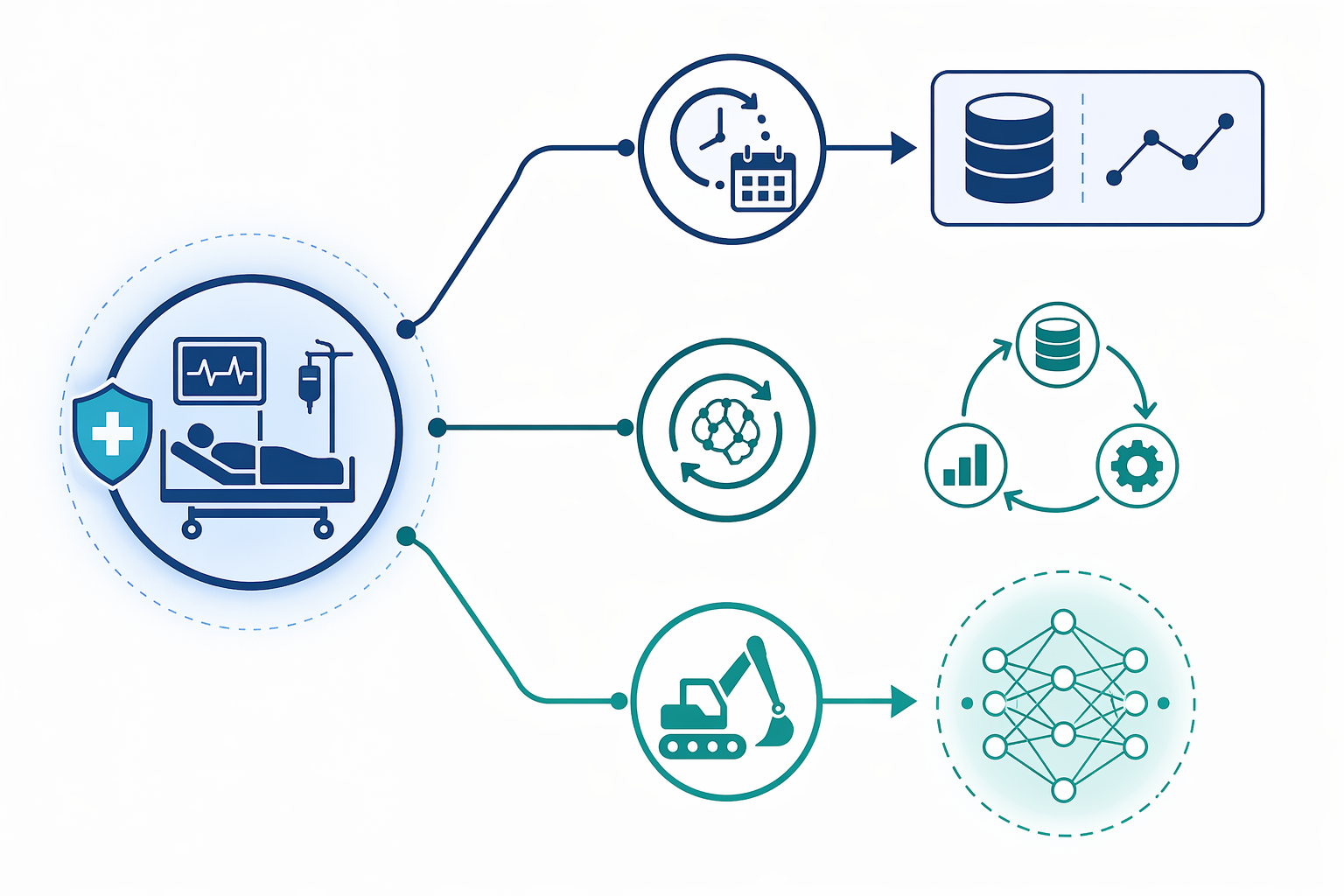
Sepsis model governance cannot live only in a quarterly AI committee packet. The committee may own the charter, but the monitoring work sits closer to the EHR, the alert queue, the lab feed, the nursing workflow, and the hospitalist who is being asked to respond. A useful governance design names who can investigate, who can approve recalibration, who can authorize retraining, and who can suspend the model if alert behavior becomes unsafe.
Vendor dashboards are not enough on their own. Censinet’s vendor-oriented guidance reports that 91% of AI models lose effectiveness over time, but the more important operational point is not the exact percentage; it is that drift monitoring must be owned as a continuing discipline, not as a procurement artifact.[2] Vendor-originated benchmarks can help start a conversation, but health systems still need local evidence about their patients, documentation, and response capacity.
A governance charter should define the monitoring packet in advance. At minimum, that packet should include recent alert volume, proxy drift signals, data-quality checks, delayed outcome metrics when available, threshold-level clinical impact, active investigations, pending model changes, and a plain-language explanation of what changed since the prior review. For committee structure, see The Essential Elements of a Clinical AI Governance Committee Charter.
The review should also include the people who bear the workflow consequences. If threshold adjustment reduces false positives but shifts missed cases toward a particular unit, that is not just a model metric. If recalibration increases the number of medium-risk alerts, someone has to say whether nurses, rapid response teams, or hospitalists can absorb the added work. Alert fatigue is not a side effect to mention after deployment; it is one of the monitored outcomes.
A minimal operating schedule
The schedule does not need to be ornate. It needs to survive contact with delayed cultures, changing charting habits, and busy clinical teams.
- Every shift or day: monitor alert volume, routing failures, response delays, and unusual clustering by unit or service.
- Daily to weekly: review feature distributions, missingness, lactate ordering, SOFA-related trajectories, patient mix, and documentation proxies.
- After label maturation: calculate AUROC, AUPRC, calibration, Brier score, and sensitivity or specificity at the operating threshold.
- Monthly or at a defined patient-count milestone: review whether enough recent, label-mature data exist to support recalibration or retraining.
- Whenever definitions, coding rules, care pathways, or EHR workflows change: perform a concept-continuity review before using the new data for incremental training.
For teams maintaining commercial tools, the same schedule should be written into vendor operations, not left as an informal request. The organization should know which local data the vendor can see, which drift signals the vendor reports, which updates require local approval, and how the health system can audit model behavior after an update. The history of sepsis AI deployment has already shown what happens when performance, governance, and accountability are separated; the Epic Sepsis Model governance case study is useful precisely because it turns monitoring absence into an operational lesson.
Where specialized monitoring changes the decision
A general monitoring program might see a feature distribution shift and ask whether the model’s performance has degraded. A sepsis monitoring program has to act before that answer is fully available. It watches proxies because the label is delayed. It uses delayed batches because confirmed outcomes still matter. It distinguishes ordinary drift from concept shift because the wrong update can make the target less coherent, not more current.
The practical separation is straightforward. Investigate when near-real-time proxy signals move. Recalibrate when risk estimates drift but ranking remains useful. Retrain when the target is stable and recent, label-mature data show degraded performance. Rebuild when the clinical meaning of the label changes. That is the difference between monitoring a dashboard and maintaining a sepsis prediction system in the clinical environment where it actually operates.
References
- Assessing the effects of data drift on the performance of machine learning models used in clinical sepsis prediction. International Journal of Medical Informatics. 2023.
- AI Model Drift Monitoring: Ensuring Ongoing Performance of Healthcare AI Vendors. Censinet. 2025.
- Subasri et al. study on Maximum Mean Discrepancy-triggered continual learning for sepsis prediction across Toronto hospitals. 2025.
Comments
Join the discussion with an anonymous comment.