
Shark attack trauma treatment and recovery has an evidence problem before it has an artificial intelligence problem. The event is rare enough that a condition-specific randomized transfusion trial is not a realistic expectation: the International Shark Attack File recorded 65 unprovoked bites worldwide in 2025, including 9 fatalities.[1] Yet the injuries that matter most in the first minutes are not subtle. Severe hemorrhage, neurovascular injury, retained tooth fragments, and infection risk are all described features of shark trauma, and early death can come from blood loss long before the patient reaches a definitive trauma team.[2]
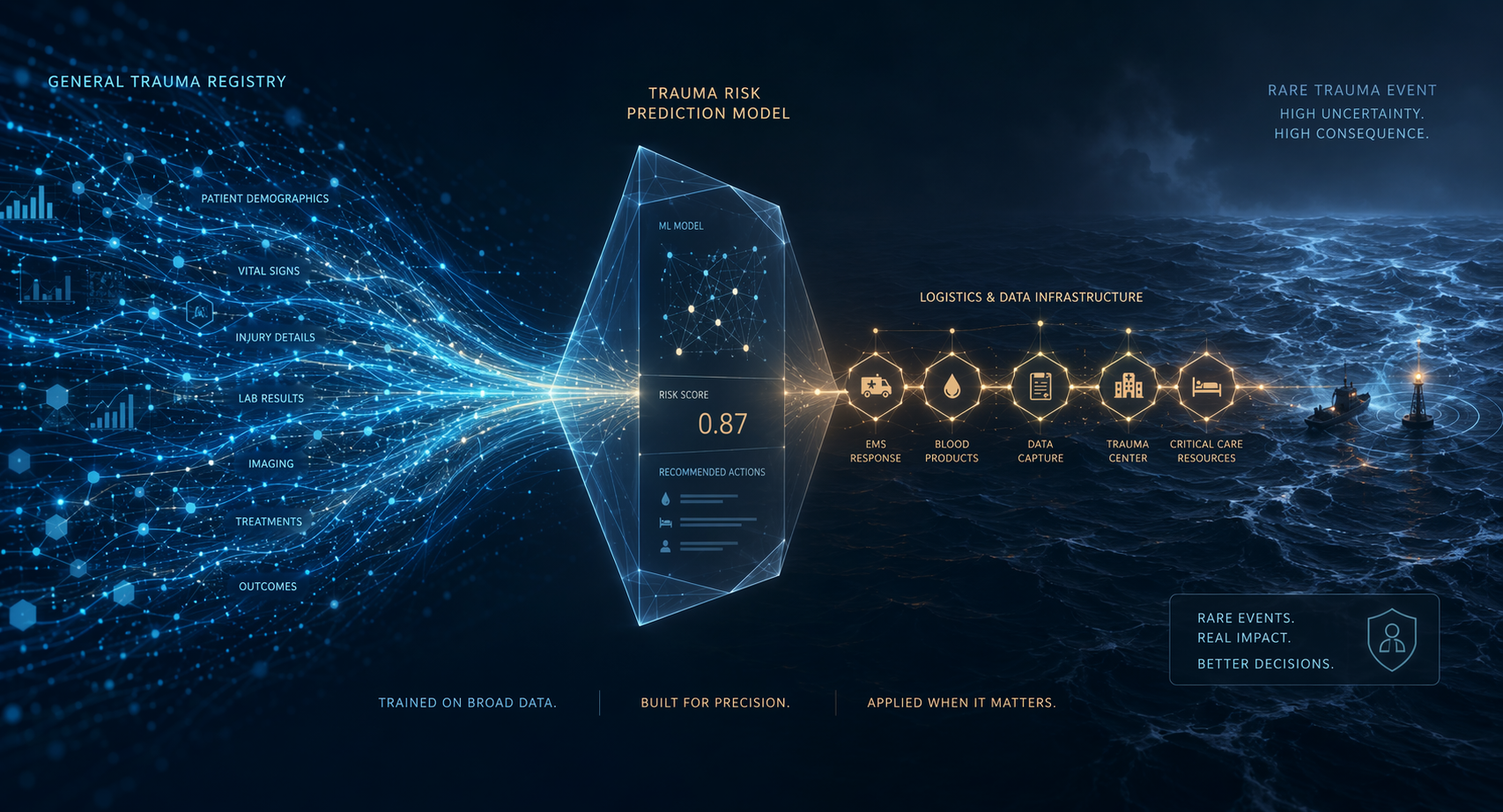
That combination makes shark attack hemorrhage an awkward test case for decision support. The clinical question is not whether a model can produce an elegant risk score. It is whether a lifeguard-to-EMS-to-trauma-center chain can recognize a patient likely to need blood, move that information fast enough, and deliver the right product early enough for the prediction to matter.
The shark-specific protocol is useful, but not definitive
The most concrete shark-specific starting point is the 2024 SHARC protocol proposal by Levenson, which tries to impose prehospital order on a literature base that contains essentially no trial-grade guidance for shark attack hemorrhage. Its value is not that it proves a transfusion rule. Its value is that it shows what clinicians actually have to look at when the patient is bleeding on a beach, boat, or shoreline access road.
The proposed algorithm centers on five inputs: systolic blood pressure below 90 mmHg, visible hemorrhage severity, patient appearance, wound radius greater than 15 cm, and signs of coagulopathy.[3] Those are not decorative variables. They correspond to things an EMS crew may plausibly observe before hospital labs, imaging, vascular surgery, or formal massive transfusion activation are available.
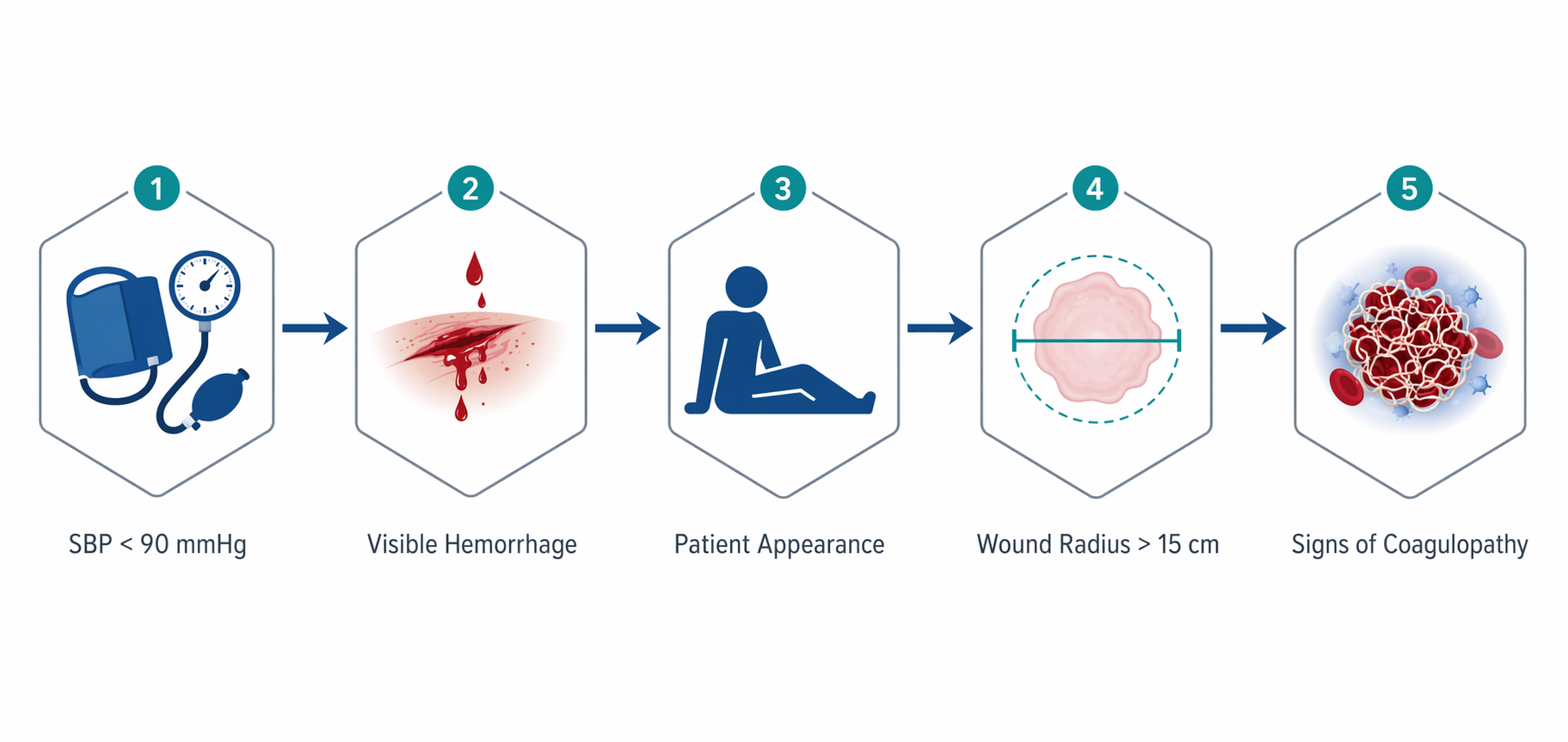
But the thresholds should not be laundered into validated rules. Levenson explicitly frames SHARC as a protocol proposal and notes the absence of prospective clinical trial data.[3] A wound radius greater than 15 cm may be a reasonable alarm bell; it is not a proven cutoff. Visible hemorrhage severity is clinically urgent; it is also subject to scene conditions, tourniquet placement, lighting, distance from the water, and who is doing the observing. Patient appearance matters; it can also change quickly after extrication, analgesia, warming, or fluid administration.
That is the right way to read SHARC: not as the answer, but as a disciplined inventory of prehospital danger signs in a setting where waiting for definitive evidence would mean waiting indefinitely.
Where the stronger evidence sits: general trauma transfusion prediction
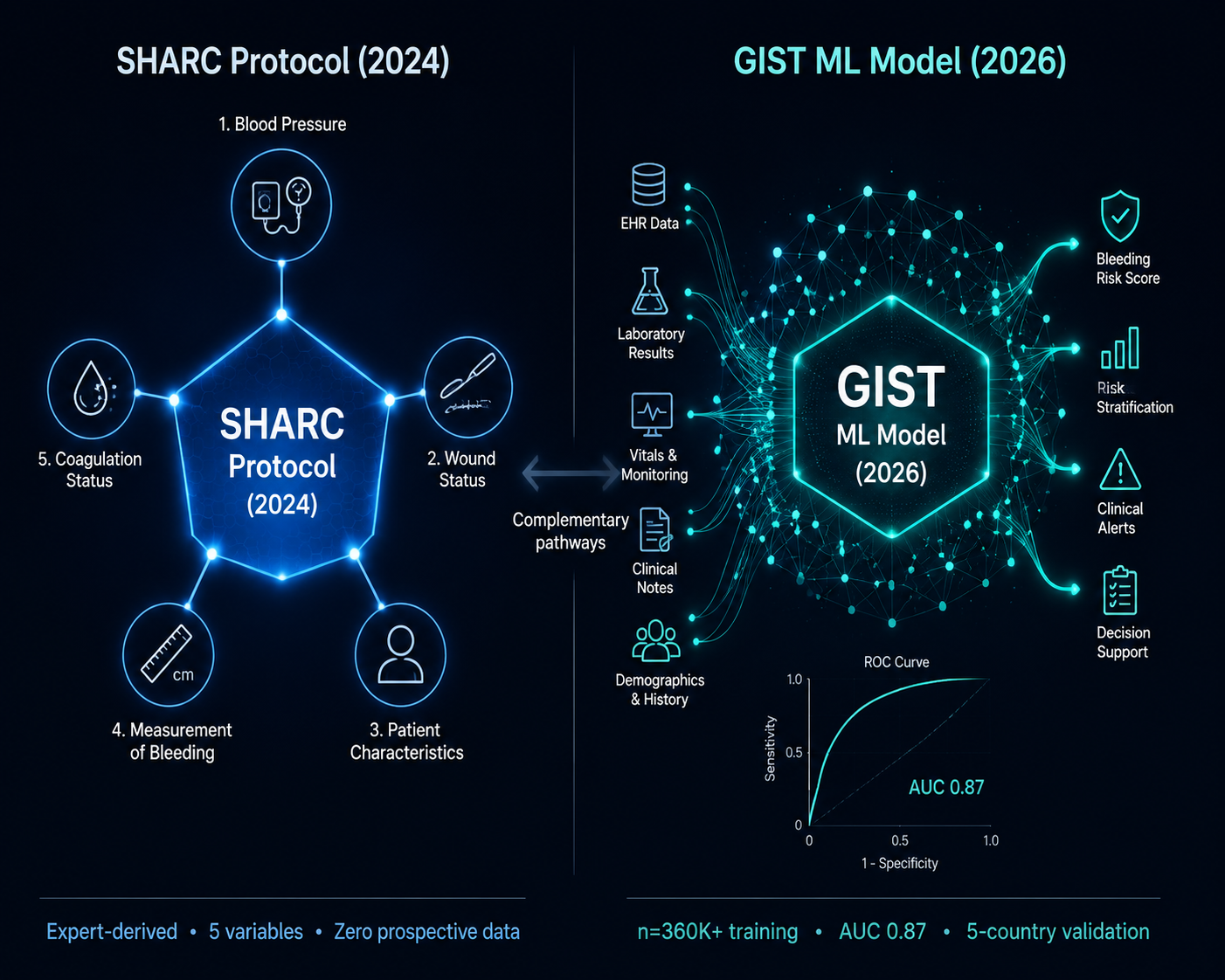
The more substantial evidence comes from a different direction. A 2026 Lancet Digital Health study developed and externally validated the GIST framework, an AI-enabled model for forecasting prehospital transfusion needs in trauma patients. The model was retrospectively developed on more than 360,000 trauma patients in the United States and externally validated across 5 countries in a population of 54,000 patients.[4]
The important design feature is that the model used only prehospital variables, including vital signs, injury patterns, and antithrombotic use.[4] That matters because a transfusion decision support tool for EMS cannot depend on information that only appears after arrival, CT imaging, or laboratory processing. If the input does not exist in the ambulance, the score is already late.
The reported discrimination was strong: the GIST model achieved an AUC of about 0.87 for predicting prehospital transfusion need and outperformed conventional measures including shock index and revised trauma score.[4] AABB’s transfusion medicine summary appropriately described the model as potentially helpful for identifying trauma patients requiring prehospital transfusion, while also placing it in the development and validation phase rather than treating it as a deployed standard of care.[5]
| Evidence source | What it contributes | What it does not prove |
|---|---|---|
| SHARC protocol proposal | A shark attack-specific prehospital heuristic using blood pressure, hemorrhage, appearance, wound size, and coagulopathy signs | That the algorithm improves survival, transfusion timing, or triage accuracy in prospective practice |
| GIST trauma ML framework | Large-scale retrospective and external validation for prehospital transfusion prediction using variables available before hospital arrival | That the model is validated for shark attack wound patterns or ready for unsupervised EMS deployment |
| EMS blood product systems | The operational ability to act on a transfusion prediction | That every EMS region can deliver red cells, plasma, or balanced products early enough for a score to change care |
What can plausibly transfer from general trauma to shark attack hemorrhage
The bridge between SHARC and GIST is not that one validates the other. It is that they overlap on several physiologic and operational signals that matter across traumatic hemorrhage.
Hypotension is the clearest example. SHARC flags systolic blood pressure below 90 mmHg.[3] GIST uses prehospital vital signs as part of a broader transfusion prediction framework.[4] In a shark bite patient with ongoing extremity hemorrhage and low blood pressure, a model does not need to know anything about sharks to recognize a dangerous hemodynamic pattern. It may still help sort the patient into a higher transfusion-risk group, especially when the alternative is a familiar but less discriminating conventional score.
Hemorrhage severity is another plausible transfer point. Shark trauma may be distinctive in mechanism, but the immediate problem of uncontrolled bleeding shares enough with penetrating and mangling injury that a general trauma model’s injury-pattern inputs are not irrelevant. The same is true for antithrombotic use. A patient taking anticoagulants or antiplatelet therapy is not a shark-specific category; it is a trauma resuscitation modifier that may influence bleeding risk and transfusion need, and it was among the prehospital variables used by GIST.[4]
The overlap is strongest when the model is treated as an adjunct to structured clinical observation. SHARC supplies a field-facing checklist of visible danger signs. GIST supplies a registry-derived estimate of transfusion need from large trauma populations. Used together in research, they could help ask a better question than either source can answer alone: when expert-recognized shark attack hemorrhage features are mapped onto general trauma transfusion predictors, does the combination identify the patients who would benefit from earlier blood product mobilization?
What does not transfer cleanly
The uncomfortable part is that shark attack injuries are not what the GIST model was specifically trained to recognize. The Lancet study supports prehospital transfusion prediction in broad trauma populations; it does not establish performance in marine injury, animal bite-related tissue loss, or the specific wound geometries produced by shark bites.[4]
That distinction is not academic. Shark trauma can involve irregular soft-tissue avulsion, major vascular injury, nerve injury, retained tooth fragments, and contaminated wounds with infection risk.[2] A model trained on general injury patterns may respond appropriately to hypotension and hemorrhage while still missing important context about wound shape, contamination, tourniquet feasibility, neurovascular compromise, or the likelihood that bleeding will worsen after movement and exposure.
Scene data quality is another weak point. A prehospital model lives or dies on what crews can enter quickly and accurately. In a controlled registry, a systolic blood pressure value, injury category, medication status, and mental status field look orderly. On a beach response, the first pressure may be delayed, unobtainable, or measured after hemorrhage control. Medication history may be unavailable. Wound size may be estimated under poor conditions. A model that performs well retrospectively can lose its footing when the missingness pattern changes in deployment.
There is also a base-rate problem. Shark attacks are so uncommon that even a strong general trauma model will encounter very few true shark cases in routine validation. That does not make extrapolation illegitimate. It does mean any article, vendor claim, or implementation plan should avoid the phrase “validated for shark attack trauma” unless shark attack cases were actually tested.
The score only matters if blood can move
For an EMS medical director, the first implementation question is not model architecture. It is whether the system can deliver blood products before arrival. If the agency does not carry prehospital red cells, plasma, or another protocolized blood product option, a high-risk transfusion prediction may only accelerate notification, destination choice, or hospital preparation. Those can still matter, but they are not the same as prehospital transfusion.
Where blood carriage exists, decision support has a narrower and more serious role. It might help decide when to launch blood to a scene, when an intercept vehicle should meet a transporting unit, when air medical resources are justified, or when a receiving trauma center should prepare for immediate balanced resuscitation. These are logistics decisions with clinical consequences. A false negative may delay blood for a patient who is bleeding out. A false positive may consume a scarce product, redirect a team, or create avoidable risk in transport.
That is why AUC alone is not enough. An AUC of about 0.87 is promising for discrimination in retrospective validation.[4] It does not specify the operating threshold an EMS agency should use, how many alerts crews will tolerate, what happens when vitals are missing, whether the score delays packaging and transport, or whether blood delivery times actually improve. Those questions are not secondary details. They are the difference between a useful clinical support tool and a well-performing retrospective model.
What prospective evidence should ask
A shark-attack-specific randomized trial is not the standard to demand. The rarity of cases makes that implausible. A more realistic evidence pathway would test the model inside existing trauma and EMS systems, with rare marine injury cases included when they occur but not required to carry the entire study.
- Prospective workflow validation: whether crews can capture the required variables during real calls without delaying hemorrhage control, packaging, or transport.
- Operational endpoints: whether alerts change blood product launch, intercept, destination selection, trauma center preparation, or time to transfusion.
- Safety endpoints: false negatives, false positives, product wastage, alert fatigue, and cases where clinicians override the score.
- Subgroup review: performance in penetrating, mangling, extremity vascular, marine, and animal bite-related injuries when enough cases accumulate.
- Governance: clear ownership by EMS medical directors and trauma systems, not silent automation embedded in documentation software.
The prospective question is not simply whether the model predicts transfusion need. It is whether adding the model to protocolized trauma care improves the rescue chain without creating new failure points. For shark attack trauma treatment and recovery, that chain starts before the operating room: hemorrhage control, rapid extraction, appropriate destination choice, early blood availability, vascular and soft-tissue management, infection prevention, and rehabilitation for neurovascular or limb injury. A transfusion score touches only one part of that sequence.
A disciplined position
Machine learning may be one of the few realistic evidence pathways for rare, high-mortality trauma transfusion decisions. The GIST study shows that prehospital variables from large trauma registries can predict transfusion need better than familiar conventional scores in retrospective and external validation.[4] The SHARC protocol shows how clinicians are already trying to structure shark attack hemorrhage decisions in the absence of prospective evidence.[3]
The responsible conclusion stops short of recommending clinical use for shark attacks. A general trauma ML model can plausibly support research and carefully governed decision support where EMS blood logistics exist. It cannot yet be treated as validated shark attack AI. The next burden is prospective implementation evidence: not another impressive score on a screen, but proof that retrospective performance survives real crews, missing data, scarce blood products, and the minutes that decide whether hemorrhage care arrives early enough.
References
- Yearly Worldwide Shark Attack Summary, International Shark Attack File, Florida Museum
- Shark Trauma, StatPearls, 2022
- Developing a Treatment Protocol for Shark Attack Victims, SCIRP, 2024
- AI-enabled forecasting of prehospital transfusion needs in patients with trauma, The Lancet Digital Health, 2026
- AI Model May Help Identify Trauma Patients Requiring Prehospital Transfusion, AABB, February 11, 2026
Comments
Join the discussion with an anonymous comment.