
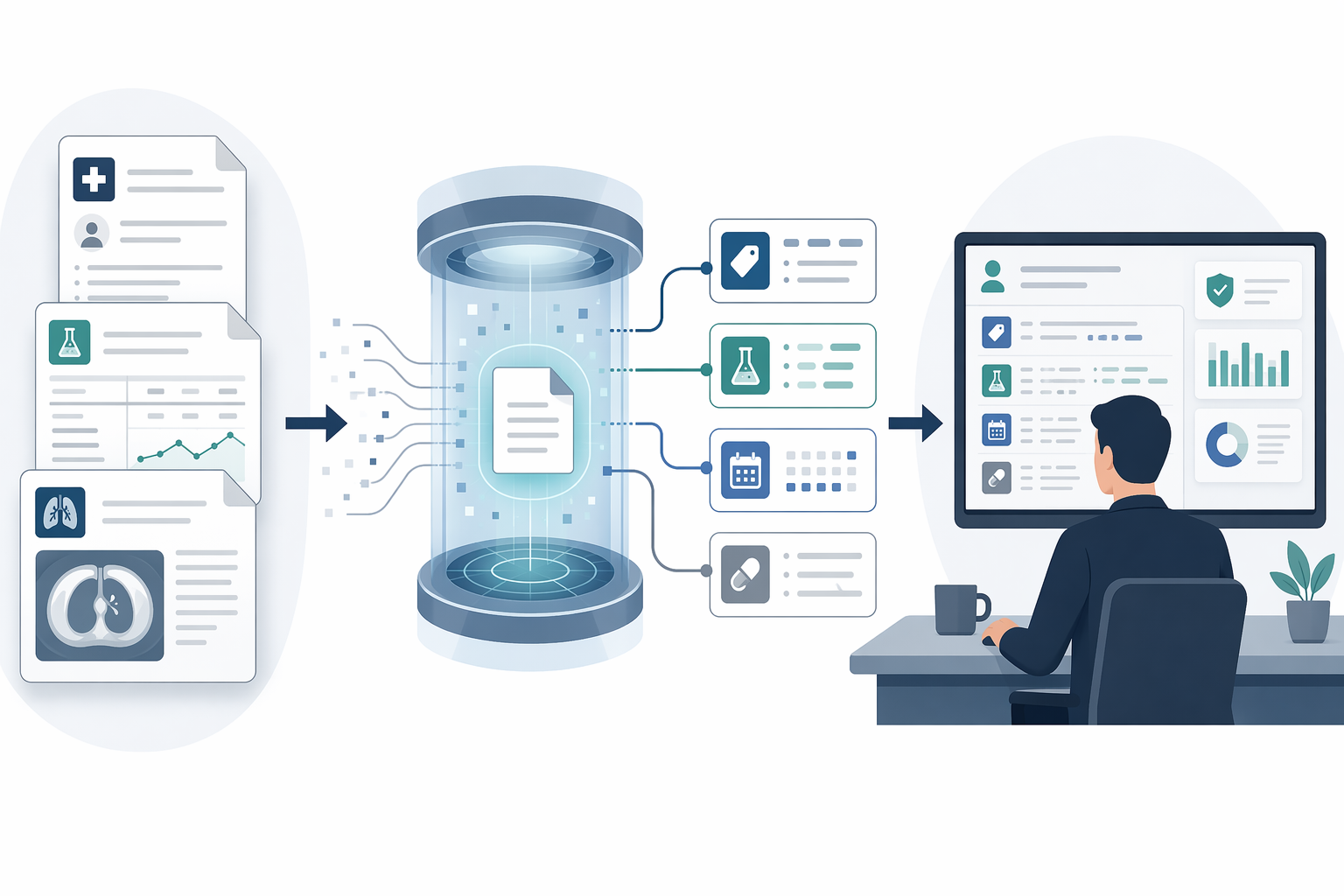
When people talk about AI chatbots for Social Security Administration, IMAGEN is the better correction than the buzzword. SSA's IMAGEN use-case profile describes a clinical NLP pipeline, not a conversational assistant or diagnostic model: it ingests unstructured medical records and turns encounters, lab results, imaging reports, and treatment patterns into structured evidence that adjudicators can search, filter, and visualize [1].
The first pass through a disability file
The scale helps explain why SSA became interested. ACT-IAC says SSA receives more than 3 million new disability applications each year, spends more than $500 million annually collecting medical records, and often handles files that run past 1,000 pages [1]. In that setting, IMAGEN changes the first pass, not the underlying adjudicative burden: it makes the record searchable before a human reviewer starts deciding what matters.
A secondary inventory places IMAGEN inside a broader SSA AI stack that also includes Insight, which checks decision quality across roughly 30 issue types, and QDD, a predictive model [2]. That matters because the evidence summary is not floating by itself. It sits inside a layered review environment where different systems are doing different jobs: one extracts, one checks, and one predicts.
What structured NLP captures most readily
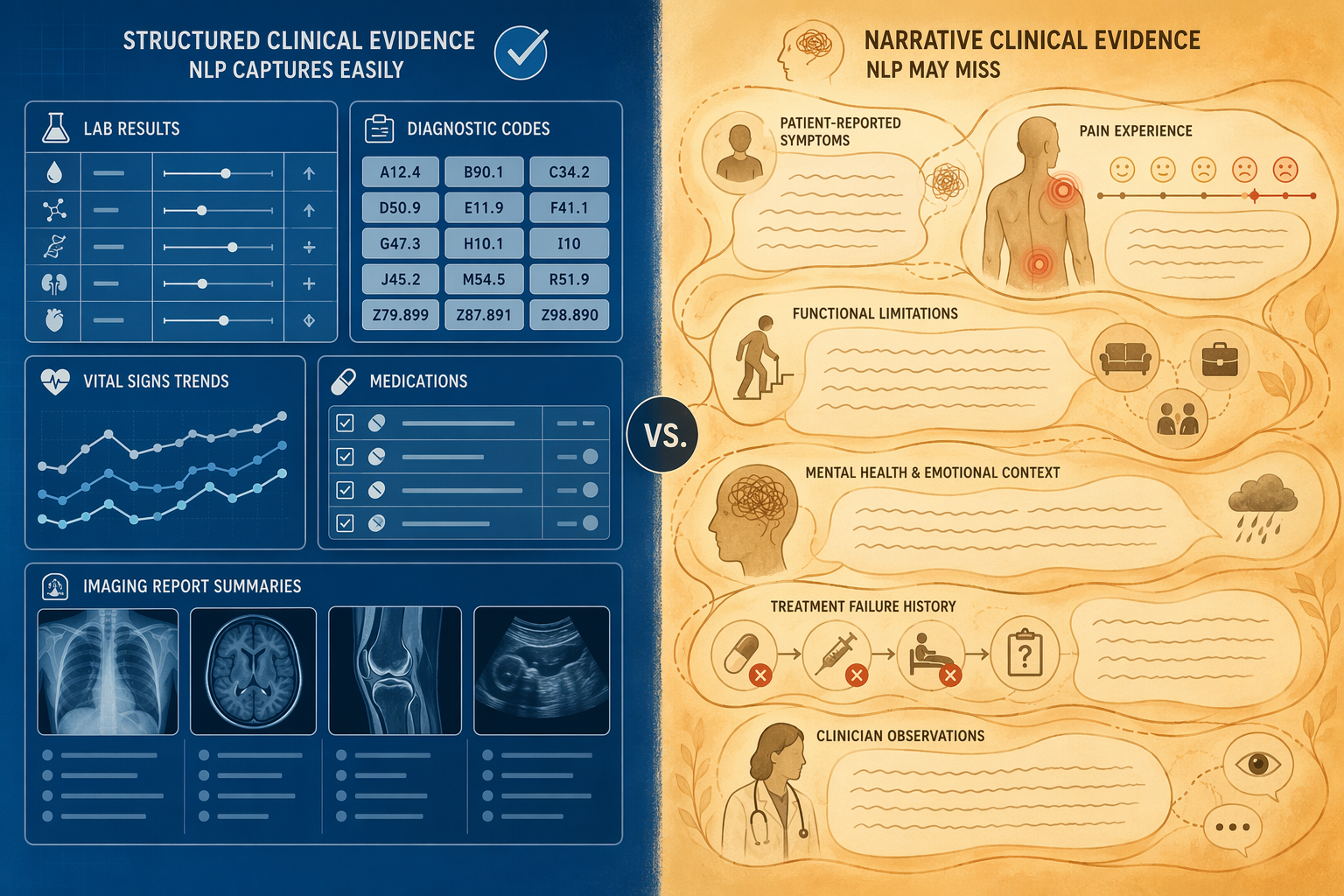
The easiest material for a clinical NLP system to surface is also the material most likely to survive handoff in ordinary documentation. That includes:
- Diagnoses and coded problems that are explicitly named in the chart
- Encounter dates and visit chronology
- Lab results and imaging impressions
- Treatment patterns, medication changes, and follow-up plans
- Repeated facts that appear across multiple notes
Those are the kinds of facts that can be named, timestamped, indexed, and pulled back out of a large file without much ambiguity. The system does not need to recreate a whole clinical conversation before it can make a field searchable. It only needs enough structure to map the text into the categories it already knows how to recognize.
Where narrative-heavy conditions can thin out
The harder problem is what happens when the evidence lives in narrative rather than in a cleanly repeated code. Mental health symptoms over time, chronic pain, fibromyalgia, fluctuating capacity, failed treatments, and clinician impressions often matter because they accumulate across visits instead of appearing in one decisive test result. A note can contain all of that and still present it in a way that is less visible once the text has been segmented, classified, indexed, and summarized.
That is the gap between searchable evidence and clinically meaningful evidence. A diagnosis code can tell a reviewer that a condition exists, but it may not carry the same weight as the longitudinal description of function, persistence, or treatment failure that actually shows how the condition behaves in daily life. IMAGEN can only structure what the source text makes legible to the model; it does not turn every clinically important narrative into an equally prominent field.
One law-firm analysis of public SSA data reports that nearly half of initially denied claims that are appealed are later approved, which does not prove anything about IMAGEN by itself, but does show why the first evidence review matters [3]. If the earliest summary is what determines what a reviewer sees, then omissions at that stage can matter long before an appeal exists.
Why the surrounding infrastructure matters
IMAGEN is also being built on top of a broader electronic exchange network. SSA's Health IT initiative says it includes 266 partner organizations and about 46,000 providers across all 50 states, and SSA and GovCIO reporting describe electronic medical record exchange that identifies allowances 50% faster [5][6]. The important point is not that faster exchange is automatically fairer; it is that better connectivity gives extraction tools more complete text to work with and gives reviewers less excuse to treat missing paper as missing reality.
Governance has to sit above the summary
Secondary reporting on the NASI Task Force Phase One Report points to the usual but necessary controls: meaningful human review, bias prevention, and governance guardrails for AI that processes clinical evidence [4]. The public source trail is also uneven: this account relies on ACT-IAC and secondary inventory descriptions for IMAGEN, and on secondary reporting for NASI recommendations. That is the right level of response because the risk here is not that the system is too clever. The risk is that a structured summary starts to feel more complete than the chart it came from.
For clinicians and documentation specialists, the practical consequence is not a demand to write differently for SSA. It is the narrower realization that documentation now has computational downstream effects. A note written for care can later become part of an adjudication workflow that rewards what can be coded, timestamped, and extracted most reliably. For patients whose conditions are carried mainly in narrative detail, persistence, and functional loss, the record may be present and still not be equally visible to the pipeline that turns it into evidence.
References
- Intelligent Medical Language Analysis Generation (IMAGEN) — ACT-IAC use-case profile
- Social Security Administration — ScryAI use-case inventory
- How the Social Security Administration Uses AI in SSDI Cases — Keefe Disability Law
- NASI Task Force issues report on AI at SSA — Empire Justice Center — April 2025
- Our Initiative — Social Security Administration
- SSA cuts wait times, claims backlog through tech modernization — GovCIO Media
Comments
Join the discussion with an anonymous comment.