
The first useful answer to the search for “st jude hospital active shooter lockdown” is also the most important correction: same-day reports described the July 22, 2026 incident at St. Jude Children’s Research Hospital as a swatting-style bomb-threat hoax, not a confirmed active shooter attack. A call came in at about 6:10 PM, law enforcement agencies converged on the Memphis campus, the hospital went into lockdown, and the facility was later cleared with no danger found, according to local and wire reporting available that evening.[1][2][3] Official after-action details may still refine that account, but the operational problem was already visible before the final clearance: the hospital had to behave as if the threat might be real while responders worked through uncertainty.
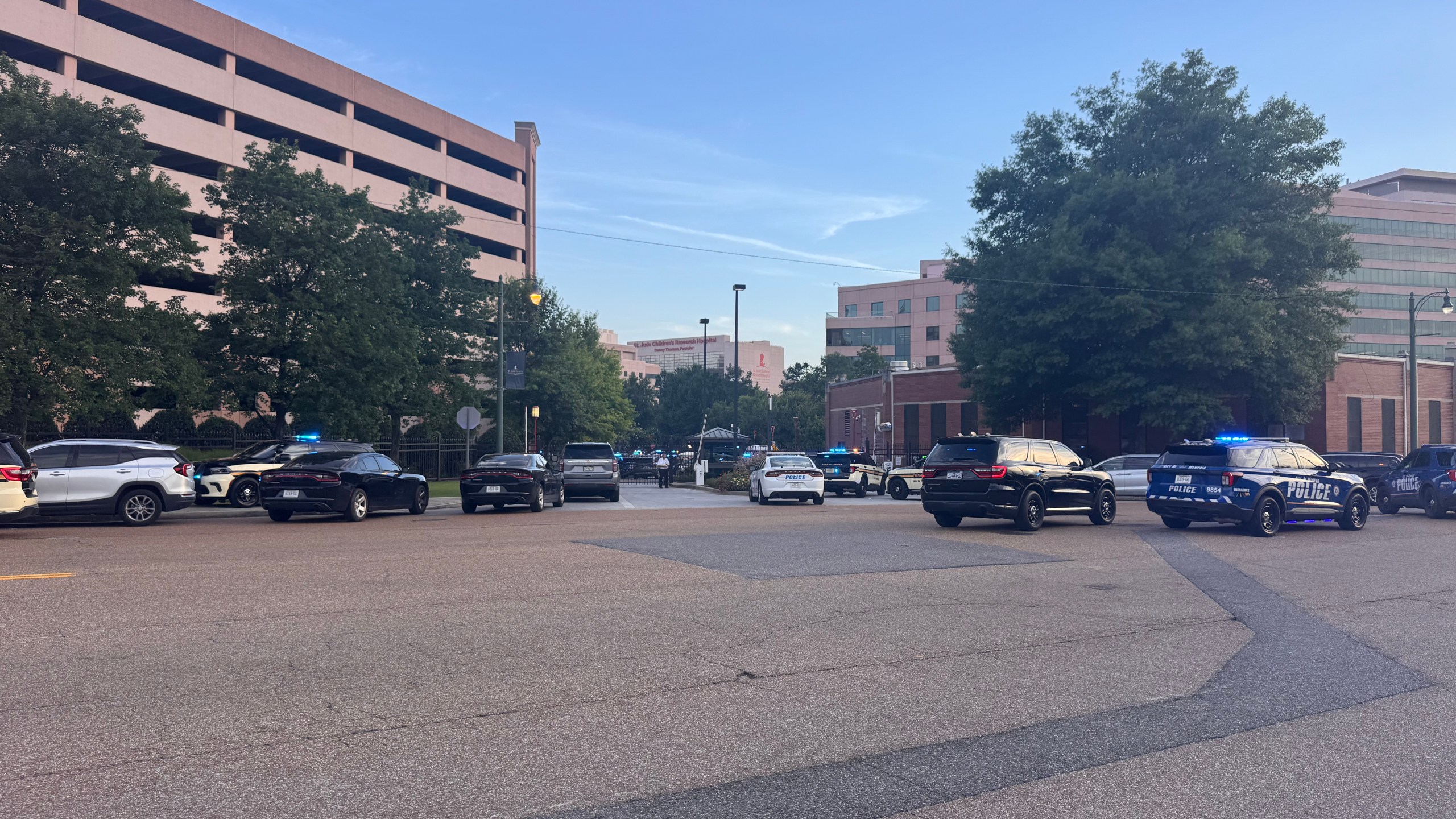
That distinction matters. A hoax does not mean a harmless event. At a pediatric cancer hospital, lockdown is not a clean administrative state that can be switched on and off without consequence. It changes routes, delays movement, traps families in place, and asks clinical teams to make safety decisions around children whose treatment schedules, immune status, mobility, and emotional condition may already be fragile. The burden falls first on the people closest to the unit: charge nurses, transport aides, physicians, security dispatchers, and officers at entrances who must act before anyone has a fully settled picture.
The St. Jude episode is therefore a hard procurement case, not just a news item. It shows why hospitals need faster ways to confirm or refute visible weapon threats in the opening minutes of an incident. AI-powered visual weapon detection cannot detect a phone-based bomb threat. It cannot see a concealed weapon. It cannot cover a hallway without a camera. But when a report mentions an armed person, or when responders need to know whether a visible firearm appears on existing camera feeds, that verification layer can change the first decisions.
What The St. Jude Lockdown Shows About Uncertainty
The reported timeline was short at the front and long in its consequences. At about 6:10 PM on July 22, 2026, St. Jude received a bomb-threat call. Memphis Police responded, and same-day accounts also named the Sheriff’s Office, State Patrol, Memphis Safe Task Force, and National Guard among the responding agencies. The hospital was placed on lockdown while the facility was searched and cleared. Reports later stated that no danger was found and the facility was declared safe.[1][2][3]
Those facts leave out the part every hospital drill struggles to reproduce: the minutes when the threat is neither confirmed nor dismissed. During that interval, a dispatcher is taking calls from inside the building, outside agencies are arriving with partial information, leaders are asking what has been seen, and clinical teams are trying to determine whether movement is more dangerous than remaining in place. In a children’s research hospital, “shelter” and “move” are not abstract options. Patients may be connected to equipment, immunocompromised, sedated, in pain, or unable to understand why adults have suddenly changed tone.
That is why the hoax label should not end the discussion. The incident did not have to be a real bombing or shooting to expose a real security gap. The gap is the period between a credible-enough report and a verified observation. Hospitals can have binders, incident command roles, and memorized codes; still, the building waits for someone to answer a plain operational question: has anyone actually seen a weapon, a suspect, a suspicious package, or a condition that changes the response?
Hospitals Have Plans, But Not Always For The Patients Who Cannot Move
A 2023 survey by Kahler and colleagues found that 98% of responding U.S. hospital systems reported having active shooter protocols. That sounds reassuring until the next numbers arrive: only 24% reported plans for critically ill or immobile patients, and 52% practiced drills. The survey had a 20.4% response rate, with 60 of 294 invited systems responding, so it should not be treated as a nationally representative census. It is still a strong warning about the realism gap in preparedness.[4]
The realism gap becomes sharper in pediatric oncology. “Run, hide, fight” language does not map well onto a child receiving cancer care, a parent at bedside, a nurse managing lines and medications, or a physician weighing whether moving a patient creates its own danger. If the early information is wrong, the system may impose a heavy safety posture on people least able to absorb it. If the early information is right, hesitation can be deadly. That tension is exactly where faster verification earns its place.
General workplace violence context adds pressure but should not be stretched into a claim about this incident. Vendor and security-industry materials citing U.S. Bureau of Labor Statistics data state that healthcare workers are five times more likely to be attacked on the job than workers in other occupations.[9] That comparison helps explain why hospital security investment is moving up the agenda. It does not prove that an AI camera system would have changed the St. Jude outcome. The narrower, better-supported point is that hospitals already face elevated violence risk while managing patient populations that make prolonged lockdown unusually costly.
The Visual Verification Layer AI Can Add
AI-powered weapon detection systems in this category generally do not replace access control, emergency communications, or police response. They sit on top of existing IP camera feeds and look for visible, brandished firearms. When the software flags a likely weapon, the alert is routed for human review before notification is escalated. The value proposition is not “AI stops hospital violence.” It is narrower: shorten the time between a report of an armed threat and a verified visual finding.
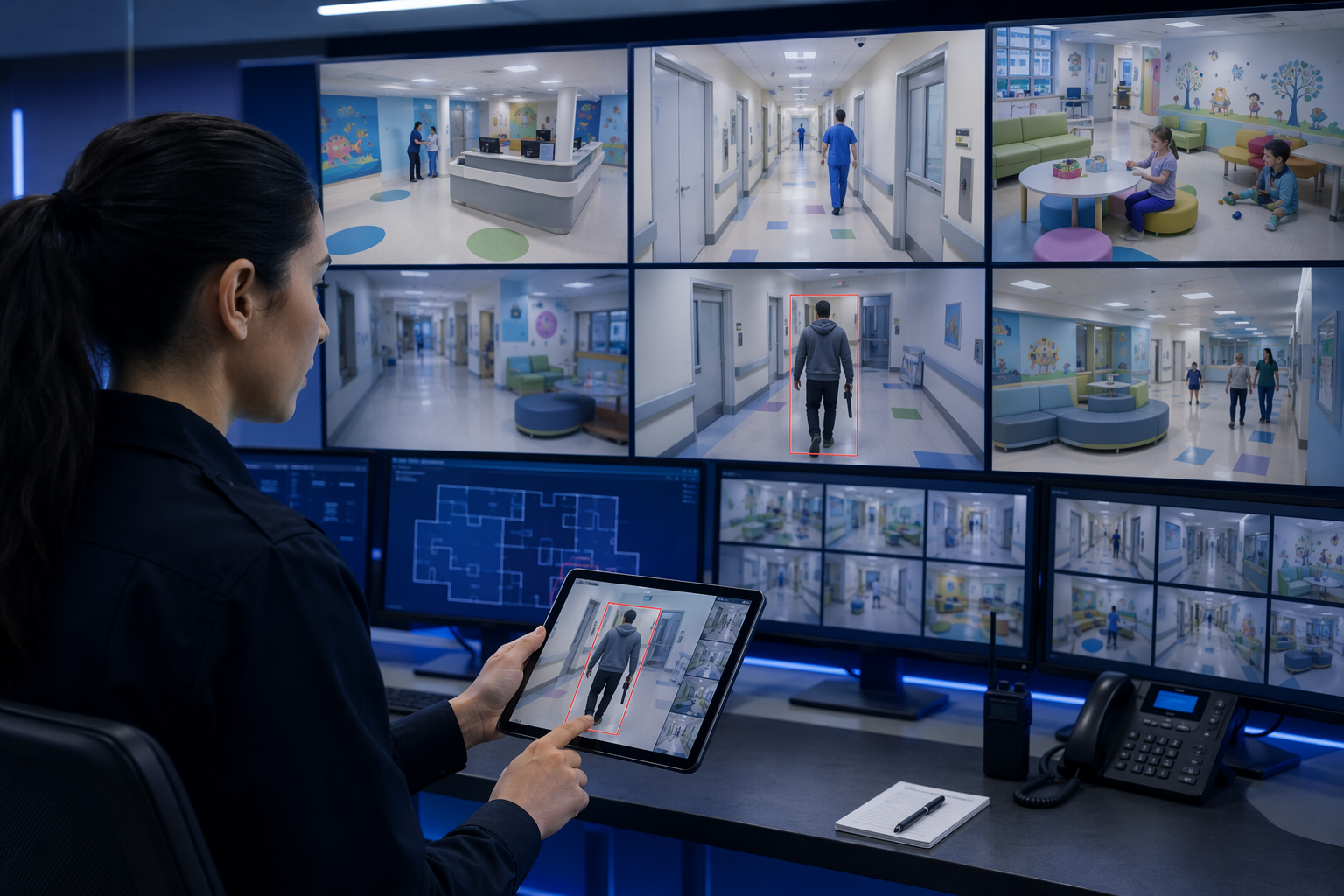
ZeroEyes, for example, says its platform works with existing IP cameras, detects brandished firearms in under one second, and provides human verification in three to five seconds. The company also says it has a U.S. Department of Homeland Security SAFETY Act Designation and announced deployment at UMC Health System, a Texas Level I trauma center with more than 500 beds, 4,900 employees, and an in-house police force.[5] Those are vendor-reported claims and deployment facts, not independent proof that outcomes improve across hospitals. They are still specific enough to matter in procurement because they describe architecture, timing, and the human review step.
Omnilert describes its Gun Detect product as protecting “hundreds” of facilities across sectors, including hospitals.[6] IntelliSee publishes healthcare and NFPA 3000 active shooter/hostile event response compliance materials and presents AI visual detection as one operational layer in that broader response lifecycle.[7] These examples show a product category maturing around existing camera infrastructure rather than a single-purpose checkpoint device. They also show why buyers need disciplined language. A system that detects a visible firearm on a camera feed is not a bomb-threat detector, a concealed-weapon detector, or a substitute for a trained dispatcher.
| Procurement Question | Why It Matters During A Lockdown |
|---|---|
| Which cameras are connected? | A detection claim only applies where camera coverage, angle, lighting, and image quality are adequate. |
| What object is the model trained to flag? | A visible brandished firearm is different from a concealed weapon, suspicious bag, or telephone threat. |
| Who verifies the alert? | Human review determines whether an AI flag becomes an operational notification or a dismissed false alert. |
| How fast does the alert reach security command? | Seconds matter only if the message reaches the people deciding lockdown scope, entrance control, and police coordination. |
| What decision changes after verification? | Technology has value when it changes a concrete action: search priority, building perimeter, staff notification, or all-clear confidence. |
In the St. Jude scenario, this distinction is decisive. AI gun detection would not have “prevented” the reported bomb-threat call. It would not have identified a caller. It would not have cleared a package. Its possible contribution would have been narrower: if the reported threat expanded into concern about an armed person, or if responders needed rapid review of entrances and corridors for a visible firearm, a camera-based detection and human verification workflow could have helped confirm or refute that visible component faster than manual camera scanning alone.
False Alarms Are Not The Only Cost
Hospital leaders often frame security AI around false positives, and that concern is legitimate. A bad alerting system can train staff to ignore alarms, pull officers away from higher-value work, and create unnecessary fear. But the St. Jude lockdown points to a second cost: the cost of not knowing. When uncertainty persists, the response expands. More agencies arrive. More doors are controlled. More units wait. More clinicians improvise around patients who cannot simply leave a zone.
The procurement question is therefore not whether AI detection is perfect. It is whether it can produce a reliable, reviewable signal faster than the existing process for a specific class of threat. If a hospital’s current process requires a dispatcher to manually search dozens or hundreds of camera views after a call, an automated visual flag with human confirmation may reduce the time to a useful answer. If camera coverage is poor, if alerts go to the wrong queue, or if no one has authority to act on the verification, the same product becomes theater.
Hospitals also need to ask who bears the operational consequence of delay. Executives may wait for confirmation in an incident command room. Outside responders may wait for scene intelligence. A pediatric oncology nurse may be deciding whether to delay transport, move a family away from glass, or keep a child calm through an unexplained lockdown. A security dispatcher may be trying to reconcile radio traffic, camera views, and calls from departments. Verification technology should be judged by whether it helps those people make the next decision sooner.
California Turns Detection Into A Compliance Calendar
For hospitals outside California, AI weapon detection may still sit in the risk-management and capital-planning category. In California, AB 2975 changes the buying conversation. The 2024 law is described as the first state law mandating weapon detection at hospital entrances, with a compliance deadline of March 1, 2027.[8] Implementation details may evolve as state regulators develop the framework, but the deadline gives health systems a practical reason to evaluate architectures now rather than after the next incident.
Entrance screening and camera-based visual detection are not identical, so buyers should not treat every vendor pitch as automatically responsive to AB 2975. A hospital may need to distinguish between weapons detection at entrances, AI analytics on interior or exterior cameras, visitor management workflows, emergency notification, and police dispatch integration. The law creates urgency; it does not remove the need to specify what is being detected, where, by whom, and under what operating procedure.
NFPA 3000, the active shooter/hostile event response standard, is useful here because it keeps the discussion larger than a device purchase. IntelliSee’s 2026 compliance briefing frames AI detection within the standard’s prevention, preparedness, response, recovery, and continuity concepts.[7] That is the right procurement frame. A detection system should connect to drills, notification trees, camera governance, dispatch protocols, police coordination, and after-action review. If it lives only as a dashboard in a corner of the security office, it will not shorten the confused first minutes.
What A Serious Hospital Evaluation Should Require
The St. Jude case argues for a verification layer, but only a serious one. The first requirement is a camera survey. Existing IP cameras are attractive because they reduce new hardware costs, but “existing” does not mean “usable.” A wide lobby camera mounted too high may see movement but not enough object detail. A corridor camera may miss a hand position. An entrance camera may be strong during daylight and weak at night. Any detection claim should be tested against the hospital’s actual fields of view.
The second requirement is a human verification design. Vendor-reported timing such as under-one-second detection and three-to-five-second human verification is meaningful only if the review path is staffed, auditable, and connected to hospital command.[5] Security leaders should know whether verification happens in the vendor’s operations center, the hospital’s dispatch center, or both; what image or clip is reviewed; how false alerts are documented; and who has authority to escalate.
The third requirement is an incident decision map. Before signing a contract, the hospital should define what changes when a verified firearm alert appears at a specific entrance, parking area, lobby, clinic corridor, or emergency department approach. Does the alert lock doors, notify police, send a mass message, dispatch in-house officers, or trigger a camera tour? Does it narrow a lockdown to one building or widen it? If the answer is vague, the technology is being purchased before the operation is ready for it.
- Test detection against real camera views, not vendor demo footage.
- Separate visible firearm detection from entrance screening, concealed-weapon detection, and bomb-threat response.
- Require documented human verification, alert routing, and escalation authority.
- Run tabletop and live drills that include immobile or critically ill patients.
- Measure whether verification changes response time, lockdown scope, search priority, or all-clear confidence.
The last point is where many hospital security programs are thinnest. Kahler and colleagues found broad protocol adoption but much lower planning for critically ill or immobile patients and only about half of respondents practicing drills.[4] A hospital that buys AI detection without exercising the alert in a realistic pediatric, oncology, ICU, perioperative, or emergency department scenario has not solved the hardest part. It has added a signal to a process that may still freeze when the building is full of patients who cannot move.
The Defensible Lesson From St. Jude
The July 22 St. Jude lockdown should not be used to claim that AI would have stopped a bomb-threat hoax. That would be the wrong lesson and the wrong sales pitch. The incident instead exposes the cost of ambiguous threat information inside a hospital where lockdown is clinically and operationally expensive. When no one yet knows what has actually been seen, the organization pays in delayed movement, expanded response, staff stress, law enforcement deployment, and uncertainty for patients and families.
AI camera-based weapon detection belongs in the procurement conversation as a verification layer for visible firearm threats, especially in hospitals caring for patients who cannot easily evacuate or shelter without clinical tradeoffs. It deserves consideration when the buyer can state its limits, prove camera coverage, define the human review process, connect alerts to decisions, and place the system inside drills that reflect real patient immobility. Anything broader than that turns a useful tool into another promise the command center cannot safely rely on.
References
- St. Jude lockdown coverage, Action News 5, July 22, 2026, link
- St. Jude lockdown coverage, Local Memphis, July 22, 2026, link
- St. Jude lockdown coverage, Hindustan Times, July 22, 2026, link
- Active shooter preparedness in United States hospital systems, PubMed, 2023, link
- UMC Health System Deploys ZeroEyes AI Gun Detection Platform, ZeroEyes, link
- Omnilert Gun Detect healthcare and facility protection materials, Omnilert, 2026, link
- NFPA 3000 compliance briefing for active shooter and hostile event response, IntelliSee, 2026, link
- AB-2975 Hospital emergency departments: security, California Legislative Information, 2024, link
- Healthcare workplace violence statistics, Centegix and Building Security Services, link
Comments
Join the discussion with an anonymous comment.