
The screening problem is operational, not abstract
A universal testosterone blood-screening order for roughly 375,000 active-duty service members aged 30 and older creates the kind of burden that invites a front-end filter before the lab queue fills up [1]. That is the real appeal of machine learning here: not replacement, but triage. A cheap pre-screen can make sense when the alternative is sending everyone straight to a blood draw, especially if the model can reliably separate low-risk from high-risk cases and spare clinics a large share of avoidable work.
The catch is that screening is not judged by whether the model looks smart in isolation. It has to survive the wrong population, the wrong workflow, and the wrong incentives. That is why the policy argument stays contentious: a model that appears efficient on paper can still shift the difficult work onto clinicians, lab teams, and follow-up systems if its flags are noisy or poorly calibrated. It also runs against longstanding endocrine guidance that does not support routine population screening for testosterone deficiency.

What the Novaes model actually learned
The strongest concrete model family in the evidence base is Novaes et al. (2021), which compared logistic regression, random forest, support vector machines, and XGBoost on 3,397 patients using six readily available clinical features: age, abdominal circumference, triglycerides, HDL, diabetes, and hypertension [2]. That is a sensible triage feature set because every variable is easy to collect before a blood draw. It is also exactly the sort of model that can be reproduced, stressed, and compared because the dataset is publicly available [2].
| Feature | Why it helps triage |
|---|---|
| Age | Captures baseline risk, but was not the best single discriminator |
| Abdominal circumference | Adds a body-composition signal that age alone misses |
| Triglycerides | Brings in a metabolic marker tied to endocrine risk |
| HDL | Complements triglycerides through the lipid pattern |
| Diabetes | Flags a clinical state that can travel with low testosterone |
| Hypertension | Adds another common comorbidity signal for higher-risk sorting |
In that study, the reported discrimination ranged roughly from 0.70 to 0.85 AUC depending on the feature set and algorithm, and the combination of abdominal circumference, triglycerides, HDL, diabetes, and hypertension outperformed age alone [2]. That is good enough to look plausible as a pre-screen. It is not good enough to assume the model has already earned the right to decide who does not need a blood test.
The hinge is external validation
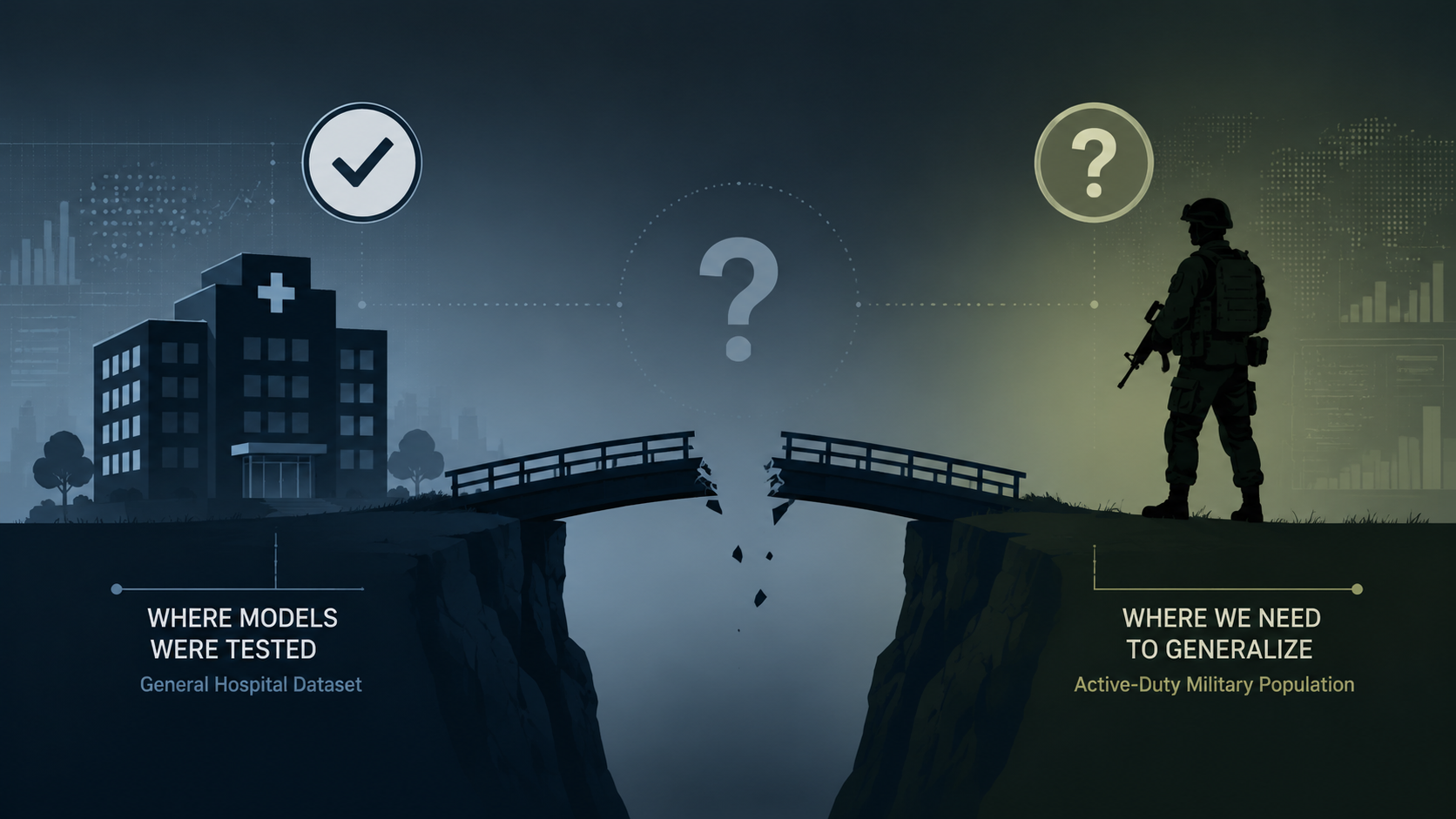
This is where the evidence thins out. Novaes was built in a general Brazilian hospital population with a mean age around 55, not in active-duty troops aged 30 to 50 [2]. No model in the brief has been externally validated in an active-duty military cohort, which matters because military physiology is not just civilian physiology with different uniforms. Sleep restriction, caloric deficit, blast exposure, and high physical demands can all change baseline patterns in ways that may blunt a model trained on a hospital sample.
That is the gap that decides whether this is a useful gatekeeper or just a polished false sense of efficiency. A model can be reproducible and still not be transportable. Public data help independent researchers check the math, but they do not solve generalizability by themselves.
Why confirmation still has to stay in the loop
The confirmation step is not optional theater. The TRAVERSE trial, which helped define cardiovascular safety monitoring for testosterone replacement therapy, enrolled 5,246 men aged 45 to 80 [3]. That leaves an obvious age mismatch with a military screening program that begins at 30, and it is another reminder that evidence from older civilian men does not automatically transfer to younger service members. The closer the system gets to action, the more confirmatory fasting testosterone and related labs matter.
Operational stress also complicates treatment decisions that are already messy. In one VA special-operations cohort tied to the Palo Alto IETP work, TRT use reached 11% among veterans with mild TBI, compared with a 1.67% national average, and only 33% met diagnostic criteria [4]. That does not prove anything about active-duty screening performance, but it does show how easily testosterone decisions can drift when the population is medically and operationally complicated. At the same time, HHS proposed June 2026 labeling changes that would loosen the current restriction against TRT for age-related low testosterone alone, which shows the policy environment is still moving rather than settled [5].
The defensible near-term use case is narrower than the rhetoric around universal screening suggests. Use ML as a front-end flagging layer, then confirm with fasting testosterone and related labs, including LH/FSH when indicated, for anyone it marks high risk. That preserves the operational upside of triage without pretending the model has already earned the right to replace the blood test it is meant to ration.
References
- Prediction of secondary testosterone deficiency using machine learning: A comparative analysis — ScienceDirect — 2021 — https://www.sciencedirect.com/science/article/pii/S2352914821000289
- Hegseth Orders Mandatory Testosterone Screening, Optional TRT for Troops 30 & Older — Military.com — 2026 — https://www.military.com/
- Cardiovascular Safety of Testosterone-Replacement Therapy — The New England Journal of Medicine — 2023 — https://www.nejm.org/doi/full/10.1056/NEJMoa2301760
- Task & Purpose report on Operator Syndrome and the Palo Alto VA IETP study — Task & Purpose — 2026 — https://taskandpurpose.com/
- HHS June 2026 proposed labeling changes for testosterone replacement therapy — U.S. Department of Health and Human Services — 2026 — https://www.hhs.gov/
Comments
Join the discussion with an anonymous comment.