
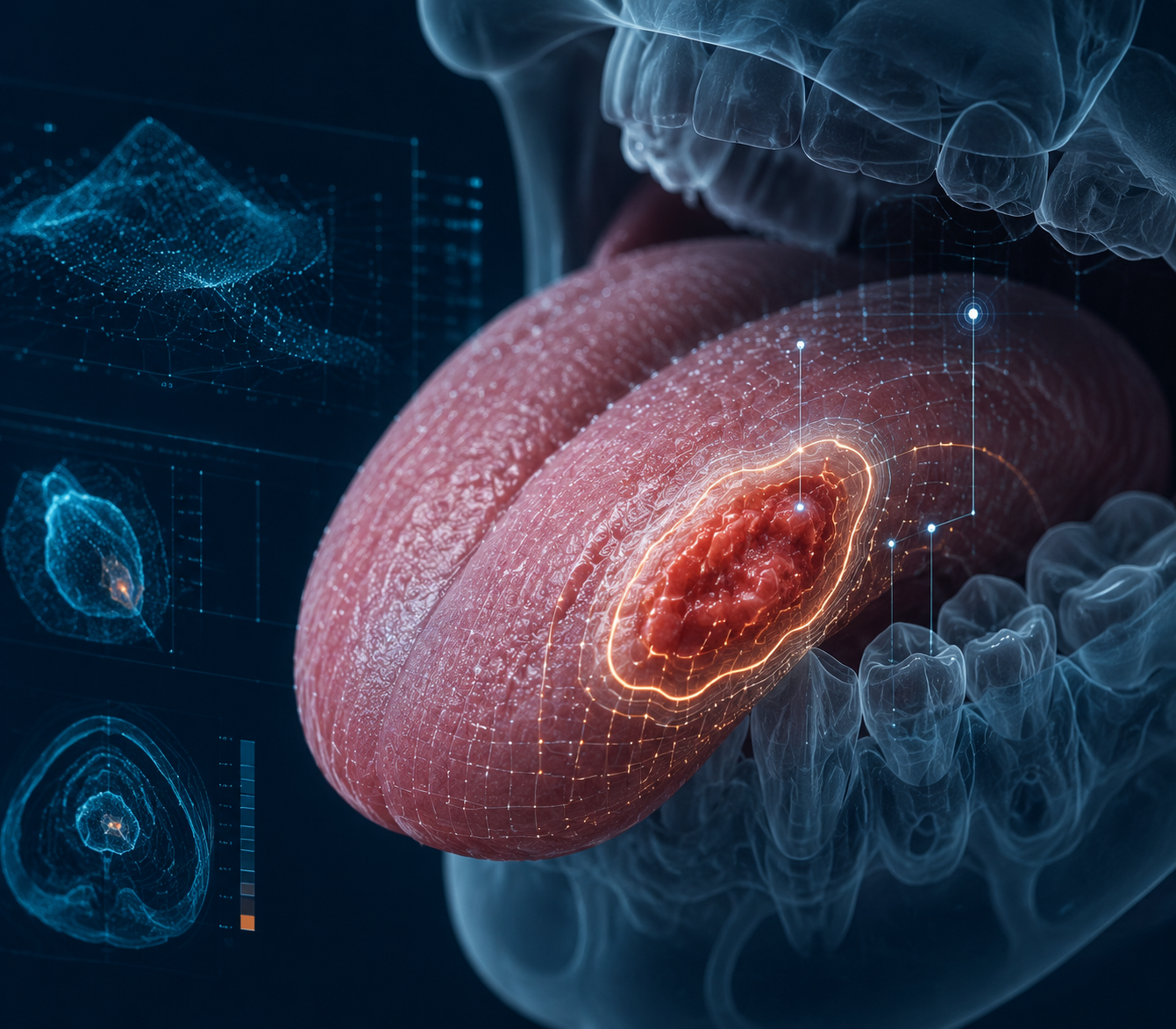
Tongue cancer still creates the kind of decisions that expose every weak link in the diagnostic chain: imaging has to match pathology, nodal risk has to be judged before treatment intensifies, and a delayed call can change how far surgery extends. In the U.S., SEER projects 20,420 new tongue cancer cases in 2026, and only 28% are diagnosed at a localized stage, which is exactly the sort of gap that makes AI attractive in the first place. [1]
What the TSCC evidence actually shows
The strongest tongue-specific evidence remains Jeong et al.'s 2025 systematic review and meta-analysis of 13 TSCC studies. Across MRI, CT, endoscopic images, and histopathology, the reported AUCs ranged from 0.717 to 0.991 for tasks that matter clinically: depth-of-invasion estimation, occult lymph node metastasis prediction, recurrence risk stratification, and related diagnostic classification problems. That range is wide enough to show genuine signal, and high enough at the top end to make clinicians pay attention. [2]
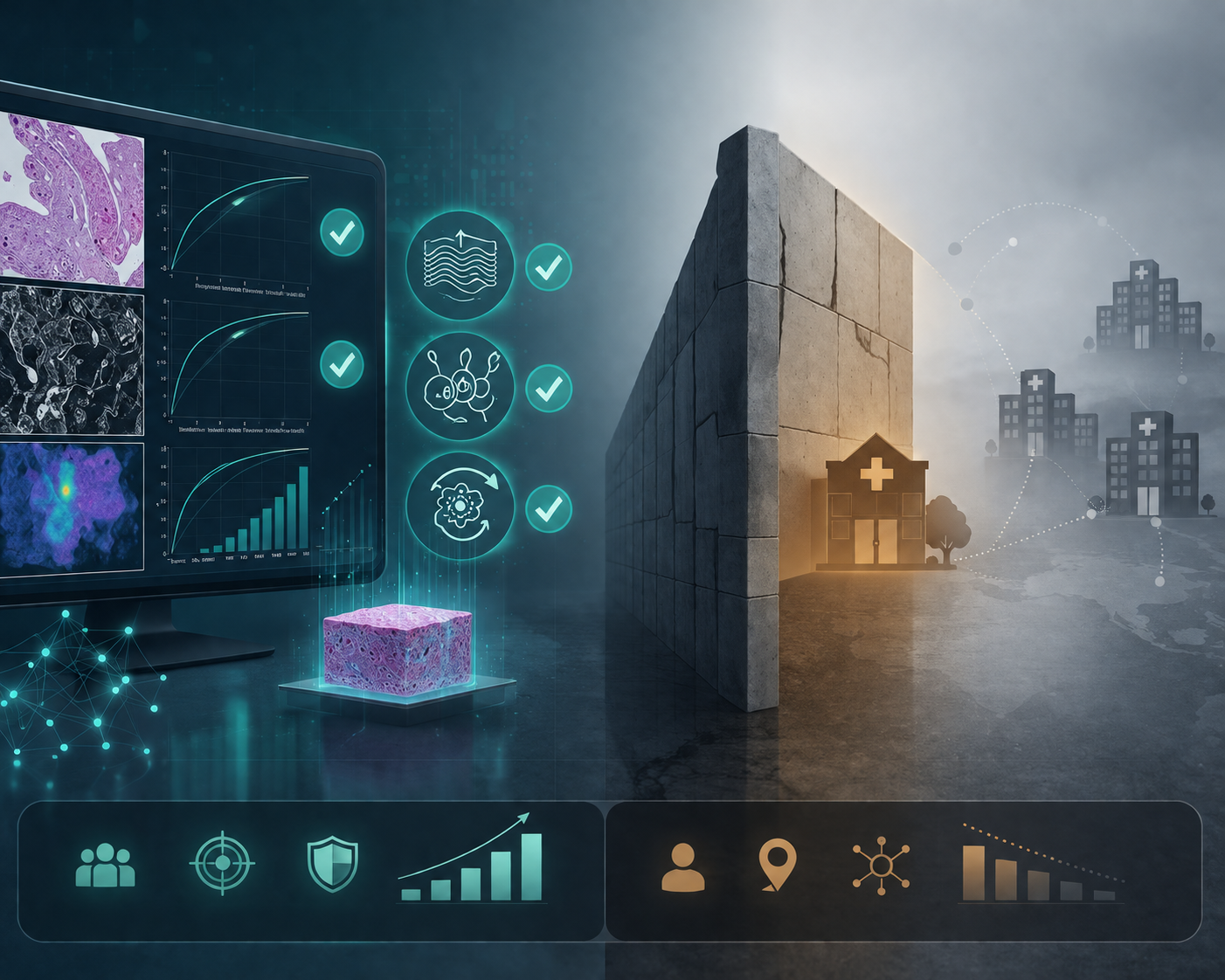
The same review also contains the part that matters most for readiness: only one of the 13 TSCC-specific studies performed external validation. Most of the evidence was single-center and retrospective, with moderate-to-high risk of bias in patient selection and index test domains. That does not make the models uninteresting; it means the next hospital, scanner, stain protocol, and case mix still have to prove the tool can survive outside the dataset that made it look so good. [2]
Broader screening evidence is active, but it answers a different question
A broader 2026 systematic review of AI in early oral cancer screening covered 55 studies and found pooled sensitivity of 0.87 and specificity of 0.81. That is a meaningful screening signal, but it should not be confused with a treatment-planning question in tongue squamous cell carcinoma. Screening performance can look strong while still leaving open whether a model can guide resection depth, neck management, or recurrence surveillance in a specific patient with a specific tumor biology. [3]
For readers interested in the early-detection angle, the companion ClinicalMind article How AI is closing the early detection gap in tongue cancer covers that part of the field more directly.
Guidelines still set the boundary
NCCN Head and Neck Cancers Version 2.2026 remains the treatment reference standard, and it has not yet folded tongue-cancer AI tools into formal recommendations. That matters more than it sounds. A model can look excellent in a paper and still have no defined place in staging, operative planning, or surveillance until the guideline structure says where it belongs and who is responsible for acting on it. [4]
The ADA oral cancer guideline update is useful in a different way: it clarifies the adjunctive-screening context, but it is still a living document, and the salivary-test section was still pending in summer 2026. So even in the dental screening space, the field is still working through what belongs in routine use, what stays adjunctive, and what remains investigational. [5]
The studies that matter most
A few individual studies deserve attention because they map directly onto decisions clinicians already make:
- Han et al. reported a CT-based integrated model for occult nodal prediction with an AUC of 0.949, which speaks to the preoperative question surgeons care about most: whether the neck is truly negative or only looks that way on routine imaging. [6]
- Adachi et al. combined CLAM and ResNet on histopathology and reached an AUC of 0.991 for lymph node recurrence modeling, showing how much signal can sit in tissue-level features that are easy for humans to underweight when the slide burden is high. [7]
- Konishi and Kakimoto used intraoral ultrasound radiomics and reported an AUC of 0.967, which is notable because it points to a noninvasive modality that can be integrated earlier in the diagnostic path if it can be validated outside the original center. [8]
What clinical readiness would still require
Taken together, the evidence says AI is no longer a novelty in tongue cancer diagnosis and treatment updates. Some models now perform at or above expert level in constrained settings. But the field still lacks the safeguards that turn a promising model into a dependable clinical tool: prospective multi-center validation, transparent reporting that can be read against STARD-AI or TRIPOD-AI expectations, and a clean role definition that aligns with NCCN and ADA guidance instead of running ahead of it. [2][4][5]
That is why adoption should still be treated as premature outside research, validation, or carefully governed pilot use.
References
- Tongue Cancer - Cancer Stat Facts, SEER, 2026.
- Systematic review and meta-analysis of artificial intelligence in tongue squamous cell carcinoma, PubMed Central, 2025.
- Artificial intelligence for early oral cancer screening: a systematic review and meta-analysis, Frontiers in Oncology, 2026.
- Head and Neck Cancers, Version 2.2026, NCCN.
- Oral Cancer Guideline, American Dental Association, 2026.
- CT-based integrated model for occult nodal prediction in tongue squamous cell carcinoma, 2024.
- CLAM + ResNet histopathology model for lymph node recurrence in tongue squamous cell carcinoma, 2024.
- Intraoral ultrasound radiomics for tongue squamous cell carcinoma, 2023.
Comments
Join the discussion with an anonymous comment.