
Most tornado safety tips still sound as if everyone is in a one-story house: go to the basement, get under something sturdy, stay away from windows. In a high-rise building, that advice is incomplete at the moment it matters most. Occupants may be twenty floors above grade. Visitors may not know the floor plan. Elevators may be stopped or unsafe. Staff may be trying to move frightened people with limited mobility through crowded corridors while the warning clock is already running.
The clinical problem is more specific than “bad weather.” Tornado injuries predictably cluster around head trauma, soft-tissue wounds, and fractures. In a BMJ Open analysis of injuries from the 2016 Yancheng, China tornado, head injuries accounted for 46.6% of tornado injuries and were the leading cause of fatalities; soft-tissue injuries accounted for 90.8%, and fractures for 38.9%.[1] That study does not describe a U.S. urban high-rise population: most victims were older than 45, and most were farmers.[1] Still, the injury mechanisms are not exotic. Flying debris, impact with hard surfaces, falls, and contaminated wounds are exactly the hazards a high-rise plan should anticipate.
Start with the injury pattern, not the skyline
A high-rise tornado plan should answer a clinical question before it answers an architectural one: what will injure people, and what can be placed between the person and that injury mechanism before the warning arrives?
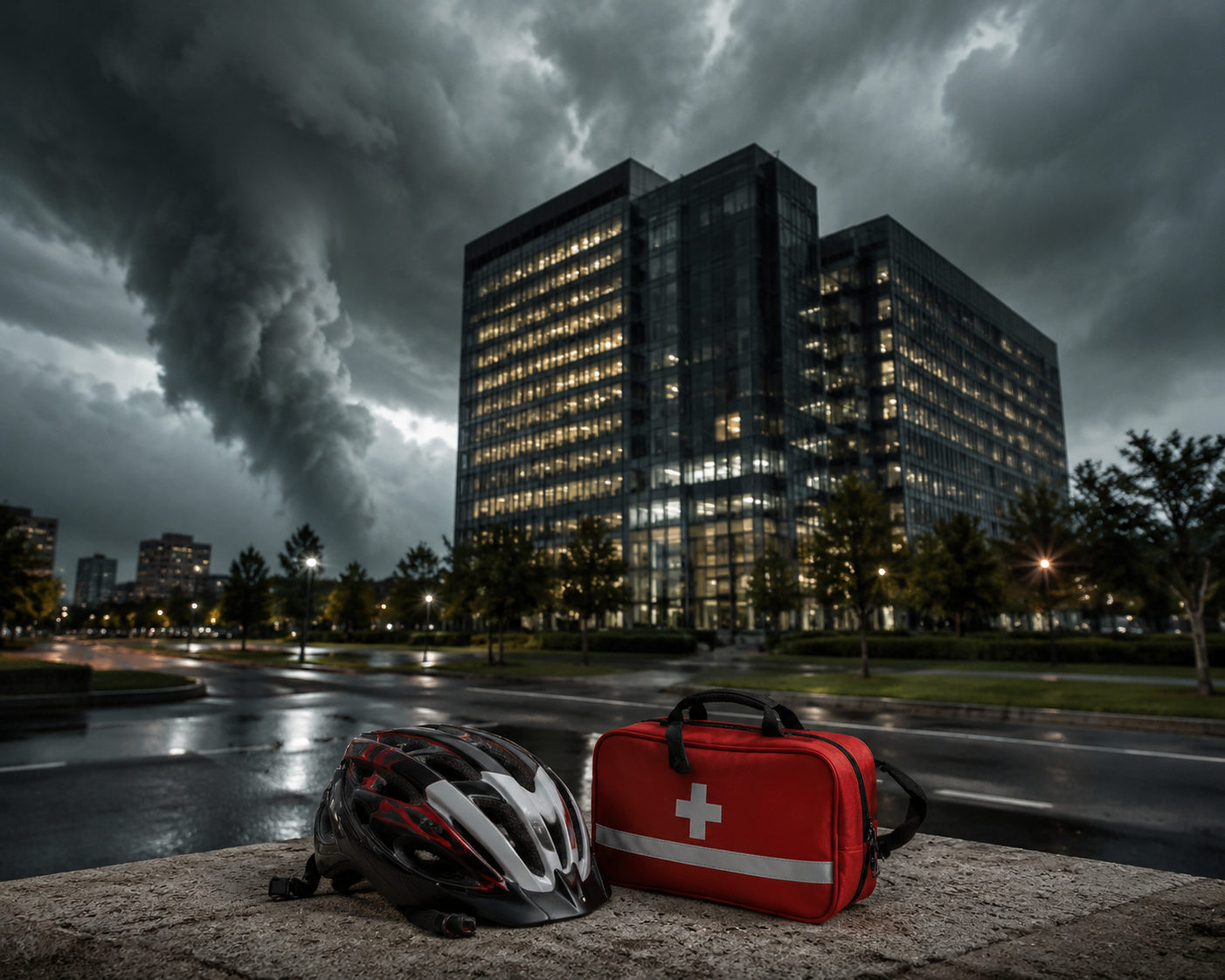
Head protection deserves more attention than it usually receives. If head injury is common and strongly associated with fatality risk, then a bicycle helmet, hard hat, or other available head covering is not cosmetic preparation. It is a low-tech injury-control measure. The same logic applies to protected positioning: seated or crouched low, away from glass, away from exterior walls when possible, with arms protecting the head and neck if no helmet is available.
Soft-tissue wounds and fractures should shape the supplies that sit where people shelter. A first-aid kit locked in a lobby office is much less useful to occupants sheltering on the 27th floor. Kits near identified shelter areas should support bleeding control, wound irrigation or cleaning, sterile dressings, splinting, gloves, and documentation of injuries for later medical review. The plan should also make tetanus status part of post-event triage, because debris-contaminated wounds are not ordinary cuts.
The warning window is too short for improvising shelter locations
Average tornado warning lead time is often described as roughly 10 to 15 minutes.[2] In a high-rise, that is not enough time to debate whether people should descend ten floors, wait for instructions, search for a stairwell, or follow a coworker who seems confident. Shelter locations need to be identified before the sky changes.
| Building condition | Practical shelter choice |
|---|---|
| A FEMA P-361-aligned safe room or engineered storm shelter is available | Use it if it can be reached quickly without relying on elevators. |
| No dedicated safe room exists | Use pre-identified interior rooms, interior corridors, or stairwell landings away from windows and exterior walls. |
| Occupants are on upper floors | Move inward and, if feasible within the warning window, down to a lower interior shelter area without creating stair congestion. |
| Visitors, patients, older adults, or people with disabilities are present | Assign staff roles in advance so assistance does not depend on spontaneous volunteers. |
The top floors and window-lined spaces are poor default choices. Glass, facade debris, ceiling materials, and unsecured furniture can become the immediate injury source. Interior rooms without windows, enclosed stairwell landings, restrooms, and protected corridors may be safer if they are structurally appropriate and not exposed to exterior glazing. The correct answer is building-specific, but it should be printed, posted, drilled, and known by floor.
General public guidance from the American Red Cross emphasizes moving to a safe shelter location, staying away from windows, and protecting the head and neck during a tornado.[3] In a high-rise, the same principles need a floor plan attached to them. “Away from windows” is not enough for a tenant, visitor, or night-shift worker unless the building has already named the rooms and routes that satisfy that instruction.
During the warning, reduce movement and protect the head
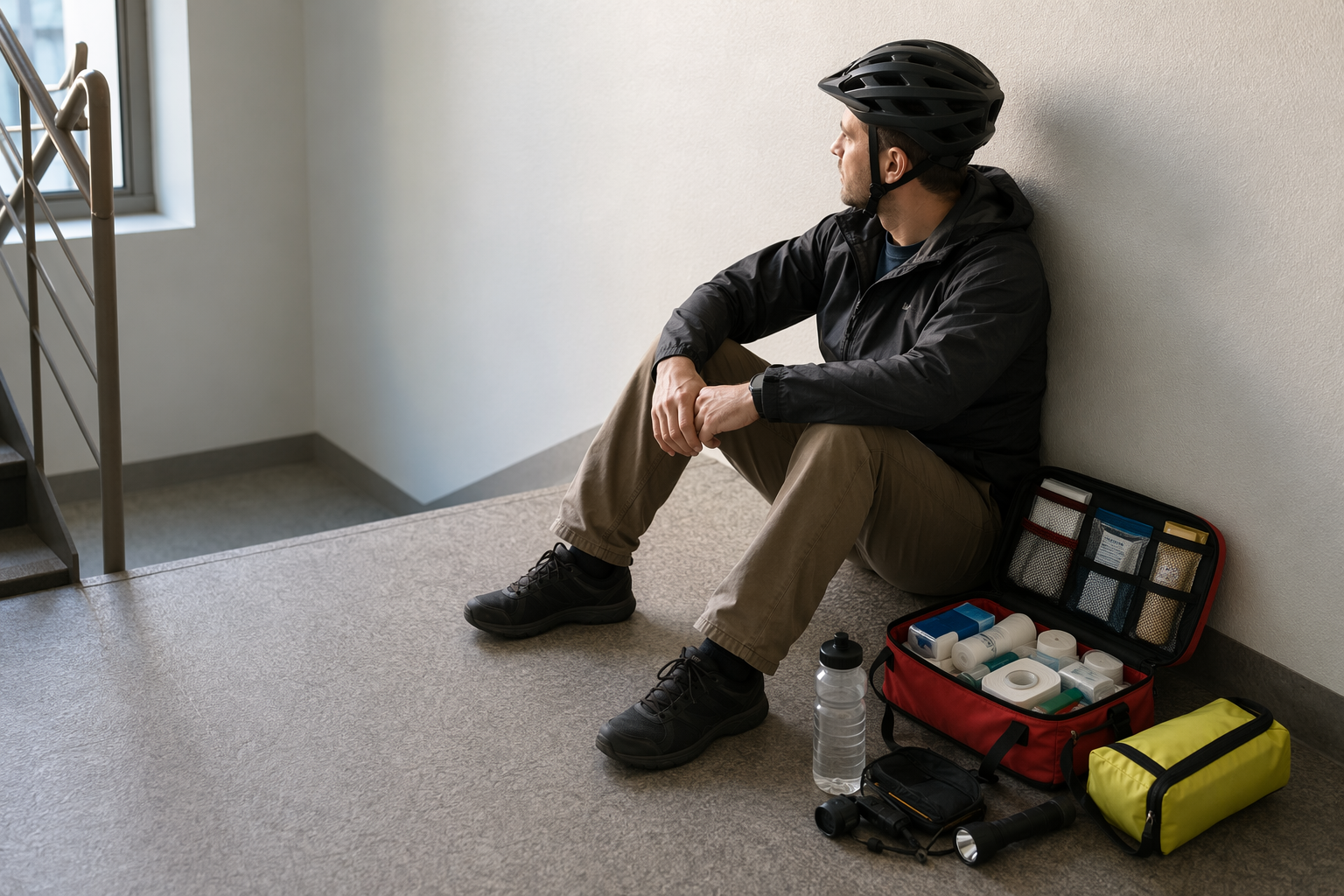
Once a warning is active, the goal is not to make the building perfect. It is to reduce exposure fast. Occupants should move to the nearest pre-identified shelter area, put on available head protection, sit or crouch low, keep away from glass, and remain there until official instructions or building leadership indicate that the immediate threat has passed.
Elevators are a weak link in this sequence. They may lose power, stop at unsafe floors, or become unavailable just as people are trying to descend. A plan that depends on elevators during a tornado warning is not a plan for the conditions under which it will be used. Stair movement may still be necessary for some occupants, but it should be limited to what the warning window realistically allows.
Workplaces have an additional duty to make the procedure usable. OSHA’s tornado preparedness guidance emphasizes planning, shelter identification, alarms, training, and accounting for workers after the event.[4] For a multi-story employer, that means shelter assignments cannot live only in a binder. New employees, contractors, security staff, reception staff, and floor wardens need to know where people go when there is no time for a meeting.
What should already be near the shelter area
- Head protection: bicycle helmets, hard hats, or other practical head coverings sized for likely occupants.
- Bleeding-control supplies: gloves, gauze, pressure dressings, elastic wraps, and tourniquets if staff are trained to use them.
- Wound-care materials: clean water or wound-irrigation supplies, antiseptic where appropriate, sterile dressings, and bags for contaminated waste.
- Fracture support: splints, triangular bandages, cold packs if feasible, and a way to immobilize an injured limb until medical help arrives.
- Access supports: flashlights, spare batteries, basic communication aids, written instructions, and supplies reachable without a key held by one absent person.
These supplies do not turn office workers into clinicians. They close the gap between injury and professional care, especially when stairwells are blocked, elevators are down, phone networks are overloaded, or emergency medical services are delayed by debris and multiple calls.
The first hour after the wind stops is still a health event
People often leave shelter too quickly because the loudest danger has ended. In a high-rise, the next hazards may be quieter: broken glass in corridors, damaged stairwells, exposed wiring, contaminated water, spoiled food during outages, unstable debris, and smoke or exhaust entering occupied floors.
CDC post-tornado guidance emphasizes avoiding downed power lines, checking for injuries, cleaning wounds with soap and clean water when available, covering wounds, seeking medical care for puncture wounds or wounds with embedded debris, and watching for signs of infection.[5] For building staff, that translates into a short post-storm protocol: triage obvious injuries first, control bleeding, keep contaminated wounds covered, document who needs medical evaluation, and avoid sending people through debris-filled routes unless evacuation is necessary.
Debris-contaminated wounds deserve a lower threshold for medical review than clean minor cuts. Glass, metal, insulation, soil, and flood-contaminated material can complicate healing. If a wound is deep, dirty, difficult to clean, associated with numbness or loss of function, or caused by a puncture mechanism, the plan should push the person toward professional evaluation rather than a quick bandage and dismissal.
Tetanus, water, and food need explicit instructions
A useful post-tornado wound protocol asks about tetanus vaccination status without pretending that staff can resolve every case on site. The practical step is to identify wounds that require medical review and remind injured occupants to discuss tetanus prophylaxis with a clinician. That is especially important when the wound is contaminated, deep, crushed, or caused by debris.
Power outages also turn routine building decisions into health decisions. CDC guidance warns people to follow local instructions about water safety and to discard food that may be unsafe after a power outage.[5] High-rise managers should not leave this to rumor on individual floors. If water is unsafe, if refrigeration has failed, or if a boil-water notice applies, occupants need direct instructions before they start using break-room supplies, ice machines, or stored food.
Carbon monoxide precautions belong in the tornado plan
Generator exhaust is one of the most preventable post-storm hazards, and it is easy to underestimate in a tall building. A portable generator placed near a loading dock, garage opening, balcony, window, or air intake can create a building-wide exposure problem rather than a small equipment issue.
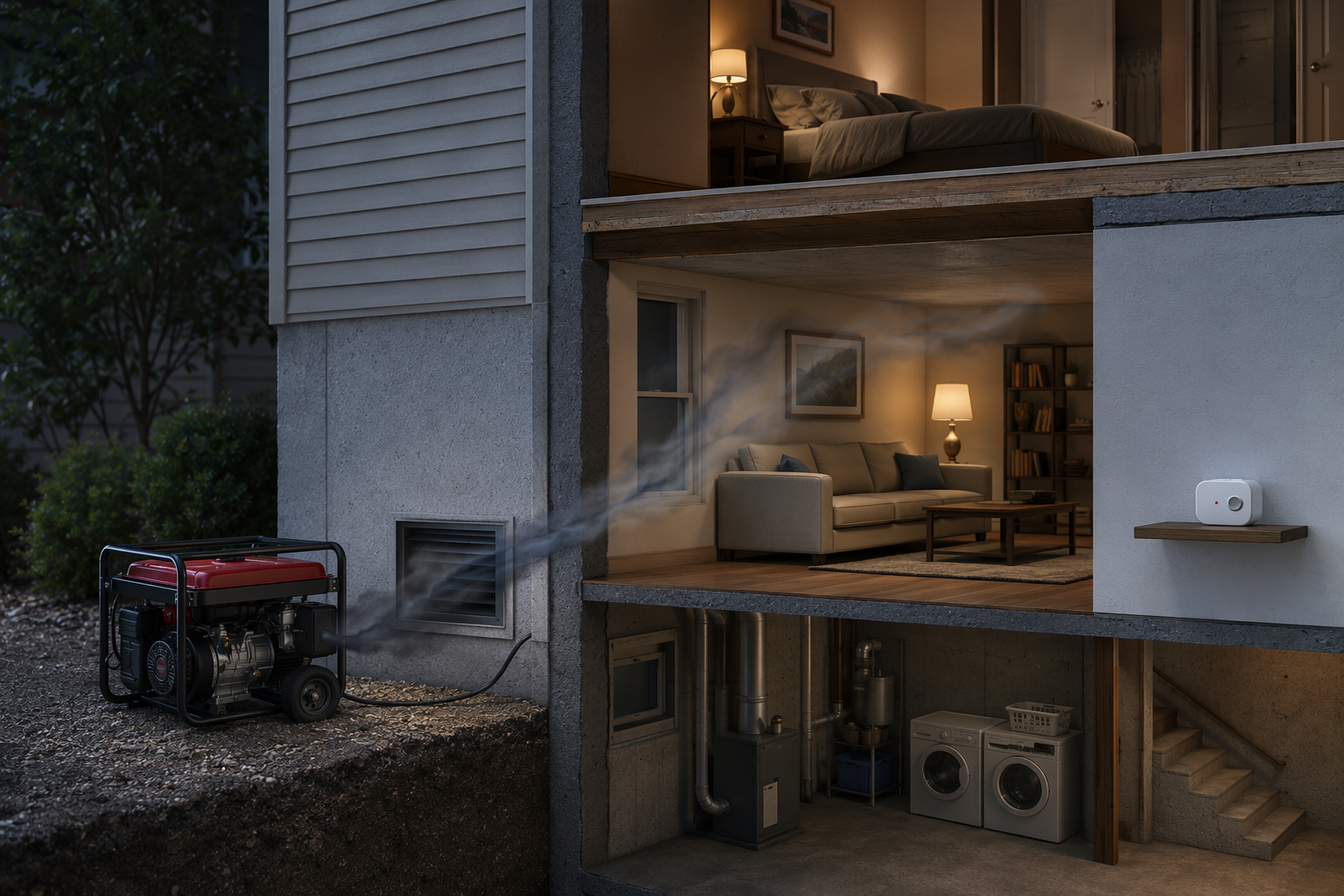
CDC guidance is direct: generators, pressure washers, grills, camp stoves, and other gasoline-, propane-, natural gas-, or charcoal-burning devices should not be used inside a home, basement, garage, or camper, or outside near an open window, door, or vent.[5] In a high-rise, that warning should be read broadly. “Outside” is not automatically safe if exhaust is pulled into occupied floors through intakes, cracked windows, service areas, or connected garages.
Carbon monoxide alarms should be present on occupied floors, not only in mechanical spaces. They are a clinical control because carbon monoxide poisoning can present with nonspecific symptoms: headache, dizziness, weakness, nausea, confusion, chest pain, or loss of consciousness. During a post-storm outage, those symptoms can be misattributed to stress, dehydration, missed meals, or panic unless the building has alarms and a response plan.
- Place portable generators far from doors, windows, vents, air intakes, balconies, and garage openings.
- Keep generators outdoors and away from any pathway that can pull exhaust into the building.
- Install and maintain carbon monoxide alarms on occupied floors.
- Treat carbon monoxide alarm activation or compatible symptoms as an evacuation and medical-evaluation issue.
- Do not let ad hoc tenant generator use bypass building safety rules during an outage.
Accessibility is part of injury prevention
A shelter plan that works only for fast-moving adults is not a high-rise plan. Some occupants will use wheelchairs or walkers. Some will be older, pregnant, recovering from surgery, visually impaired, hard of hearing, separated from family, or unable to understand English instructions under stress. These are not side issues; they determine whether people can reach the safer area before the warning window closes.
The operational answer is not to promise individualized rescue for every scenario. It is to remove predictable barriers before the warning: accessible shelter routes, floor-by-floor assistance roles, backup communication methods, visible signage, plain-language instructions, and supplies stored at reachable heights. Staff should know who may need help without turning privacy into a public roll call.
Mental health also needs a place in the plan. After a tornado warning or impact, people may be shaking, disoriented, angry, silent, or desperate to contact family. That does not replace bleeding control, wound care, or carbon monoxide precautions, but it affects whether instructions are followed. Calm, repeated, concrete directions are safer than a stream of announcements that assume everyone can process new information normally.
A usable high-rise checklist
The useful checklist is short enough to audit before tornado season and concrete enough to use during a warning.
- Name shelter areas on every occupied floor or zone, including alternatives if the primary area is blocked.
- Keep people away from windows, exterior walls, atriums, lobbies, and top-floor spaces when safer interior options are reachable.
- Pre-position helmets or practical head protection where people shelter.
- Stock first-aid materials for bleeding, contaminated wounds, and fractures near shelter areas.
- Write post-storm instructions for wound cleaning, medical referral, tetanus awareness, unsafe water, spoiled food, and debris avoidance.
- Install and maintain carbon monoxide alarms on occupied floors and control generator placement before outages occur.
In high-rise buildings, evidence-based tornado safety tips and health precautions are not limited to moving inward and away from glass. They match the plan to the injuries and hazards most likely to occur: head trauma, lacerations, puncture wounds, fractures, contaminated debris exposure, unsafe food or water, and carbon monoxide poisoning. The controls are plain but consequential: helmets, stocked first-aid materials, identified shelter areas, wound-care procedures, and carbon monoxide alarms. None of them eliminates risk. Each makes the plan less dependent on luck during the minutes when luck is a poor safety system.
References
- Epidemiological characteristics of injuries caused by the 2016 tornado in Jiangsu Province, China. BMJ Open. 2018. https://bmjopen.bmj.com/content/8/6/e021552
- Tornado warning: What to do if you live in a high-rise building. Chicago Tribune. July 16, 2024. https://www.chicagotribune.com/2024/07/16/tornado-warning-high-rise-buildings/
- Tornado Safety. American Red Cross. https://www.redcross.org/get-help/how-to-prepare-for-emergencies/types-of-emergencies/tornado.html
- Tornado Preparedness and Response. Occupational Safety and Health Administration. http://www.osha.gov/tornado/preparedness
- Stay Safe After a Tornado. Centers for Disease Control and Prevention. https://www.cdc.gov/tornadoes/safety/stay-safe-after-a-tornado-safety.html
Comments
Join the discussion with an anonymous comment.