
For a severe knee injury like the one reported for Tyreek Hill, the useful question is not whether AI can make rehabilitation faster. It is whether AI can improve the evidence clinicians use when deciding whether the knee is ready for the next load.
The public description of Hill's injury has included a knee dislocation with an ACL-plus injury pattern, a probable need for complex surgery, and a staged rehabilitation horizon commonly discussed in the 9- to 12-plus-month range.[1] That is enough to frame the clinical problem, but not enough to reconstruct the injury. The exact ligament constellation, cartilage status, meniscal involvement, nerve or vascular findings, and intraoperative repair or reconstruction choices have not been confirmed from primary medical records.
That uncertainty matters. A multi-ligament knee injury is not a scaled-up ACL tear. It can involve competing biological clocks: graft incorporation, collateral or posterolateral corner healing, stiffness risk, neuromuscular inhibition, swelling response, strength recovery, and confidence that often returns before objective readiness. Public return projections, including reports placing Hill at roughly 5.5 months post-injury with a possible September 2026 return, are better read as timeline pressure than as clinical evidence.[2]
Where AI Actually Enters the Rehab Pipeline
In knee rehabilitation, AI is not one thing. It appears at several decision points, and those decision points are not equally mature. The strongest evidence sits closest to diagnosis, where the input is standardized imaging and the output can be compared against known findings. The weaker evidence appears further downstream, where the question becomes harder: not just what is torn, but whether a particular athlete is safe to progress.
| Clinical phase | AI application | Current evidence signal | Practical limitation |
|---|---|---|---|
| Diagnosis and injury characterization | CNN-based MRI detection of ACL tears | Strongest support, with reported AUC values above 0.90 and external validation in heterogeneous datasets | Best suited as an assistive read, not a replacement for radiology, surgical findings, or examination |
| Risk prediction | Machine-learning models for revision or reinjury risk | Moderate registry-based performance in large Norwegian and Danish datasets | Ceiling effect suggests more of the same registry data may not solve prediction |
| Biomechanical monitoring | 3D motion capture, markerless systems, Kinect-style jump analysis | Clinically attractive because it measures movement rather than asking for recall | Interpretation standards and return-to-play thresholds remain underdeveloped |
| Remote rehabilitation | AI-integrated brace and telerehabilitation systems | Promising early cohort data after ACL reconstruction | Single-study evidence is not enough for routine adoption |
A 2024 review of AI in ACL injuries reached a similar hierarchy: diagnostic imaging applications are the most developed, while predictive and telerehabilitation applications remain earlier in the evidence curve.[3] A 2026 narrative review in The Knee took the broader sports-knee view and concluded that most AI models still require multicenter validation, better interpretability, and regulatory oversight before they can be treated as clinically deployable systems.[4]
Imaging AI Has the Cleanest Evidence
If an AI tool is going to earn a serious place in knee injury care today, MRI interpretation is the most plausible starting point. The task is bounded. The image exists. The model can be tested against expert interpretation and clinical diagnosis. Errors can be audited. External validation is possible.
The ACL literature is the best example. The 2024 review describes convolutional neural network approaches for ACL tear detection on MRI with reported AUC values in the 97% to 99.9% range in some studies, while also emphasizing the importance of validation outside the dataset on which a model was trained.[3] More broadly, the same evidence base supports the narrower conclusion that CNN-based ACL detection can exceed AUC 0.90 across externally validated and heterogeneous datasets.[3]
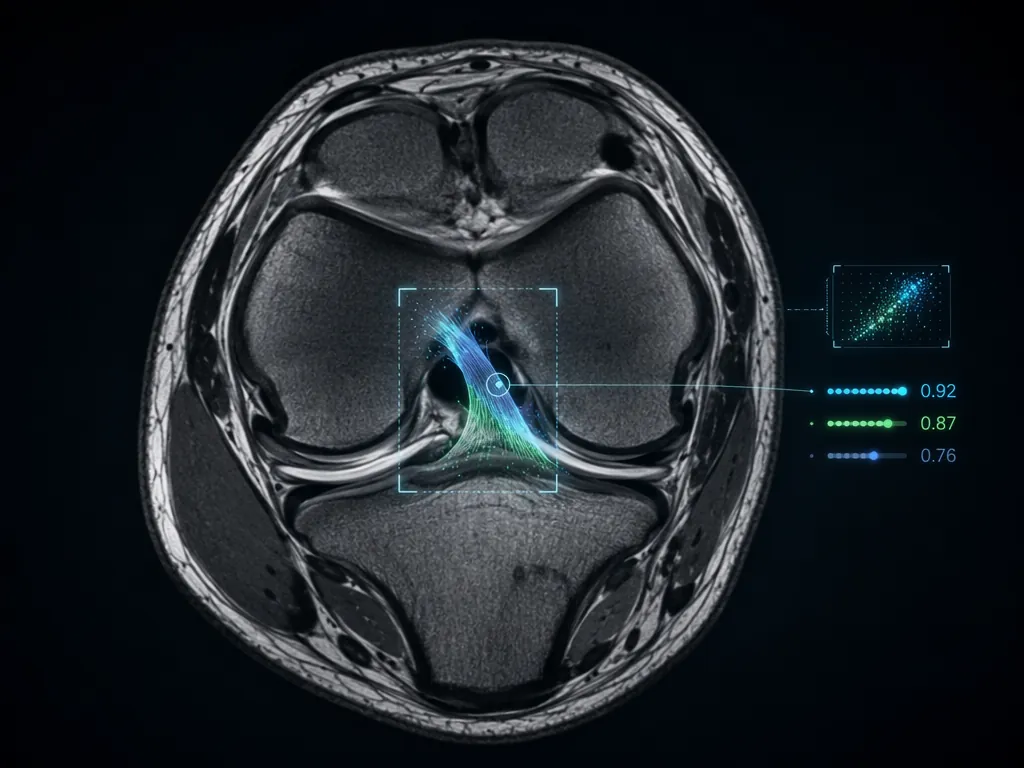
That distinction is not pedantic. A high AUC from one institution's images can reflect local scanner protocols, labeling habits, case mix, and prevalence. A model that keeps performing when the images come from different scanners, different populations, and different acquisition protocols is far more useful to a clinician who is trying to avoid a missed diagnosis or a false sense of certainty.
For a Hill-like injury, imaging AI would not decide the reconstruction plan. It could, however, become a useful second reader for ACL integrity or associated structural findings if the model has been validated for the relevant anatomy and image quality. The surgeon still needs the examination under anesthesia, intraoperative findings, and a plan for the whole knee rather than one ligament.
Prediction Models Are Interesting, but the Decision Is Harder
Predicting failure, revision, or reinjury is a more ambitious assignment than detecting an ACL tear on MRI. The outcome is influenced by surgical technique, graft choice, age, sport exposure, strength, movement quality, psychology, adherence, return-to-play timing, and plain bad luck. Some of those variables live comfortably in registries. Others do not.
The 2024 review discusses machine-learning work using Norwegian and Danish registry data involving approximately 63,000 patients to predict revision risk after ACL reconstruction.[3] The model's performance was described as moderate, and the review notes a ceiling effect: adding more patients from similar registry sources may not meaningfully improve prediction accuracy.[3]
That ceiling effect is clinically important. It suggests the problem may not be sample size alone. A registry can be large and still miss the variables that matter at the point of progression: quadriceps rate of force development, frontal-plane control under fatigue, effusion after loading, graft signal changes, sport-specific exposure, or the therapist's observation that an athlete unloads the involved limb when the task becomes chaotic.
A moderate-risk model may still have value if it changes a decision: longer bracing, closer follow-up, delayed cutting progression, targeted movement retraining, or a more conservative return-to-contact pathway. If the output is a risk score that no one knows how to act on, it is a research signal rather than a clinical instrument.
Movement Measurement Is Clinically Appealing, but Interpretation Lags
The next useful layer is not prediction in the abstract. It is measurement. After knee reconstruction, clinicians spend months watching whether the athlete can accept load, decelerate, land, cut, and repeat those tasks without swelling, pain, instability, or compensation. AI-assisted motion analysis is attractive because it can make some of those observations more reproducible.
DARI Motion is one commercially available example: an FDA-cleared 3D motion capture system that has been studied for biomechanical assessment after ACL reconstruction.[4] Its availability should not be confused with settled interpretation. The literature still notes the absence of established guidelines for translating biometric outputs into clinical decisions.[4]
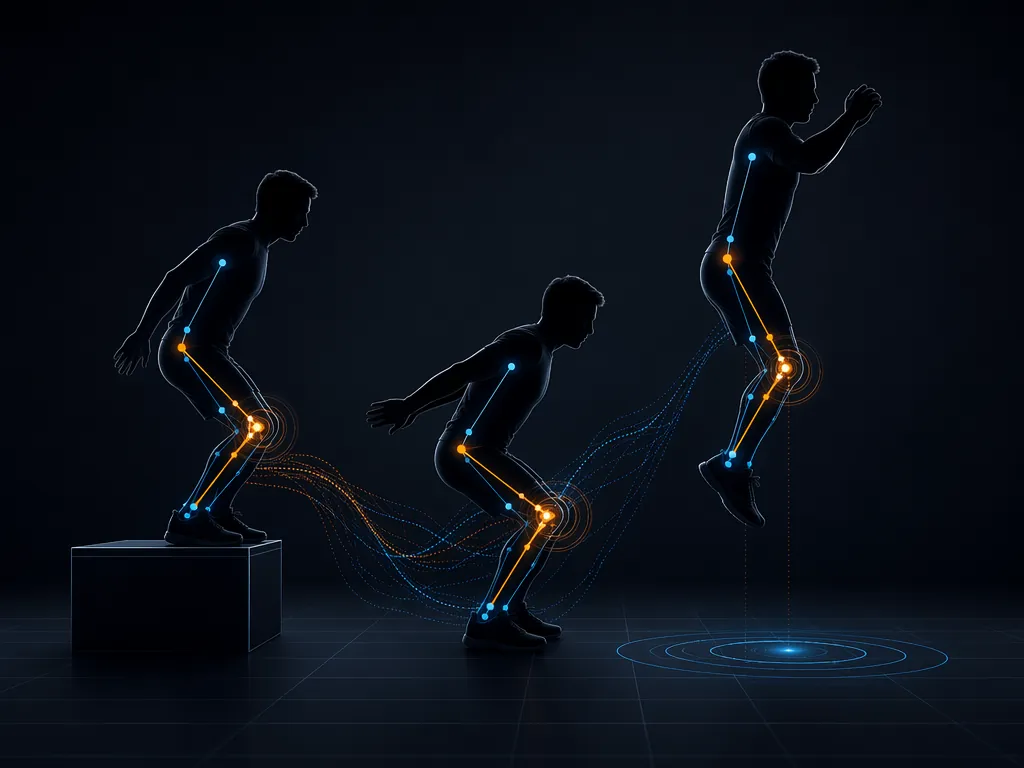
Lower-cost approaches are also being explored. Kinect-based drop vertical jump analysis has been linked to noncontact ACL injury risk assessment, offering a more accessible route than lab-grade motion capture.[4] For rehabilitation clinics, that kind of tool is appealing because it might move objective movement assessment out of specialized biomechanics labs and into routine follow-up.
The caution is straightforward: measuring more variables does not automatically clarify readiness. A system can report knee valgus angle, trunk lean, limb asymmetry, landing strategy, or temporal features, but the clinician still needs to know what amount of abnormality is meaningful for this athlete, this surgery, this sport, and this phase of healing. A wide receiver returning from a multi-ligament injury is not simply trying to pass a clean jump test; he is trying to tolerate repeated high-speed acceleration, deceleration, cutting, contact, fatigue, and unplanned perturbation.
Telerehabilitation Evidence Is Promising but Thin
Remote rehabilitation is where the marketing often runs ahead of the clinical evidence. There is a real need here. After complex knee surgery, clinicians want to know whether the patient is doing the right volume, moving with the intended mechanics, responding with acceptable swelling and pain, and progressing rather than simply accumulating exercises. Athletes and non-athletes both lose clinical signal between visits.
The most relevant early signal is an AI-integrated brace telerehabilitation cohort described in the ACL literature. In that 2023 study, patients using the AI-integrated brace had higher IKDC and KOOS scores than patients receiving in-person rehabilitation after ACL reconstruction.[3] That is promising. It is also a single cohort study, and it should not be treated as proof that an AI brace can replace skilled postoperative care.
IKDC and KOOS are meaningful patient-reported outcome measures, but they do not settle graft readiness, multi-ligament stability, sport-specific movement quality, or safe return to collision and cutting demands. A remote system may help with adherence, feedback, and early detection of concerning patterns. Before routine adoption, it needs replication, clearer patient selection, defined escalation rules, and evidence that the information changes clinical management rather than simply producing more data.
Why Multi-Ligament Cases Raise the Bar
A straightforward ACL reconstruction already contains uncertainty. A knee dislocation with multiple ligament injuries multiplies it. Surgical staging may vary. Protected weight bearing may be longer. Motion may need to be advanced carefully to avoid stiffness without overstressing repairs. The therapist may be balancing extension, flexion, swelling control, quadriceps activation, gait normalization, and protection of healing structures all at once.
This is where broad AI claims become least helpful. A model trained mostly on isolated ACL reconstructions may not apply to a rare or atypical multi-ligament injury. A return-to-play algorithm that does not know the surgical findings, tissue quality, concomitant injuries, or sport demands is not making the decision clinicians actually face.
Expert perspectives from sports medicine have been appropriately cautious. A CU Anschutz clinician perspective summarized the working rule as "trust, but verify," especially for rare or atypical cases.[5] An AOSSM review made a related point: AI models "are only as powerful as their training experience and volume, not unlike the expertise and judgment of a sports medicine specialist."[6]
Those are not anti-technology positions. They are the conditions for responsible use. A tool can be valuable if it identifies a tear earlier, standardizes a motion assessment, flags an outlier recovery pattern, or helps clinicians see change over time. It becomes dangerous when its output is treated as more general than the data that created it.
What to Expect in Practice
For clinicians evaluating AI in knee rehab after a Tyreek Hill-type injury, the most realistic expectation is an assistive measurement layer, not an autonomous decision system.
- In diagnosis, CNN-based MRI tools have the strongest support and may serve as useful adjuncts when externally validated.
- In risk prediction, registry-based models can be statistically informative but need outputs that clearly change management.
- In motion assessment, AI-assisted capture can make compensation patterns more visible, but interpretation thresholds remain unsettled.
- In telerehabilitation, AI-integrated braces and remote feedback systems are promising but not yet supported by enough replicated evidence for broad routine use.
The 2026 review's conclusion that many tools remain investigational rather than clinically deployable is the right posture for Q3 2026.[4] The field is not empty. It is also not ready to hand over progression decisions for complex knee injuries.
For a Hill-like injury, AI may help organize evidence around the knee: imaging findings, movement metrics, patient-reported outcomes, adherence data, and change over time. The return-to-play decision still depends on validated tools, interpretable outputs, surgical findings, physical examination, functional testing, sport-specific exposure, and clinician judgment.
References
- Tyreek Hill Knee Injury Explained: ACL Tear, Dislocation, and Recovery Outlook, Midwest Orthopaedics at Rush.
- USA Today update, USA Today, February 2026.
- The Role of Artificial Intelligence in Anterior Cruciate Ligament Injuries: Current Concepts and Future Perspectives, Andriollo et al., 2024.
- Artificial intelligence in the management of sports knee injuries, The Knee, 2026.
- AI in Sports Medicine and Orthopedics, CU Anschutz, 2025.
- AOSSM 2024 review, American Orthopaedic Society for Sports Medicine, 2024.
Comments
Join the discussion with an anonymous comment.