
AI predictions have pushed universal basic income back into serious policy conversation, including healthcare conversations that were not originally about automation. The forecasts themselves are unsettled: some imagine large-scale task automation and labor-market disruption, while others expect more job reshaping than outright job loss. For healthcare readers, that uncertainty matters. A projection about work is not evidence that a cash policy improves health.
The narrower question is more useful: when people receive unconditional cash, what happens to anxiety, depression, hospital use, preventive care, drinking, biomarkers, and the daily pressure of making too little money stretch too far? That is where the evidence is less theatrical than the AI debate, and more relevant to clinicians and health policy researchers.

The strongest health signal is psychological, not futuristic
The recurring finding across basic-income and basic-income-like studies is not that unconditional cash cures disease. It is that it reduces psychological strain. That distinction is not a downgrade. In health systems, distress is not a decorative outcome; it changes sleep, substance use, family conflict, appointment-keeping, crisis presentations, and the capacity to make decisions under pressure.
The Canadian Mincome experiment remains unusually important because it gives the health debate something more concrete than self-reported optimism. Conducted in Manitoba from 1974 to 1979, it provided a guaranteed annual income, with Dauphin often treated as the central community case. Later analysis found an 8.5% reduction in hospitalizations in Dauphin, driven mainly by fewer accident-and-injury admissions and fewer mental health admissions.[1]
That hospitalization result deserves the attention it receives. It is a health-system outcome, not only a sentiment measure. It also points toward plausible pathways: less financial panic, less risky coping, fewer acute crises, and fewer situations in which distress becomes an emergency department or inpatient episode. At the same time, Mincome was not a national permanent UBI. It was a time-limited experiment in a particular setting, later reconstructed through administrative and archival analysis.
The old worry that unconditional income would simply pull people out of work is not strongly supported by the Mincome story. Contemporary accounts and later reporting note that employment did not broadly collapse during the experiment, with reductions concentrated in specific groups such as new mothers and teenagers staying in school.[2] That does not settle labor-market behavior under a permanent national program, but it does make the lazy-recipient caricature a poor starting point for health analysis.
Modern pilots keep finding mental health gains
More recent pilots point in the same psychological direction. Finland’s 2017–2018 basic income experiment found that recipients reported better wellbeing and life satisfaction and lower depression rates than controls; recipients were also more likely to move into full-time employment, according to a synthesis of UBI mental health research.[3]
Stockton’s SEED program in California gives the claim a clinical texture. Over the two-year program, clinical anxiety prevalence among recipients fell from 28% to 20%.[3] That is not a claim that cash is psychotherapy, nor that all recipients became well. It is evidence that unconditional income can move a clinically meaningful distress measure in a population living under financial constraint.
The Kenya evidence from GiveDirectly extends the pattern beyond North American and European welfare states. Reported mental health improvements were comparable in magnitude to depression treatment effects seen in clinical trials, according to the same synthesis.[3] That comparison should be handled carefully: a cash transfer and a depression treatment are not interchangeable interventions. But the size of the mental health signal is hard to dismiss.
The most defensible reading is cumulative rather than triumphant. Different countries, transfer designs, and populations repeatedly show improvements in wellbeing, life satisfaction, depression, anxiety, or related mental health measures. The pattern is stronger than any single pilot, but still bounded by the fact that these are pilots and cash-transfer studies, not full universal permanent income systems.
OpenResearch is the necessary complication
The OpenResearch Unconditional Cash Study is especially useful because it is recent, U.S.-based, and rigorous enough to keep the argument honest. The three-year study found a 20% decrease in problematic drinking and roughly $20 more per month in medical spending among recipients, but no significant effects on measured physical health outcomes such as blood pressure, cholesterol, or obesity.[4]
That combination is exactly what a cautious healthcare reader should expect to wrestle with. Less problematic drinking is a meaningful behavioral and public health result. More medical spending may indicate delayed care being taken up, greater willingness to seek help, or simply more capacity to pay for care. But the absence of detectable biomarker improvement means the study cannot be used to claim broad clinical gains.
OpenResearch also found that mental health gains faded after the first year for some measures.[4] This does not erase the initial benefit. It does weaken any simple story in which a cash transfer produces a steadily accumulating mental health improvement over time. Adaptation, persistent structural stressors, insufficient transfer size, unmet healthcare needs, and local labor or housing conditions could all limit the durability of gains. The study does not let us choose one explanation with confidence.
| Evidence source | Health signal | What it can support | What it cannot support |
|---|---|---|---|
| Mincome | 8.5% fewer hospitalizations in Dauphin, mainly fewer accident/injury and mental health admissions | A plausible utilization benefit from guaranteed income | A permanent national UBI effect |
| Finland | Better wellbeing and life satisfaction; lower depression rates | Mental health and wellbeing improvement in a modern welfare-state pilot | A claim of broad physical health improvement |
| Stockton SEED | Clinical anxiety prevalence fell from 28% to 20% | A clinically relevant anxiety signal | A universal effect across all low-income populations |
| GiveDirectly Kenya | Mental health gains comparable in magnitude to depression treatment effects in clinical trials | Evidence that the mental health pattern extends beyond wealthy countries | A claim that cash replaces mental healthcare |
| OpenResearch | 20% less problematic drinking; about $20 more monthly medical spending; no significant biomarker effects | Behavioral and care-seeking changes with important physical-health limits | A proven route to lower blood pressure, cholesterol, or obesity |
Why cash changes distress before it changes biomarkers
The mechanism does not require romance about money. Financial scarcity forces constant triage: rent or medication, groceries or transport, a shift at work or a child’s appointment, a bill paid now or a penalty later. Unconditional cash changes the timing and emotional load of those decisions. It removes some surveillance, reduces stigma, and gives households more room to act before a problem becomes acute.
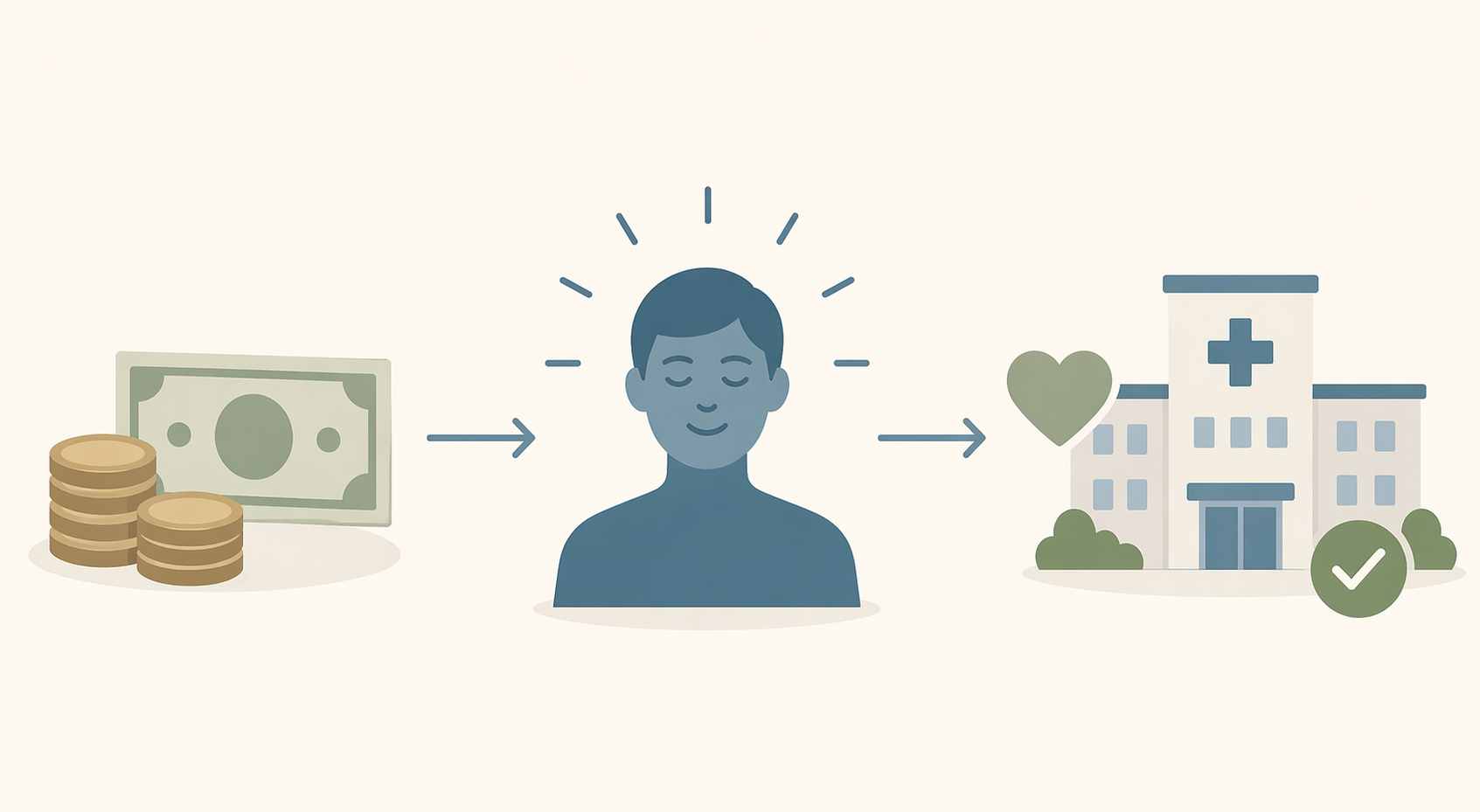
A systematic review by Wilson and McDaid found that unconditional cash transfers consistently improved mental health across multiple pilots, with mechanisms including reduced stigma, more time with family, and renewed hope.[5] Those mechanisms matter because they are not the same as buying more healthcare. A recipient may sleep better because the electricity bill is no longer an immediate threat. A parent may spend more time with a child because one extra shift is no longer mandatory. A person may seek care earlier because the appointment no longer competes with food money.
This also explains why physical health evidence is harder to produce. Blood pressure, cholesterol, obesity, birth outcomes, and chronic disease trajectories are shaped by years of exposure, local food environments, housing, work conditions, clinical access, and baseline risk. A two- or three-year transfer may improve stress and behavior without leaving a measurable imprint on every biomarker.
Gibson and colleagues’ review in The Lancet Public Health found modest to strong positive effects on birthweight and mental health from basic-income-like interventions.[6] That finding broadens the health case, but it still does not justify treating UBI as a general-purpose clinical intervention. Birthweight and mental health are important endpoints; they are not proof of comprehensive population health transformation.
Healthcare utilization may fall in one place and spending may rise in another
The utilization evidence is easy to over-simplify. Mincome’s hospitalization reduction suggests that guaranteed income can reduce acute health-system use.[1] OpenResearch’s increase in monthly medical spending suggests that cash can also increase care-seeking or health-related purchases.[4] These findings are not necessarily contradictory.
A household with more cash may fill a prescription, attend a visit, buy transportation to a clinic, or address a neglected dental or medical need. In the short term, that can increase measured spending. Over time, if earlier care prevents avoidable crises, hospital use could fall. Existing studies do not give a clean long-term accounting of that sequence at national scale.
This distinction matters for healthcare budgeting. A UBI proposal should not be sold as an immediate healthcare cost-cutting device. The more defensible claim is that unconditional cash may shift the timing and type of healthcare use: less crisis-driven care in some settings, more ordinary medical spending in others, and possibly more preventive or delayed care when people have enough liquidity to act.
The evidence base is wider than wealthy-country pilots
Low- and middle-income country evidence is important because it tests cash transfers in settings where formal safety nets, healthcare access, and household income patterns can look very different from the United States, Canada, or Finland. A 2024 systematic review found mental health benefits across low- and middle-income country pilots, extending the evidence base beyond high-income welfare states.[7]
That extension strengthens the mental health argument, but it does not erase context. The same dollar amount, transfer frequency, delivery system, and healthcare environment will not mean the same thing everywhere. In one setting, unconditional cash may reduce food insecurity enough to change daily stress. In another, it may help with rent or transportation but still leave people unable to access specialty care.
What AI adds, and what it does not
AI adds political urgency, not health proof. If automation destabilizes income for a large number of households, the health relevance of income security grows. But the healthcare case for UBI should not depend on choosing the most alarming automation forecast. It should depend on whether unconditional cash reliably improves outcomes that health systems and public health agencies care about.
That is also why UBI should not be confused with healthcare AI. Tools such as AI clinical decision support in primary care operate inside care delivery: diagnosis, prevention, triage, or clinician workflow. UBI operates upstream, on the economic conditions that shape whether people arrive in clinic stable, exhausted, ashamed, intoxicated, insured, housed, or already in crisis. They belong to different parts of the causal chain.
The affordability debate remains unresolved and cannot be wished away. A national permanent UBI would require a financing structure, tax choices, and decisions about whether existing benefits are supplemented or replaced. Those design choices would affect health equity directly. Replacing targeted disability, housing, nutrition, or medical supports with a flat transfer could harm people whose needs are higher than average. Adding income security on top of functioning services would be a different policy.
The permanent universal-policy question is still unanswered
No existing study has tested a truly universal, population-wide, long-term guaranteed income. The available evidence comes from partial pilots, cash-transfer programs, and basic-income-like interventions with limited duration. That is not a reason to ignore the evidence. It is a reason to stop asking it to answer questions it was not designed to answer.
A permanent UBI could change wages, prices, household formation, migration, benefit enrollment, political expectations, and local service demand. It could also change stigma differently from a pilot because everyone would know the income floor is not temporary and not restricted to a studied group. Those are exactly the features that make universal policy interesting, and exactly the features pilots cannot fully reproduce.
The strongest health implication of AI-era UBI proposals is therefore narrower than many advocates want and stronger than many skeptics admit. Existing evidence supports unconditional cash most clearly as a psychological wellbeing and stress-reduction intervention, with credible signs of changed healthcare utilization and some evidence of reduced hospitalizations. It does not yet prove broad physical health improvement, durable biomarker change, or health equity transformation at national scale.
If AI displacement makes income volatility more common, healthcare systems will feel the consequences in anxiety, substance use, delayed care, crisis admissions, and family stress long before the labor-market models agree. UBI belongs in that conversation, but as an economic determinant of health, not as a substitute for coverage, clinical care, mental health services, or the harder work of building systems that do not wait for poverty to become pathology.
References
- The Town with No Poverty: The Health Effects of a Canadian Guaranteed Annual Income Field Experiment, Canadian Public Policy.
- Canada’s forgotten universal basic income experiment, BBC.
- UBI Mental Health Research, UniversalBasicIncome.com.
- Unconditional Cash Study, OpenResearch.
- The mental health effects of a Universal Basic Income: A synthesis of the evidence from previous pilots, Social Science & Medicine, 2021.
- The public health effects of interventions similar to basic income: a scoping review, The Lancet Public Health, 2020.
- The effect of cash transfers on mental health in low- and middle-income countries: A systematic review and meta-analysis, 2024.
Comments
Join the discussion with an anonymous comment.