
The phrase ai in medical devices now carries more imagination than classification. In regulatory summaries, however, the work is usually more concrete: a device measures a structure, marks a region, prioritizes a case, improves an image, guides acquisition, or supports a narrower diagnostic task. Among 1,016 FDA authorizations analyzed from 1995 through September 2024, 84.4% were image-based and 85.6% performed analysis rather than generation.[1]
That matters because “AI-enabled” does not tell a clinician what will happen on Monday morning. A ventricular volume tool, a stroke triage flag, and a denoising algorithm can all sit under the same public label, while asking different things of the radiologist, technologist, service line, evidence reviewer, and care team.
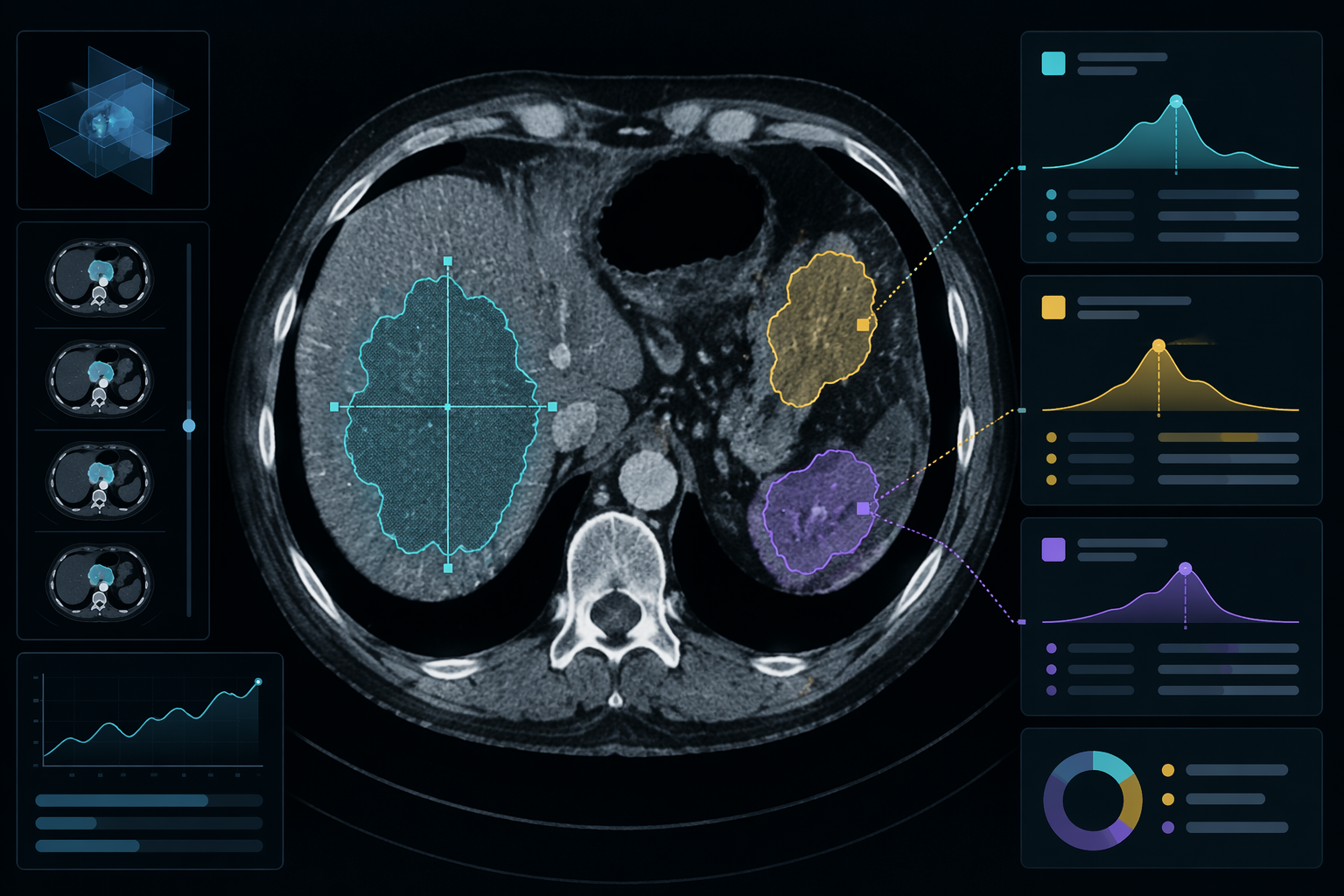
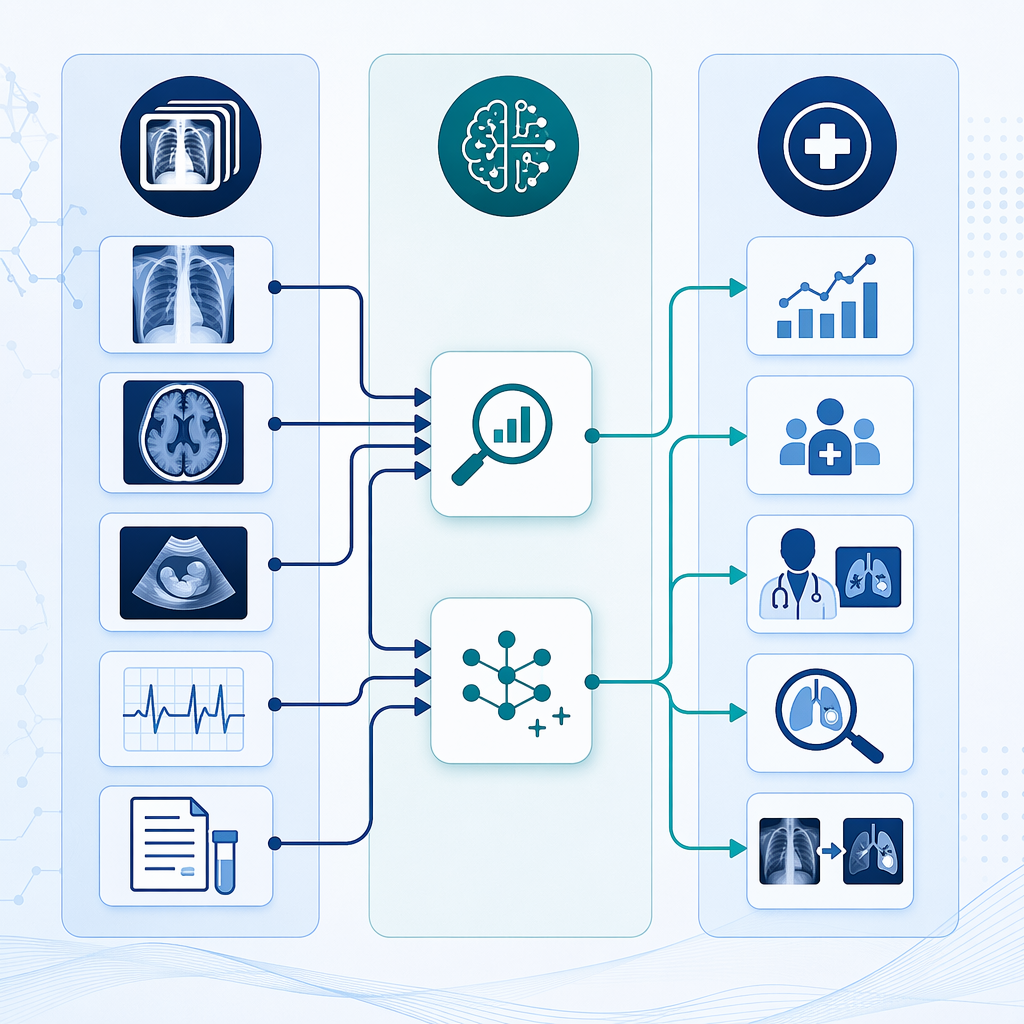
The most useful first move is not to ask whether the device is “intelligent.” It is to ask three plainer questions: what data it uses, what AI function it performs, and what clinical function it claims to support. Singh et al. used that three-factor taxonomy to make the FDA-authorized landscape legible: data type, AI function, and clinical function.[1]
Start With The Data The Device Sees
The FDA’s public list of AI-enabled medical devices is cumulative, and by year-end 2025 it contained 1,451 authorizations.[2] The Singh taxonomy does not analyze that entire year-end 2025 total; it studies 1,016 authorizations from 1995 through September 2024.[1] Keeping those denominators separate prevents a familiar mistake: treating one analytic dataset as if it were the current complete inventory.
Within the 1,016-authorizations analysis, the dominant input is unmistakable. Most authorized devices work on medical images. The study found that 84.4% were image-based, while only 3 of 1,016 used tabular electronic health record data.[1] That is not a small footnote. It is a boundary around what authorized AI medical devices mostly are: software functions attached to imaging-heavy clinical work, not broad EHR reasoning systems.
This is why the phrase “AI in healthcare” can mislead when it is imported directly into device discussions. It can make the field sound like a contest among general-purpose assistants, bedside agents, and autonomous diagnostic systems. The authorization record points instead toward narrower, auditable functions in radiology, cardiology, ophthalmology, pathology, and other image-centered specialties.
Then Separate Analysis From Generation
The second sorting question is what the AI function does to the data. In the Singh analysis, 85.6% of devices perform analysis rather than generation.[1] In practical terms, these devices usually do not create new clinical narratives or open-ended outputs. They analyze an image or signal and return a measurement, localization, probability, prioritization flag, detection, diagnostic support output, or prediction tied to a defined task.
Generation is present, but it is a smaller and more specific category than current AI conversations might suggest. The study identified 106 generation devices. Of those, 79.2% were image enhancement, 16.0% were acquisition guidance, and 7.5% were synthetic data.[1] This is generation as a medical-device function: improving or assisting the production of clinical data, not producing free-form medical advice.
The absence that should recalibrate expectations is simple: Singh et al. found zero LLM-based devices in the FDA authorization set they analyzed.[1] That does not say large language models cannot become medical devices, or that no health systems are testing language-model tools outside this authorization set. It says the authorized device landscape examined in this study had not yet become an LLM-device landscape.
For readers tracking imaging evidence more closely, the adjacent question is how these image-facing tools perform in actual clinical studies. That belongs in a different layer of review; see AI in Medical Image Analysis for the imaging evidence landscape rather than the authorization taxonomy.
The Main Clinical Job Is Still Measurement And Localization
The clinical-function layer is where the device becomes operationally recognizable. In the analysis-device group, quantification and feature localization dominated at 65%.[1] This category covers the kind of work clinicians can often place immediately inside an existing workflow: estimate a volume, measure a dimension, segment a structure, mark a region, or localize a feature that still has to be interpreted within the clinical context.
| Clinical function within analysis devices | Share |
|---|---|
| Quantification / feature localization | 65.0% |
| Triage | 12.9% |
| Diagnosis | 7.2% |
| Detection | 6.9% |
| Detection / diagnosis | 6.1% |
| Predictive | 1.5% |
Triage was the next-largest category at 12.9%.[1] A triage device changes the queue before it changes the diagnosis. Its immediate claim is usually about prioritizing review, alerting a clinician, or surfacing a case sooner. The operational consequence is not merely whether the model is accurate in isolation; it is who receives the flag, what gets interrupted, how false positives are handled, and whether the promised time-sensitive benefit survives the local workflow.
Diagnosis, detection, and combined detection/diagnosis occupy smaller but important shares: 7.2%, 6.9%, and 6.1%, respectively.[1] The distinctions are not semantic housekeeping. A detection device that marks a suspected finding does different clinical work from a diagnostic-support device that classifies or characterizes a condition. The former may increase attention to a region; the latter moves closer to an interpretive claim. Evidence reviewers should not collapse those tasks just because both are sold under AI language.
Predictive functions were the smallest group in this breakdown at 1.5%.[1] That is a useful corrective to the common assumption that authorized AI devices are mainly risk-prediction engines. In this dataset, prediction exists, but the center of gravity is still image analysis that measures, localizes, detects, diagnoses, triages, or enhances rather than longitudinally forecasts a patient’s future course.
The Mix Is Diversifying, But Not Into The Story People Usually Tell
The field is not frozen in its quantification-heavy phase. Singh et al. report that quantification devices fell from 81% of authorizations in 2016 to 51% in 2024.[1] That is a real shift, and it deserves more attention than another abstract forecast about AI “transforming care.”
The shift does not mean quantification stopped mattering. It means the authorized set broadened. Triage gained share, and image enhancement became a more visible generative function.[1] Those are different kinds of diversification. Triage affects timing and prioritization; enhancement affects the image that downstream clinicians review; quantification affects the measurement or region presented to the clinician. Lumping them together as “AI diagnosis” erases the most important workflow differences.
There is also a separate count problem in public discussions. Innolitics reported 295 AI/ML medical-device clearances in 2025.[3] That annual clearance count is not interchangeable with the Singh 1,016-authorizations analytic cohort or the FDA’s 1,451 cumulative year-end 2025 total.[1][2][3] Each number answers a different question: what one study classified through September 2024, what the FDA cumulatively listed by year-end 2025, and what one source counted during 2025.
The same caution applies to market sizing. Estimates for AI in healthcare or AI-enabled medical devices vary by source definition and methodology, so they should not be used as substitutes for functional classification. A revenue estimate cannot tell a stroke program whether a tool is a queue-prioritization aid, a detection aid, or an image reconstruction function.
For readers who need the vendor-market view rather than the function taxonomy, AI Medical Imaging Companies in 2026 is the more natural companion. The taxonomy here is deliberately less interested in who sells the device than in what work the authorization says the device is built to do.
A Practical Reading Of An AI Device Summary
A device summary becomes easier to read when the first pass is functional rather than promotional. Before asking whether a device is advanced, ask where it sits in the taxonomy.
- Data type: image, waveform, signal, tabular EHR data, or another input.
- AI function: analysis, generation, enhancement, acquisition guidance, or another defined computational role.
- Clinical function: quantification, feature localization, triage, detection, diagnosis, detection/diagnosis, prediction, or another stated use.
- Workflow consequence: measurement added, case reordered, image changed, region marked, classification suggested, or risk estimated.
- Evidence boundary: authorization pathway and performance evidence are not the same as proven broad clinical benefit.
This is not a purchasing checklist and not clinical guidance. It is a way to stop the category from becoming too large to evaluate. A localization aid should not be judged as if it were an autonomous diagnostic agent. A triage tool should not be reviewed only as a stand-alone classifier if its main claim depends on time-to-review. An image-enhancement device should be assessed partly by what it changes before interpretation begins.
The regulatory layer is also changing, especially around lifecycle oversight and predetermined change control plans. That policy question is adjacent to the taxonomy, not a replacement for it. For that angle, see From Evidence Gaps to Lifecycle Oversight.
Authorization Is Not The Same As Clinical Benefit
Classification can prevent confusion, but it does not prove patient benefit. FDA authorization means a device has met the requirements of a regulatory pathway for its stated use. It does not, by itself, show that the device improves outcomes across varied clinical settings, staffing patterns, scanner fleets, patient populations, or alerting workflows.
That evidence gap is not hypothetical. A Proxima Clinical Research summary cited an American Heart Association study reporting that less than 2% of AI-enabled medical devices had randomized controlled trial support.[4] The exact implication is narrower than “these devices do not work.” It is that authorization and high-grade clinical-effectiveness evidence should not be treated as the same evidentiary event.
The cleanest reading of the authorized field is therefore modest and useful. FDA-authorized AI medical devices are not mainly LLM medicine or autonomous generative diagnosis. They are still mostly image-based analysis tools, with quantification and feature localization as the largest clinical function, and with visible diversification toward triage and image enhancement. The durable questions are the plain ones: what data does it use, what AI function does it perform, and what clinical task does it claim to support?
References
- Three-factor taxonomy of AI-enabled medical devices, Nature Digital Medicine, 2025, https://www.nature.com/articles/s41746-025-01800-1
- Artificial Intelligence-Enabled Medical Devices, FDA, fda.gov/medical-devices/software-medical-device-samd/artificial-intelligence-enabled-medical-devices
- Year in Review: AI/ML Medical Device 510(k) Clearances, Innolitics, innolitics.com/articles/year-in-review-ai-ml-medical-device-k-clearances/
- Proxima Clinical Research source citing an American Heart Association study on randomized controlled trial support for AI-enabled medical devices, Proxima Clinical Research
Comments
Join the discussion with an anonymous comment.