
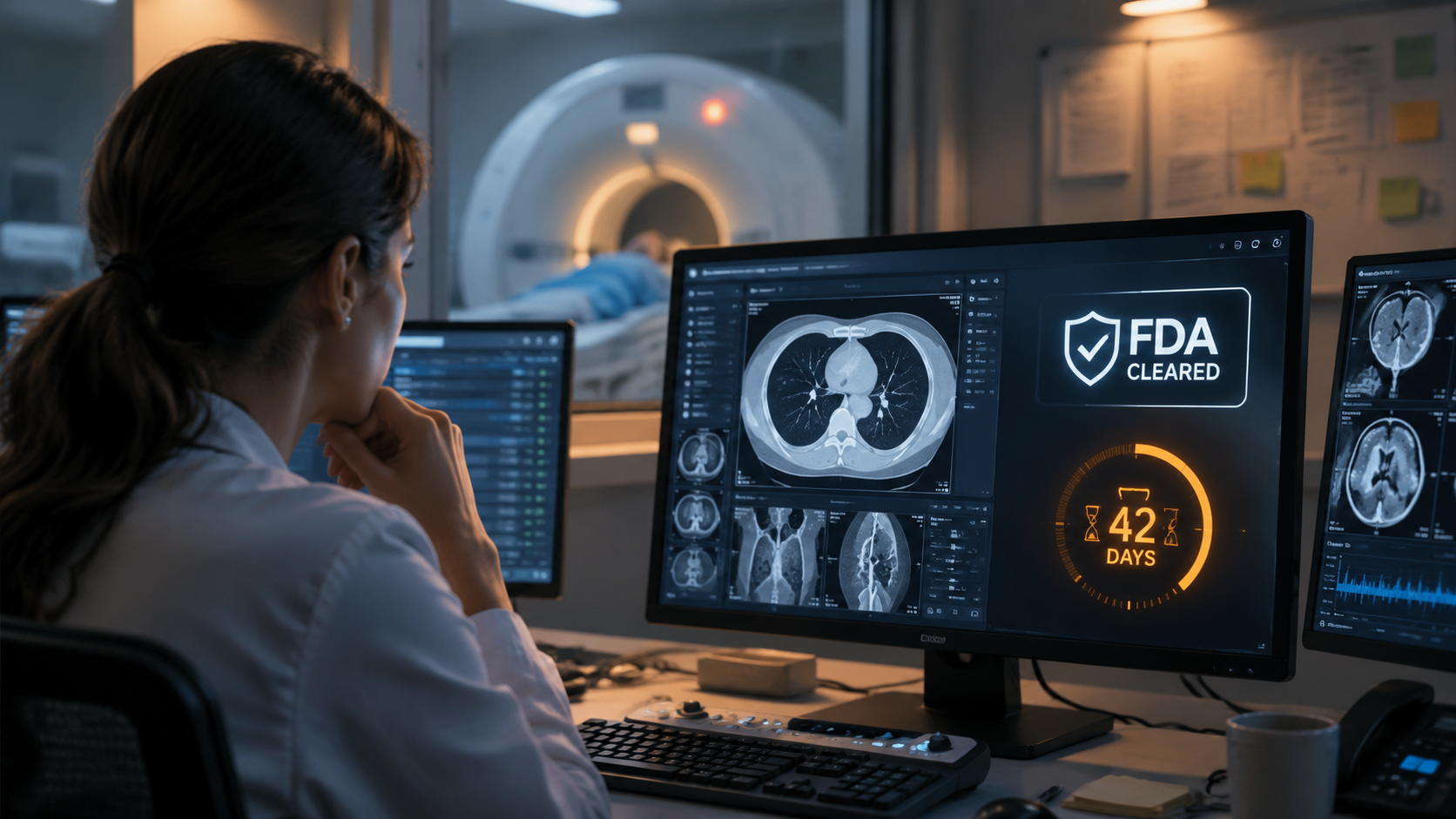
The uncomfortable signal in recent recall evidence is not simply that AI-enabled medical devices are being recalled. It is how soon recalls are appearing after authorization. In one JAMA Health Forum study, 43.4% of recalls for AI-enabled devices occurred within the first year after clearance, about double the first-year share reported for conventional 510(k) devices.[1] For hospitals evaluating AI tools for patient safety and injury prevention, that timing matters: a first-year recall is often still inside the period when a device is being installed, tuned to local workflow, explained to clinicians, and defended in governance meetings.
A device that fails after years of broad clinical use raises one kind of question. A device that is pulled back shortly after clearance raises another: what did premarket review, buyer diligence, and early deployment monitoring fail to see?
The Recall Pattern Is Early, Not Just Larger
The scale of AI medical device adoption now makes this more than a niche regulatory concern. FDA had authorized more than 878 AI/ML-enabled medical devices through March 2024, with authorizations concentrated heavily in radiology and cardiology; one study describes 82% of authorized devices as falling in those areas.[1] That concentration is not surprising. Imaging and signal-rich specialties produce the kind of structured digital inputs that software developers can use. It also means many of the first operational lessons are being learned in departments where throughput, triage, and diagnostic confidence already carry substantial clinical consequences.
The broader recall environment is already active. Across all devices, FDA issued 234 serious device recalls from 2018 through 2023, while the JAMA Health Forum study reported recall rates of 10.7% for 510(k)-cleared devices and 27.1% for PMA devices over its study period.[1] Those figures are useful context, but they should not flatten the AI question into “devices get recalled.” The sharper issue is that AI-enabled devices appear to be recalled earlier, and the causes cluster around software design and development rather than the more familiar hardware-centered problems hospitals are used to managing.
A first-year recall also lands differently inside a hospital. By then, procurement may be complete, interfaces may be live, radiologists or cardiologists may have adjusted reading patterns, and quality teams may already be tracking performance assumptions in dashboards or committee reports. The cleanup is rarely limited to removing a product. It can include retraining clinicians, rechecking affected cases, changing escalation rules, notifying service lines, revising policies, and explaining to leadership why an FDA-cleared tool did not behave as expected.
Software Design Errors Are the Dominant Root Cause
The most important root-cause finding comes from Chen et al.’s analysis of 27 years of AI/ML-enabled medical device recalls in the United States. Software design errors accounted for 42% of AI/ML recall events, compared with 7% for all 510(k) devices; design and development factors together accounted for 50% of AI/ML recalls.[2] That comparison is the part that should change how a hospital reads a clearance letter.
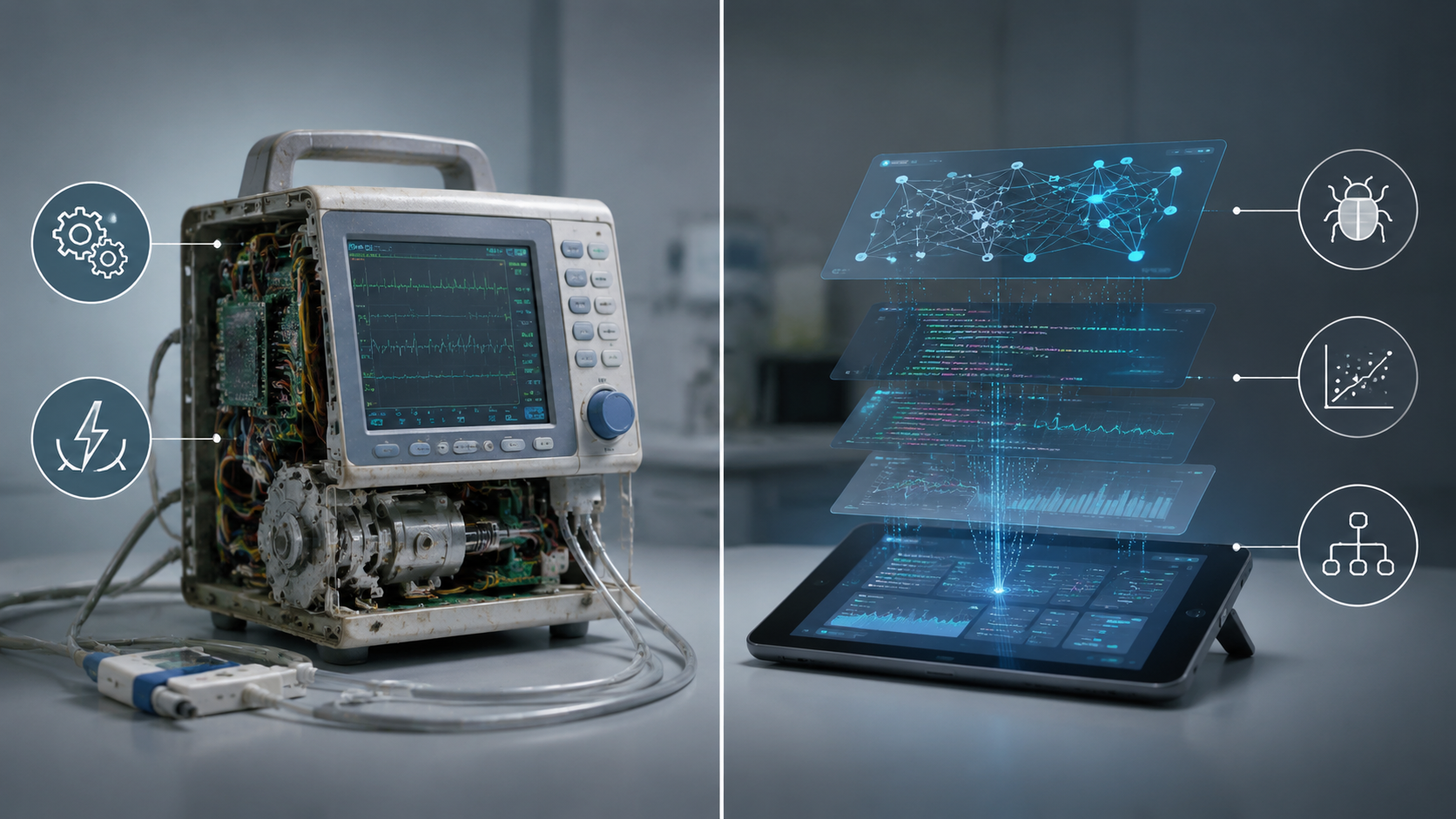
Conventional device review often leans on tangible failure modes: component fatigue, labeling errors, manufacturing defects, sterilization problems, battery risk, tubing connections, mechanical tolerances. AI-enabled devices add another layer. Their safety can depend on code behavior, data preprocessing, model thresholds, training distribution, user-interface prompts, alert routing, integration with PACS or EHR systems, and how clinicians respond when an output arrives at the wrong time or with too much apparent confidence.
That does not make AI devices uniquely unmanageable. It does mean the failure surface is less visible during a standard product demonstration. A model can perform acceptably on a curated validation set and still behave poorly when an institution’s scanner mix, patient population, acquisition protocol, image quality, documentation habits, or clinical routing differs from the environment in which the device was developed.
The Chen et al. study also depends on FDA’s manually maintained AI/ML-enabled device list, which the authors note may have omissions and irregular updates.[2] That limitation matters. It argues against treating the exact denominator as perfectly stable. It does not erase the root-cause pattern. When software design accounts for a much larger share of recalls in AI/ML devices than in the overall 510(k) population, the prudent response is not to wait for a perfect taxonomy. It is to ask more specific software and workflow questions before purchase.
| Evidence point | What it measures | Why it matters for evaluation |
|---|---|---|
| 43.4% of AI-enabled device recalls occurred within the first year after clearance | Recall timing after authorization | Early failure suggests premarket evidence and early deployment surveillance deserve more scrutiny |
| Software design errors accounted for 42% of AI/ML recall events | Reported recall root cause | Risk review needs to examine code, model behavior, data handling, and workflow integration |
| Design and development factors accounted for 50% of AI/ML recalls | Combined design/development contribution | Technical controls should be reviewed as safety controls, not just engineering documentation |
| 82% of authorized devices were concentrated in radiology and cardiology | Clinical-area concentration | Hospitals in these specialties are likely to encounter the operational consequences first |
Clearance Is Not the Same as Prospective Clinical Validation
The second problem is not that every software design error would have been caught by a prospective clinical study. Many defects are engineering failures, and some will only become visible through code review, version control, cybersecurity testing, interface testing, human-factors assessment, or post-market monitoring. Clinical validation is not a universal defect detector.
Still, the absence of prospective clinical validation weakens the claim that a device will behave safely in the real clinical setting where it is being sold. Lee et al. identified early recalls and clinical validation gaps in AI-enabled medical devices, with the study covering devices authorized through November 2024; the authors also noted that devices cleared after 2022 had limited follow-up duration, so the true recall rate may be understated.[1] That caveat cuts in an inconvenient direction for buyers: some devices may simply not have been observed long enough for their postmarket problems to become visible.
The American Hospital Association’s Center for Health Innovation separately highlighted clinical validation gaps in AI-enabled medical devices, reinforcing the same operational concern for health systems: authorization volume is rising faster than the public evidence base many hospitals would normally want before relying on a tool in clinical workflow.[3]
Prospective validation matters because it asks a different question from retrospective testing. Retrospective evidence can show how an algorithm performed on existing data. Prospective evidence can show how the tool behaves when clinicians know it is present, when alerts compete with other alerts, when users override or over-trust outputs, when cases arrive in real time, and when workflow friction changes who sees the result and when. For an AI triage product, for example, the relevant safety question is not only whether the model can identify a finding in stored images. It is whether the whole deployed system changes the right patient’s path at the right time without creating new blind spots.
Hospitals do not need to treat every AI product as high risk in the same way. A documentation assistant, a prioritization tool, and a diagnostic support system have different consequences when they fail. But the validation question should follow intended use, not vendor enthusiasm. If the product affects triage, diagnosis, treatment selection, monitoring, or escalation, the evidence threshold should rise accordingly.
What a Validation Review Should Separate
- Adoption from effectiveness: a device used by many sites is not necessarily proven to improve outcomes or reduce harm.
- Retrospective performance from prospective clinical behavior: archived data performance does not show how clinicians respond in live workflow.
- Internal validation from external validation: testing on the developer’s data environment is not the same as testing across institutions, scanners, populations, or care processes.
- Cleared intended use from local use: a hospital can create new risk when a device is informally used outside the population, setting, or decision point described in its clearance.
- Model performance from system performance: the output must still reach the right clinician, in the right format, with the right escalation path.
This is where internal evidence review needs to be more disciplined than a sales-cycle checklist. A device can be FDA-cleared, technically impressive, and still poorly matched to a hospital’s patient mix or workflow. Conversely, a narrowly scoped tool with strong external validation, monitored deployment, and clear escalation rules may be easier to govern than a broader product with more ambitious claims and thinner clinical evidence.
The 510(k) Gate Was Not Built Around Learning Software
The 510(k) pathway asks whether a device is substantially equivalent to a predicate device. That logic is familiar to device teams, and it has supported a large share of medical device clearance. The unresolved question is whether the same gate is adequate for AI/ML technologies whose behavior may depend on data distributions, software updates, model maintenance, and postmarket learning. The current evidence does not prove that the pathway is categorically incapable of reviewing AI devices. It does show that clearing the gate has not prevented a notable pattern of early, software-centered recalls.
For hospital reviewers, the practical consequence is straightforward. Clearance should begin the evaluation conversation, not end it. The most useful internal review often starts with the product’s intended use statement and then works outward: what patient population was studied, what comparator was used, what clinical action the output is meant to influence, what happens when the model is wrong, and who is responsible for monitoring drift or unexpected behavior after go-live.
Readers who need to trace the authorization landscape can use ClinicalMind’s guide on how to search FDA-authorized AI devices efficiently. For a closer look at the evidence gap in one heavily represented specialty, the radiology-specific analysis of FDA-cleared radiology AI devices and prospective clinical validation is the more relevant companion question.
Market Structure Adds Pressure, but It Does Not Prove Motive
The investor-pressure evidence should be read carefully. A Johns Hopkins Hub summary of Chen and Wu’s work reported that publicly traded companies were six times more likely to have a recall, accounted for more than 90% of recall events while representing 53.2% of AI/ML devices on the market, and that recalled devices from established public companies often lacked clinical validation: 77.7% among established public firms, rising to 96.9% for smaller public firms.[4]
Those findings are not proof that investors caused unsafe launches. Public firms may have larger portfolios, broader distribution, more complex installed bases, higher visibility, or different reporting dynamics. The evidence is correlational. It shows an association between public company status, recall representation, and validation gaps; it does not establish a direct causal chain from investor pressure to a particular recall.
Even with that boundary, market structure is relevant to a hospital’s risk review. A company’s incentives shape timelines, resourcing, update practices, support capacity, and the willingness to invest in prospective studies before broad deployment. For a small public firm, the pressure to show growth may coexist with limited ability to run expensive prospective trials. For a large public firm, the concern may be scale: a design defect can propagate across a much wider installed base before local users understand the failure pattern.
The point is not to prefer private companies or penalize public ones. It is to stop treating ownership structure as irrelevant. During due diligence, company context belongs beside the clinical evidence file, software quality documentation, update policy, adverse-event history, and postmarket surveillance plan.
What Should Change in Hospital Evaluation
The recall evidence points toward a more demanding review posture, not a blanket rejection of AI medical devices. Some AI tools will reduce brittle workflows, shorten queues, surface missed findings, or make scarce expertise easier to deploy. The question is whether the evidence package supports that use in the setting where the hospital intends to install the product.
A serious review should make five questions difficult to answer with marketing language alone.
- Prospective validation: Has the device been tested prospectively in a clinical workflow similar to the one being proposed, and were the endpoints clinically meaningful?
- External validation: Was performance tested outside the developer’s environment, including relevant patient populations, equipment variation, and practice patterns?
- Software design controls: What design, development, versioning, cybersecurity, interface, and human-factors controls reduce the chance of software-centered failure?
- Postmarket monitoring: Who watches performance after go-live, what signals trigger review, and how quickly can the hospital suspend or narrow use?
- Intended-use discipline: Does the planned local use match the cleared indication, population, setting, input data, and clinical decision point?
The postmarket question deserves particular attention because early recalls can occur while local enthusiasm is still high. A hospital that has no owner for monitoring model behavior, overrides, alert volume, missed cases, and vendor updates is relying on external recall machinery to discover problems that may already be affecting its own workflow. That is a weak safety position.
A practical deployment plan should also define what happens when the device is wrong. If an AI tool reprioritizes a worklist, who reviews delayed cases? If it flags a finding, how is disagreement documented? If a software update changes performance, who approves reactivation? If local clinicians begin using the output for a decision beyond the cleared intended use, who has authority to stop that drift?
None of this requires a hospital to become a device manufacturer. It does require the buyer to recognize that AI-enabled medical devices can fail through code, data, and workflow, not just through broken hardware. The recall studies make that distinction hard to ignore. FDA clearance can calm a procurement meeting, but it should not quiet the questions that determine whether a tool is ready for the clinical environment that will inherit its consequences.
References
- Early Recalls and Clinical Validation Gaps in AI-Enabled Medical Devices, JAMA Health Forum, 2025.
- Regulatory Insights From 27 Years of AI/ML-Enabled Medical Device Recalls in the United States, JMIR Medical Informatics, 2025.
- Keep an Eye on Clinical Validation Gaps in AI-enabled Medical Devices, AHA Center for Health Innovation, 2025-09-16.
- Investor pressure may be leading to risky AI medical devices, Johns Hopkins Hub, 2025-10-30.
Comments
Join the discussion with an anonymous comment.