The cleanest result in AI-assisted emergency medicine for stroke detection is also the one that makes the field hardest to summarize. In the Martinez-Gutierrez stepped-wedge cluster randomized trial across 4 stroke centers, AI triage reduced door-to-groin time by 11.2 minutes and CT-to-thrombectomy-start time by 9.8 minutes. The same trial did not show a statistically significant improvement in 90-day functional independence, with an odds ratio of 1.3 and a 95% confidence interval from 0.42 to 4.0.[1]
That is not a failed technology story. It is a clinical pathway story. The algorithm helped a real workflow move faster, in a randomized implementation, and the patient-level outcome estimate was too imprecise to let anyone honestly say that recovery improved. The result is irritating precisely because both halves are true.
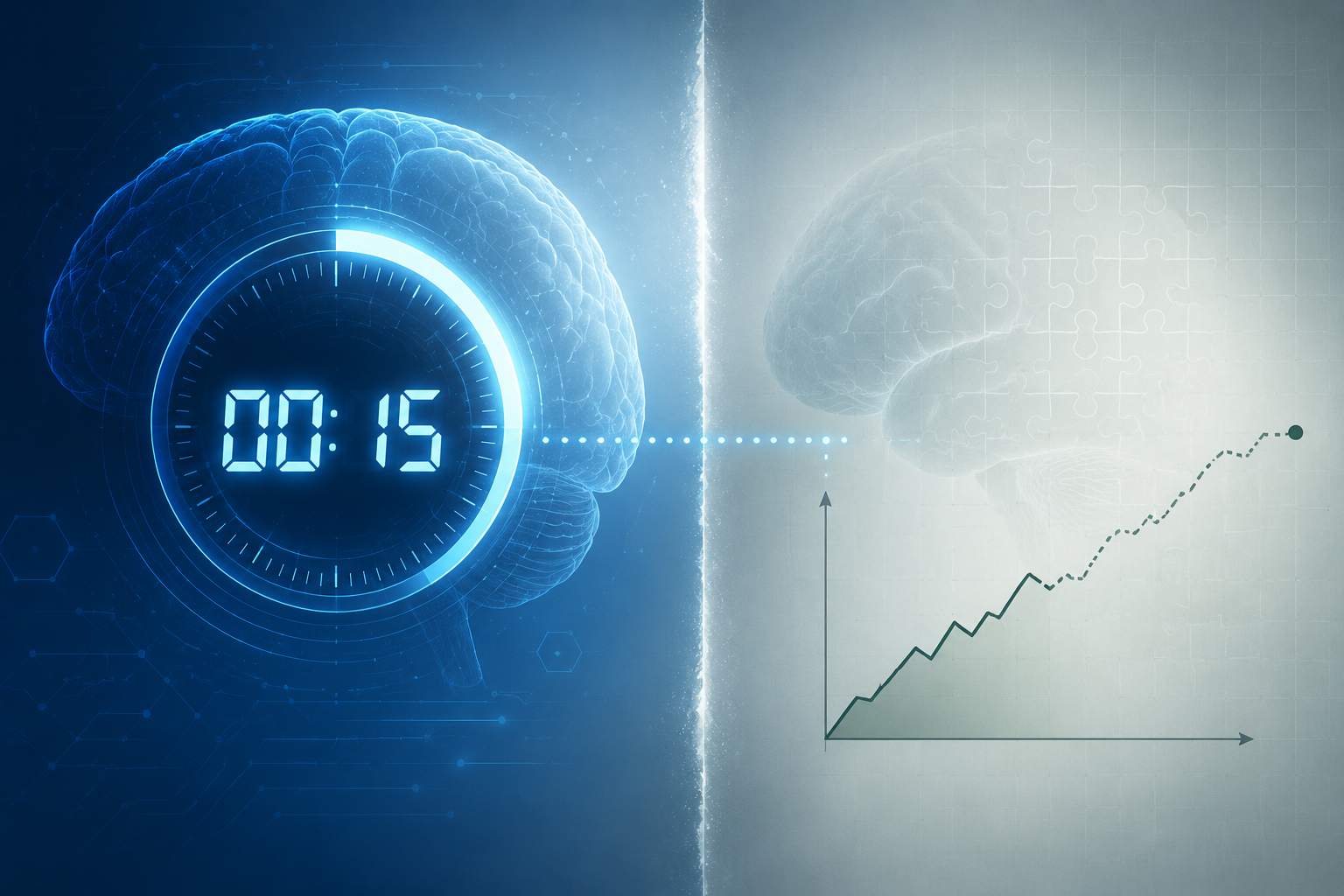
For hospitals, the first half matters. A thrombectomy alert that reaches the neurointerventionalist earlier is not cosmetic. It changes who leaves another room, who opens the angio suite, who starts transfer calls, and how quickly a patient moves from scan to table. For patients, though, the second half is the measure that finally counts: whether those minutes survive the rest of the pathway strongly enough to change disability at 90 days.
The Field Has Diagnostic Maturity, Not Therapeutic Proof
A 2026 decade review of AI in stroke care described the current state as “diagnostic maturity but therapeutic immaturity.” The review synthesized 1,335 studies, documented growth from 98 annual publications in 2015 to about 1,500 in 2024, and noted more than 30 FDA-cleared tools in the space.[1] Those numbers are useful, but not because the field needs another inventory of platforms. They show that stroke AI is no longer a speculative corner of radiology informatics. It has regulatory presence, commercial deployment, and a large enough literature that the absence of proven functional benefit cannot be waved away as mere infancy.
The diagnostic side is no longer the weakest link in the argument. A 2025 meta-analysis reported pooled sensitivity of 86.9% for ischemic stroke and 90.6% for hemorrhagic stroke, with pooled specificity of 88.6% and 93.9%, respectively.[2] Those figures do not mean every tool performs equally well in every hospital or every scanner environment. They do mean the broad claim that AI can detect stroke-relevant imaging findings at clinically meaningful accuracy is now better supported than the claim that those detections improve long-term function.
Workflow evidence points in the same direction. In the VALIDATE study of Viz.ai across 166 facilities and 14,116 patients, median door-to-neurointerventionalist notification time was 50 minutes with AI compared with 89.5 minutes without AI, a 39.5-minute reduction.[1] That is large enough to deserve attention even from people allergic to product claims. It is also still a notification endpoint.
The Brainomix 360 real-world study reported more than 450,000 patients and a 100% relative increase in mechanical thrombectomy rates.[1] That scale is impressive, and increased thrombectomy use may be operationally important. But the study was retrospective, not prospectively randomized, and thrombectomy rate is not the same as independent living after stroke. The distinction is not pedantry; it is the central evidence problem.
Where the Minutes Can Disappear
The tempting model is simple: AI sees the occlusion sooner, the team treats sooner, the patient does better. Stroke care is rarely that linear. Saved minutes have to pass through a series of gates before they can become saved tissue.
| Point in the pathway | What AI can plausibly improve | Why function may not improve |
|---|---|---|
| Image interpretation | Detection of suspected stroke pathology and automated alerting | Accuracy still depends on case mix, imaging quality, and validation setting |
| Notification | Shorter time from CT or CTA to specialist awareness | The right specialist may still be off-site, in another case, or waiting on transfer logistics |
| Treatment readiness | Earlier team activation | Angio suite availability, anesthesia, consent, and procedural setup can absorb the gain |
| Biology | Earlier opportunity to treat | Large core infarcts, comorbidity, and stroke severity may limit recoverable tissue |
| Outcome measurement | Potential shift in 90-day disability | Trials may be underpowered for functional independence even when workflow changes are real |
The Martinez-Gutierrez trial sits directly on that fault line. It showed earlier treatment steps, but the functional outcome estimate was wide. A confidence interval from possible harm through substantial benefit is not evidence that nothing happened. It is evidence that the trial did not resolve what patients and health systems most want to know.[1]
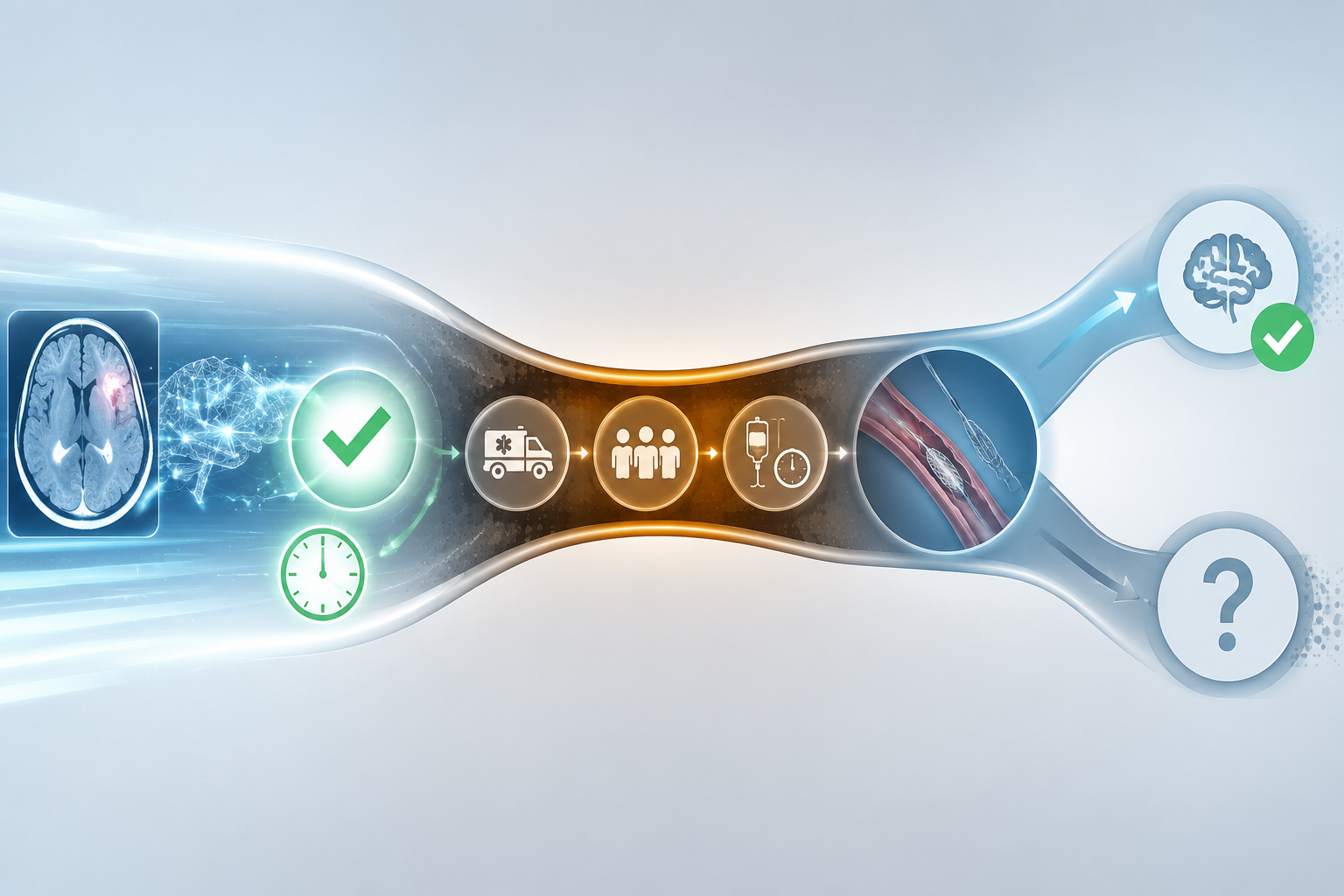
This is where many discussions become too careless in opposite directions. One side treats door-to-groin reduction as if it were already a disability result. The other treats a null 90-day endpoint as if it invalidated notification, coordination, and treatment-readiness gains. Neither reading is disciplined. The appropriate conclusion is narrower: current AI triage tools have demonstrated acceleration, while the published randomized evidence has not yet demonstrated improved 90-day functional independence.
Detection Performance Is Probably Not the Main Bottleneck
Automated ASPECTS work makes the same point from another angle. In one study summarized by the decade review, physician review aided by AI improved AUC from 67.43% to 89.76% and reduced reading time by 74.8%, from 130.6±61.3 seconds to 33.3±8.3 seconds.[1] That kind of improvement is not trivial. It suggests the system can help clinicians extract imaging information more consistently and faster.
But better reading of an image is upstream of the harder question: is there enough salvageable tissue, in the right patient, at the right time, with a team able to act before the biological opportunity closes? A patient with a large core infarct may be identified quickly and still have limited capacity for functional recovery. A patient at a spoke hospital may trigger an alert quickly and then wait on transport. A thrombectomy-capable center may receive the notification quickly and still lose time to team assembly, room turnover, or procedural complexity.
Those are not excuses for weak evidence. They are candidate mechanisms. The decade review lists several explanations for the current divide: underpowered outcome trials, time savings too small to change trajectory in some patients with large core infarcts, downstream bottlenecks such as transfer and procedural delays, and confounding by stroke severity and comorbidity.[1] The important point is that none of these mechanisms requires the AI alert to be fake. They require the alert to be only one intervention inside a fragile chain.
A Faster Alert Is Not the Same Intervention as Better Patient Selection
The contrast with CT perfusion AI is useful because it prevents an overly broad conclusion about “stroke AI.” RAPID-based trials such as DEFUSE 3, EXTEND, and SELECT2 improved outcomes, but they did so by selecting patients for treatment eligibility, not merely by notifying teams faster.[1] That difference matters.
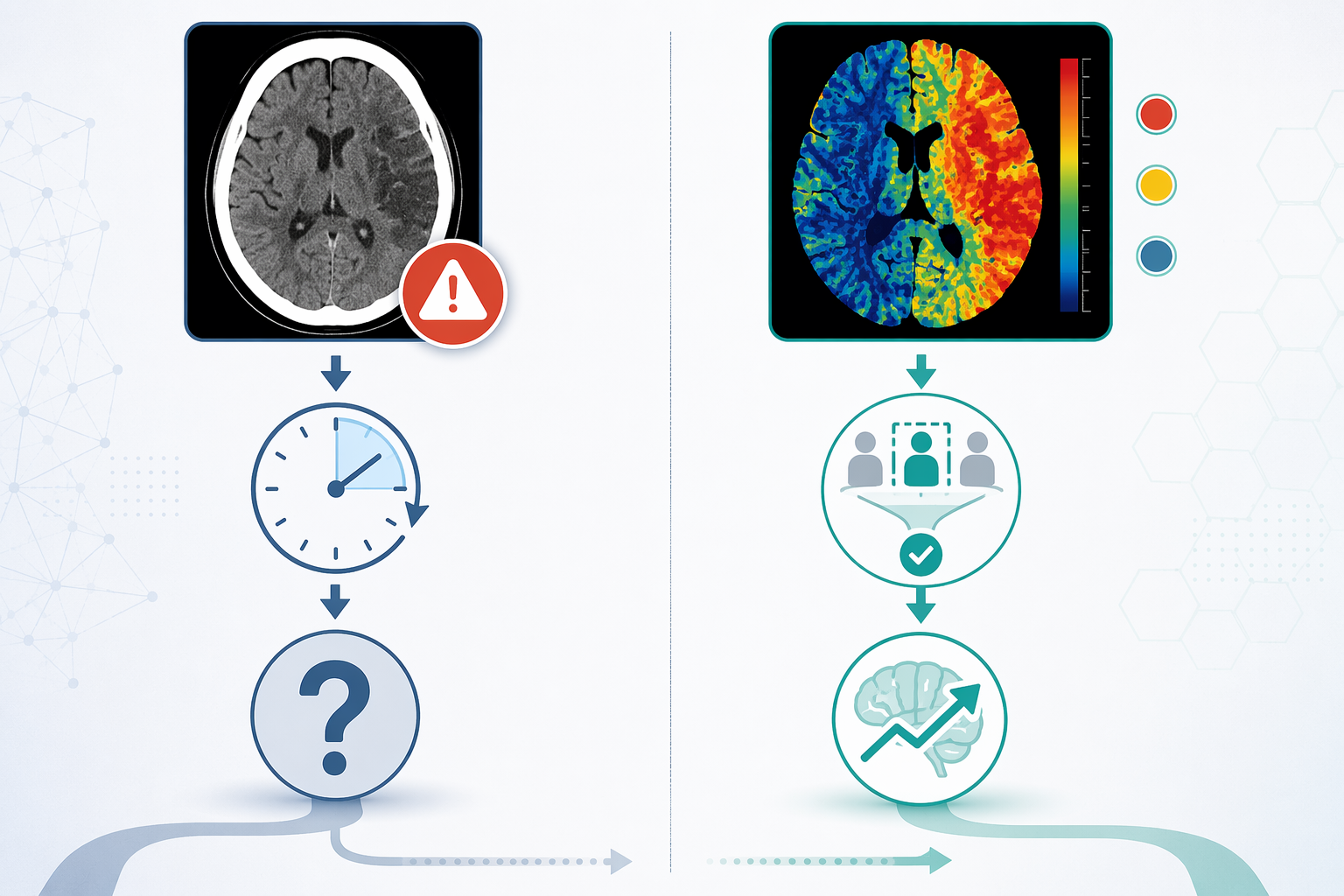
Notification AI asks whether the right people can be alerted sooner. Perfusion-selection AI asks whether a patient who might otherwise be excluded should receive treatment because imaging suggests salvageable tissue. Both can use algorithms. They do not test the same clinical hypothesis.
This distinction helps explain why diagnostic maturity has not automatically produced therapeutic proof. If an algorithm changes eligibility, it can alter who receives an effective treatment. If it changes notification time, the benefit depends on whether the treated patient still has salvageable tissue and whether the system converts the alert into earlier reperfusion. One intervention changes the selection boundary; the other tries to compress the pathway.
The Economic Evidence Has the Same Shape
The cost argument is often made with more confidence than the evidence permits. Brin and Tau’s 2025 economic evidence review found only 10 model-based economic studies and no prospective real-world cost-effectiveness evaluations, despite more than 30 deployed tools.[1] Model-based work can be useful, especially when clinical trials lag behind implementation, but it inherits assumptions about treatment rates, time-to-treatment effects, disability shifts, staffing, and licensing costs.
A hospital may still have a rational operational reason to buy an AI stroke triage product. Faster specialist notification can reduce chaos, standardize escalation, and make a hub-and-spoke network easier to run. The mistake is to call that the same thing as proven cost-effectiveness based on observed patient outcomes. It is not.
Whose Workflow Is Being Improved?
Equity is not a side issue in emergency stroke AI, because workflow gains are measured inside particular hospitals, referral networks, and imaging practices. The decade review notes that stroke risk models performed worse in Black individuals than in White individuals, with C-index values of 0.64–0.69 versus 0.76, and that many datasets come from high-income academic centers.[1] That evidence is about risk models rather than every deployed imaging triage tool, so it should not be stretched into a universal indictment. It is still a warning about generalization.
A model validated in well-resourced systems may not behave the same way in hospitals with different scanner protocols, transfer distances, staffing patterns, patient demographics, or baseline treatment delays. Even if the algorithmic detection is stable, the intervention may deliver most of its practical benefit to systems already capable of acting on the alert. The outcome gap can therefore be biological, statistical, logistical, and distributive at the same time.
What Would Actually Resolve the Divide
The next evidentiary threshold is not another retrospective report showing that alerts fire quickly. It is a prospective, multi-hospital test of whether the alert changes 90-day function when implemented across real emergency systems. Two ongoing trials are designed closer to that standard.
- DETECT is a UK trial led from Oxford, planned across 40 hospitals and 6,000 patients from 2023 to 2027, with functional independence as the primary endpoint.[1]
- FAST-AI is a US Yale stepped-wedge trial planned for 8,000 patients from 2024 to 2028, also using functional independence as the primary endpoint.[1]
- Results are expected in the 2027–2028 window.[1]
Those trials will not decide whether AI-assisted stroke detection can make notifications faster. That has already been shown often enough to be taken seriously. They will test whether speed survives the entire clinical pathway: patient selection, transfer, team activation, treatment start, reperfusion, and recovery.
Until then, the evidence supports a deliberately limited conclusion. Current AI stroke triage has proven time savings and plausible operational value. It has not yet proven a statistically significant improvement in patient functional outcomes. The unresolved question is not whether the tools are fast, but whether the saved minutes arrive at the part of the pathway where brain tissue, treatment eligibility, and recovery can still be changed.
References
- A Decade of Artificial Intelligence in Stroke Care 2015–2025, PMC, 2026.
- Diagnostic accuracy meta-analysis, PMC, 2025.
Comments
Join the discussion with an anonymous comment.