Will Roberts’ death is now being told as a pediatric cancer tragedy, which is accurate and still too small. The more useful way to read it is as a map of where pediatric rare-cancer care makes families do work the system should have organized earlier.
The sequence matters. Will’s leg pain was first treated as growing pains. In January 2025, he was diagnosed with osteosarcoma. In February, he underwent rotationplasty. Standard chemotherapy later failed. By late 2025 and into 2026, his mother, Aundrea Roberts, was searching for something beyond the ordinary pathway and identified DeltaRex-G, an FDA orphan-designated gene therapy that was not reachable through routine access. The family raised more than $700,000 through GoFundMe. In April 2026, Will’s Facebook video asking for help went viral. CMS Administrator Dr. Mehmet Oz intervened. Will later rang the bell in June. He died on July 23, 2026.
That chronology should stop anyone who works around cancer policy from moving too quickly to the phrase “innovation ecosystem.” The operational failures are visible at each turn: a symptom pattern that did not trigger faster escalation, a standard regimen that could not control the disease, a parent forced into trial and therapy research, a fundraising campaign to keep options open, and a public-pressure route to an experimental treatment.

Executive Order 14355, signed on September 30, 2025, did not arise from Will’s national story; the timing does not support that. But it names the same choke points. The order directs federal work toward AI-enabled pediatric cancer research, including predictive modeling of treatment response, AI-powered clinical trial matching and design, and improved diagnostics using multimodal data. It also doubles the Childhood Cancer Data Initiative commitment from $50 million to $100 million per year.[1]
The policy is therefore neither irrelevant theater nor proof that the next child will be spared the same path. Its value depends on whether those AI ambitions become tools embedded in ordinary care: the imaging review, the pathology workflow, the molecular tumor board, the trial office, the access program, the place where a family is currently told to wait.
The first failure was not rare
Osteosarcoma often begins in a way that looks ordinary enough to be misread. The Osteosarcoma Institute describes an average delay of several months from symptom onset to diagnosis, with pain often attributed to growing pains or sports injuries.[2] That does not mean every delayed diagnosis is negligence. It does mean the system is working with a known blind spot.
For a teenager with leg pain, the clinical question is not whether every ache should become an oncology workup. It is whether primary care, urgent care, orthopedics, radiology, and referral systems can better identify the pattern that deserves escalation: persistent localized pain, night pain, swelling, worsening function, or symptoms that do not behave like a routine injury. The hard part is that rare cancers ask common front doors to notice uncommon trajectories.
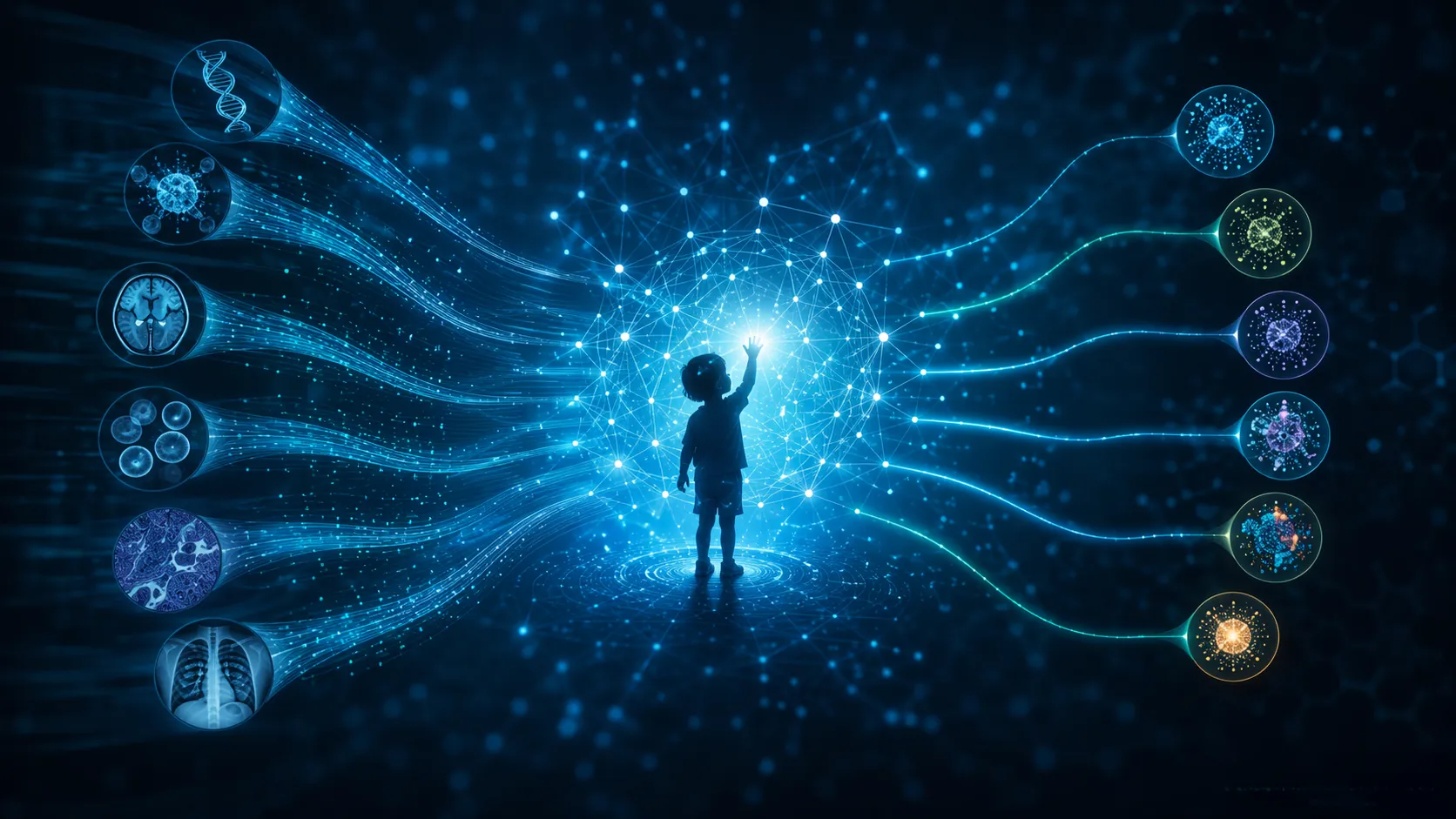
This is where the diagnostic promise in EO 14355 becomes concrete. “Multimodal data” is not a magic phrase. In a useful version, it means a system that can combine the symptom record, repeat visits, radiology findings, pathology images, laboratory data, age, anatomy, and clinical trajectory into a signal strong enough to prompt a second look. The goal is not to replace the clinician who sees the child. It is to reduce the odds that each clinician sees only one fragment of a slow-moving emergency.
There is already research pointing in that direction, though it remains narrower than the policy language. A Kyushu University-linked study reported an AI model that evaluated viable tumor cell density in osteosarcoma pathology images; a threshold of 400 cells per square millimeter predicted disease-specific and metastasis-free survival more reliably than conventional necrosis rate in the reported work.[3] That is not an early-diagnosis tool, and it is not proof of broad pediatric deployment. It is evidence that AI can extract prognostic information from tissue images in a disease where treatment decisions still depend heavily on imperfect markers.
The distinction matters. A pathology-image model that helps classify risk after biopsy would not have prevented Will’s first leg pain from being dismissed. But the same technical direction — making unstructured clinical and image data computable — is relevant to the diagnostic-delay problem. The policy question is whether federal funding will support tools that are validated across institutions, children, tumor subtypes, and real-world workflows, rather than impressive models that live only inside retrospective datasets.
Trial access should not depend on a parent becoming the search engine
After standard therapy failed, the burden shifted. Aundrea Roberts identified DeltaRex-G through her own research. That detail is easy to admire and hard to accept. Parent persistence is heroic only because the ordinary system leaves too much of the search unassigned.
Clinical trial matching is one of the least glamorous and most consequential uses of AI in oncology. It asks a simple operational question: among many patients and many trials, who might be eligible now? The work is tedious, rule-bound, and fragmented across structured and unstructured data. It is also exactly the kind of work families should not have to perform from a kitchen table while a child’s disease is progressing.
Cleveland Clinic’s rare-cancer trial-matching program gives a more grounded picture of what AI can do now. Reported at ESMO 2024, the program screened 840,523 patients across 74 trials, identified 24,500 potentially eligible patients, and enrolled 189 patients in six months, or about one per day. It also reduced “just in time” trial activation from 39 days to 14 business days.[4]
Those numbers do not show that AI solves pediatric osteosarcoma access. They come from a single health-system program, not a national pediatric rare-cancer network. They do show the practical shape of the opportunity. AI can screen more records than a coordinator can manually review. It can flag eligibility before an oncologist happens to remember a trial. It can make trial activation less dependent on a last-minute scramble. It can turn “someone should look” into a work queue.
| Failure exposed in Will Roberts’ path | What AI policy is promising | What would count as real progress |
|---|---|---|
| Leg pain initially treated as growing pains | Diagnostics from multimodal data | Earlier escalation when symptoms, visits, imaging, and clinical trajectory form a concerning pattern |
| Conventional chemotherapy failed | Predictive modeling of treatment response | Better risk stratification and earlier identification of patients unlikely to benefit from standard approaches |
| A parent found the experimental therapy | AI-powered clinical trial matching and design | Systematic matching before families have exhausted options or public attention |
| Access required virality and political intervention | Improved research coordination and data infrastructure | Lawful access pathways that clinicians can navigate without a media campaign |
The access problem does not end at matching. A match is not an open slot, an activated site, a payer agreement, a travel plan, an investigational-drug supply, or a lawful expanded-access route. But matching is where many families lose time first. If an AI system can surface a credible option earlier, the rest of the access machinery at least begins while the child still has more reserve.
The Right to Try pathway revealed a system workaround, not a system
Will’s eventual access to DeltaRex-G through a White House-brokered Right to Try pathway is the kind of detail that can be misread as a triumph of responsiveness. It was responsive, but only after a video went viral and reached someone with political and administrative reach. That is not a replicable care pathway for children with rare cancers.
Right to Try and expanded access mechanisms exist because some patients cannot wait for the normal research sequence to produce an approved option. They also depend on constraints that AI cannot remove: manufacturer willingness, regulatory conditions, physician participation, institutional review, safety monitoring, cost, logistics, and timing. A model can identify a therapy worth considering. It cannot by itself make that therapy available.
This is why the trial-access promise in EO 14355 has to be judged beyond software procurement. A useful federal AI effort would connect matching to actual access operations: trial availability, site activation, eligibility verification, pediatric consent workflows, data-sharing agreements, and pathways for children whose diseases progress outside the tempo of ordinary trial enrollment.
Osteosarcoma is hard biology, not just poor coordination
The danger in policy writing is to make every failure sound administrative. Osteosarcoma resists that simplification. The Osteosarcoma Institute quotes Stanford researcher Dr. Christina Curtis describing the disease’s extreme genomic instability this way: “chromosomes can shatter and get stitched back together like a quilt.”[5] That instability helps explain why targeted therapies have remained difficult in osteosarcoma compared with cancers driven by cleaner, more targetable alterations.
The same research direction has used AI and machine-learning models to identify two distinct evolutionary subtypes of osteosarcoma.[5] That is the kind of finding that could eventually matter for risk prediction, trial design, and therapy development. It is also far from a bedside guarantee. A child’s family cannot be handed a genomic-instability explanation in place of an option.
Still, this is one of the strongest arguments for using AI in pediatric rare cancers. Small patient populations and complex tumor biology make traditional evidence generation slow. Better computational models may help researchers see patterns across institutions that no single center can see alone. But that requires clean data, shared standards, pediatric-specific validation, and sustained research capacity.

The budget contradiction sits in the middle of the promise
The $100 million annual CCDI commitment in EO 14355 is meaningful because pediatric cancer data infrastructure is not a side project. AI needs longitudinal clinical records, imaging, pathology, genomics, outcomes, trial data, and the governance needed to use them across institutions. Doubling a targeted data initiative can matter if the money reaches the unglamorous infrastructure that makes models usable.
But the same administration also proposed NIH cuts of roughly 40%. That tension cannot be treated as a footnote. Pediatric cancer AI does not mature in isolation from the broader NIH-funded research base: cooperative groups, cancer centers, data repositories, early-career investigators, biostatistics cores, translational labs, and clinical trial networks all supply the conditions under which an AI initiative can become more than a demonstration.
A narrow AI fund can launch tools. A weakened research ecosystem can keep those tools from being validated, deployed, audited, and updated. That is the policy contradiction facing EO 14355: it points toward real bottlenecks while the surrounding budget posture threatens the institutions needed to clear them.
What would have to change before the next Will Roberts story
The honest standard is not whether AI would have saved Will Roberts. The available evidence does not support that claim. The standard is whether the next child with an uncommon cancer is less likely to need a parent to become the diagnostic advocate, trial navigator, fundraiser, and media strategist.
For diagnosis, that means tools that recognize concerning patterns across repeated encounters and prompt escalation without flooding clinicians with false alarms. For pathology and imaging, it means models validated beyond the dataset that built them. For trial matching, it means screening that connects to open trials, activated sites, and staff who can act on the match. For experimental access, it means lawful pathways that do not depend on a viral video reaching a federal official.
EO 14355 is relevant because Will’s path exposes the exact failures it names. Its promise is bounded by the same facts: pediatric-specific evidence is still thin, rare-cancer models need validation at scale, and a data initiative cannot compensate for broad damage to the research infrastructure around it. The measure will be practical and unforgiving: fewer families forced into virality, personal fundraising, and political access before the system offers timely diagnosis, trial matching, and experimental options.
References
- Unlocking Cures for Pediatric Cancer with Artificial Intelligence, The White House, September 30, 2025.
- Osteosarcoma Symptoms, Osteosarcoma Institute.
- AI Model to Evaluate Surviving Tumor Cells Could Drive More Accurate Prognoses of Bone Cancer, Inside Precision Medicine.
- AI Can Help Find Trials for Patients with Rare Cancers, Cleveland Clinic.
- AI-Driven Tumor Research, Osteosarcoma Institute.
Comments
Join the discussion with an anonymous comment.