
The most useful Medicare for All healthcare policy analysis in 2026 does not start with a white paper about national financing. It starts with a much narrower experiment: a Medicare pilot that lets technology companies help decide whether certain care in traditional Medicare should be approved before it happens, then pays those companies from the savings generated when care is denied or modified.
That experiment is WISeR, a CMS prior authorization pilot launched in January 2026 in six states. It covers 13 procedures, involves six technology companies, affects 6.4 million traditional Medicare beneficiaries, and is scheduled to run through 2031. Participating companies include Retina-AI, Plain Healthcare, and Lasso Healthcare. The important design choice is not simply that AI is involved. It is that vendors receive a percentage of the savings produced by denied or modified prior authorization requests.[1]
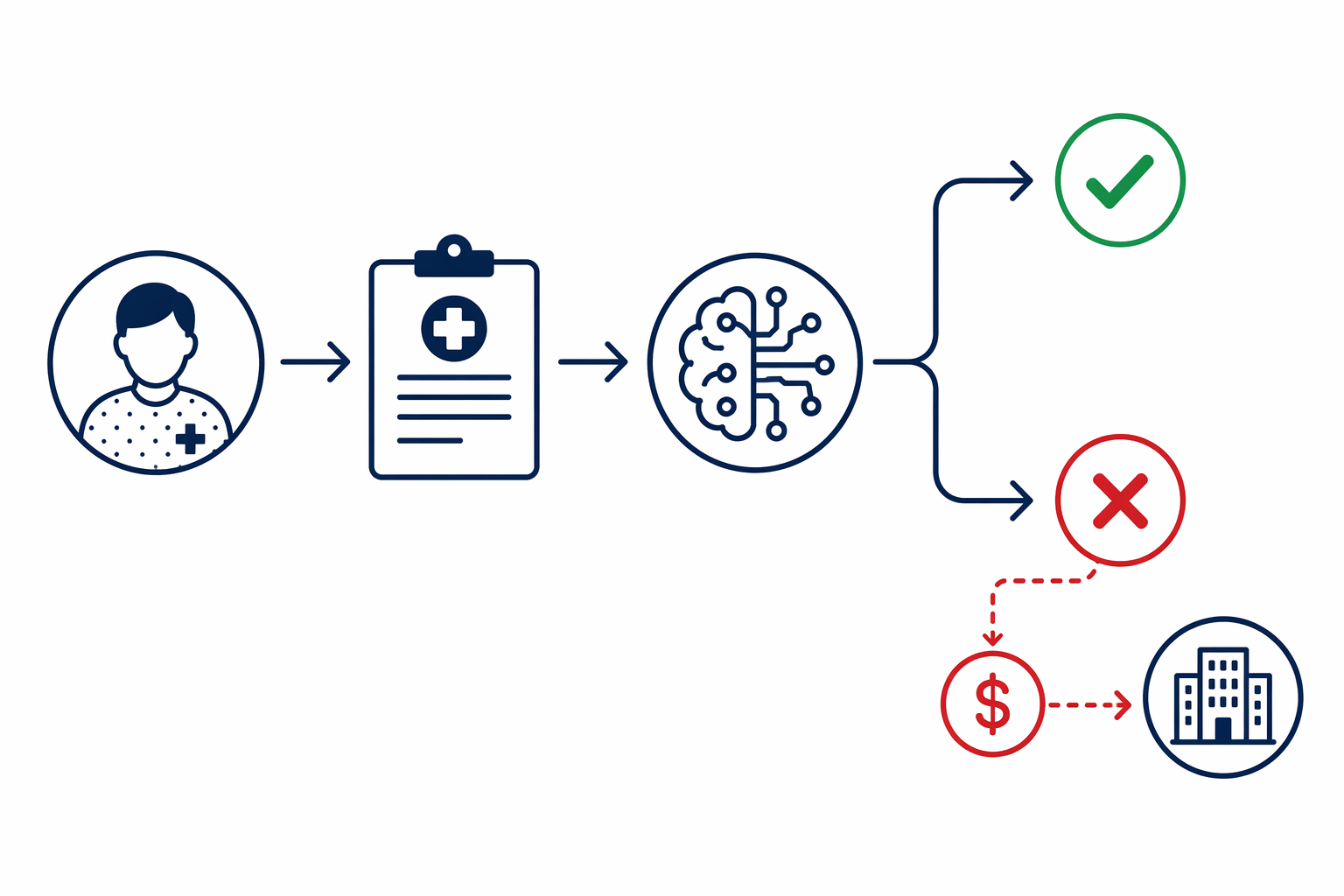
For traditional Medicare, this is a major policy break. Traditional Medicare has historically not required prior authorization for most services, which means WISeR is not just an administrative modernization project. It is a test of utilization management inside a program where many beneficiaries and clinicians have not had to navigate insurer-style preapproval for ordinary coverage at this scale.[1]
AARP has opposed the pilot on the ground that the payment model creates a financial incentive to deny care to older adults.[2] That objection lands because the incentive is not hidden several layers down in procurement language. If a vendor benefits when the system spends less after a prior authorization review, the review process must be governed as a coverage-denial system, not merely as a workflow tool.
WISeR turns efficiency into a denial incentive
Prior authorization has always been a gatekeeping mechanism. The question is who operates the gate, what evidence they use, how much discretion they have, and how quickly a wrong decision can be corrected. WISeR adds another question: what does the gatekeeper gain when the gate stays closed?
The pilot does not yet have mature public outcome data. As of July 2026, it is only seven months old, so the available evidence does not show WISeR-specific denial rates, appeal rates, or patient outcomes. The governance problem is visible earlier than that. A payment formula that rewards savings from denied or modified requests asks the public to trust that the same vendors financially rewarded by lower spending will also calibrate their tools conservatively enough to avoid improper denials.
That may be defensible only if the rest of the system is unusually strong: transparent criteria, meaningful human review before denial, independent appeals, monitoring for disparate impact, and public reporting that allows outsiders to see whether the tool is blocking care in predictable patterns. Without those safeguards, the pilot creates the administrative equivalent of a bounty on avoided claims.
The Medicare for All implication is narrower than the usual argument about whether a single payer would spend more or less. A national payer would concentrate coverage authority. If that authority uses AI-assisted prior authorization, the safeguards must be concentrated as well. Otherwise, the country would not have merely centralized payment; it would have centralized a denial machine whose operating rules are difficult for patients and clinicians to inspect.
The closest warning sign is already in Medicare Advantage
WISeR is not Medicare Advantage, and Medicare Advantage data should not be treated as WISeR outcome data. But Medicare Advantage is the nearest large-scale warning about what happens when prior authorization, plan incentives, and automated or algorithm-adjacent review systems meet the daily reality of older adults trying to get care.
KFF reported that Medicare Advantage plans denied 7.7% of 53 million prior authorization requests. Only 11.5% of those denials were appealed. Among the denials that were appealed, 81% were overturned.[3]
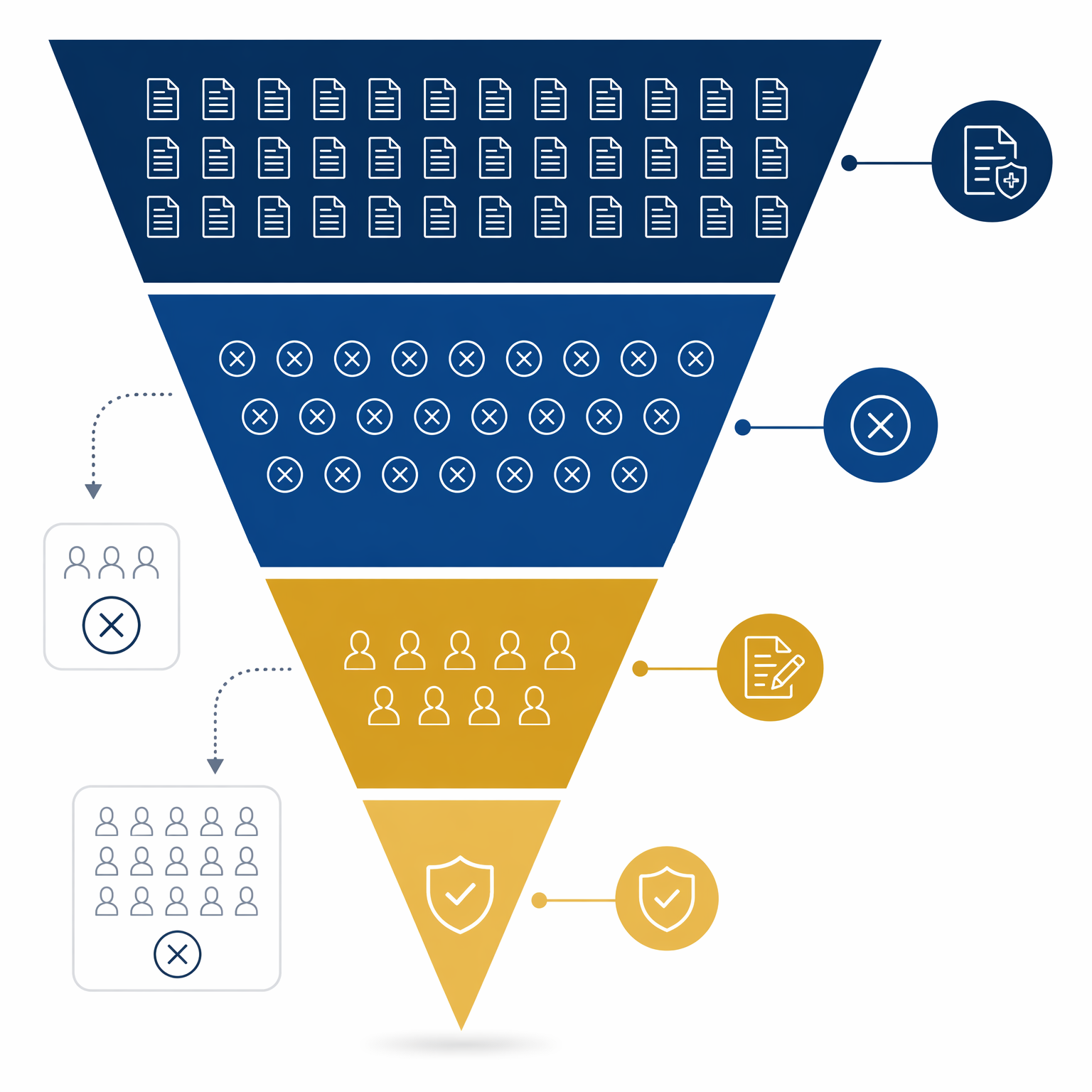
The 81% figure should do more work in policy analysis than it usually does. It does not prove that every initial denial was algorithmic. It does not prove that all denials were clinically reckless. It does show that, among the small share of denials patients or providers pushed through appeal, the original decision failed at a remarkable rate.[3]
That matters because appeals are often described as the safety valve. In practice, the safety valve only helps the people who know it exists, have the time and support to use it, and can withstand delay. The denominator is not appealed denials; it is all the people who accept the denial, abandon the service, wait for a clinician’s office to fight on their behalf, or never learn why the request failed.
For clinicians, a bad denial is not a clean administrative event. It creates new documentation work, peer-to-peer scheduling, staff time, patient communication, and clinical risk during delay. For beneficiaries, it can turn a coverage promise into a sequence of opaque refusals. If a Medicare for All system adopted centralized AI-assisted review without redesigning appeals, it could reduce payer fragmentation while preserving the most punishing part of private utilization management: the burden of proving that covered care should be covered.
State laws are moving, but not in a way that can govern a national payer
States have noticed the problem. In 2026, Alabama SB 63, Indiana HB 1271, Washington SB 5395, Maryland HB 1563, Georgia SB 544, and Utah SB 319 all passed with provisions addressing AI in healthcare. A common thread is that AI cannot be the sole basis for denying care.[4]
| Policy response | What it protects against | Why it is insufficient for Medicare for All |
|---|---|---|
| State rules requiring human involvement | A denial issued solely by an AI system | Protection varies by state and may not cover a federal payer uniformly |
| Appeal rights after denial | Some incorrect coverage decisions | Appeals help only after delay and only when patients or providers can pursue them |
| AI sandboxes and experimentation rules | Regulatory uncertainty for new tools | Experimentation can expand autonomy before national accountability standards exist |
| Federal algorithmic governance | Opaque criteria, biased outcomes, conflicted incentives, and weak appeals | This is the level at which a national payer would need enforceable safeguards |
Utah’s law also stands out because its sandbox is the first to allow autonomous AI prescription renewal.[4] That is not the same issue as AI denial of care, but it shows how unevenly states are drawing the boundary between AI assistance and AI autonomy. Some states are emphasizing human review before adverse coverage decisions. Others are creating controlled pathways for more autonomous clinical-administrative functions.
The state response is useful as an early warning system. It is not a durable governance architecture for a national single-payer program. A Medicare for All system would not be safely governed by a map in which a beneficiary’s protection depends on whether their state legislature has already defined AI review, barred sole-basis denials, funded enforcement, and survived federal preemption fights.
The federal countercurrent makes the patchwork less stable
The state patchwork is not merely incomplete. It is politically unstable. Executive Order 14365, issued in December 2025, directs the Department of Justice to challenge state AI laws deemed burdensome. In January 2026, the DOJ AI Litigation Task Force was already targeting Colorado’s AI anti-discrimination law.[5]
That federal posture complicates healthcare AI regulation even before Medicare for All enters the conversation. If states try to regulate AI denials and the federal government challenges those laws as burdensome, the result is not a coherent national standard. It is a fight over who may regulate, while patients and providers still face the operational consequences of automated review.
Under a single-payer system, this conflict would be resolved one way or another because the payment authority would sit federally. That makes the design question unavoidable. Federal control could create uniform protections. It could also eliminate state-level protections without replacing them with anything equally strong. Centralization is not a safeguard by itself.
What WISeR says a national system would have to build first
The case for using AI in coverage administration is not imaginary. Medicare processes enormous volumes of claims, documentation varies, and some services are overused. A national payer would need administrative tools capable of scale. The policy mistake is to treat scale as the first requirement rather than the last one. A system should not scale a denial process faster than it can audit, explain, correct, and discipline that process.
Algorithmic transparency
A national payer using AI-assisted prior authorization would need to disclose more than the existence of a tool. Patients, clinicians, auditors, and policymakers would need to know which services are subject to review, what clinical criteria are being applied, how often the tool recommends denial or modification, how often humans follow that recommendation, and how those decisions vary across geography, race, disability status, age, language, and provider type.
Transparency also has to reach the contracting model. WISeR shows why. If vendors are paid from savings tied to denied or modified requests, that financial arrangement belongs in public accountability reports, not behind procurement language. The incentive is part of the system’s clinical behavior.
Mandatory human review before adverse decisions
State laws that prohibit AI from being the sole basis for denial are pointing at the right floor. A federal program would need to make that floor enforceable. Human-in-the-loop review cannot mean a clinician rubber-stamps a queue after the model has already framed the answer. It has to mean that a qualified reviewer can see the relevant record, understand the tool’s rationale, depart from the recommendation, and be accountable for the final decision.
The reviewer also needs insulation from the same savings incentive. If the model is rewarded for reducing spending and the human review layer is judged by throughput or denial savings, the human layer becomes a liability shield rather than a safeguard.
Independent appeals that do not depend on exhaustion
The Medicare Advantage appeal pattern makes one point hard to avoid: a system cannot defend weak first-level review by pointing to appeals if most denials are never appealed and most appealed denials are overturned.[3] Appeals must be fast, independent of the entity that benefits from denial, and simple enough that a beneficiary does not need an expert advocate to trigger review.
For high-risk services, a national system should also consider automatic escalation rather than waiting for the patient to appeal. If a denial involves a service with significant clinical consequences, the burden should not rest entirely on the beneficiary or the clinician’s office to force a second look.
Anti-bias safeguards with enforcement power
AI denial systems can reproduce inequity through training data, documentation patterns, access to specialist notes, language barriers, and different levels of provider administrative capacity. A tool may appear neutral while denying more care to people whose records are less complete, whose clinicians have fewer staff to submit documentation, or whose conditions do not fit cleanly into standardized criteria.
That means anti-bias safeguards cannot be limited to predeployment promises. They require outcome monitoring, subgroup reporting, complaint channels, corrective action, and the ability to suspend or modify tools that produce discriminatory results. A national payer would have the reach to collect those signals. It would also have the power to ignore them unless the obligation is built into law and contract terms.
The Medicare for All lesson is administrative, not ideological
WISeR does not settle the Medicare for All debate. It does not show whether a national payer would be more generous or more restrictive than today’s mix of Medicare, Medicaid, employer coverage, and individual market plans. It shows something more operational and more immediate: when public coverage adopts AI-assisted prior authorization, the payment model and appeal architecture determine whether the technology behaves like a review aid or a denial accelerator.
The current regulatory field is not ready to answer that problem at national scale. WISeR places the incentive problem inside traditional Medicare. Medicare Advantage appeal data shows how often contested denials can fail when someone has the capacity to challenge them. State laws are beginning to require human involvement, but they do so unevenly and under federal pressure. A Medicare for All system that concentrated payment authority would need to concentrate algorithmic transparency, mandatory human review, independent appeals, and anti-bias enforcement before trusting AI with denials.
References
- Medicare is Experimenting With Having AI Review Claims, USC Schaeffer Center
- AI Prior Authorization Pilot Hits Original Medicare, AARP
- The Growing Use of Artificial Intelligence in Health Care and Implications for Disparities, KFF
- States Continue Efforts to Regulate AI in Healthcare: A Review of Legislation Passed in 2026, Holland & Knight
- Federal AI Policy Threatens Prior Authorization Reform, NHeLP
Comments
Join the discussion with an anonymous comment.