
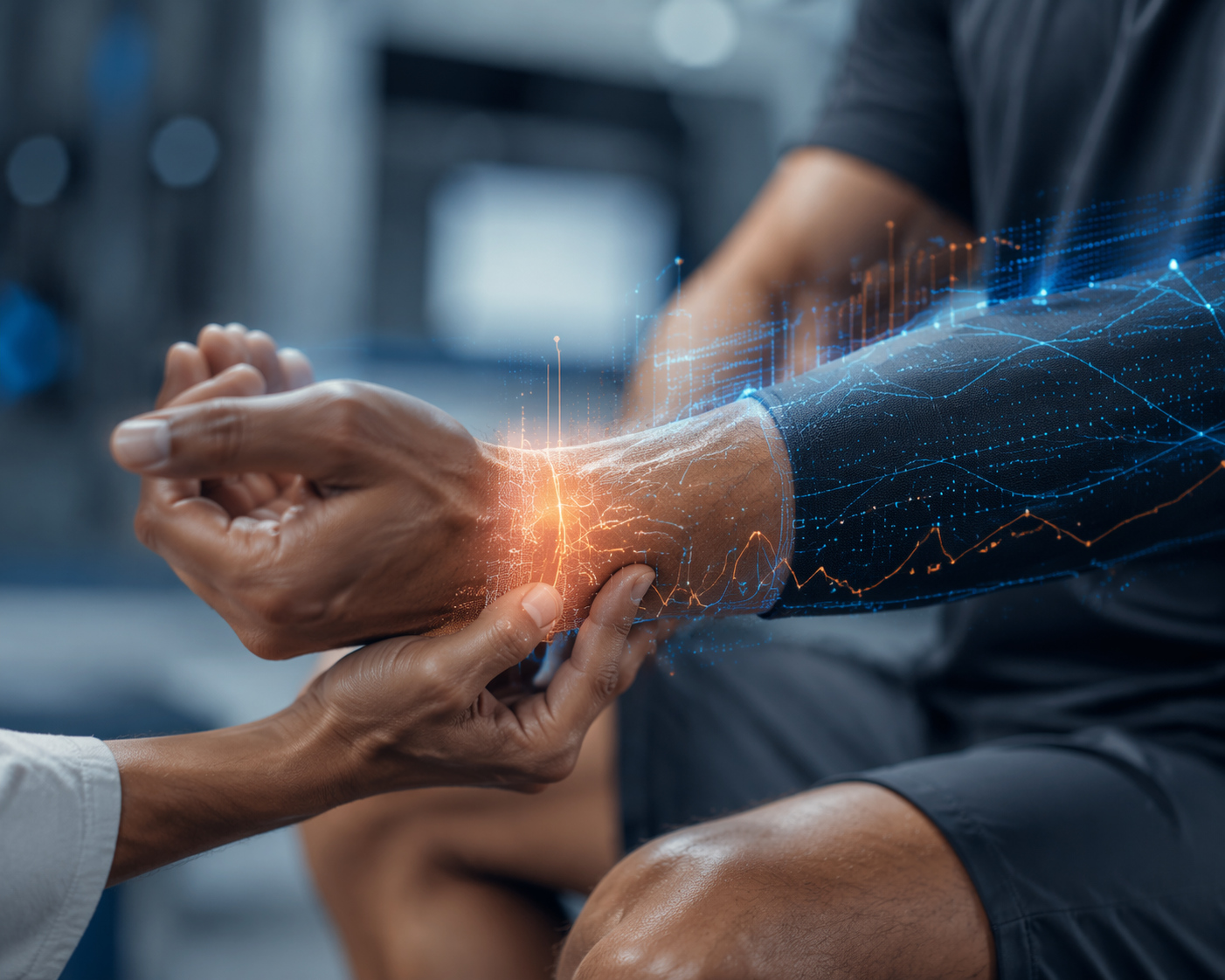
A wrist injury recovery timeline for athletes is useful until it starts pretending to be a clearance decision. “One to three weeks” for a mild sprain, “several months” for a severe sprain, or “about seven to ten weeks” after a scaphoid fracture can orient the room. It tells the athlete, coach, clinician, and insurer what is ordinary enough to expect. It does not tell them whether this particular wrist can tolerate a vault landing, a slap shot, a handlebars fall, a racket grip, or repeated weight-bearing under fatigue.
That distinction matters because wrist timelines are usually population summaries. They average across tissue severity, immobilization, surgery, pain tolerance, grip demand, sport mechanics, access to therapy, and the athlete’s willingness to trust the hand again. The calendar may be accurate and still be clinically incomplete.
The Timeline Is a Benchmark, Not a Finish Line
The cleanest wrist-specific data in this discussion comes from scaphoid fractures, not from artificial intelligence. In a 2019 systematic review and meta-analysis of sport-related scaphoid fractures, scaphoid injuries accounted for more than 85% of sport-related carpal bone fractures. Surgical management was associated with a 98% return-to-sport rate and mean return at 7.3 weeks, while conservative management was associated with a 90% return-to-sport rate and mean return at 9.6 weeks in the pooled analysis of 160 cases.[1]
Those numbers are useful because they are wrist-specific and treatment-specific. They also show why a single generic timeline is too blunt. Even inside one injury category, treatment path changes the expected return window. The athlete’s job description changes it again. A wrist that is “ready” for conditioning drills may not be ready for contact, stick handling, tumbling, catching body weight, or taking an unpredictable fall.
| Injury or treatment category | Common recovery benchmark | What the benchmark does not answer |
|---|---|---|
| Grade 1 wrist sprain | Often described as 1-3 weeks.[2][3] | Whether grip, loading tolerance, proprioception, and sport-specific motion have recovered. |
| Grade 2 wrist sprain | Often described as 3-6 weeks.[2][3] | Whether the athlete can control force through the wrist without guarding or compensation. |
| Grade 3 wrist sprain | Often described as several months, sometimes up to 3-6 months.[2][3] | Whether the athlete has regained functional stability under the demands of the sport. |
| Sport-related scaphoid fracture, surgical management | 98% return to sport; mean return at 7.3 weeks in one meta-analysis.[1] | Whether radiographic healing, pain, strength, motion, and confidence converge for the athlete’s sport. |
| Sport-related scaphoid fracture, conservative management | 90% return to sport; mean return at 9.6 weeks in the same meta-analysis.[1] | Whether the athlete can safely progress from immobilization to sport-specific load. |
Fracture rehabilitation adds another layer because physical therapy progression depends on the individual’s healing, stiffness, strength loss, pain, and functional goals rather than the fracture date alone.[4] The date of injury is still part of the story. It is just not enough of the story to carry a return-to-sport decision by itself.
Where Time-Based Clearance Breaks Down
The strongest warnings about time-based clearance come mostly from lower-extremity return-to-sport literature, so they should not be imported into wrist care as if they were direct wrist evidence. Still, they explain the clinical hazard clearly. A criterion-based return-to-sport testing review reports that time-based clearance alone fails 42% of athletes who return to sport, while only 9% of clinicians use objective return-to-sport testing criteria; it also notes that only 13% of studies report objective measurements as return-to-sport criteria and 85% use time as the primary criterion.[5]
For the wrist-injured athlete, the exact percentage may not transfer. The mechanism does. A calendar can advance while grip strength lags. Pain can settle while motion quality remains cautious. Imaging can improve while the athlete still avoids loading the hand. A therapist may see this in one session, the athletic trainer may see it during practice, and the physician may see a different slice in clinic. The problem is not that clinicians ignore these signals. The problem is that the signals often arrive in different places, in different formats, and at different moments.
What an AI-Enhanced Timeline Would Actually Need to Learn
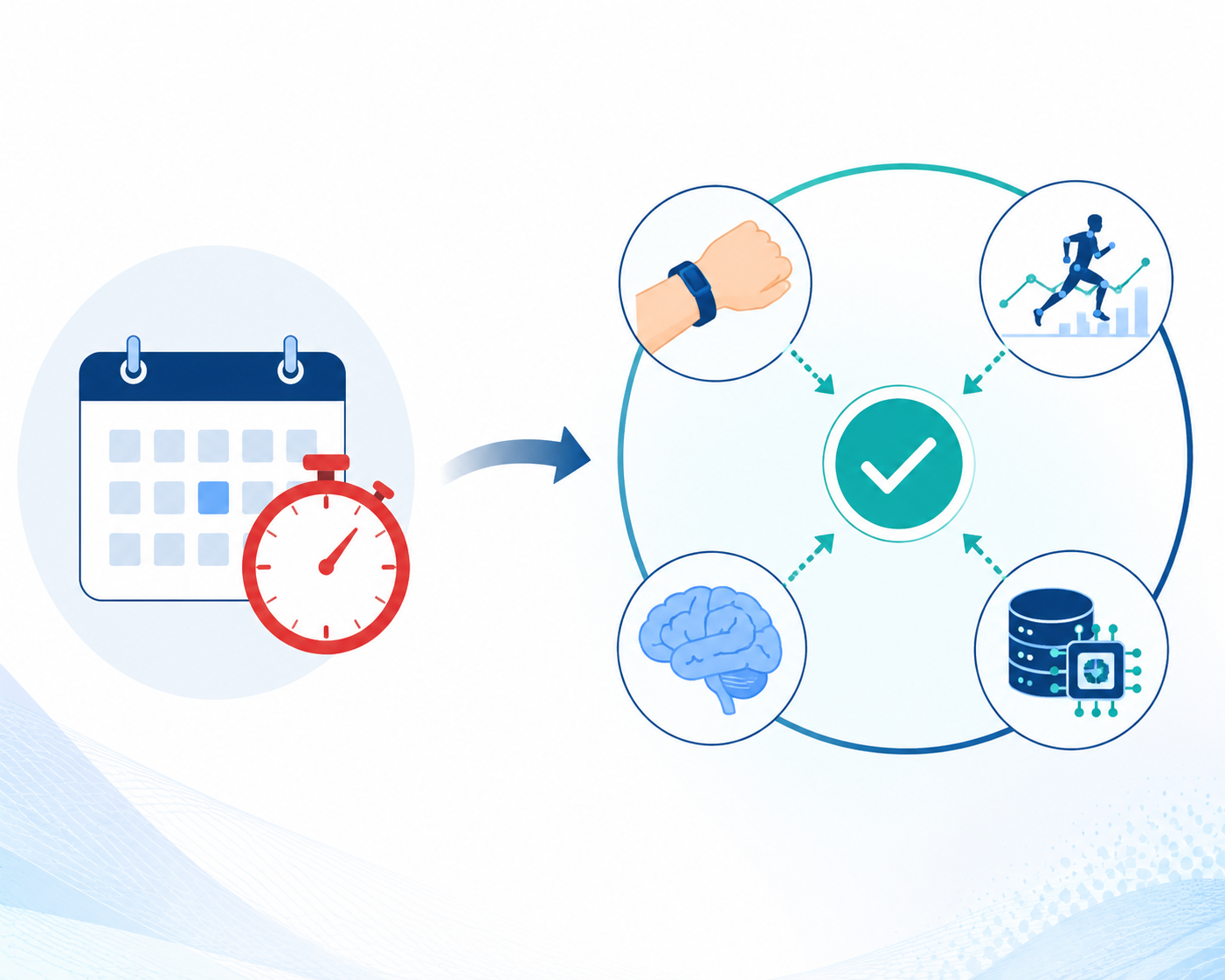
The credible use case for machine learning is not a model that replaces a hand therapist’s judgment with a countdown clock. It is a model that keeps track of multiple recovery domains at once and estimates whether the current pattern resembles athletes who returned successfully, athletes who needed more time, or athletes who returned with unresolved deficits.
For a wrist injury, the relevant inputs would likely include injury type, treatment method, time since injury or surgery, pain trajectory, range of motion, grip strength, load tolerance, sport demands, recurrence history, therapy progression, movement quality, and psychological readiness. Some of those data are already collected in routine care. Some are collected inconsistently. Some, such as sport-specific movement quality, are harder to standardize.

Random Forest and Gradient Boosting methods, including XGBoost, are practical candidates for this kind of work because they can model nonlinear relationships among mixed clinical variables. They are not magic. They are pattern-recognition tools. Their value depends on whether the training data represent the athletes, injuries, treatments, and decisions the model will later be asked to support.
The adjacent evidence is encouraging. A 2026 systematic review of machine learning models for return-to-sport prediction found AUC values up to 0.96, with Random Forest used in 55% of included studies. The same review found that only 18% of studies incorporated psychological readiness factors, which is a revealing omission for decisions that often hinge on more than tissue capacity.[6]
ACL research also shows that multi-domain models can perform well when physiological, biomechanical, and psychological variables are combined. In a 2024 study of functional recovery after ACL reconstruction, AI models using those domains reported AUC values ranging from 0.84 to 0.95.[7] That supports the method, not a wrist-specific conclusion. A model that works for knee recovery cannot simply be relabeled for scaphoid fracture, ligament sprain, triangular fibrocartilage complex injury, or post-immobilization wrist stiffness.
Readiness Is a Signal, Even When the Wrist Tool Is Missing
Psychological readiness is easy to underweight in wrist injuries because it can sound softer than grip strength or range of motion. In practice, hesitation changes mechanics. An athlete who does not trust the wrist may avoid load, shift weight, alter catch position, protect during contact, or withdraw from the exact exposures needed to rebuild tolerance.
The best-known readiness metrics come from lower-extremity work. ACL-RSI scores below 60 have been associated with lower return-to-sport rates, and thresholds above 65 have been cited as optimal for return to the same sport at 2-year follow-up.[5] That should make readiness visible in wrist discussions, but it should not be treated as a validated wrist-specific rule. As of Q3 2026, the evidence base does not provide a comparable, validated psychological readiness instrument built specifically for wrist return-to-sport decisions.
The same caution applies to symmetry thresholds. A simple 90% limb symmetry target can create a comforting number without proving that the athlete has recovered pre-injury capacity. Research summarized in return-to-sport testing discussions reports that only 28.6% of athletes who met 90% limb symmetry also reached 90% of estimated pre-injury capacity, which is one reason multi-test convergence may be more useful than a single pass-fail threshold.[5]
The Clinical Workflow Is the Hard Part
An AI-enhanced wrist recovery timeline would need to sit inside a criterion-based workflow, not beside it as a decorative risk score. The sequence would be plain enough: establish the injury and treatment category, use the expected timeline as an initial benchmark, collect objective recovery measures repeatedly, add sport-specific load tests when appropriate, include readiness and confidence, then use the model’s output as one input into a shared return-to-sport decision.
- The physician or surgeon anchors diagnosis, healing constraints, and medical risk.
- The hand therapist or physical therapist tracks motion, strength, pain response, and progressive loading.
- The athletic trainer sees whether the wrist survives practice conditions, fatigue, equipment demands, and imperfect technique.
- The athlete supplies symptoms, confidence, hesitation, and sport-specific feedback that may not appear in a clinic-based test.
- The model should make the evidence trail easier to review, not make the decision harder to audit.
This is where explainability becomes more than a software preference. If a model flags delayed readiness, the clinical team needs to know whether the concern comes from persistent pain, poor grip recovery, treatment category, repeated swelling after load, low confidence, or a combination. A risk score that cannot be interrogated is hard to defend when the athlete, coach, or parent asks why the calendar says yes but the clearance note says not yet.
What Can Be Used Now, and What Still Belongs in Validation
Clinicians can use existing wrist timelines now as benchmarks. They can also use criterion-based thinking now: do not clear solely because enough weeks have passed; look for convergence across healing status, pain, range of motion, grip strength, loading tolerance, sport mechanics, and readiness. That does not require a deployed machine learning product.
What still belongs in research and pilot validation is the wrist-specific machine learning model itself. The current evidence supports the plausibility of AI-enhanced return-to-sport prediction because ML models have performed well in broader sports-injury and ACL recovery studies.[6][7] It does not prove that a wrist model can accurately predict safe return after scaphoid fracture, sprain, or other upper-extremity injuries.
A responsible pilot would need wrist-specific cohorts, clear outcome definitions, sport-demand categories, standardized functional measures, psychological readiness inputs, external validation, and monitoring for bias across athlete populations. It would also need governance for how model recommendations are documented and overridden. The point is not to make clinicians obedient to an algorithm. The point is to make return-to-sport reasoning more complete, more traceable, and less dependent on whichever variable happened to be measured last.
So the answer is narrow. Generic wrist recovery timelines are not wrong; they are insufficient for athletes when used as clearance decisions. AI-enhanced, criterion-based timelines are a plausible and evidence-supported direction because they can integrate multi-domain recovery signals that clinicians already know matter. As of Q3 2026, they should be treated as a promising clinical-informatics framework for wrist injuries, not as validated wrist-specific decision tools.
References
- Return to sport following scaphoid fractures: A systematic review and meta-analysis, World Journal of Orthopedics, 2019.
- Wrist Sprain, Mass General Brigham Sports Medicine.
- Understanding Wrist Sprains and Healing Time, Orlando Orthopaedic Center.
- Physical Therapy Guide to Wrist Fracture, Choose PT.
- The Complete Guide to Criterion-Based Return to Sport Testing, True Sports Physical Therapy.
- Machine learning models for return-to-sport prediction, Digital Health, 2026.
- Artificial intelligence models incorporating physiological, biomechanical, and psychological variables for predicting functional recovery after ACL reconstruction, Digital Health, 2024.
Comments
Join the discussion with an anonymous comment.