
The practical question for AI in weight-loss drug development and investment is not whether AI can make an obesity pitch deck sound better. It is which AI-native biotechs have produced a plausible obesity program, what biology they are betting on, and whether the program is meaningfully different from another incretin-era follow-on.
This is a company-product comparison, not a market-size essay. The cohort here is narrow: Insilico Medicine, Superluminal Medicines, Merrifield Therapeutics out of the Stanford BRP work, Earendil Labs, and Recursion Pharmaceuticals. Each is using AI as part of discovery, but the more useful comparison is what that work has actually turned into: a named molecule, a target class, a partner-backed program, or a still-broad platform claim.
The shared caveat belongs up front. None of these AI-native obesity programs has yet delivered human proof-of-concept. Insilico’s ISM0676 and Stanford’s BRP data are preclinical. Superluminal’s obesity-relevant work is earlier than clinical validation. Earendil and Recursion broaden the landscape, but they do not remove the central uncertainty. As of mid-2026, the broader AI drug discovery field also still lacks an FDA-approved AI-discovered drug, a point covered in this site’s AI drug discovery evidence review.
That caution does not make the sector trivial. Obesity licensing deals reached $18.2 billion in the first half of 2025, while 95% of pharma companies were reported to be investing in AI and pharma AI spending was projected to rise from $4 billion in 2025 to $25 billion in 2030.[1] Those numbers explain why obesity-AI programs are getting BD attention. They do not prove that any specific molecule will work.
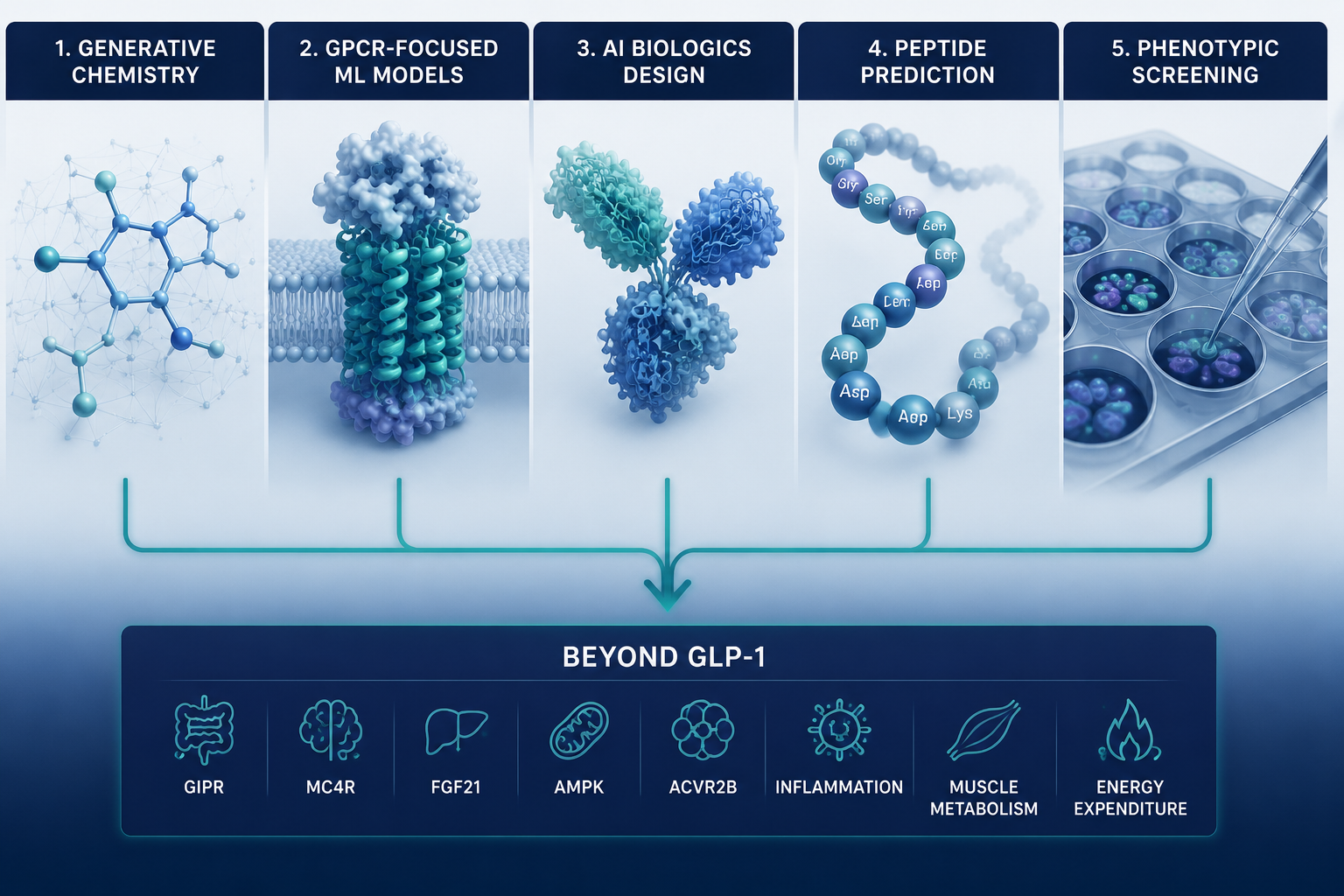
The comparison starts with mechanism, not branding
AI-native obesity discovery is not one thing. In this group, the platforms range from generative small-molecule design to GPCR modeling, peptide prediction, biologics engineering, and phenotypic screening. Those differences matter because obesity is no longer just a question of who can imitate GLP-1 most efficiently. The relevant question is whether AI is helping teams enter target space that is hard, underexplored, or poorly served by existing modalities.
| Company or program | AI approach | Obesity biology in view | Readiness signal |
|---|---|---|---|
| Insilico Medicine | Generative chemistry and target-to-molecule design | GIPR antagonism, including ISM0676 | Named preclinical small-molecule candidate |
| Superluminal Medicines | Machine learning for GPCR structure and ligand design | MC4R and additional GPCR weight-loss biology | Rare genetic obesity candidate plus Lilly GPCR collaboration |
| Stanford / Merrifield Therapeutics | Peptide prediction and AI-enabled molecule discovery | BRP, a 12-amino-acid peptide affecting food intake in animal models | Preclinical peptide being readied through company formation |
| Earendil Labs | AI biologics design platform | Obesity-relevant biologic programs within a broader pipeline | Large 2026 financing and strategic investor syndicate |
| Recursion Pharmaceuticals | Phenotypic AI and high-throughput biological maps | Obesity-relevant discovery optionality rather than a highlighted named obesity asset in the provided materials | Platform-scale discovery company; obesity relevance is less product-specific here |
The table is deliberately uneven. Insilico and the Stanford/Merrifield work can be judged against named preclinical candidates. Superluminal can be judged against a target area and a major strategic deal. Earendil is more about platform scale and capital formation. Recursion is included because phenotypic AI is a different discovery logic, but its obesity relevance is less tied to a single public candidate in the materials available for this comparison.
Insilico Medicine: the cleanest named-candidate case
Insilico’s ISM0676 is the most straightforward example in this set of an AI discovery platform yielding a named obesity candidate with specific preclinical pharmacology. The company describes ISM0676 as an oral small-molecule GIPR antagonist discovered through its Chemistry42 platform. In preclinical models, Insilico reported 10.4% body-weight loss as monotherapy and 31.3% body-weight loss when combined with semaglutide.[2]
Those are not human data, and they should not be treated like human data. The useful point is narrower: the program is not merely another GLP-1 agonist story. GIPR antagonism sits in the incretin neighborhood, but the claim here is combination logic and differentiated pathway use rather than simple GLP-1 mimicry.
The discovery timeline is also part of why ISM0676 gets attention. Insilico said the candidate was discovered in 14 months with fewer than 200 synthesized molecules.[2] For a BD reader, that is interesting because it speaks to search efficiency: fewer chemistry cycles, a defined molecule, and an obesity-relevant pharmacology package. It still does not answer tolerability, durability, dose, human translation, or whether the semaglutide-combination effect survives clinical testing.
Insilico’s broader platform has already been discussed in this site’s AI drug discovery company profile. In obesity, though, the company’s credibility does not come from platform breadth alone. It comes from the fact that there is a concrete candidate, a target rationale, and a disclosed preclinical package. That is the minimum standard this field should be held to.
Superluminal Medicines: GPCR design with real strategic gravity
Superluminal is a different kind of obesity-AI story. The company is built around machine-learning-enabled GPCR drug discovery, a reasonable place to hunt if the goal is to move beyond the best-known incretin assets. GPCRs are central to metabolic signaling, but they are also structurally and pharmacologically difficult enough that better computational handling could matter.
The most concrete obesity-relevant program described in the available materials is an MC4R candidate for rare genetic obesity. MC4R is not a casual target choice: it sits closer to central energy-balance biology than to another peripheral incretin optimization exercise. The caveat is that rare genetic obesity and broad commercial obesity are not the same development problem, even if learnings can travel between them.
The deal signal is harder to ignore. Eli Lilly entered a research collaboration with Superluminal focused on GPCR-targeted weight-loss drugs, with a total potential value reported at up to $1.3 billion.[3] This is not proof that Superluminal’s programs will translate. It is evidence that a top obesity sponsor saw enough in the GPCR platform and target space to write a serious option into its external innovation strategy.
That distinction matters. A large headline value can include milestones that may never be earned. It is still more informative than a generic “AI for obesity” announcement because it ties a specific platform logic, GPCRs, to a pharma partner with unusually strong obesity incentives. In a crowded partnering room, that is the kind of signal worth separating from noise.
Stanford and Merrifield: peptide discovery with an unusually specific preclinical claim
The Stanford/Merrifield story is not a standard small-molecule platform narrative. Stanford researchers used an AI tool described as Peptide Predictor to identify BRP, a 12-amino-acid peptide reported to reduce food intake by 50% in animal models. The same reporting described no nausea or muscle loss in those animal studies, with the program being readied through Merrifield Therapeutics.[4]
Again, the claim has to stop at animal models. Reduced food intake in animals is not a clinical obesity outcome, and absence of nausea or muscle loss in preclinical experiments is not a human safety profile. But the biology is interesting because the claim is not just stronger appetite suppression. It is a peptide signal that, if it translates, could potentially separate food-intake effects from some tolerability or body-composition liabilities that matter in the current obesity market.
This is also where the AI attribution needs discipline. The AI contribution, as described, is in peptide identification and prediction. The therapeutic value will be decided by peptide pharmacology, delivery feasibility, exposure, tolerability, and human efficacy. Discovery software can get a candidate onto the bench. It cannot negotiate with human physiology on behalf of the molecule.
Earendil Labs: platform scale, capital density, and the biologics question
Earendil Labs belongs in this comparison for a different reason. The company is less useful as a single obesity-candidate case, based on the materials available here, and more useful as a sign of how much capital is willing to back AI biologics platforms that include obesity-relevant work.
Earendil was reported to have raised $787 million in March 2026, with strategic investors including Sanofi and Pfizer/Hillhouse, and to have more than 40 biologic programs.[5] Those are platform-scale numbers. They suggest conviction around AI-enabled biologics design, but they do not by themselves identify which obesity mechanism will matter clinically.
This is where investment readers should resist both easy reactions. Dismissing the financing as hype ignores the strategic-investor signal and the fact that biologics remain central to metabolic medicine. Treating the raise as validation of an obesity product is equally sloppy. A large private round can fund many shots on goal; it does not tell us which shot has target engagement, which one has a therapeutic index, or which one can survive clinical development.
Earendil is therefore a watchlist company rather than a candidate-led obesity bet in this article. The right diligence question is not “How much did it raise?” It is: which obesity-relevant biologic program becomes named, what pathway does it engage, and what evidence connects the AI design process to a molecule with translatable biology?
Recursion: the phenotypic-AI counterpoint
Recursion broadens the comparison because its discovery logic is not target-first generative chemistry in the Insilico sense, nor GPCR-specialized design in the Superluminal sense. Its platform thesis is phenotypic: build large biological maps from high-throughput experimental systems and use computation to identify relationships that conventional target-by-target discovery may miss.
For obesity, that approach is conceptually relevant because metabolic disease is a systems problem. Weight, appetite, energy expenditure, inflammation, muscle preservation, liver biology, and central signaling do not move in isolation. A phenotypic platform may find biology that a narrower target campaign would not prioritize.
But Recursion is also the least product-specific obesity entry in this set based on the provided materials. That makes it useful as a platform anchor, not as evidence that a particular AI-discovered obesity drug is nearing proof-of-concept. In BD terms, it belongs on the landscape map; it does not yet carry the same obesity-candidate weight as ISM0676 or BRP in this comparison.
What has actually been produced?
The cleanest way to rank readiness is to ignore platform adjectives for a moment and ask what exists.
- Insilico has a named oral small-molecule GIPR antagonist, ISM0676, with disclosed preclinical weight-loss data and a stated AI-enabled discovery path.[2]
- Stanford/Merrifield has BRP, a named 12-amino-acid peptide with animal food-intake data and reported tolerability observations in those models.[4]
- Superluminal has an MC4R rare genetic obesity candidate and a Lilly collaboration around GPCR weight-loss drug discovery.[3]
- Earendil has a heavily financed AI biologics platform with many programs, but the obesity-specific evidence available here is less candidate-defined.[5]
- Recursion provides a phenotypic AI model that is relevant to metabolic discovery, but the obesity case is platform-level rather than centered on a public named asset in these materials.
That ordering is not a prediction of eventual success. It is a readiness distinction. A named preclinical candidate can fail quickly. A platform without a highlighted obesity asset can later produce a better molecule. But for 2026 diligence, candidate specificity still deserves a premium because it lets investors and researchers interrogate mechanism, modality, and translational risk rather than only company vocabulary.
Why the capital context matters, but only up to a point
The obesity-AI intersection is drawing attention because two funding cycles have collided. Obesity has become one of pharma’s most valuable external innovation battlegrounds, and AI drug discovery has moved from tool adoption into infrastructure and platform financing. This site’s broader AI medical research infrastructure analysis covers that shift at the field level.
The deal numbers are large enough to shape behavior. Pharma’s reported $18.2 billion in obesity licensing activity in H1 2025 creates an obvious incentive to look for next-wave mechanisms before they are de-risked in humans.[1] That is why GIPR antagonists, MC4R programs, peptide signals, GPCR discovery engines, and biologics platforms all get attention even before the clinical evidence is mature.
AI drug discovery financing also has a concentration problem. Funding-trend reporting for 2026 put AI drug discovery funding at $2.42 billion year to date, but noted that this figure was heavily skewed by Isomorphic Labs’ $2.1 billion Series B.[5] In other words, “AI drug discovery is well funded” is true in aggregate and still potentially misleading if used to imply broad validation across every platform and indication.
The same caution applies to obesity partnerships. A deal headline can reflect option value, competitive blocking, discovery capacity, target access, or milestone math. It is not equivalent to clinical conviction. The strongest signals combine strategic backing with a defined biological thesis and a candidate that can be tested.
The programs worth watching are the ones that make AI falsifiable
The better obesity-AI stories have a feature in common: they turn a platform claim into something that can be wrong. ISM0676 can be wrong in human GIPR biology, exposure, tolerability, or combination utility. BRP can be wrong in human translation, peptide druggability, or durability. Superluminal’s GPCR programs can be wrong about ligand design, selectivity, or whether the chosen receptors produce clinically useful weight loss. Those are real development risks, which is exactly why the programs are more substantive than undifferentiated AI optimism.
For investors and BD teams, the near-term diligence should stay concrete:
- Does the company have a named obesity candidate, or only a platform that could theoretically produce one?
- Is the mechanism meaningfully distinct from GLP-1 imitation, and is the distinction pharmacologically useful?
- Are the reported effects preclinical, early clinical, or true human proof-of-concept?
- Does strategic backing come from a partner with real obesity development incentives?
- Can the company explain what AI changed in discovery without implying that AI has already solved translation?
On those criteria, Insilico is the clearest candidate-led case, Superluminal is the strongest GPCR-partnering case, Merrifield is the most specific peptide-discovery case, Earendil is the capital-and-platform-scale case, and Recursion is the phenotypic-AI counterpoint. The broader ecosystem positioning is consistent with the AI-native biotech activity tracked in this site’s top AI healthcare companies analysis and AI health companies landscape.
This is an unusually well-funded and genuinely differentiated early-stage cohort. The biology is interesting because it reaches beyond a simple GLP-1 copycat frame, and the investment context is new enough to watch closely. But the decisive line has not been crossed. No AI-native obesity program in this group has yet shown that attractive preclinical design can become validated clinical value in humans.
References
- Pharma at an inflection point. FounderNest.
- Up to 31.3% Body Weight Loss: Insilico Medicine’s AI-Designed GIPR Antagonist Shows Promise as a Next-Generation Anti-Obesity Treatment. Insilico Medicine.
- Eli Lilly seeks more GPCR weight-loss drugs in $1.3bn research deal. Pharmaceutical Technology.
- AI-enabled molecule discovery rivals Ozempic in weight loss. DDW.
- AI In Drug Discovery Funding Trends (2026). New Market Pitch.
Comments
Join the discussion with an anonymous comment.