
1,451 Devices and Counting: The Scale of the AI Medical Device Milestone
As of the end of 2025, the FDA had authorized a cumulative total of 1,451 AI/ML-enabled medical devices for marketing in the United States. This is not a symbolic number — it represents a tangible shift in the regulatory and clinical landscape. In 2025 alone, the agency cleared 295 devices from 221 unique manufacturers, setting a new annual record. To put that in perspective: the entire AI/ML device inventory from 2015 through 2020 totaled fewer than 200 authorizations. The field has effectively doubled in size since 2023.
For healthcare professionals, hospital administrators, and health IT decision-makers, the implications are immediate. The devices entering the market are not experimental prototypes — they are cleared for clinical use, integrated into workflows, and increasingly marketed directly to health systems. Yet volume alone tells an incomplete story. Understanding where these devices are concentrated, how they are regulated, what evidence supports them, and where the gaps remain is essential for making informed adoption decisions.
This article provides a data-driven overview of the entire 1,451-device landscape, drawing on the FDA's AI/ML device list, peer-reviewed taxonomy analyses, regulatory data from Innolitics, and market research from The Business Research Company. The goal is not to catalog every device but to equip readers with a structured understanding of what the AI medical device boom actually looks like — and what it means for clinical practice and procurement.
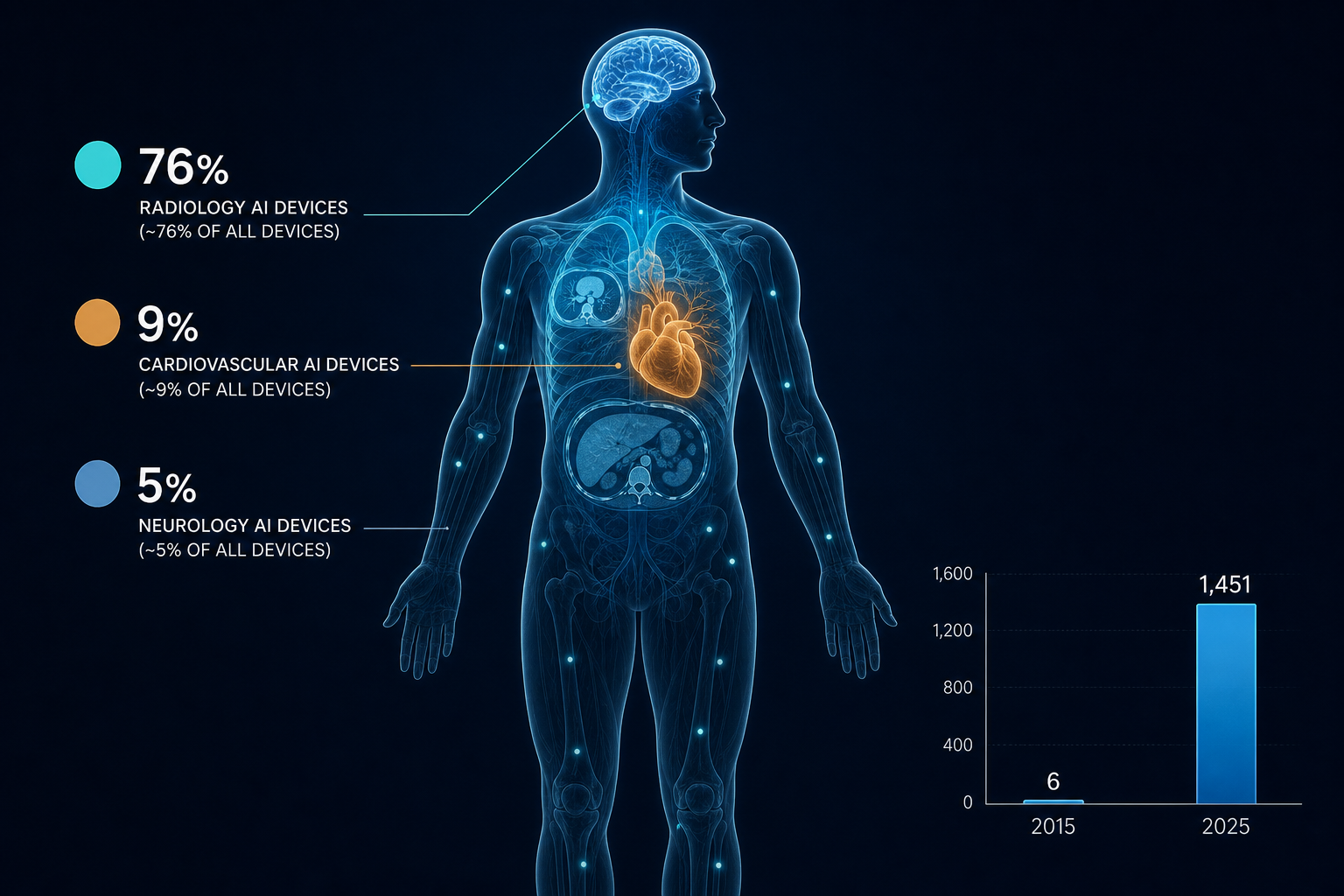
From 6 to 295: The Growth Trajectory of AI/ML Medical Devices (2015–2025)
The first AI/ML-enabled medical device was authorized by the FDA in 2015. By the end of that year, six devices had been cleared. Growth remained modest through 2018, with annual clearances in the single digits or low teens. The inflection point came in 2019, when 27 devices were authorized — more than the cumulative total from the previous four years combined.
Since then, the trajectory has been steep. Annual clearances rose to 47 in 2020, 69 in 2021, 97 in 2022, 161 in 2023, and 221 in 2024. The 2025 total of 295 represents a 33% increase over 2024 and a nearly 50-fold increase over the 2015 baseline. The majority of all AI/ML device authorizations — roughly 70% — have occurred since the beginning of 2023.
| Year | AI/ML Device Clearances | Cumulative Total |
|---|---|---|
| 2015 | 6 | 6 |
| 2016 | 4 | 10 |
| 2017 | 9 | 19 |
| 2018 | 11 | 30 |
| 2019 | 27 | 57 |
| 2020 | 47 | 104 |
| 2021 | 69 | 173 |
| 2022 | 97 | 270 |
| 2023 | 161 | 431 |
| 2024 | 221 | 652 |
| 2025 | 295 | 1,451 |